15 Beautiful Dining Table Centerpiece Ideas
A dining table centerpiece is the deliberate visual anchor of the table’s surface — a composed arrangement of objects, botanicals, candles, or materials placed at the table’s primary focal point to create beauty, warmth, and a sense of occasion that transforms the act of gathering at the table from a functional necessity into something more considered and more memorable. This article gives you 15 dining table centerpiece ideas across botanical arrangements, candle compositions, seasonal displays, everyday styling, and special occasion setups so your table has a center that genuinely earns its place in the room.
The dining table is the room’s most social surface — the place where meals are shared, conversations happen, and the household gathers with genuine regularity. A centerpiece that is poorly chosen or absent reduces the table to its mechanical function; one that is thoughtfully composed elevates every meal, makes the everyday feel slightly ceremonial, and communicates that the people gathering around this table are worth the effort of a beautiful surface. The difference between a table that is merely set and one that is genuinely arranged is almost always in what occupies its center. Here are 15 ideas worth saving — and setting.
Why Dining Table Centerpieces Transform the Gathering Experience
The dining table centerpiece draws from ancient traditions of table decoration across cultures — the Roman triclinium’s central oil lamp clusters, the European Renaissance credenza’s elaborate fruit and flower pyramids, the Japanese kaiseki tradition of a single seasonal object placed at the table’s center to acknowledge the current moment in the natural year, and the Scandinavian tradition of a single candle cluster that transforms midwinter darkness into an occasion for warmth and gathering. What all these traditions share is the recognition that the center of the table is a significant location — the geometric and social center of the gathering — and that what occupies that position sets the tone for everything that happens around it.
The material palette of dining table centerpieces is as broad as the seasons and as specific as individual aesthetic intention. Fresh and dried botanicals provide the organic warmth that no manufactured material replicates. Candles in their many forms — tapers, pillars, votives, tea lights — provide the most universally flattering and most atmosphere-transforming centerpiece element available. Natural materials — stone, wood, ceramic, woven fiber — provide the warmth and material honesty that manufactured plastic and metallic alternatives cannot achieve. Seasonal produce — citrus, pumpkins, artichokes, pomegranates, figs — provides centerpiece material with a particular quality of abundance and honest seasonal relevance. The best centerpiece compositions combine elements from at least two of these categories, creating the material layering and tonal depth that single-material arrangements lack.
The practical constraints of dining table centerpieces are as important as their aesthetic qualities. The centerpiece must be low enough — or vertically open enough — that diners on opposite sides of the table can see each other and converse without visual obstruction. The centerpiece must be stable and spill-resistant enough for the reality of a meal being served and cleared around it. It must be positioned at the table’s center (which varies by meal — formal dinners may center the arrangement on the table’s full length, while everyday family meals may require one end to remain clear for serving). And it must be compatible with the scale of the table — a centerpiece that is too small reads as insufficient, while one that is too large crowds the place settings and makes the table feel difficult to use.
The scale rule for dining table centerpieces is specific and reliable: the centerpiece’s total diameter (or spread) should be no more than one-third of the table’s width, and its height should stay below 12 inches for a conventional arrangement or exceed 24 inches for a tall, visually open arrangement like a tall vase with branching stems that allows sightlines to pass beneath. The zone between 12 and 24 inches is the dead zone — tall enough to obstruct conversation but not tall enough to have the visual presence that justifies the obstruction.
Style at a Glance
| Element | Detail |
|---|---|
| Philosophy | The table’s center as the gathering’s visual anchor — designed to enhance the meal and the conversation |
| Key Materials | Fresh and dried botanicals, candles, natural stone and wood, ceramic, seasonal produce |
| Scale Rule | Width maximum one-third of table width; height below 12 inches or above 24 inches |
15 Beautiful Dining Table Centerpiece Ideas
1. Taper Candle Cluster with Varied Heights and Natural Greenery
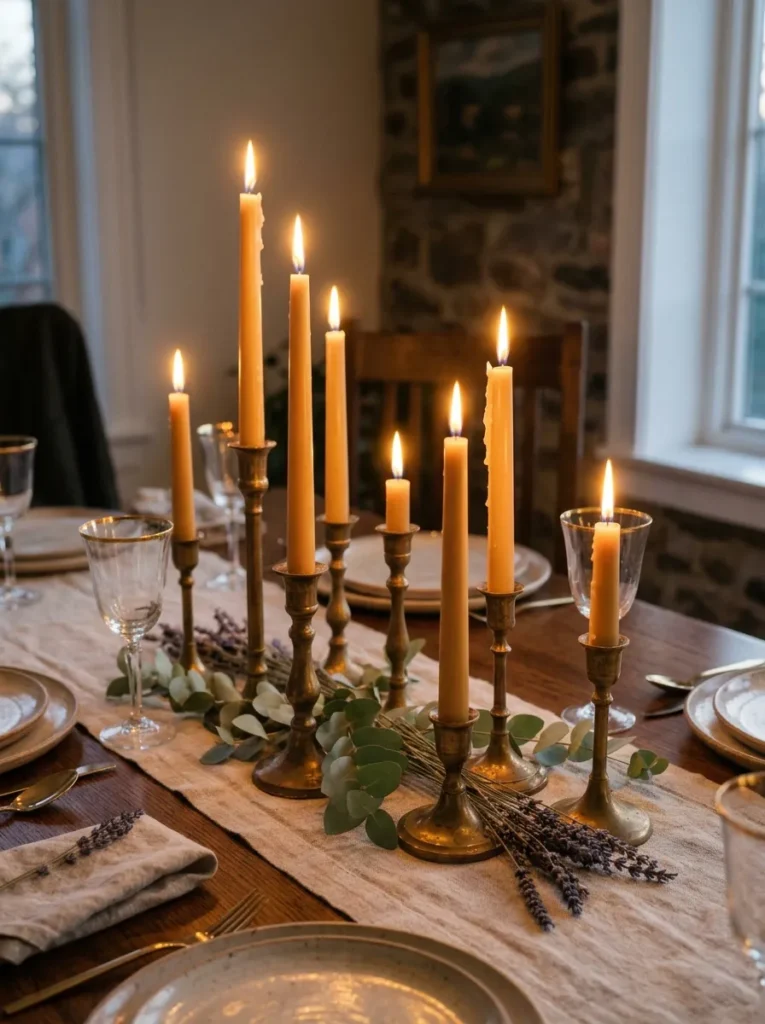
Vibe: The centerpiece is celebratory — a cluster of taper candles in varied brass candlesticks with natural greenery between the bases creates the most universally flattering and most atmospherically warm dining table centerpiece available, where the accumulated candlelight transforms even a weeknight dinner into something that feels worth gathering for.
Why it works: The taper candle cluster works through the principle of accumulated light — seven candles together produce a light quality that one or two cannot approach, creating the warm, multi-directional ambient glow that flatters both food and faces. The varied heights (ranging from 8 to 18 inches) create a silhouette that reads as designed rather than uniform, and the asymmetric arrangement (no two candlesticks of the same height placed symmetrically) creates the collected, organic quality that matched pairs cannot achieve. Unlacquered brass candlesticks are the optimal material for this application — they develop a natural patina over time that deepens rather than diminishes their beauty, and their warm gold tone amplifies the candle flame’s amber quality. The taper candle’s narrow profile allows diners to maintain sightlines across the table through the cluster rather than around a solid mass.
How to get it: Source unlacquered brass candlesticks in varied heights from antique markets, thrift stores, and specialty home retailers — purchased incrementally over time, a collection of seven mismatched brass candlesticks from varied sources reads as curated rather than purchased as a set. Use tapered beeswax candles ($3–$6 each) rather than paraffin for a cleaner burn and more flattering warm-toned flame. Tuck 3–5 small eucalyptus sprigs and dried lavender stems between the candlestick bases on the linen runner — this grounding botanical element connects the vertical candle forms to the table surface. Never leave lit candles unattended.
Quick Win: Three brass candlesticks in varied heights (available from thrift stores for $2–$8 each) with plain white taper candles creates 80% of this centerpiece’s effect at minimal cost — the height variation and the brass material are the elements that do the design work.
Shop The Look
- Unlacquered brass taper candlestick set varied
- Beeswax taper candle natural cream set
- Natural linen table runner neutral
- Dried lavender bunch aromatic decor
- Fresh eucalyptus stem bunch silver
Also view: 14 Bouclé Furniture Alternatives You’ll Love
2. Low Wildflower and Herb Arrangement in a Ceramic Vessel
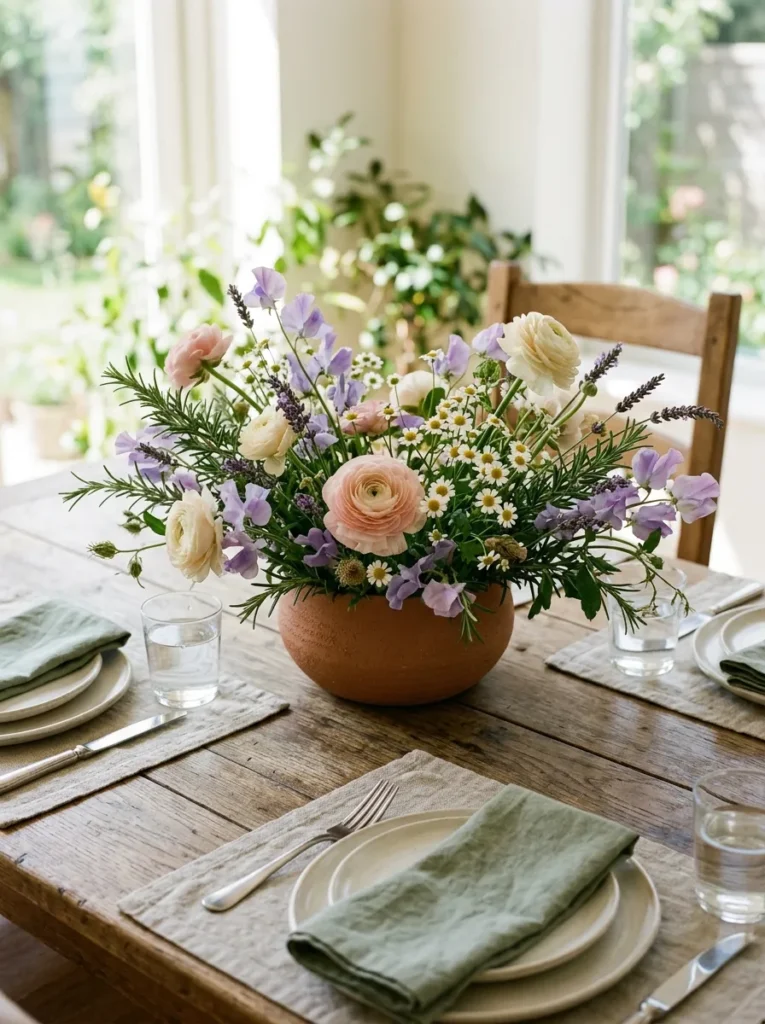
Vibe: The arrangement is garden-generous — a loose wildflower and fresh herb arrangement in a wide ceramic vessel creates the specific quality of flowers gathered from a garden at the moment of their best bloom — abundant, slightly imperfect, and communicating that someone brought the best of their garden to the table.
Why it works: Low flower arrangements on dining tables work because they respect the conversational function of the dining table — no sightline obstruction, no leaning-around behavior, full visual connection between diners across the table. The 10-inch maximum height is the critical constraint that keeps a flower arrangement functional rather than merely decorative. The loose, garden-gathered style (asymmetric, varied stem heights, botanicals tucked at different angles and depths) reads as genuinely arranged rather than mechanically composed. Fresh herbs (rosemary, lavender, chamomile) in a flower arrangement add a fragrance dimension that purely visual arrangements lack — the scent of rosemary and lavender at the table is subtle enough not to compete with food aromas while adding a sensory layer that guests notice and appreciate without necessarily identifying.
How to get it: Use a wide-mouth ceramic or terracotta vessel (a wide soup bowl, a low vase, or a ceramic planter at 5–7 inches diameter) rather than a narrow-neck vase — wide-mouth vessels allow the horizontal spread that low arrangements require. Fill with fresh-cut flowers and herbs in three height categories: tall elements (rosemary, lavender stems) at 8–10 inches, medium elements (ranunculus, sweet pea) at 5–7 inches, and low filler elements (chamomile, small herb sprigs) at 3–5 inches. Work from the outside in, placing the longest stems first and filling toward the center. Change water every two days and recut stems at an angle for maximum vase life.
Shop The Look
- Wide mouth matte stoneware vase low
- Fresh ranunculus bunch spring
- Sweet pea fresh stem bunch
- Fresh chamomile stem bunch
- Fresh rosemary bunch fragrant herb
3. Pillar Candle and River Stone Composition
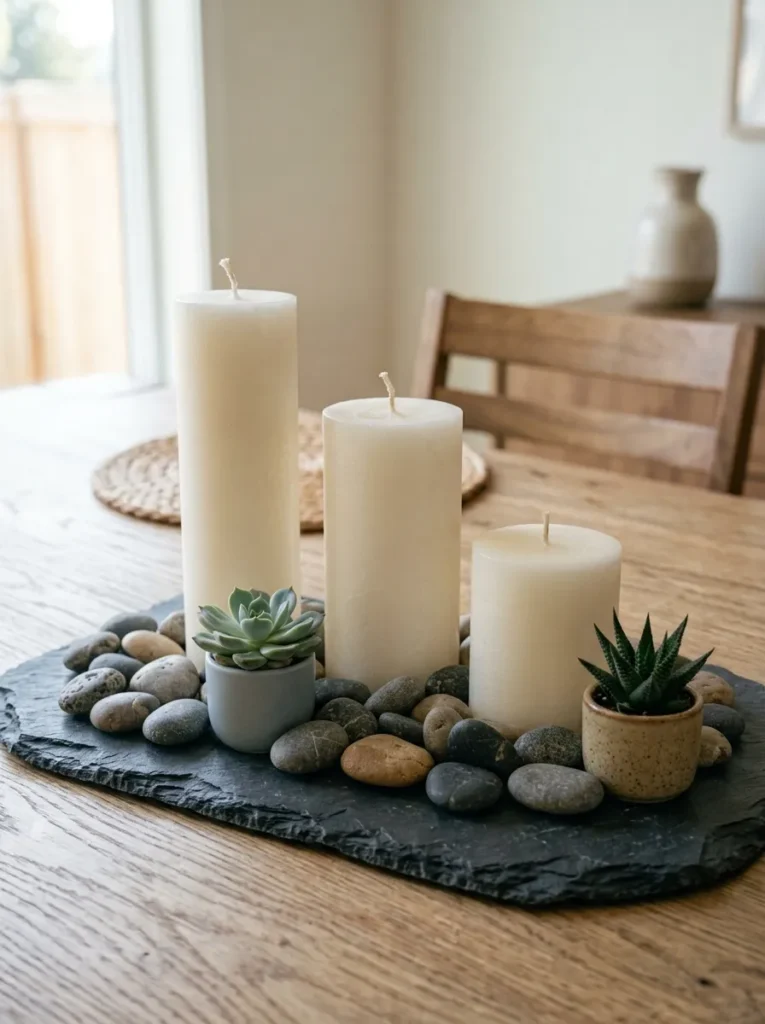
Vibe: The composition is calm — a pillar candle and river stone arrangement on a natural stone slab creates a centerpiece of genuine material restraint, where the beauty comes from the quality of the materials and the clarity of the composition rather than from abundance or decoration.
Why it works: Pillar candles on a stone base with river stones is the centerpiece approach that most directly references the Japanese aesthetic of stone gardens and tea ceremony table setting — the beauty of composed natural materials in a minimal arrangement that rewards sustained looking without demanding attention. The stone slab base is critical — it defines the centerpiece’s footprint clearly (the composition begins and ends at the slab edges), provides a heat-safe surface for dripping candle wax, and adds a mineral material quality that a wooden tray or woven mat cannot approach. Smooth river stones in varied sizes around the base of the candles prevent the candles from looking isolated and add the natural material grounding that makes the composition complete. The small succulents in minimal ceramic pots introduce living plant material at the composition’s base level without any water management concern.
How to get it: Source a natural slate or marble slab ($10–$30 from a kitchen supplier or stone yard offcut pile) in approximately 12×18 inches for a standard dining table. Position three pillar candles (diameter 2, 3, and 4 inches; heights 4, 6, and 8 inches) in an asymmetric triangular arrangement on the slab. Fill the spaces between and around the candles with smooth river stones (a 5-pound bag from a garden center or craft store, $5–$10) in grey and warm tan tones. Tuck two or three small succulents (in 2-inch minimal white ceramic pots, $3–$6 each) among the stones at the slab’s lower-interest zone. Replace succulents as needed — they last 2–4 weeks without watering in this application.
Shop The Look
- White pillar candle set varied heights
- Natural slate slab display board
- Smooth river stone bag grey tan
- Small succulent assortment 2 inch pot
- Minimal white ceramic pot set small
4. Floating Flower Bowls for a Modern Water Feature Effect
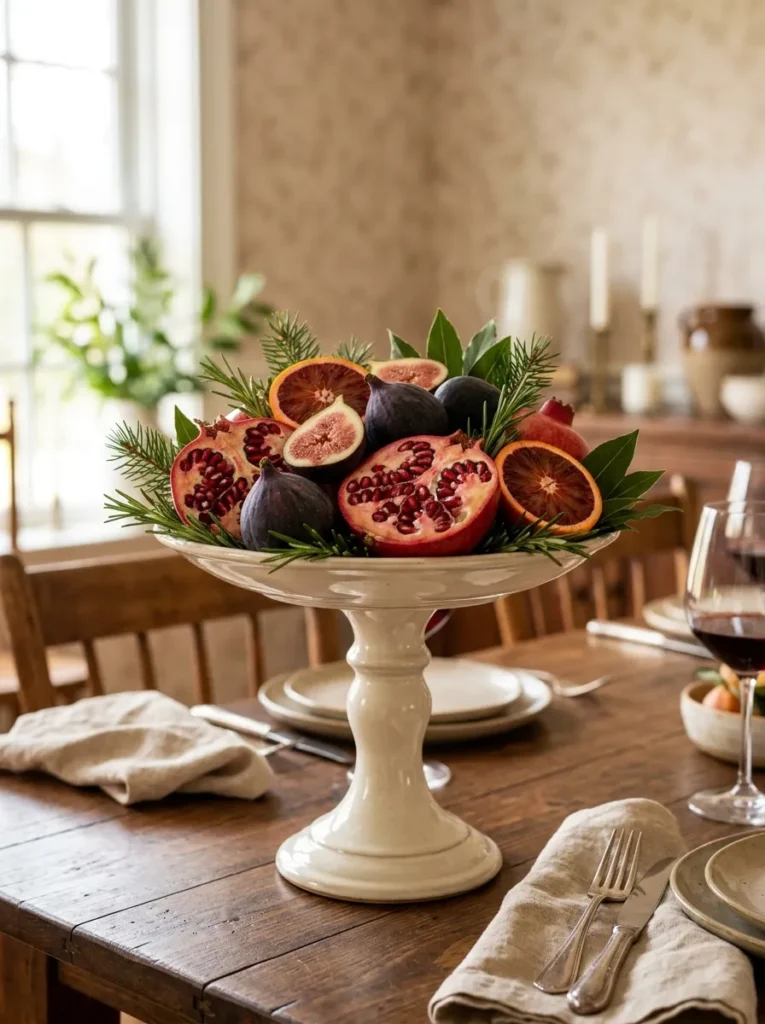
Vibe: The arrangement is serene — floating flowers and tea lights on still water create a centerpiece of unusual elegance, where the reflective water surface doubles the visual presence of both the flowers and the candlelight, producing an effect of floating beauty that no vase arrangement can replicate.
Why it works: Water as a centerpiece element is specifically effective on dining tables because it introduces a reflective surface at table level — the water mirrors the candles and flowers above it, creating a doubling effect that gives the composition unusual visual depth. The low bowl format keeps the composition well below the conversational sightline while providing a substantial visual presence through the width of the arrangement rather than its height. Three bowls in a linear row creates a centerpiece that extends along the table’s length, which is more appropriate for a long rectangular dining table than a single centered arrangement. Floating flowers (cut at the base of the flower head, not as stems) last 4–8 hours in water, making this an ideal special occasion centerpiece.
How to get it: Source three identical or complementary low, wide bowls (salad bowls, wide soup bowls, or shallow ceramic flower bowls work perfectly). Fill with room-temperature water to 1 inch below the rim. Float flower heads (cut flush at the calyx) on the water surface — one to three flowers per bowl depending on the flower head size and bowl diameter. Add three or four floating tea lights per bowl between the flowers. Position in a linear row down the table center, spacing bowls approximately 8 inches apart. To extend the arrangement’s lifespan, use high-quality fresh blooms purchased the day of use and keep at cool room temperature.
Shop The Look
- Low wide ceramic bowl set three
- Fresh gardenia bloom stem white
- Fresh blush rose bunch florist grade
- Floating tea light candle set white
- Fresh ranunculus cream bunch
5. Seasonal Fruit and Botanical Compote Display
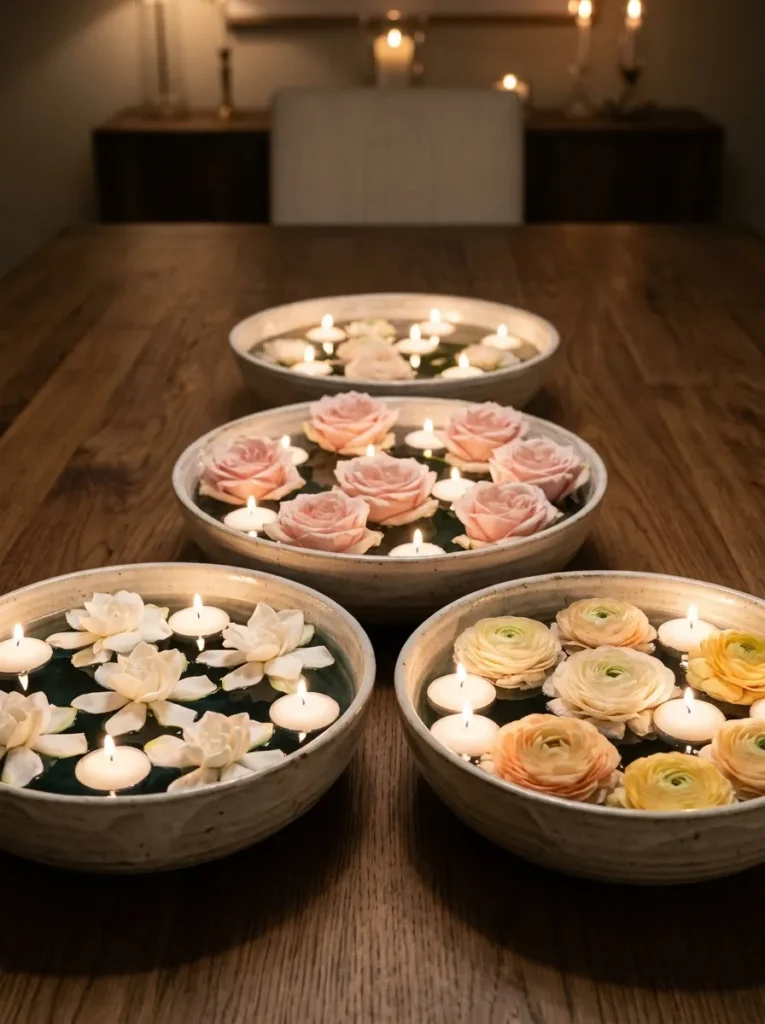
Vibe: The compote is abundant — a footed compote filled with seasonal fruits at the moment of their most beautiful maturity creates a centerpiece that communicates the abundance of the harvest, where the edible and the beautiful are the same thing and the table celebrates the season’s best produce.
Why it works: The footed compote format solves the centerpiece height problem elegantly — by elevating the arrangement on a pedestal (typically 8–12 inches above the table surface), the fruit composition can be generous and abundant without blocking sightlines, because the open leg structure of the compote’s foot allows visual connection between diners at the table level while the fruit creates presence at a higher visual plane. Seasonal fruit arrangements work specifically because the fruits chosen are at their natural peak of color and form — deep purple figs at their darkest, pomegranates beginning to split at their interior ruby density, blood oranges showing their deep rust flesh when halved. This celebration of produce at its most beautiful moment is one of the oldest dining table traditions in Western culture, appearing in Dutch still-life painting, Renaissance feast decoration, and contemporary farm-to-table restaurant presentation.
How to get it: Source a footed compote, cake stand, or pedestal bowl ($15–$60 from home decor retailers or vintage markets) in white ceramic, antique silver, or natural stone. Build the arrangement by placing the largest, most visually dominant fruits (pomegranates, whole oranges) first as the structural base, then adding medium fruits (figs, small citrus halves placed face-up to show interior color) among the larger pieces, and finally tucking herb sprigs, small pine branch sections, and rosemary stems into the gaps to fill and add botanical texture. Change fruit as individual pieces begin to over-ripen — a staged seasonal compote can remain fresh for 5–7 days with attentive fruit replacement.
Shop The Look
- Footed compote bowl white ceramic
- Fresh fig assortment seasonal dark
- Pomegranate whole decorative fruit
- Blood orange fresh seasonal
- Fresh rosemary sprig long stem
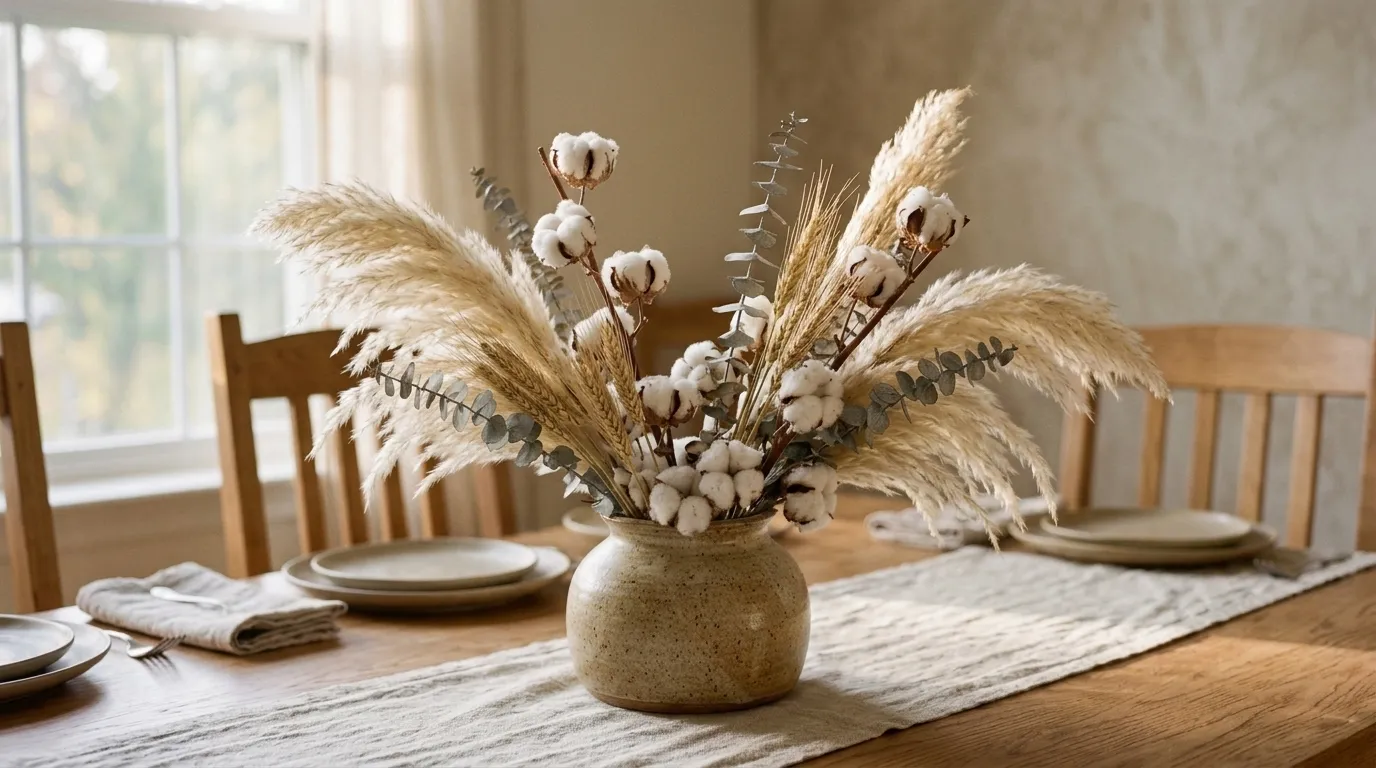
6. Dried Pampas and Cotton Stem Arrangement in a Stoneware Vessel
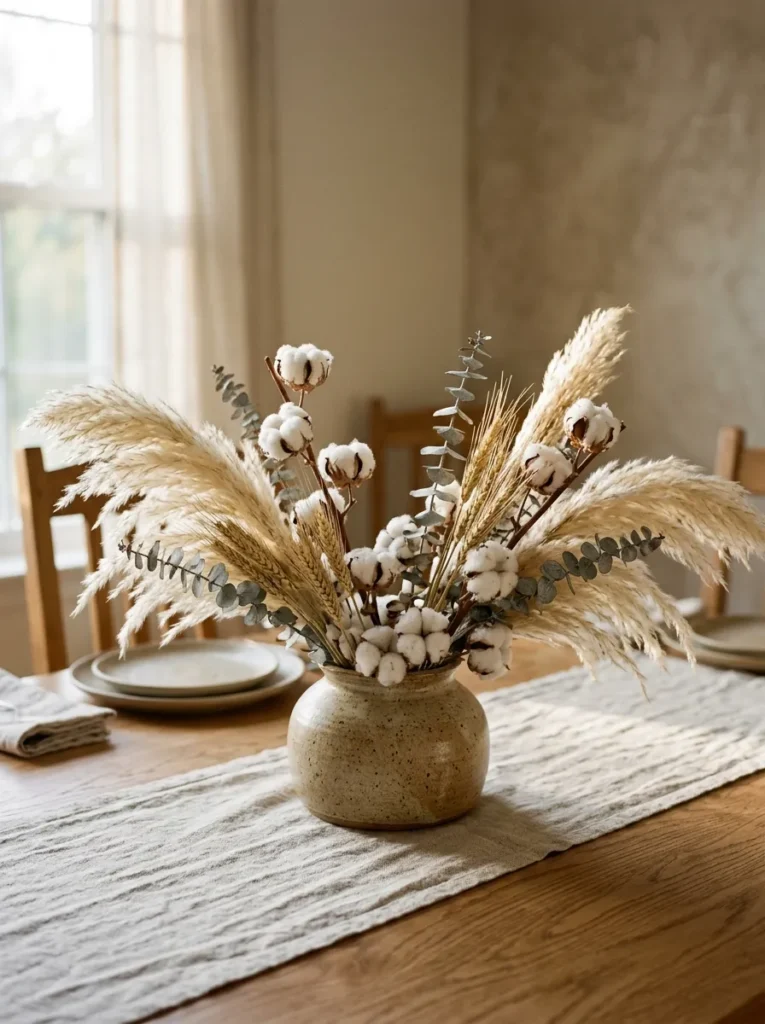
Vibe: The arrangement is organic — dried pampas grass plumes and cotton stems in a stoneware vessel create a centerpiece that is simultaneously architectural in its graceful arching forms and naturalistically soft in its material palette, requiring no water, no maintenance, and no replacement for months.
Why it works: Dried botanical arrangements have a specific advantage over fresh flowers for everyday dining table centerpieces — they require no water management, no stem recutting, no wilting monitoring, and no replacement for 2–6 months depending on the materials used. This low-maintenance quality makes them the most practical choice for everyday table use. The pampas grass plume’s natural arching form creates a centerpiece that is technically tall (14–16 inches) but visually open — the feathery plumes do not create a solid visual barrier, allowing sightlines to pass through the arrangement rather than around it. Cotton stems (dried pods on their natural stems) add a sculptural element with a specific warmth and material interest that no cultivated flower stem replicates.
How to get it: Source a wide-mouth stoneware vessel (a generous vase or ceramic pitcher at 8–10 inches tall works well) in a warm clay or ash glaze tone. Begin the arrangement by establishing the arching pampas stems (2–4 stems, cut to 16–18 inches and placed at angles that allow the plumes to arc outward over the vessel rim). Fill in with dried cotton stems (3–5 stems at 12–14 inches), dried wheat stalks (5–7 stems as filler), and preserved eucalyptus (3–5 stems at the arrangement’s base level). The arrangement’s natural beauty requires only placement — no floral foam, no wire, and no complex mechanical support. Refresh by gently dusting with a soft cloth or low-pressure compressed air as needed.
Shop The Look
- Stoneware vase wide mouth warm clay
- Dried pampas grass stem natural cream
- Dried cotton stem boll natural
- Dried wheat bunch natural gold
- Preserved eucalyptus stem silver
7. Moss and Candle Terrarium Centerpiece
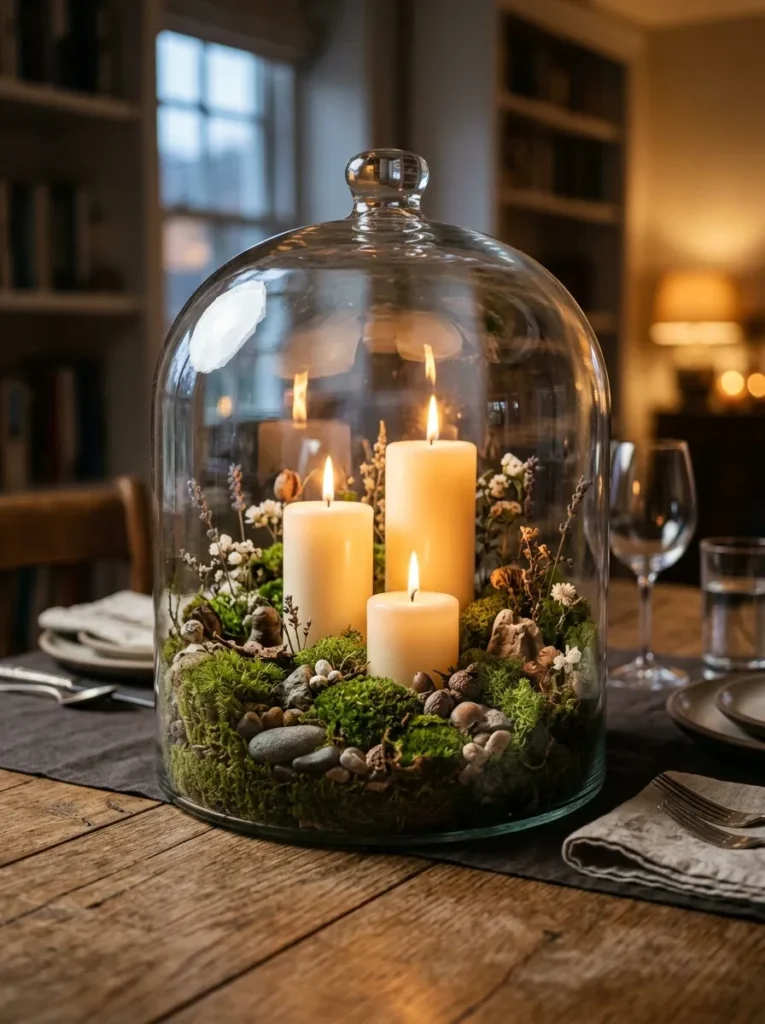
Vibe: The terrarium is magical — a large glass cloche or open terrarium with a moss landscape and embedded candles creates a contained world of botanical beauty at the table center, where the glass vessel’s enclosure amplifies the candlelight into a warm, concentrated glow that seems to come from within the landscape itself.
Why it works: A glass-enclosed moss and candle composition exploits the optical principle of the lantern — the glass vessel concentrates and reflects the candle’s light within a bounded space, amplifying its apparent warmth and creating a glow that reads as more luminous than the same candle in open air would produce. The preserved moss landscape creates a fairy-tale quality of a miniature forest floor or garden, which gives the glass composition a narrative dimension that simpler centerpieces lack — diners notice small details (a tiny stone, a dried flower tucked into the moss, the way the candle flame reflects in the curved glass interior) that create conversation and sustained visual interest across a long meal. Use battery-operated LED candles for open terrarium designs where the moss is close to the flame.
How to get it: Source a large glass cloche (bell jar) or open-top terrarium vessel ($20–$50 from home decor retailers) at a diameter sufficient for the table (10–14 inches for a standard dining table). Create a moss base by pressing preserved sheet moss into the vessel floor, building it up 2–3 inches deep. Arrange smooth stones at intervals on the moss surface. Insert three battery-operated LED pillar candles (realistic flame effect, warm amber) at varied heights by pushing their bases into the moss. Tuck small dried flowers, miniature pine cones, or dried seed pods into the moss at the stones’ edges. The composition requires no maintenance beyond battery replacement in the LED candles.
Shop The Look
- Large glass cloche bell jar display
- Preserved sheet moss bag natural green
- Smooth decorative stone bag small
- Battery LED pillar candle set warm
- Small dried botanical assortment terrarium
8. Single Dramatic Branch in a Tall Ceramic Vase
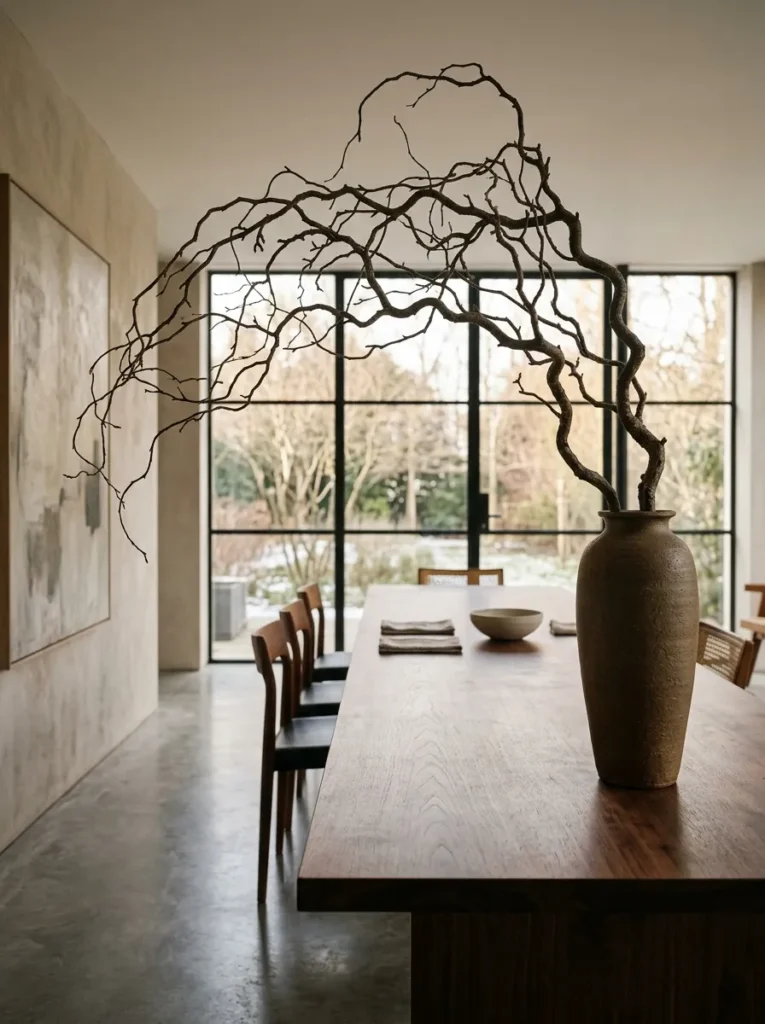
Vibe: The arrangement is architectural — a single dramatic branch in a tall ceramic vase at the table’s end is the centerpiece of maximum restraint and maximum visual impact, where one well-chosen natural form carries the entire visual weight of the table’s decoration with no other element required.
Why it works: The single branch arrangement is the centerpiece approach most directly descended from the Japanese ikebana tradition — the practice of flower arrangement as an art form focused on the beauty of a single stem or branch rather than the abundance of many. A single forceful architectural branch (cherry blossom in spring, curly willow in winter, autumn maple with turning leaves, budding forsythia in early spring) positioned in a tall, heavy ceramic vase at the table’s end creates a visual statement of confident restraint that reads as more designed than any more-complex arrangement. The branch’s height (extending above the vase to 36–48 inches) is justified by its placement at the table’s end rather than its center — placed at one end, it frames the table rather than bisecting it, and its arching form extends over the table without blocking any sightline.
How to get it: The ceramic vase selection is as important as the branch — the vessel must be heavy enough at the base to anchor the branch’s leverage without tipping, and its form must have the visual weight to balance a single dramatic branch rather than looking sparse. Large stoneware floor vases (20–24 inches tall, 5–6 inches diameter at the opening) from ceramic studios or specialty retailers ($30–$150) are the correct format. Source branches from your own garden (fruit trees, Japanese maples, pussy willows, forsythia), a flower wholesaler, or a specialty florist — branches that have forced early bloom (cut in late winter and kept in warm water indoors for 2–3 weeks) create one of the most beautiful spring centerpiece moments available.
Shop The Look
- Tall ceramic stoneware vase 22 inch
- Cherry blossom branch forced bloom spring
- Curly willow branch architectural winter
- Autumn maple branch seasonal turning
- Pussy willow stem bunch seasonal
9. Herb Garden Pot Cluster for a Kitchen or Farm Table
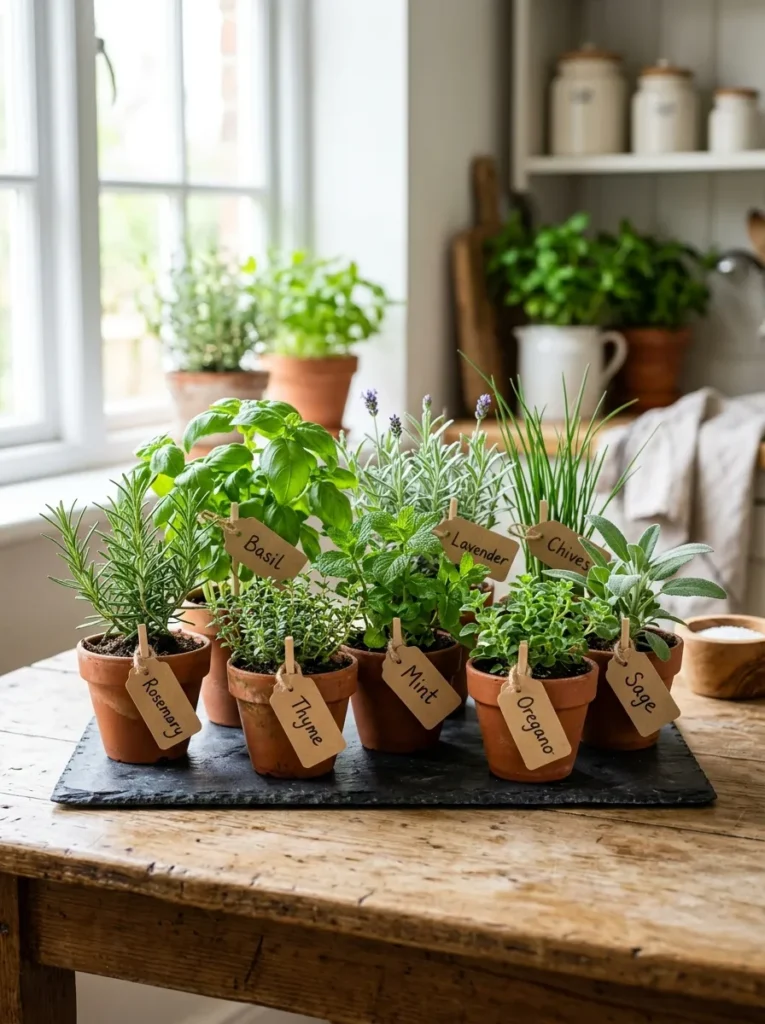
Vibe: The cluster is kitchen-warm — a collection of fresh potted herbs on a wooden tray creates a centerpiece that is simultaneously beautiful, fragrant, and useful, where the table center is also the table’s herb garden and every meal can draw from it directly.
Why it works: Fresh potted herb clusters are the centerpiece approach that most directly integrates the table’s decoration with the meal it serves — herbs are plucked from the table center and used in cooking, garnishing, or herbal tea during the meal, giving the centerpiece a participatory quality that purely decorative arrangements cannot provide. The cluster format (multiple small pots on a shared tray base) creates a visual composition with botanical variety and height variation (rosemary tall, basil medium, thyme and creeping herbs low) while the individual pots allow easy rearrangement for service and seasonal rotation. The fragrance of a fresh herb cluster (particularly basil, rosemary, and mint) is subtle and appetizing at the dining table — unlike strongly scented flowers that can compete with food aromas.
How to get it: Source 6–8 small potted herbs (4-inch pots, $2–$4 each at grocery stores or garden centers) in a combination of fragrant and culinary varieties. Arrange on a wooden tray (a kitchen cutting board, a bread board, or a wooden serving board works perfectly) or a slate slab sized to hold the cluster with a 1-inch border on each side. Create small hand-lettered labels from stiff cardstock or small wooden craft sticks ($2–$5 for a pack) identifying each herb — the labels add a personal, made-with-care quality. Water the herbs every 2–3 days and keep in a location with natural light when not on the table. Rotate the herbs to a windowsill between meals for their light requirements, returning the cluster to the table for meal occasions.
Shop The Look
- Fresh rosemary herb pot 4 inch live
- Fresh basil herb pot live kitchen
- Small terracotta pot 4 inch set
- Wooden serving board tray kitchen
- Small kraft label tag set hand letter
10. Geometric Candle Holder Arrangement with Mixed Metals
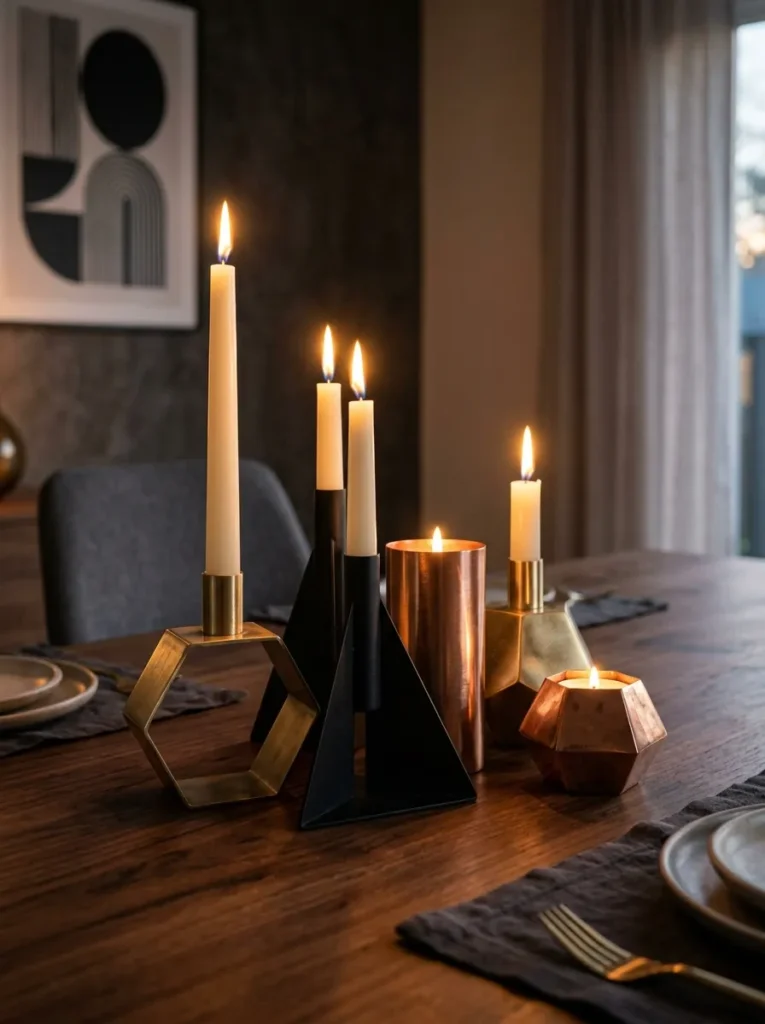
Vibe: The centerpiece is graphic — a collection of geometric metal candle holders in mixed warm metal finishes creates a contemporary, architectural centerpiece that reads as a designed object rather than a traditional flower arrangement, making it specifically appropriate for modern interior settings.
Why it works: Mixed metal geometric candle holders work as a centerpiece because the geometric forms create a graphic composition of shapes rather than the organic composition of botanical arrangements, which reads as distinctly modern and design-conscious. The mixed metal approach (brushed brass, matte black, copper) is more visually interesting than matched metal — the tonal variation between warm brass gold, cool matte black, and warm copper rose creates a metallic color story that rewards close examination. The candlelight playing across varied geometric metal surfaces creates the most complex light and shadow interaction of any centerpiece material — flat surfaces, angled faces, and cylindrical curves each reflect and cast light differently, giving the composition a dynamic visual quality that changes as the candles burn and the flame moves.
How to get it: Source geometric metal candle holders from modern home decor retailers, West Elm, CB2, or specialty metalwork studios — look for varied forms (not all the same shape) in at least two different warm metal finishes. Arrange asymmetrically with taller holders toward the composition’s center-back and lower holders toward the front and sides. Mix taper candles in the taller holders with votive candles in the lower geometric forms for height variation. All holders must be on a heat-safe surface — a marble or stone slab beneath the composition is the safest and most visually appropriate base for a geometric metal arrangement.
Shop The Look
- Geometric brass candleholder modern
- Matte black candle holder geometric set
- Copper metal votive holder set
- White taper candle natural wax
- Marble slab display base candle
11. Tiered Cake Stand Display for Festive Occasions
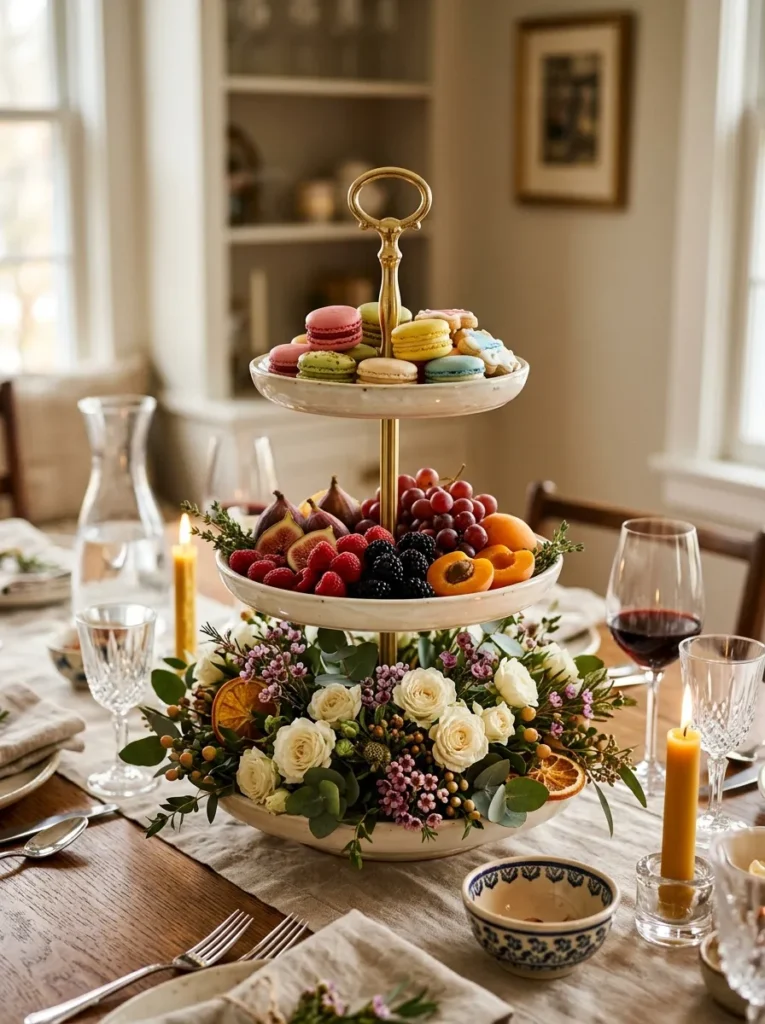
Vibe: The tiered display is festive — a three-tiered stand filled with different seasonal items at each level creates a centerpiece of genuine abundance and visual complexity that communicates celebration and the kind of generous hosting that makes guests feel genuinely welcomed.
Why it works: The tiered stand format is specifically effective for celebratory dining occasions because it creates a centerpiece with three distinct visual zones — base, middle, and top — each containing different content that rewards exploration. The vertical structure allows a generous, abundant centerpiece without the floor plan demands of a wide horizontal arrangement. A tiered stand is also uniquely interactive — guests can select from the stand’s contents during the meal, making the centerpiece a serving piece and reducing the number of separate dishes on the table. The combination of sweet foods (cookies, macarons), seasonal fruits, and botanical decoration on the different tiers creates a visual and sensory variety that single-content arrangements cannot achieve.
How to get it: A three-tiered ceramic or metal cake stand ($20–$80 from kitchen retailers or vintage markets) is the structural base. Fill each tier with a different category of item: the top tier (smallest) with the most precious item (macarons, small chocolates, or a single beautiful flower bloom), the middle tier with seasonal fruit or additional sweet items, and the bottom tier (largest) with botanical decoration, flower heads, or additional seasonal items. The content should be visually cohesive (a single color palette or seasonal theme across all tiers) while varied in category. Replace consumable items as they are taken.
Shop The Look
- Three tier cake stand ceramic white
- Fresh macaron assortment bakery quality
- Seasonal fruit small assortment display
- Single flower head assortment base tier
- Fresh berry mix decorative edible
12. Lantern Cluster with Dried Botanicals and Fairy Lights
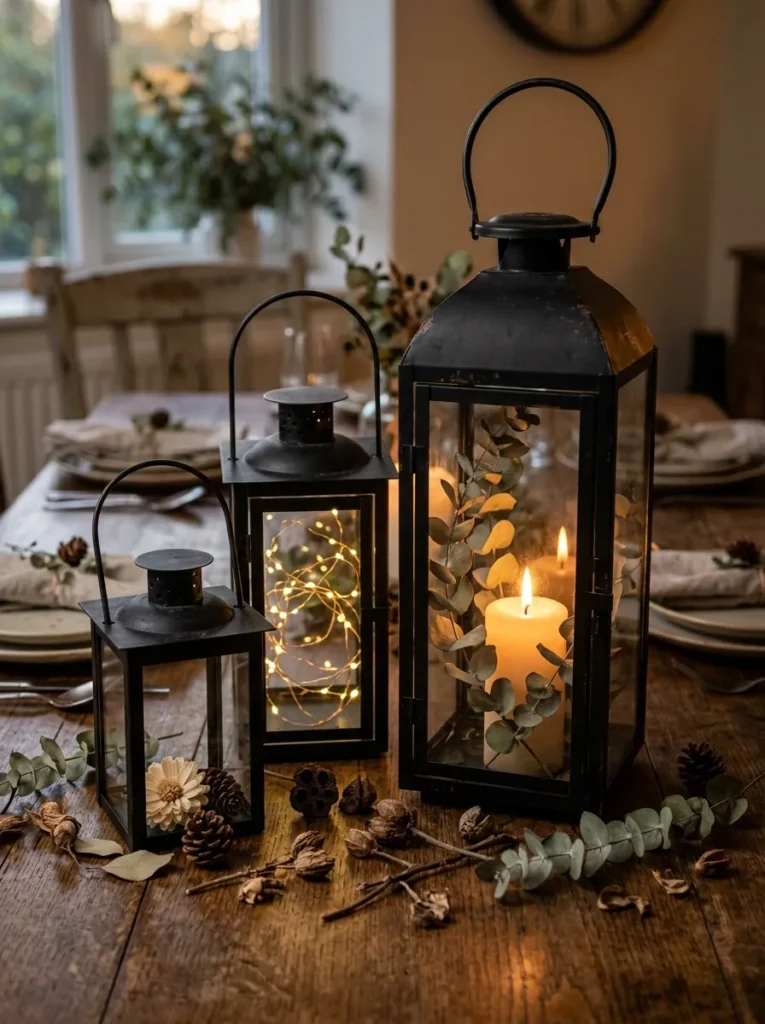
Vibe: The cluster is cozy — a group of varied iron lanterns with warm light sources and dried botanicals creates the most casually warm centerpiece available, where the different lantern sizes and the mix of candle light and fairy light glow creates an intimate, gathered quality that more formal arrangements cannot approach.
Why it works: Lantern clusters work as centerpieces because lanterns are inherently architectural objects with internal visual depth — unlike a flat-sided vase or holder, a lantern has an interior that can be seen through its glass panels, creating a visual complexity that rewards close inspection. The asymmetric group of three (large, medium, small) creates the collected quality of objects gathered rather than purchased as a set, and the varied light sources within the cluster (candle in the largest, fairy lights in the medium, unlit botanical styling in the smallest) create light variation that a uniformly-lit arrangement lacks. Dried eucalyptus stems inside the largest lantern frame the central candle with botanical structure that is visually interesting even when unlit.
How to get it: Source three black iron lanterns in distinct sizes (large: 16 inches tall, medium: 12 inches, small: 8 inches) from home decor retailers or thrift stores — matching metal finish across varied sizes creates the collected quality. Place a battery LED pillar candle in the largest lantern with dried eucalyptus stems inserted around the candle base (the eucalyptus stems stand between the candle and the lantern glass panels). Drape a warm white fairy light strand (battery operated, 20–30 lights on fine wire) loosely inside the medium lantern with the battery pack hidden at the lantern base. Style the smallest lantern with a single dried flower or herb sprig at its base, unlit. Scatter dried botanicals and small pine cones on the table surface between the lanterns as ground-level filler.
Shop The Look
- Black iron lantern set three sizes
- Battery LED pillar candle warm realistic
- Warm fairy lights battery fine wire
- Dried eucalyptus stem bunch silver
- Natural pinecone bag small decorative
13. Seasonal Foliage and Berry Garland as a Runner Centerpiece
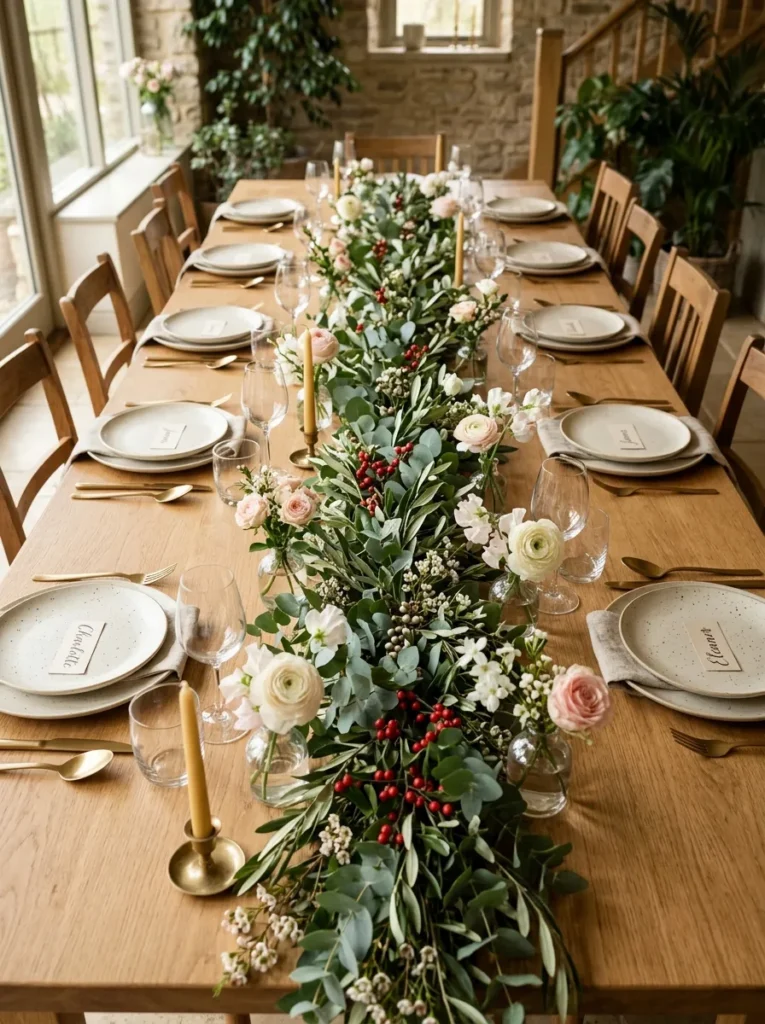
Vibe: The garland is generous — a botanical garland that runs the full length of the dining table creates the most abundant and most visually resolved centerpiece for a long rectangular table, where the continuous botanical line connects the full gathering rather than centering the eye on a single point.
Why it works: A botanical garland as a table runner-centerpiece is the centerpiece approach best suited to long rectangular tables because it distributes visual interest along the table’s entire length rather than concentrating it at a single midpoint — this makes the table feel equally considered at every seat rather than privileging the seats nearest the center arrangement. The low, flowing form of a loose botanical garland stays consistently below the 12-inch sightline, allowing full conversational connection across the table at every position. The small bud vases with single flowers tucked into the garland at intervals add vertical accents without obstruction — at 5–7 inches height, they provide the visual punctuation that prevents the horizontal garland from reading as purely flat.
How to get it: Lay a continuous length of flexible eucalyptus or olive branch on the table center, working from one end to the other and tucking additional branches to build the garland’s width to approximately 6–8 inches. Add seasonal berry stems (bittersweet, rosehip, or holly berry depending on the season) into the foliage at intervals. Tuck small bud vases (1–2 inch diameter, filled with water) at 12-inch intervals along the garland and insert single flower stems (one ranunculus, one anemone, or one sweet pea per vase). The garland naturally holds the bud vases in position through the surrounding botanical material. This centerpiece is best assembled on the table immediately before the meal and lasts 4–8 hours before the cut botanicals begin to wilt.
Shop The Look
- Fresh eucalyptus branch bunch garland
- Fresh olive branch stem bunch
- Seasonal berry stem bunch fresh
- Mini bud vase set small glass
- Fresh anemone bloom stem bunch
14. Candlelit Brass Bowl with Floating Flowers and Petals
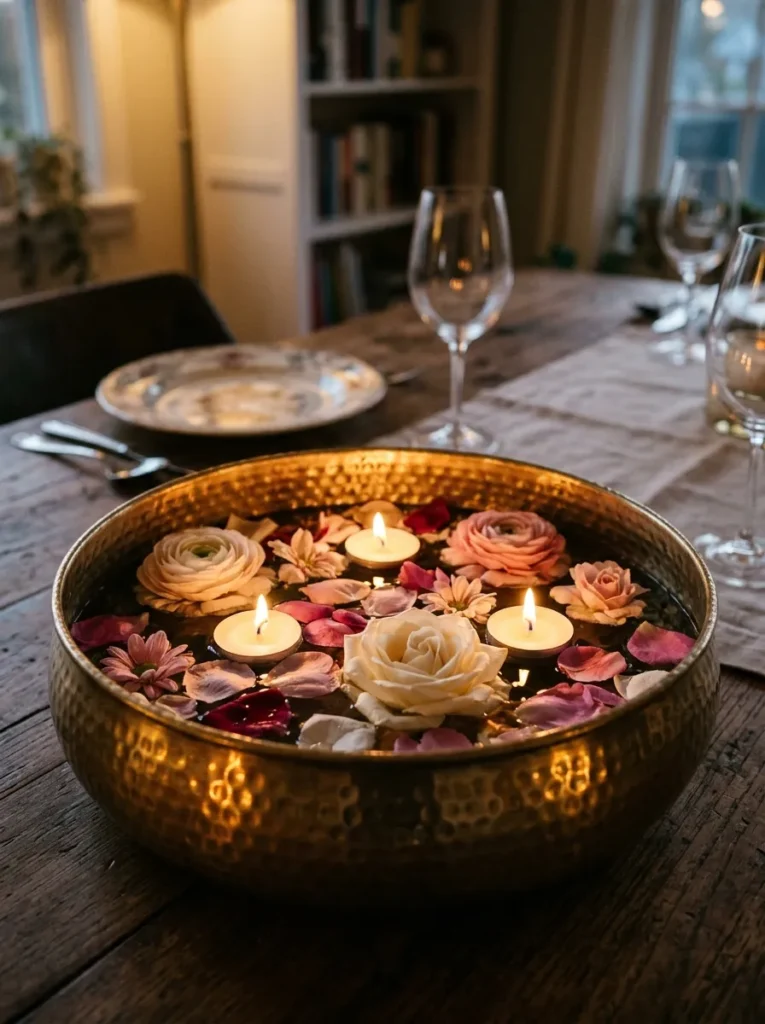
Vibe: The bowl is ceremonial — a hammered brass or copper bowl filled with water and floating flowers and candlelight creates a centerpiece of specific ritual warmth, where the material depth of the hammered metal, the reflective water, and the floating botanical and flame elements together create something that feels ancient and intentional.
Why it works: A hammered metal bowl with water and floating elements exploits three distinct reflective surfaces simultaneously — the hammered metal’s faceted interior, the water’s mirror surface, and the tea lights’ flickering flame all interact to create a constantly shifting light display that transforms throughout the meal. The hammered surface of unlacquered brass or copper is specifically valuable here because each hammer facet faces a slightly different direction, creating dozens of individual micro-reflections of both the candles and the ambient room light — the bowl appears to glow from within rather than merely reflecting from its surface. This optical complexity is what distinguishes a hammered metal bowl from a smooth-surfaced bowl in this application — the smooth bowl creates one large reflection, while the hammered bowl creates hundreds of small ones.
How to get it: Source a wide, low hammered brass or copper bowl ($25–$80 from specialty import retailers, Indian craft importers, or specialty home stores) — the bowl diameter should be 10–14 inches for a dining table centerpiece, with sides no higher than 3 inches to maintain the low profile required for sightline clearance. Fill with room-temperature water to 1 inch below the rim. Float 3–5 flower heads (cut flush at the calyx to float horizontally — gardenias, roses, and ranunculus all float well). Scatter loose petals on the water surface between the flower heads. Add three floating tea lights and light immediately before the meal is served.
Shop The Look
- Hammered brass bowl wide low display
- Hammered copper bowl centerpiece
- Fresh gardenia bloom head white
- Floating tea light candle set
- Fresh rose petal bag loose decoration
15. Holiday Evergreen, Candle, and Pinecone Composition
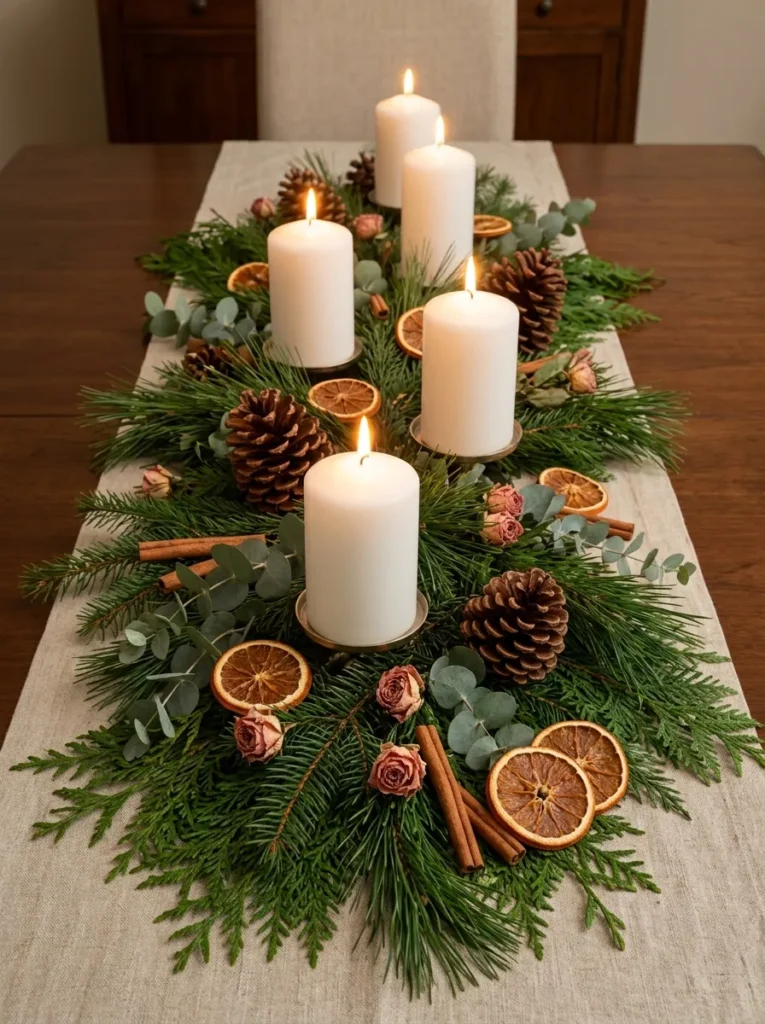
Vibe: The composition is festive — a long holiday evergreen and candle arrangement across a dining table runner is the centerpiece that most fully captures the sensory quality of the winter holiday season, where the fragrance of fresh cedar and cinnamon, the warm glow of pillar candles, and the visual abundance of pinecones and dried citrus create an atmosphere that makes the holiday table genuinely memorable.
Why it works: The holiday evergreen centerpiece is effective specifically because it engages all five senses simultaneously — the visual beauty of varied greenery and candlelight, the fragrance of fresh cedar, pine, and eucalyptus, the warmth of the candle glow on the skin of diners sitting close to the table, the textural variety of smooth pine needles, rough pinecone scales, and the papery surface of dried orange slices, and potentially the taste connection through the cinnamon and citrus that reference holiday foods. This multisensory engagement is why the holiday evergreen centerpiece creates a stronger emotional memory of a meal than any single-sensory arrangement. The composition’s longevity (fresh evergreen branches last 2–3 weeks at cool room temperature) makes it practical as well as beautiful across the full holiday season.
How to get it: Source fresh evergreen branches from a garden center, Christmas tree farm, or your own property — a combination of cedar, Douglas fir, and eucalyptus provides the best fragrance range and visual texture variety. Lay branches on a linen runner as a flat base, overlapping ends and covering the runner’s full 18-inch width and 36-inch length. Insert four pillar candles in metal or glass candle holders at intervals along the arrangement’s centerline, pressing the holders firmly into the branch layer for stability. Tuck pinecones, dried orange slices, cinnamon sticks, and dried rose heads into the greenery at irregular intervals. Mist the greenery lightly with water every two days to maintain freshness and reduce fire risk near the candles.
Shop The Look
- Fresh cedar branch bunch holiday
- Fresh pine branch bundle winter
- White pillar candle set holiday
- Natural pinecone bag varied size
- Dried orange slice bag decoration
How to Create a Dining Table Centerpiece That Lasts
The single most important principle in building a dining table centerpiece practice is to establish a consistent vessel or base before varying the content. A vessel that lives permanently on the table — a favorite ceramic bowl, a loved brass compote, a natural stone slab — creates the compositional anchor that makes seasonal and weekly centerpiece changes simple and beautiful: the vessel is always there, and what it holds or what is arranged around it changes with the season, the occasion, or whatever is most beautiful at that moment. This vessel-as-anchor approach eliminates the decision fatigue of starting from scratch for every centerpiece and creates a table personality over time that develops and deepens with each seasonal iteration.
The most common centerpiece mistake is prioritizing height over sightline — choosing an arrangement that looks impressive in a photograph but obstructs conversation across the table in actual use. The practical test for any dining table centerpiece before guests arrive is to sit in a chair at the table and look directly across to the opposite chair: if the centerpiece blocks the view of the person who would be sitting there, it is too tall, and something must be changed. Either lower the arrangement (remove taller elements), replace it with a taller but visually open arrangement (a single branch, a tall vase with open structure), or move the centerpiece to one end of the table.
Three centerpiece upgrades under $30 that immediately improve any dining table’s visual quality: a single warm white taper candle in a $3–$8 thrift store brass candlestick that adds warmth and occasion to every meal with no other change required; a small ceramic bowl ($5–$15) filled with seasonal fruit (three figs, a handful of grapes, two pomegranates) that creates beauty from produce already in the kitchen; and a single fresh branch from the garden ($0) in the table’s existing vase that brings a seasonal botanical moment of genuine beauty with no purchase required.
A complete, considered dining table centerpiece — one that serves the table across four seasons with a rotating botanical and candle composition — costs between $40 and $150 in the first year of establishing the vessel collection and base materials, and significantly less in subsequent years as seasonal botanical additions build on an existing base. The investment in a beautiful center for the room’s most social surface delivers daily returns in the quality of every meal eaten at that table, which makes it among the highest-value-per-use design investments available in the home.
Frequently Asked Questions About Dining Table Centerpieces
How tall should a dining table centerpiece be?
The height rule for dining table centerpieces has two correct answers depending on the arrangement type. Low arrangements — flower vases, botanical compositions, candle and stone compositions — should stay below 12 inches from the table surface. This height allows full sightlines across the table for all diners and is the standard for everyday and formal dining centerpieces. Tall arrangements — a single dramatic branch in a floor vase, a tall candlestick cluster, or a sculptural installation — should exceed 24 inches from the table surface, at which point the arrangement is above seated eye level and sightlines pass beneath the arrangement rather than being blocked by it. The zone from 12 to 24 inches is the dead zone: tall enough to obstruct conversation but not tall enough to have the dramatic presence that justifies the obstruction. For the most common centerpiece types — flowers, candles, fruit, and botanicals — staying below 12 inches is the correct practical guideline.
How do I create a centerpiece that works for both everyday meals and special occasions?
The most practical approach is a layered system where a permanent, low-maintenance base element is supplemented by occasion-specific additions. For everyday meals, the permanent base element (a simple botanical arrangement of dried stems in a ceramic vessel, a herb cluster on a wooden tray, or a moss and stone composition) sits alone at the table center. For special occasions, additions are layered into and around the base element: candles added to the botanical arrangement for a dinner party, fresh flowers added to the dried botanical composition for a celebration, seasonal produce arranged around the existing moss composition for a holiday meal. The base element is always present; the additions are brought out and returned to storage as occasions demand. This approach means the table is always composed and always beautiful without requiring a complete rebuild for every meal.
What are the most long-lasting centerpiece materials for low-maintenance tables?
Dried and preserved botanicals are the most long-lasting centerpiece materials available, requiring no water, no wilting management, and no replacement for 2–6 months depending on the specific materials. Preserved eucalyptus (a professional preservation process using glycerin) maintains its green color and flexibility for 6–12 months. Dried pampas grass plumes last 2–4 months before beginning to shed. Dried cotton stems last 3–6 months. Dried wheat and grasses last 2–3 months. Beyond botanicals, permanent centerpiece elements — smooth river stones, ceramic objects, carved wooden pieces, glass terrariums — require no maintenance and last indefinitely. The most practical long-lasting centerpiece combines a permanent structural element (a ceramic vessel, a wooden tray, a stone slab) with preserved or dried botanical content that is refreshed seasonally rather than weekly.
How do I size a centerpiece correctly for my specific dining table?
The sizing guidelines depend on the table’s shape and dimensions. For round tables: the centerpiece’s diameter should be no more than one-third of the table’s diameter — a 48-inch round table calls for a centerpiece footprint of maximum 16 inches diameter. For rectangular tables: the centerpiece’s width should be no more than one-third of the table’s width (a 36-inch-wide table calls for a maximum 12-inch-wide centerpiece) and its length can extend to one-half of the table’s length for elongated garland-style arrangements. For square tables: a single centered composition of maximum 14 inches diameter works for most standard 42-inch square tables. The critical practical test is always to set the table with actual place settings and assess whether the centerpiece leaves sufficient clear space for dishes, glasses, and service items at every place setting — a minimum of 18 inches of clear depth from the plate front to the centerpiece edge is the functional standard.
What is the most impactful single change I can make to improve my dining table’s centerpiece?
The most impactful single change for most dining tables is adding candlelight — specifically, two or three taper candles in mismatched brass candlesticks of varied heights, lit during every meal including weeknight dinners. Candlelight changes the fundamental atmosphere of a meal in a way that no other single element can — it warms the faces of every person at the table, creates a quality of light that is flattering to both people and food, transforms the occasion of eating from functional to ceremonial, and produces a visual warmth that is perceptible and felt rather than merely seen. The combination of candlelight and the collected quality of mismatched brass candlesticks also creates a centerpiece of genuine warmth and character with a total investment of $15–$30 for three thrift store candlesticks and a pack of quality taper candles. The impact of this single change on the quality of the dining table experience is disproportionate to its simplicity and its cost.
Ready to Transform Your Dining Table?
These 15 ideas cover the full range of what a dining table centerpiece can be — from the everyday warmth of a taper candle cluster in collected brass candlesticks and the kitchen generosity of a fresh herb pot cluster, to the seasonal celebration of a holiday evergreen and candle composition and the serene restraint of a single dramatic branch in a tall ceramic vase, from the botanical abundance of a wildflower and herb arrangement to the material sophistication of a hammered brass bowl with floating flowers and candlelight. You do not need all 15 to create a table that is genuinely beautiful — you need one good vessel, one quality light source, and the habit of placing something worth looking at in the center of the surface where you gather most often. Start this week with three thrift store candlesticks and a pack of taper candles, light them at the next meal you eat at that table, and notice the difference in how the meal feels. A table that is beautiful at its center is a table that makes every gathering around it feel worth attending. Pin the ideas that made you want to set your table immediately — those are the ones your dining room is already ready for.