15 Thoughtful Handmade Gifts That Wow Everyone
Thoughtful handmade gifts that wow everyone combine genuine craft skill with personal intention — gifts that communicate the maker’s time, care, and knowledge of the recipient in a way that purchased gifts rarely achieve, regardless of their monetary value. This article gives you exactly 15 ideas spanning food gifts, textile projects, paper crafts, botanical makes, candles, jewelry, and personalized keepsakes so every skill level, every budget, and every recipient type finds a handmade gift that genuinely delights.
The best handmade gifts have two qualities that no purchase can replicate: the evidence of time deliberately spent, and the evidence that the maker knows the recipient specifically rather than generically. A jar of homemade lemon curd says both — the making took hours, and the choice of lemon (rather than another flavor) says: I know you. That combination — time plus specificity — is what makes a handmade gift feel genuinely different from even the most expensive purchase. Here are 15 ideas worth making.
Why Thoughtful Handmade Gifts That Wow Everyone Work So Well
The act of giving handmade gifts has a continuous cross-cultural history — from the woven and carved gifts of pre-industrial societies to the Victorian tradition of domestic craft as love-work to the contemporary gifting culture that has seen handmade and artisan gifts command premium positioning in both commercial and personal contexts. Research in gift-giving psychology consistently documents that recipients value handmade gifts more highly than their monetary cost would suggest, specifically because handmade gifts communicate what economists call “costly signaling” — the maker invested time that could have been spent on other things, which communicates the priority the recipient holds for the maker.
The contemporary handmade gift revival sits within a broader cultural context of revaluing making over consuming, slowing down from digital saturation, and seeking authentic material objects with genuine provenance — objects that can be described not just as “nice” but as “made by someone who knew me.” The gifting market data supports this cultural shift: Etsy’s annual gifting reports consistently document that “made for you” and “personalized handmade” are among the highest-converting search categories in gifting contexts, and the wellness and slow-living media convergence around handmade gifts (documented in publications from Kinfolk to Country Living to Martha Stewart Living) shows sustained engagement.
The practical advantages of handmade gifts extend beyond emotional resonance: they are genuinely customizable to the recipient’s specific tastes, dietary requirements, aesthetic preferences, and life circumstances in ways that commercial gifts rarely accommodate; they are frequently more cost-effective than purchased equivalents (a jar of homemade vanilla extract costs $8–12 to make and reads as a $25–35 gift in a commercial context); and the making process itself is a documented wellness activity for the maker — whether baking, sewing, crafting, or painting, the absorption of making is associated with reduced anxiety, improved mood, and the specific satisfaction of competence that completing a skilled task provides.
Skill level is the honest variable in handmade gifting — some ideas in this list require only kitchen pantry skills (the homemade food gifts), others require basic craft techniques (the paper and botanical projects), and a few require learned craft skills (the textile and jewelry ideas). Every idea is described with enough technique detail to assess whether it matches the maker’s current skills, and the skill gradients within each category are signaled clearly. No idea in this list requires professional-level expertise, but some require more practiced skill than others.
Style at a Glance
| Element | Handmade Core | Gift Edge |
|---|---|---|
| Philosophy | Time plus specificity over monetary value | The making communicates what money cannot |
| Materials | Kitchen pantry, craft yarn, botanical, wax | Quality ingredients, natural fiber, ceramic |
| Occasion Range | Birthday, holiday, host gift, thank-you, milestone |
15 Thoughtful Handmade Gifts That Wow Everyone
1. Homemade Infused Olive Oil with Herb and Spice Combinations
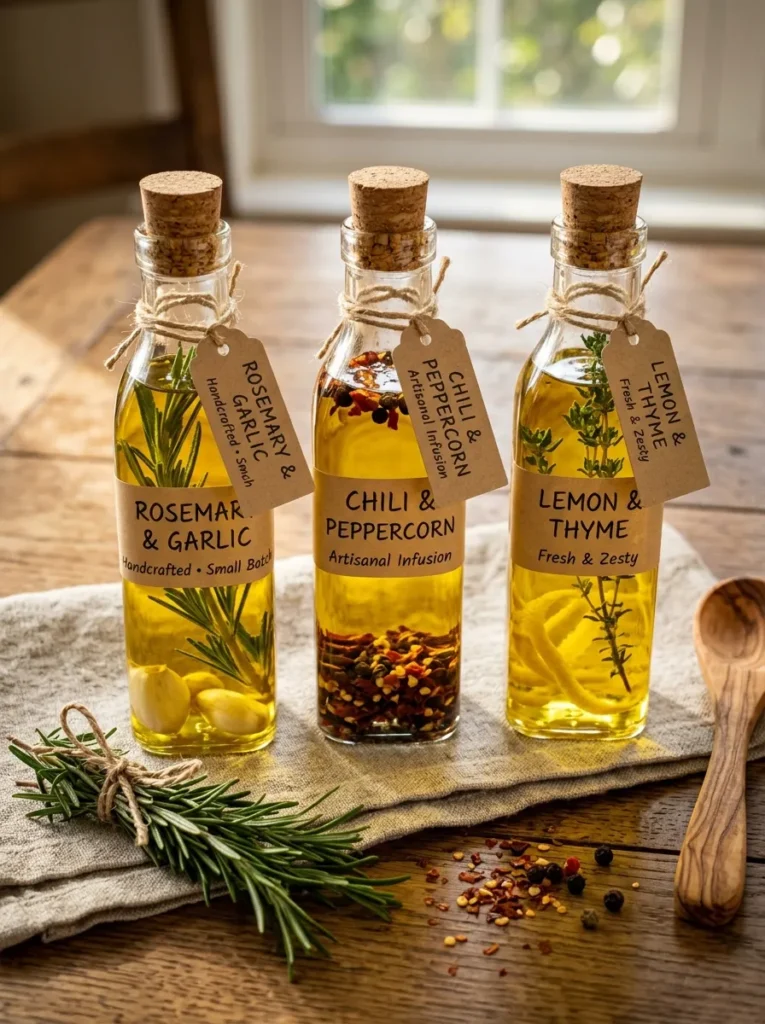
Vibe: The bottles feel like something from a specialist Italian deli — the visible ingredients floating in golden oil making the recipient want to use them before they’ve been unwrapped.
Why it works: Infused olive oils apply the food gift principle of elevated everyday use — the recipient is already buying olive oil; this version simply makes that daily act more interesting, more flavorful, and more emotionally resonant because it was made by someone who thought about their specific cooking preferences. The visible infusion ingredients through the clear glass communicate the maker’s care and the oil’s provenance simultaneously. Different flavor combinations signal different things about the recipient’s cooking style — rosemary and garlic for a roast cook, chili and peppercorn for someone who loves heat, lemon and thyme for a fish and chicken cook — demonstrating the specific knowledge of the recipient that makes this gift genuinely thoughtful rather than generic.
How to get it: Use a good-quality mild extra virgin olive oil as the base (not a strongly flavored single estate oil, which would compete with the infusion flavors). For a cold-infusion (the safest method): fill a clean sterilized glass bottle with the fresh or dried herb combination, fill with oil, cork, and allow to infuse at room temperature for 1–2 weeks before gifting. Note: fresh herb cold infusions carry a small risk of botulism if not refrigerated — for gifting safety, use dried herbs only or use the hot-infusion method (gently heat oil with herbs to 85°C, cool, strain, and bottle in a sterilized container). Include a note with the suggested use on the gift label.
Quick Win: Three 250ml slim glass bottles ($8–12 for a set of three), 750ml of good quality olive oil ($12–18), and dried herbs from the kitchen store ($5–10) produce three complete gift bottles for under $40 total — a gift that reads as a $75+ deli purchase.
Shop The Look
| Product |
|---|
| Slim glass bottle set cork lid 250ml |
| Good quality mild extra virgin olive oil |
| Dried herb set rosemary thyme chili |
| Kraft card gift tag set hole punched |
| Thin twine natural set tying |
Also view: 15 Aesthetic Wall Ideas That Transform Any Room
2. Hand-Poured Soy Wax Candle in a Ceramic Vessel
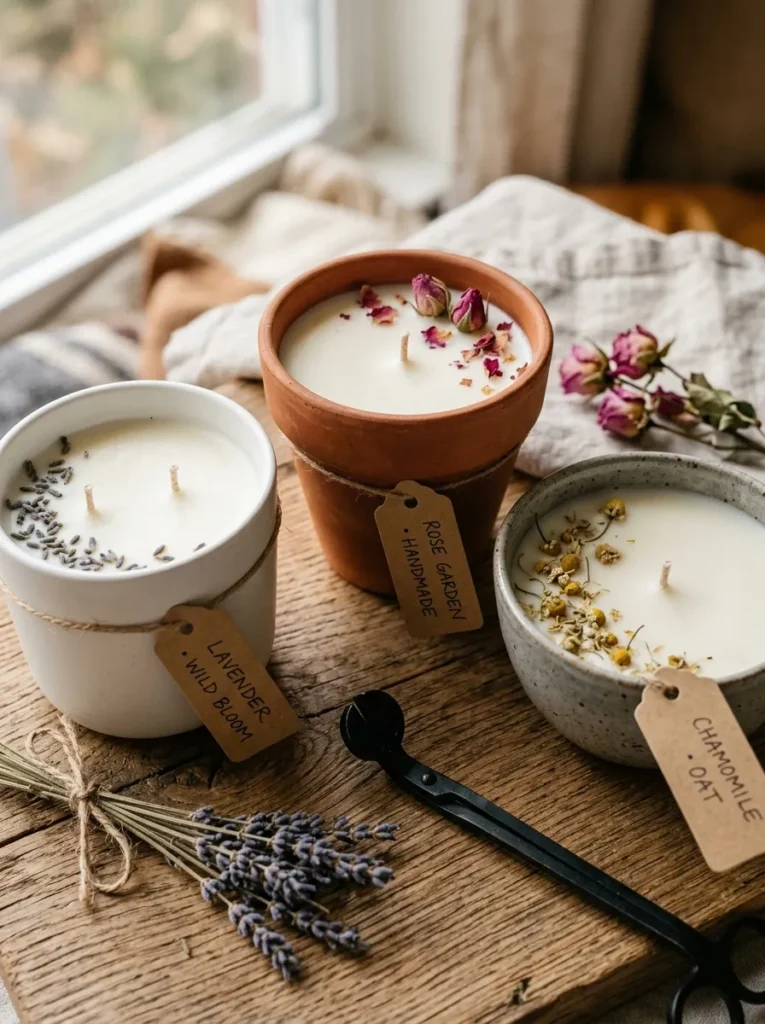
Vibe: The candle gift feels genuinely made — the ceramic vessel giving the gift a permanence beyond the candle’s burn life.
Why it works: A soy wax candle poured into a ceramic vessel rather than a standard glass jar applies the gift design principle of continued utility — when the candle has burned down, the ceramic vessel becomes a useful object (a pen holder, a small planter, a trinket dish), extending the gift’s presence in the recipient’s home beyond the candle’s life. Soy wax specifically signals considered making — it burns slower and cleaner than paraffin, is biodegradable, and has become the widely understood signal of artisan candle quality. A dried botanical pressed into the wax surface (a signature aesthetic detail in handmade candle culture) adds the visual evidence of careful finishing that elevates the gift above a plain-wax commercial candle.
How to get it: Source soy wax flakes (container soy wax, not pillar wax — the formulation is specifically for poured vessels), pre-tabbed cotton wicks sized to the vessel diameter, and fragrance oil or essential oil at a maximum 10% fragrance load (more than 10% risks fire safety). Melt the soy wax to 75–80°C, add fragrance at 65°C, pour at 55–60°C into the pre-warmed ceramic vessel with the wick centered using a wick holder or two pencils. Allow to cool fully at room temperature without moving — moving a cooling candle creates surface cracking. Press dried botanical accents into the partially cooled but still soft wax surface approximately 30 minutes after pouring.
Shop The Look
| Product |
|---|
| Soy wax flakes container grade 1kg |
| Pre-tabbed cotton wick set various sizes |
| Fragrance oil set 30ml natural scent |
| Small ceramic vessel set matte finish |
| Dried botanical set lavender rose |
Also view: 15 Handcrafted Decor Ideas for a Warm, Stylish Home
3. Personalized Pressed Flower Bookmark Set
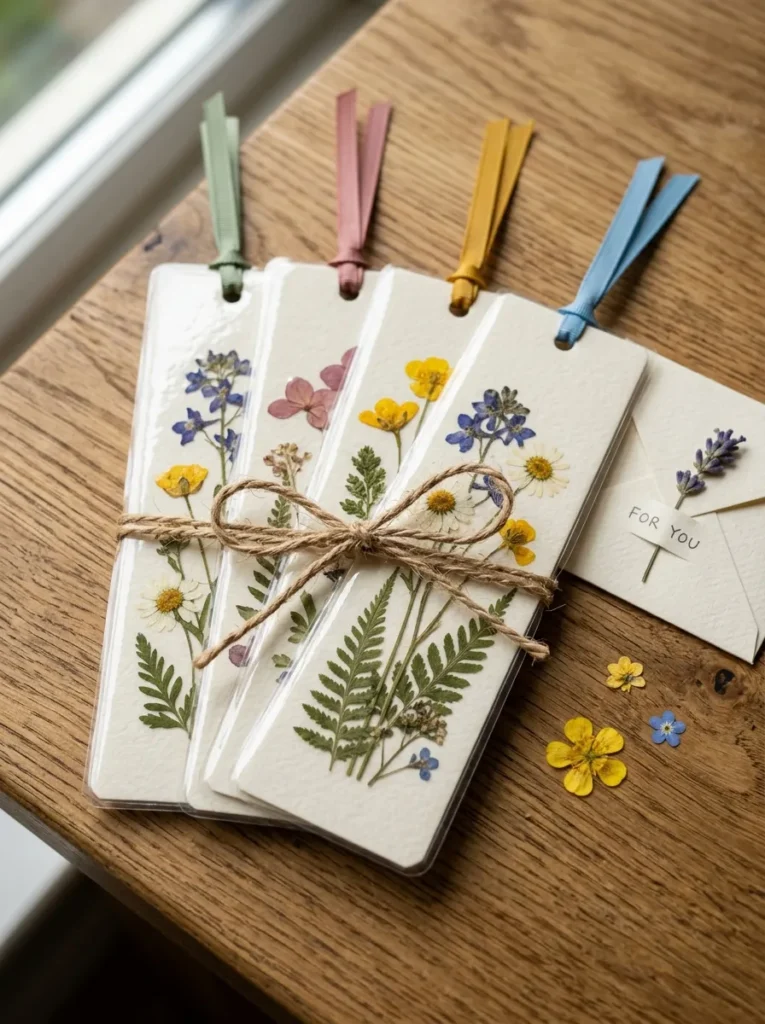
Vibe: The bookmark set feels like tiny botanical artworks — the pressed flowers too precise and beautiful for something that lives inside a book.
Why it works: Pressed flower bookmarks apply the gift design principle of functional beauty — a gift that is beautiful enough to be decorative but functional enough to be used daily occupies a unique position in the recipient’s experience, because they encounter it repeatedly during an activity (reading) that is already associated with pleasure and calm. The personalization dimension is significant: choosing specific flowers that have meaning to the recipient (their birth month flower, flowers from a shared occasion, or simply their favorite plant) transforms a generic craft project into a specific and meaningful personal statement. The set format (four bookmarks rather than one) communicates the maker’s generosity of effort and ensures the gift has practical utility across multiple books simultaneously.
How to get it: Press flowers and small ferns between book pages under weight for 1–2 weeks. Cut bookmarks to 5×20cm from 300gsm watercolor paper. Arrange the pressed botanicals on each bookmark using a thin layer of Mod Podge to adhere. Seal with two coats of Mod Podge gloss on the botanical face and one coat on the reverse for a laminated look. Punch a hole at the top with a hole punch and thread a narrow satin or linen ribbon (15–20cm) through the hole and tie. Present the set of four tied together with a natural twine bow in a small glassine envelope or kraft box.
Shop The Look
| Product |
|---|
| Watercolor paper 300gsm thick bookmark |
| Mod Podge gloss sealer craft |
| Narrow satin ribbon set assorted |
| Pressed flower set small botanical |
| Kraft gift box small jewelry size |
4. Homemade Vanilla Extract — The Long-Game Gift
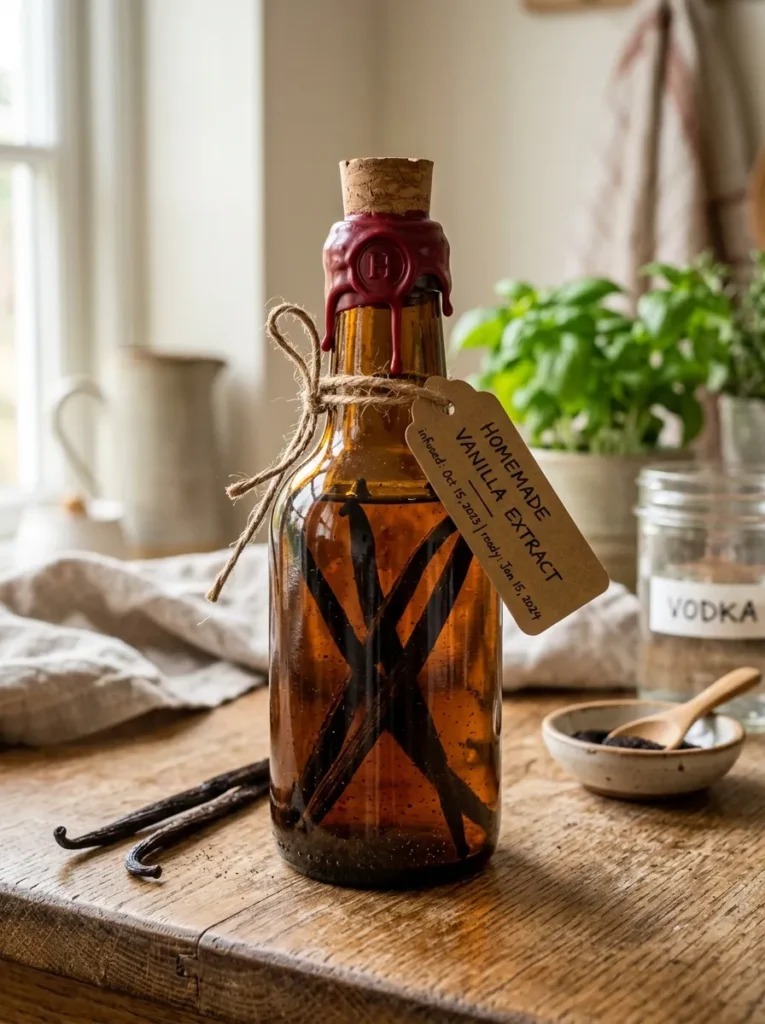
Vibe: The vanilla extract feels like patience made liquid — a gift that the recipient knows took months to prepare, which says more than any price tag.
Why it works: Homemade vanilla extract applies the gift principle of invested time as demonstrated care — the extract requires a minimum of 8 weeks of infusion before it reaches the depth of flavor that makes it genuinely superior to commercial vanilla extract, which means the maker must think of the recipient and their upcoming celebration months in advance of the gifting moment. This temporal investment is visible to the recipient in the handwritten “infused” and “ready” dates on the label, communicating explicitly that the maker began this gift months ago specifically for them. The practical gift value is also significant: pure high-quality vanilla extract is genuinely expensive ($15–25 for a small commercial bottle), and a maker-produced equivalent using premium vanilla beans is both superior in flavor and more cost-efficient.
How to get it: Split 6–8 Grade A vanilla beans lengthwise to expose the seeds. Place in a 200ml clean amber glass bottle. Fill with an 80-proof spirit (vodka for a neutral flavor, bourbon for a warmer caramel note, dark rum for a tropical note). Seal and store in a dark cool place for a minimum of 8 weeks, shaking gently once per week. The extract is ready when it is dark brown and deeply fragrant — the longer it infuses, the more complex the flavor. Label with the spirit base, the infusion date, and the ready date. Seal the cork with a dip in melted wax for a professional finish.
Shop The Look
| Product |
|---|
| Grade A vanilla bean set 10 pieces |
| Amber glass bottle cork 200ml set |
| Sealing wax for bottles craft |
| Kraft label card hole punched |
| Brown twine natural set |
5. Hand-Illustrated Portrait of the Recipient’s Pet
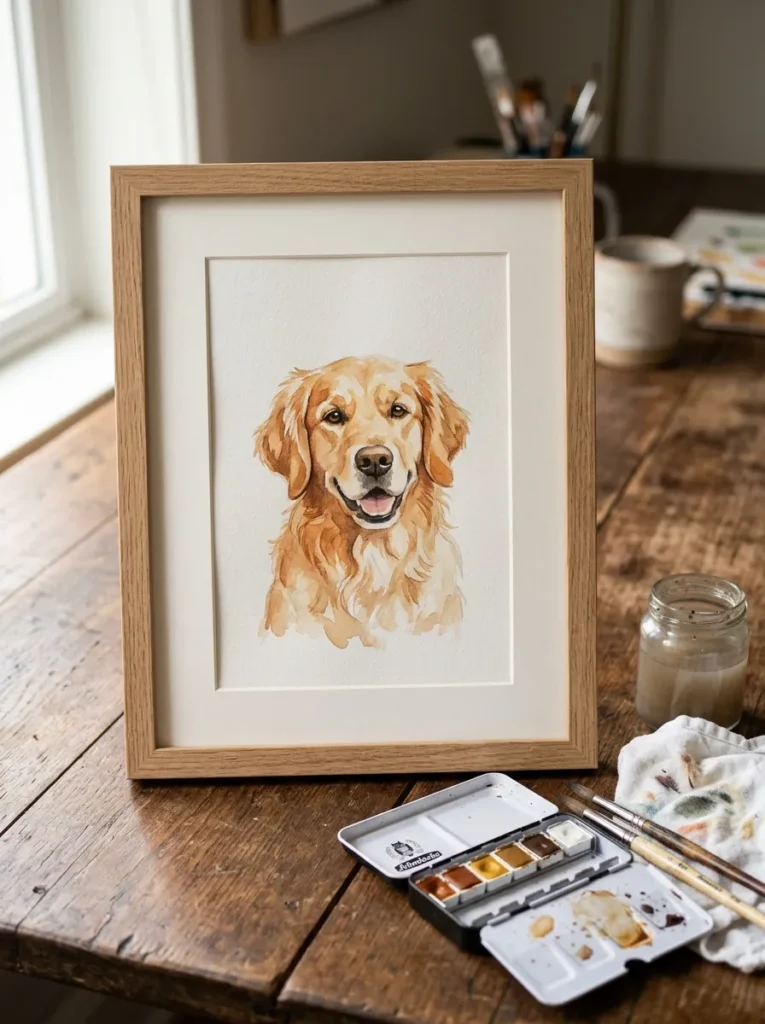
Vibe: The portrait feels irreplaceable — the only gift in this list that is by definition impossible to buy and completely impossible to duplicate.
Why it works: A hand-illustrated pet portrait applies the ultimate gift personalization principle — it is literally and definitively made for one specific recipient and their specific pet, meaning it cannot be found in any shop, at any price, in any form. For recipients who love their pet (a significant and growing demographic), a portrait of that specific animal in the maker’s own visual style communicates the complete intersection of: the maker’s time, the maker’s creative skill, and the maker’s specific knowledge of what the recipient loves. The skill required is the honest variable — this idea requires sufficient illustration or painting skill to produce a likeness that reads as the specific animal rather than a generic version of the species. For makers with some artistic experience, a loose watercolor style is the most achievable approach because its inherent softness accommodates imprecision.
How to get it: Request three to four clear reference photographs of the pet from different angles, in good natural light. Sketch the composition lightly in pencil on 300gsm cold-press watercolor paper, working from the focal point (the eyes) outward. Work in watercolor using wet-on-wet technique for the fur texture — float multiple warm tones (amber, ochre, burnt sienna, warm gray) into each other while wet for the soft, blended quality that reads as natural animal fur. Keep the background minimal — a simple warm white or pale color wash that focuses the eye on the animal. Mount in a simple oak or natural wood frame with a white or cream mat.
Shop The Look
| Product |
|---|
| Watercolor paint set professional 24 color |
| Watercolor paper 300gsm cold press A4 |
| Natural oak picture frame A4 |
| White mat card picture frame insert |
| Fine watercolor brush set 2 4 6 round |
6. Homemade Compound Butter Collection
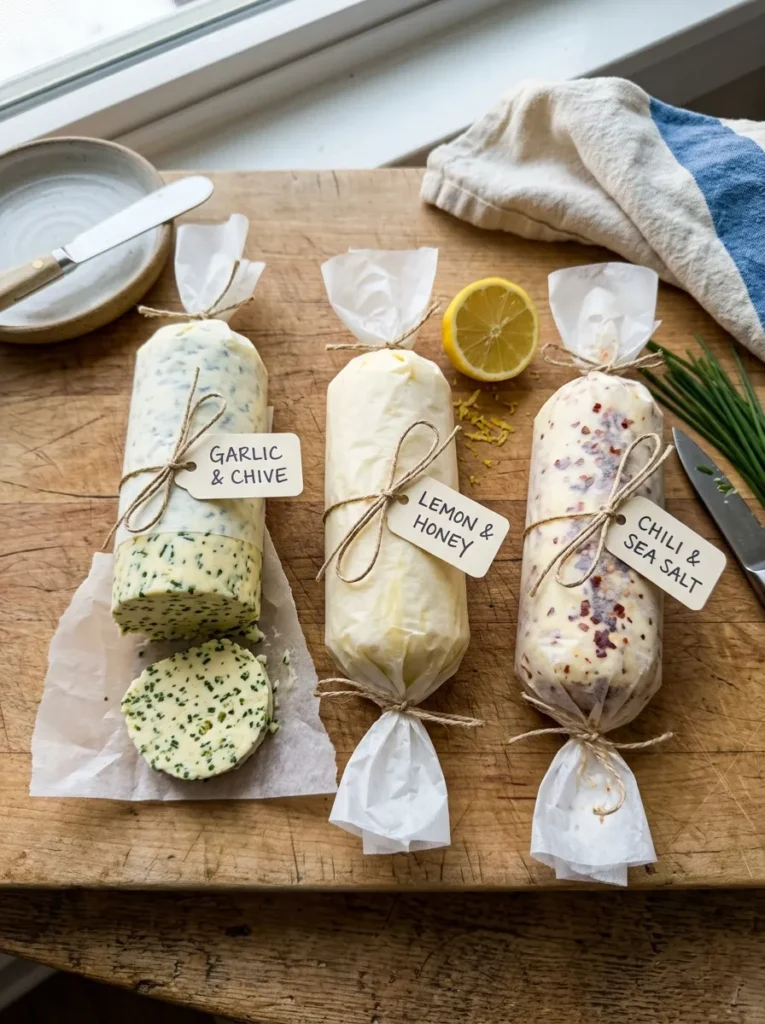
Vibe: The compound butter logs feel like something a professional chef gives as a gift — immediately useful, immediately impressive, genuinely delicious.
Why it works: Compound butters apply the food gift principle of immediate, impressive utility — the recipient uses the butter that day or that week in a real cooking context (melted over steak, spread on warm bread, finished on pasta), creating a direct sensory connection between the maker and the recipient’s pleasurable food experience. Three different flavored butters in a set communicates both generosity (the effort of three separate preparations) and specific knowledge of the recipient’s cooking preferences. The parchment roll presentation reads as professional and considered — it is the presentation format used in professional kitchens and specialty food shops, communicating quality despite the accessible material cost.
How to get it: Bring unsalted butter to room temperature until soft. For each flavor combination, blend approximately 100g of softened butter with the flavor additions: (1) 3 garlic cloves (roasted and minced) plus 2 tablespoons fresh chive; (2) 2 teaspoons lemon zest plus 1 tablespoon honey plus 1 teaspoon thyme; (3) 1 teaspoon dried chili flakes plus 1 teaspoon flaked sea salt plus 1 teaspoon smoked paprika. Place each mixture on parchment paper, roll into a log approximately 15cm long, twist the ends tightly, and refrigerate until firm. Freeze until needed for gifting — compound butters keep frozen for up to three months.
Shop The Look
| Product |
|---|
| Unsalted butter 250g quality |
| Parchment paper baking roll |
| Kitchen twine natural set |
| Small handwritten label kraft card |
| Flaked sea salt quality finishing |
7. Embroidered Linen Kitchen Towel Set
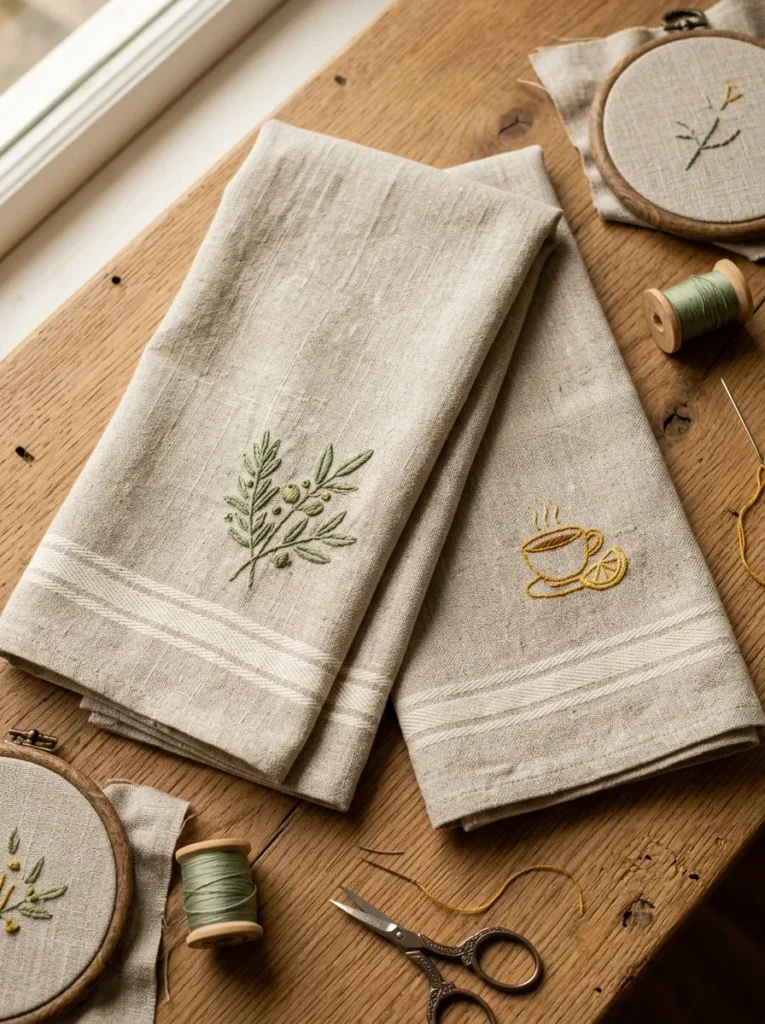
Vibe: The embroidered towels feel like something from a Provençal market — the kind of kitchen linen that hangs on a hook and makes the kitchen look like someone cares.
Why it works: An embroidered linen kitchen towel set applies the gift principle of daily beauty — a kitchen towel is used every day, meaning a beautiful one is encountered and appreciated every day rather than once at the unwrapping moment. Embroidery on natural linen specifically is the intersection of material quality (linen’s durability and natural warmth) and craft evidence (the visible hand-stitching communicates the maker’s time at close range, every time the towel is used or displayed). Personalizing the embroidery motif to the recipient’s interests (a herb sprig for a keen cook, a small cat for an animal lover, a coffee cup for a coffee obsessive) adds the specific knowledge dimension that elevates this beyond a generic craft project.
How to get it: Source natural undyed linen kitchen towels (blank un-embroidered linen towels are available from specialist linen suppliers and craft stores in various sizes) or cut and hem linen fabric to 40×60cm. Transfer the embroidery design using water-soluble fabric pen or a printed water-soluble transfer sheet. Work the design in six-strand embroidery thread (three strands for fine detail, six strands for bold outlines), using backstitch for outlines and satin stitch for filled color areas. Wash the completed towel in cool water to remove all transfer marks before gifting, and press while slightly damp.
Shop The Look
| Product |
|---|
| Natural linen kitchen towel blank set |
| Embroidery thread set botanical colors |
| Water-soluble embroidery transfer paper |
| Embroidery hoop wooden 6 inch |
| Embroidery needle set assorted |
8. Homemade Flavored Salt Collection
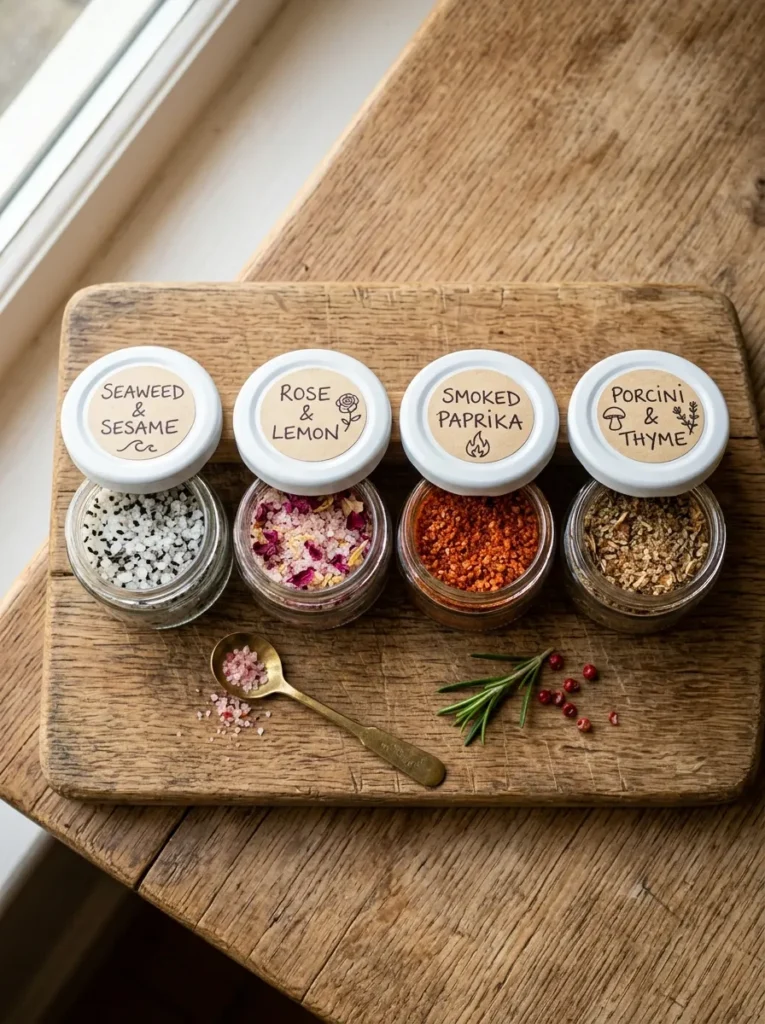
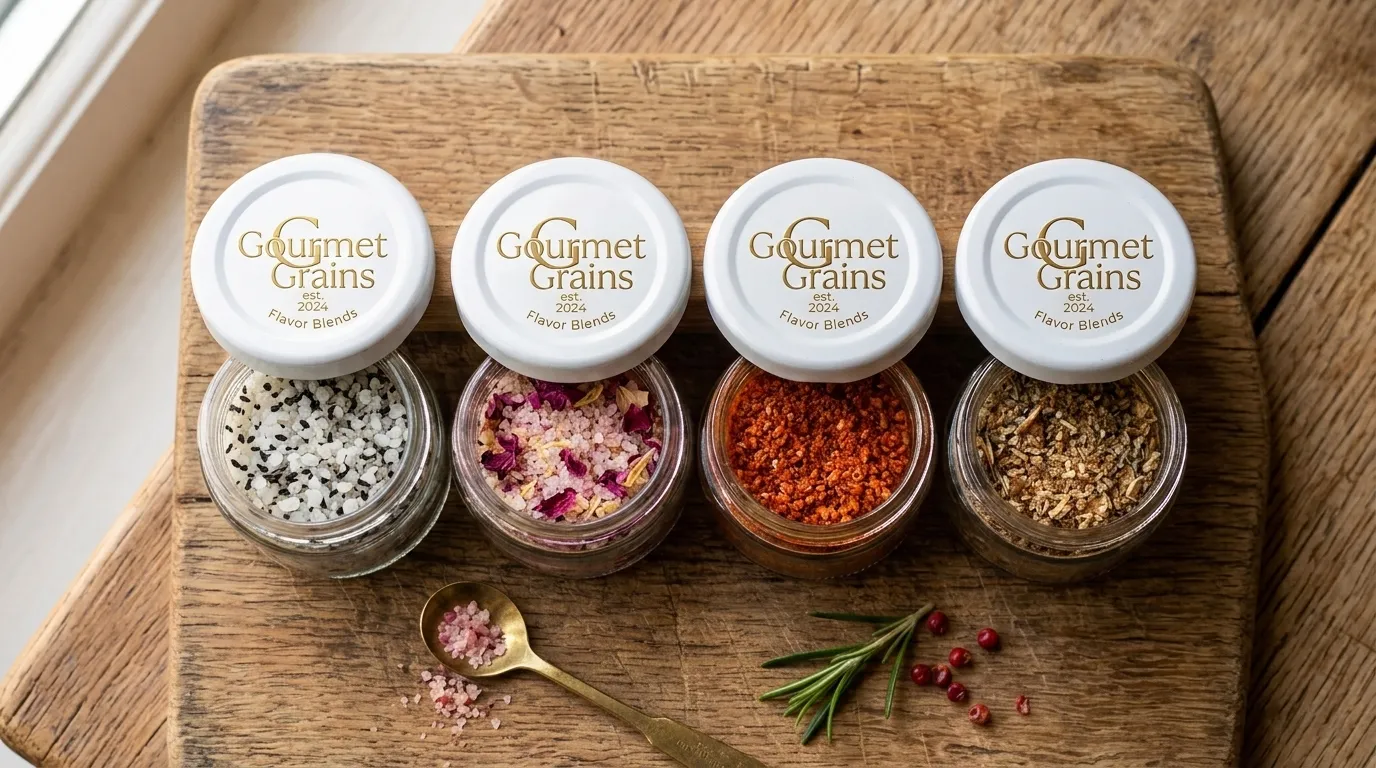
Vibe: The salt collection feels like a professional chef’s finishing kit — four jars that change what cooking tastes like.
Why it works: Flavored finishing salts apply the food gift principle of accessible luxury — salt is the most fundamental cooking ingredient, and a high-quality flavored finishing salt is something most people know about from restaurant experiences but rarely purchase for home use. A collection of four distinctly flavored salts in a consistent small jar format communicates both generosity (four different preparations) and the maker’s knowledge of the recipient’s cooking interests. The practical gift value is high — finishing salts genuinely improve home cooking in an immediate, noticeable way, creating a direct positive sensory association with the maker every time the recipient uses them.
How to get it: Use a quality flaked sea salt or coarse kosher salt as the base. For each flavor: (1) Sesame seaweed: mix flaked sea salt with toasted black sesame and crumbled dried seaweed in a 6:2:1 ratio; (2) Rose lemon: grind dried rose petals with lemon zest and flaked salt in a food processor; (3) Smoked paprika: blend smoked sweet paprika with flaked salt 1:3 until the salt is uniformly colored; (4) Porcini: blitz dried porcini mushrooms to a powder and blend with flaked salt 1:4. Spread each mixture on a baking sheet and dry in an oven at 60°C for 30 minutes to ensure shelf stability. Package in 50ml sterilized jam jars and label the lid with the salt name and brief usage suggestion.
Shop The Look
| Product |
|---|
| Flaked sea salt quality finishing 500g |
| Small 50ml jam jar set metal lid |
| Dried rose petal food grade set |
| Dried porcini mushroom sliced set |
| Smoked paprika sweet quality |
9. Personalized Wax Seal Stamp and Letter Writing Kit
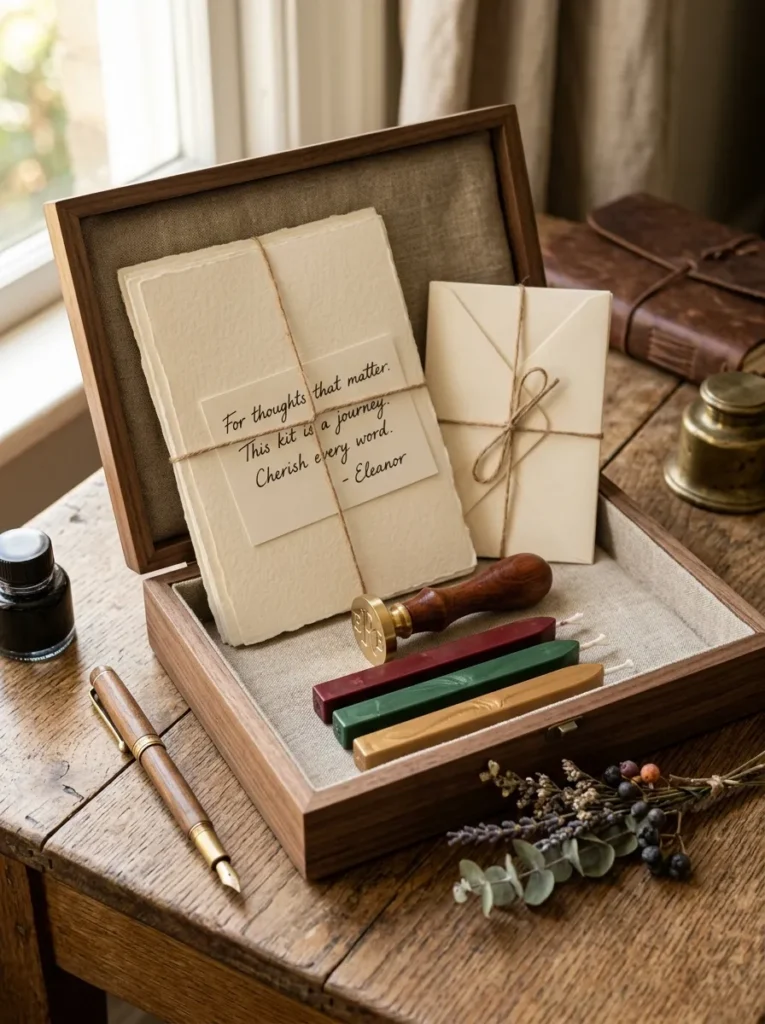
Vibe: The letter writing kit feels like receiving permission to slow down — everything needed for the specific pleasure of a handwritten letter.
Why it works: A personalized letter writing kit applies the gift design principle of enabling a pleasurable practice — many people feel the appeal of letter writing and wax seals but have never assembled the specific materials needed to begin. The kit removes all friction from starting the practice by providing everything simultaneously. The personalization of the wax seal stamp (engraved with the recipient’s initial or monogram) makes the kit irreversibly theirs — the stamp cannot be used by or for anyone else. This irreversibility is a gift signal: the maker had this object made specifically for this person. The combined cost of a custom wax seal stamp ($25–45) plus quality paper and wax sticks ($15–25) produces a gift that reads as significantly more expensive than its actual cost while being more personally meaningful than anything in the equivalent commercial price range.
How to get it: Order a custom wax seal stamp with the recipient’s initial, monogram, or a meaningful symbol from an Etsy stamp maker (typical turnaround 5–10 days, cost $25–45). Source a set of sealing wax sticks in 2–3 colors that coordinate with the recipient’s aesthetic preferences or meaningful associations (red for passion, green for nature, gold for warmth). Add a set of 20–30 sheets of quality cream writing paper (90gsm or above, unlined) and matching envelopes. Arrange in a small wooden box or wrap in a linen envelope. Include a brief handwritten note demonstrating the seal with the recipient’s initial — a small practical demonstration of the kit’s use.
Shop The Look
| Product |
|---|
| Custom wax seal stamp initial monogram |
| Sealing wax stick set 3 colors |
| Quality cream writing paper 90gsm |
| Matching cream envelope set |
| Small wooden gift box or linen wrap |
10. Macramé Plant Hanger for an Indoor Plant Lover
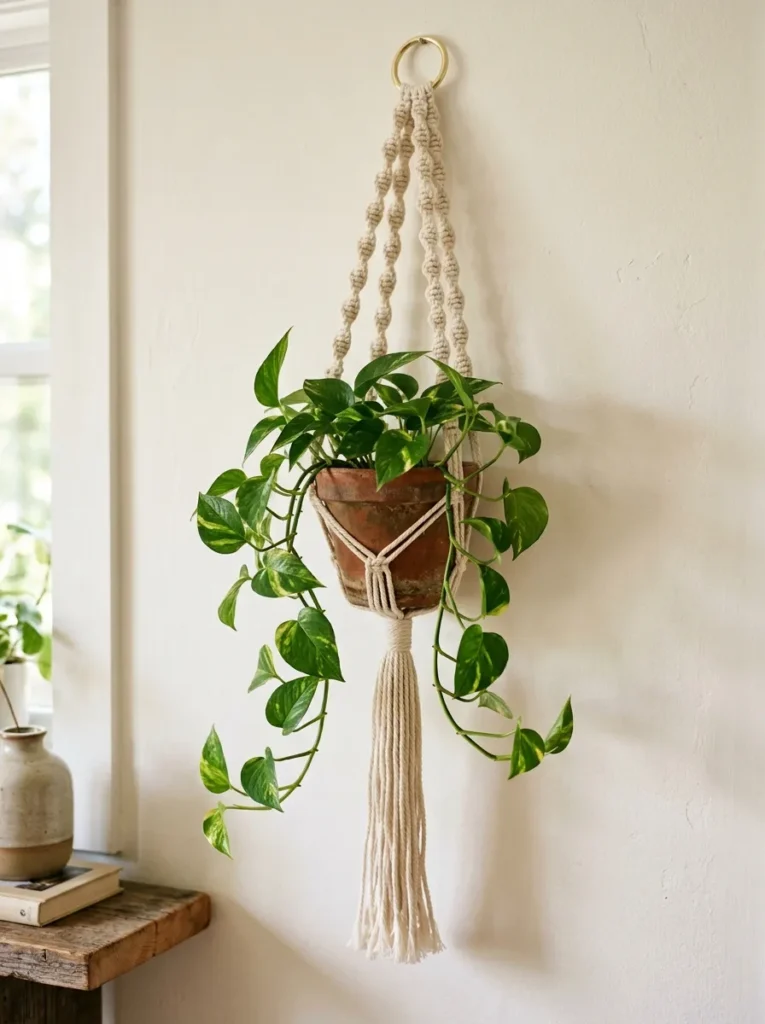
Vibe: The macramé hanger feels handmade and warm — the kind of home object that people ask about and photograph for their own inspiration.
Why it works: A handmade macramé plant hanger applies the gift design principle of home environment enhancement — it improves the recipient’s living space in a way that is visible every day rather than being consumed (food gifts) or stored (many keepsake gifts). For indoor plant enthusiasts, a handmade plant hanger is a considered and specific gift that demonstrates the maker’s knowledge of the recipient’s home aesthetic and interests simultaneously. The macramé technique is one of the most accessible fiber crafts — requiring only two knots (the square knot and the half-hitch) to produce a result that reads as genuinely skilled — making this a realistic gift project for a maker with limited craft experience who is willing to invest three to four hours of learning and making.
How to get it: Use 3mm single-strand natural cotton macramé cord. Cut eight lengths at 200cm each. Fold all eight in half and attach to a wooden dowel using lark’s head knots, producing 16 working strands. Divide into groups of four and work square knots at 20cm intervals to create the hanging section. Form the pot cradle by connecting adjacent strand groups with square knots at a consistent height. Add a gathering knot below the cradle to support the pot’s base. Finish with a spiral half-hitch pattern on the remaining strands above the fringe, then trim the fringe ends straight. Gift with the terracotta pot and a small trailing pothos or succulent already placed inside.
Shop The Look
| Product |
|---|
| Natural cotton macramé cord 3mm 100m |
| Small terracotta pot 10cm drainage |
| Trailing pothos small indoor plant |
| Wooden dowel 20cm thin natural |
| Macramé beginner guide simple patterns |
11. Homemade Flavored Honey Collection
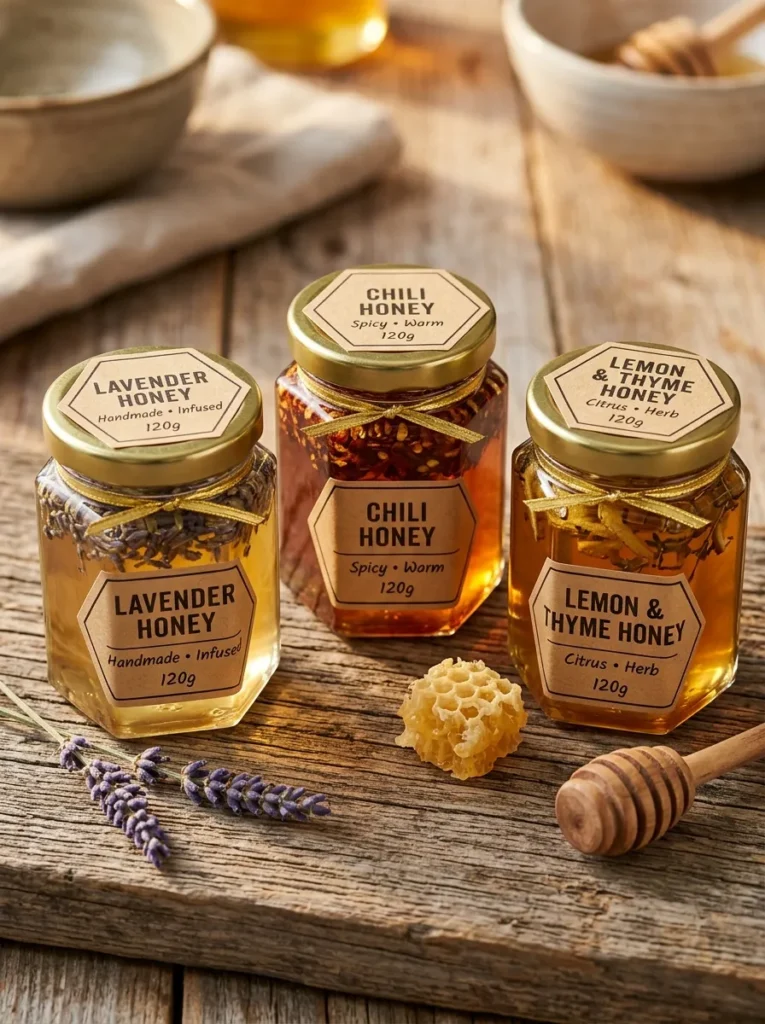
Vibe: The honey jars feel like liquid amber — a gift as beautiful on a shelf as it is useful in the kitchen.
Why it works: Flavored honey applies the food gift principle of enhanced everyday ritual — honey is already a domestic pleasure, and infused honey versions elevate that pleasure into something specific, surprising, and genuinely useful across multiple applications (lavender honey on yogurt and toast, chili honey on cheese and charcuterie, lemon thyme honey in tea and baking). The visual appeal of honey itself — its amber color, the way it catches light, the visibility of the infusion ingredients suspended within it — makes this one of the most photogenic handmade food gifts available, which matters because beautiful food gifts are shared on social media and generate genuine appreciation before they are even tasted.
How to get it: Use a good-quality raw or artisan honey as the base (supermarket processed honey lacks the flavor complexity that makes a flavored honey genuinely superior). For each flavor, gently warm the honey to 40°C (no higher — above 45°C destroys the beneficial enzymes that make raw honey special). Add the flavoring: (1) 1 tablespoon dried lavender buds per 200g honey; (2) 1 tablespoon dried chili flakes per 200g honey; (3) 1 tablespoon lemon zest plus 1 teaspoon dried thyme per 200g honey. Stir to combine and pour into sterilized 100ml hexagonal jars. Allow to infuse at room temperature for at least one week before gifting. The ingredients visible in the honey are both decorative and a signal of the flavor — do not strain them out.
Shop The Look
| Product |
|---|
| Good quality raw honey 500g |
| Hexagonal small jar 100ml set |
| Dried culinary lavender buds |
| Hexagonal kraft label set |
| Thin gold ribbon small spool |
12. Handmade Ceramic Pinch Pot Set
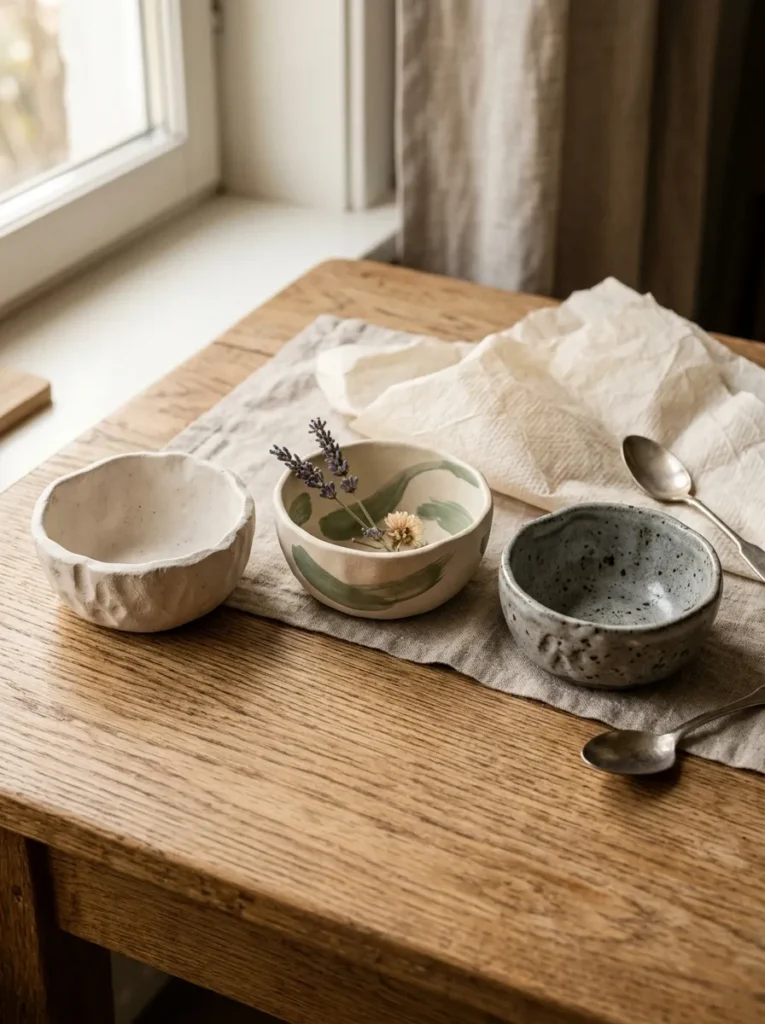
Vibe: The pinch pots feel individually made and genuinely irreplaceable — the visible handwork in each one communicating hours of patient attention.
Why it works: Handmade ceramic pinch pots apply the gift principle of material evidence of making — the visible pinch marks on the exterior of each bowl are the literal record of the maker’s hands shaping the clay, meaning the recipient holds a physical impression of the maker’s touch every time they use or handle the bowl. This material intimacy is unique to handmade ceramic work and explains why handmade pottery has a gift cultural prestige far beyond its functional properties — it is not merely a small bowl but an artifact of making. A set of three provides sufficient visual variety (different sizes, different finishes) to suggest curation without requiring advanced ceramic skill — pinch pots are genuinely accessible to a complete beginner using air-dry clay.
How to get it: Air-dry clay requires no kiln or wheel and is available from craft stores in both white and terra cotta versions. Roll a ball of clay, press the thumb into the center to one-third depth, and slowly pinch the walls outward and upward while rotating the ball — this is the complete pinch pot technique. Allow 24–48 hours to dry fully before painting or finishing. Paint with acrylic paint or specific air-dry clay underglazes; seal with a matte or gloss Mod Podge sealer. Note: air-dry clay bowls are not food-safe for wet foods or liquids — label the gift with a suggested use (trinkets, jewelry, key storage, dried botanicals) and do not imply food-safe use.
Shop The Look
| Product |
|---|
| White air-dry clay 2lb block |
| Acrylic paint set ceramic muted tones |
| Matte sealer Mod Podge craft |
| Small natural bristle brush set |
| Kraft gift box small ceramic |
13. Personalized Hand-Lettered Recipe Card Set
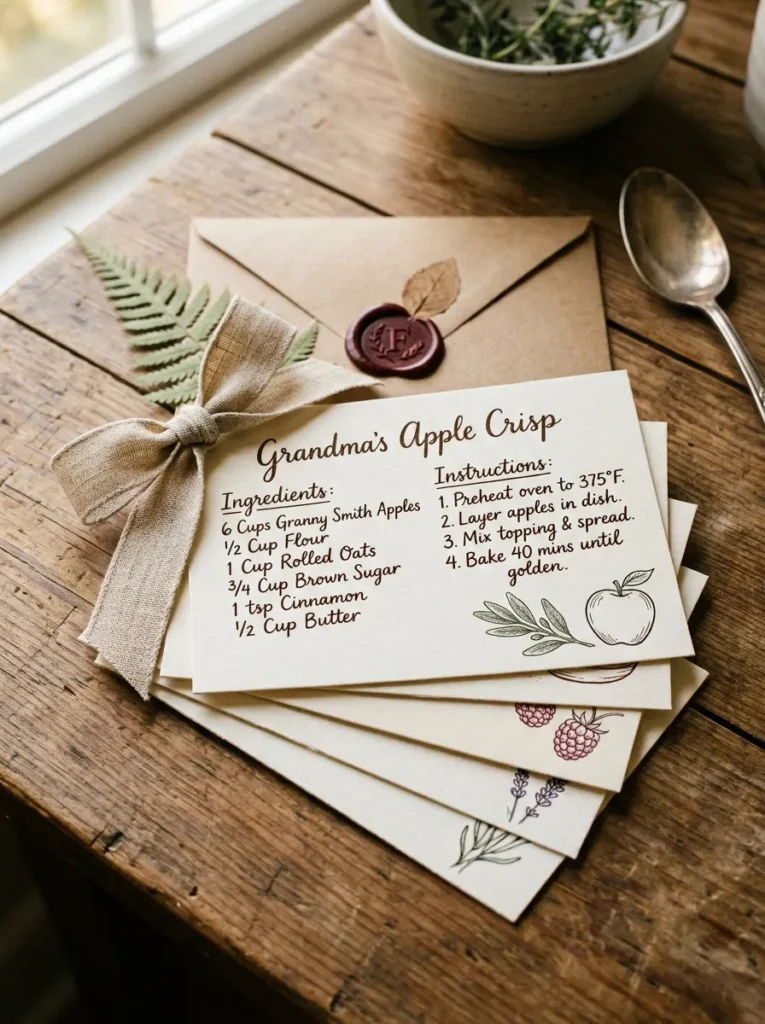
Vibe: The recipe cards feel like a family archive in six cards — a gift that preserves something that might otherwise exist only in someone’s head.
Why it works: A hand-lettered recipe card set applies the gift principle of irreplaceable knowledge transfer — if the recipes on the cards are genuinely meaningful (a grandmother’s specific recipe, a family Christmas dish, the recipient’s favorite restaurant dish reverse-engineered by the maker), the gift transfers knowledge that cannot be purchased, searched for, or found anywhere else. The hand lettering makes the cards visually beautiful enough to display rather than merely file, which means the gift has a continued presence in the recipient’s kitchen as a displayed object rather than being stored away after receipt. Personalizing the recipe selection to the recipient’s specific food loves (writing out their favorite childhood recipe, their most-made dinner, the dish they associate with a specific memory) elevates this from a generic craft project to a deeply personal gift.
How to get it: Research or gather the specific recipes that are meaningful to the recipient (this may involve asking their family members, reverse-engineering a dish they love, or transcribing a recipe from a relative’s handwritten card). Practice the layout and lettering style on plain paper before working on the final cards. Use 5×7 inch thick cream card stock (300gsm minimum for longevity and the quality feel appropriate to a displayed card). Write in a consistent hand-lettering style using a fine-point archival ink pen. Add a small botanical or food-relevant ink illustration in one corner of each card. Bind with a thin linen ribbon through a punched hole, place in a kraft envelope, and seal with a wax seal.
Shop The Look
| Product |
|---|
| Thick cream card stock 300gsm set |
| Archival ink pen fine point black |
| Hand lettering guide beginner book |
| Linen ribbon thin natural |
| Kraft envelope set A6 |
14. Beeswax Rolled Candle Bundle in Natural Colors
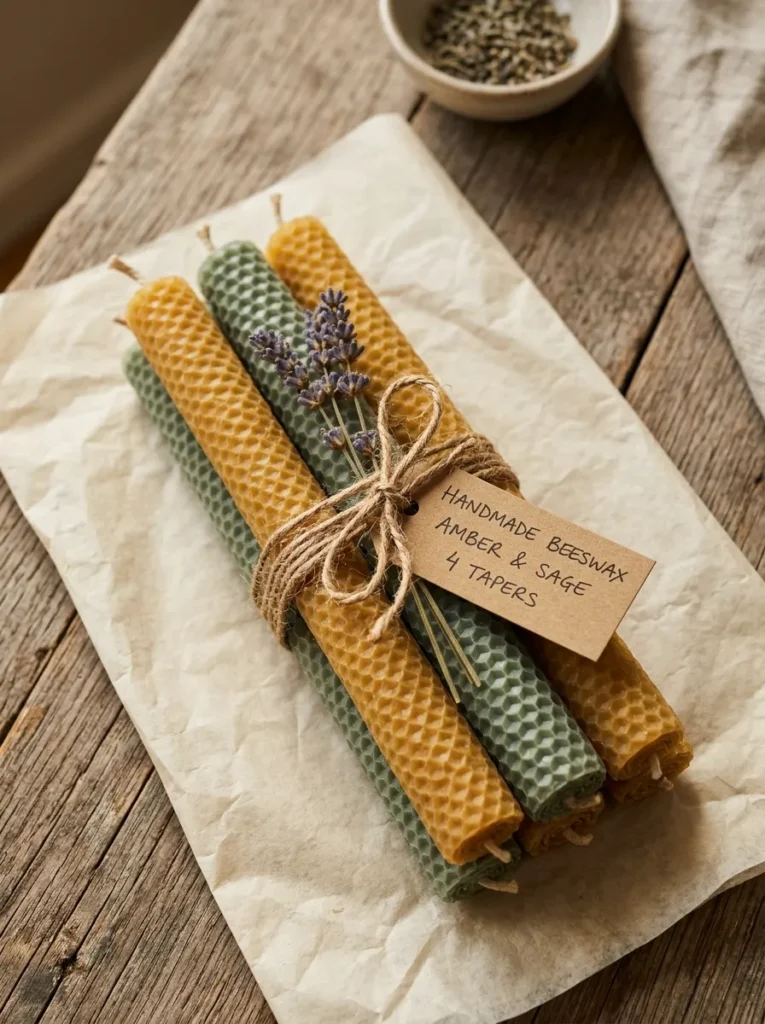
Vibe: The beeswax candles feel warm and ancient — the honeycomb texture and natural amber color referencing something genuinely organic rather than manufactured.
Why it works: Beeswax rolled taper candles apply the craft gift principle of technique accessibility with material quality — the rolling technique (no heat, no melting, simply warming the beeswax sheet in your hands and rolling it around a wick) is genuinely achievable by a complete beginner in under ten minutes per candle, yet the finished result reads as a quality artisan product because the material itself (genuine beeswax with its honeycomb texture, natural honey scent, and amber color) carries inherent quality signals. The bundle format (four candles together) provides practical gift volume — four candles are a genuinely useful quantity for a dinner table setting — while the natural and sage color pairing creates a composed aesthetic that reads as intentionally designed rather than simply natural.
How to get it: Purchase natural beeswax honeycomb sheets in natural amber (and optionally in a dyed color such as sage green or dusty rose). Lay a pre-tabbed cotton wick along the sheet’s short edge with a small overhang at the base. Gently warm the beeswax with a hair dryer on low heat for 10–15 seconds if the room is cool — cold beeswax cracks when rolled. Roll the sheet tightly from the wick edge, pressing firmly at each turn, until the full sheet is rolled. Trim the wick to 1cm above the candle top. Make four candles and bundle with jute twine, tucking a small dried botanical sprig under the twine for decoration.
Shop The Look
| Product |
|---|
| Natural beeswax honeycomb sheet set |
| Pre-tabbed cotton wick set |
| Dusty sage beeswax sheet colored |
| Natural jute twine small roll |
| Dried lavender sprig small bundle |
15. Handmade Memory Book — Curated Photographs and Notes
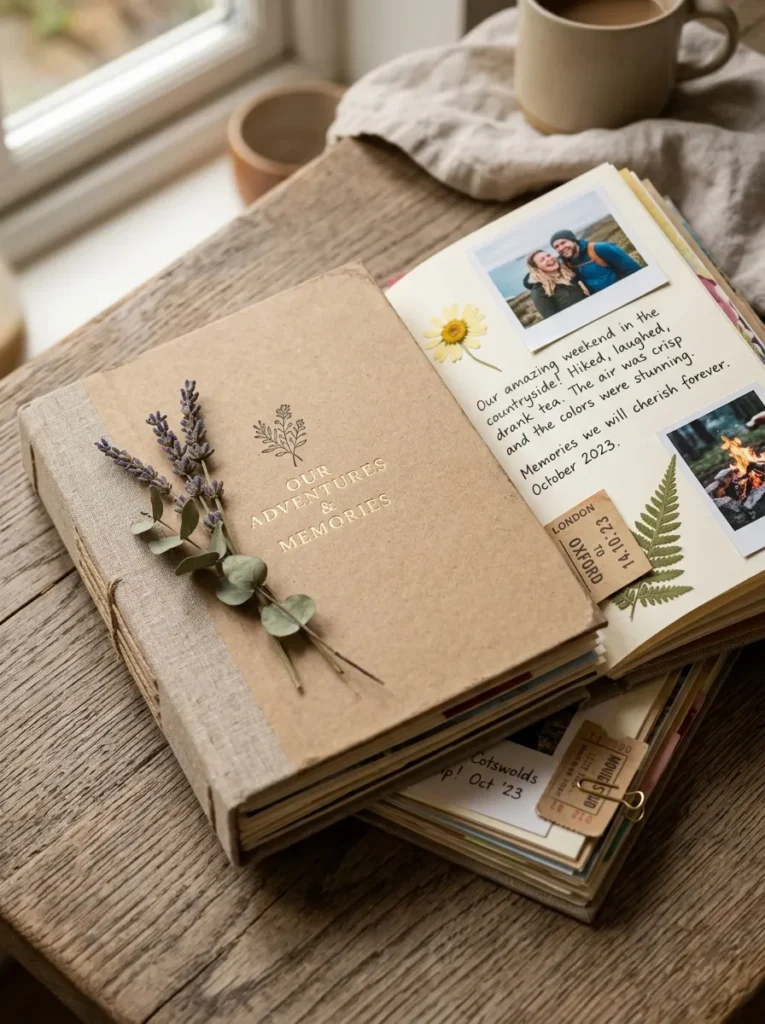
Vibe: The memory book feels irreplaceable in a way no object can be — a curated record of shared experiences that exists in no other form anywhere.
Why it works: A handmade memory book applies the ultimate gift principle of irreplaceable curation — the act of selecting, printing, arranging, and annotating photographs and keepsakes from a shared experience or relationship requires the maker to decide what mattered, what should be preserved, and what the recipient would most want to see and remember. This curatorial act is itself the gift: the maker’s interpretation of the shared story, expressed in a physical object. Unlike a digital album (which most people have but rarely look at), a physical handmade book is encountered serendipitously, is a tactile pleasure to handle, and communicates the maker’s care through every page decision — what was included, what was written, what was pressed between the pages, and how it was all arranged together.
How to get it: Select a small blank album or bind your own using a bookbinding kit (Japanese stab binding requires only a needle, thread, and a hole punch). Print photographs at 4×6 inches on quality photo paper from a local print service or home printer. Arrange the photographs chronologically or thematically rather than attempting to include everything — the curation is the gift, and fewer well-chosen images read better than many indiscriminate ones. Add handwritten notes beside or beneath the photographs (one or two sentences per image is sufficient — present-tense descriptions of the moment are more resonant than captions). Include small flat keepsakes (ticket stubs, pressed flowers from meaningful locations, a small map section). Leave the last three pages blank with a note from the maker explaining what the book documents and why.
Shop The Look
| Product |
|---|
| Small blank photo album A5 |
| Quality photo print paper 4×6 |
| Archival pen black fine writing |
| Pressed flower set botanical |
| Small kraft cover bookbinding kit |
How to Start Your Handmade Gift Practice
The single best first move in developing a handmade gift practice is deciding, before beginning any project, what the maker knows about the recipient that a shop cannot know — their specific flavor preferences, their particular home aesthetic, a meaningful shared memory, a family recipe that should be preserved, their pet’s name and appearance. This specificity research (which takes ten minutes of deliberate thought) is what separates a handmade gift that genuinely wows from one that simply demonstrates craft skill. A beautifully made macramé hanger in a color the recipient dislikes is less thoughtful than a simply made one in exactly the right color for their home — the thoughtfulness is in the knowing, and the making is the vehicle for that knowledge.
The most common mistake in handmade gifting is underestimating the time required and rushing the finishing stage — a jar of infused olive oil with an unlabeled lid reads as an afterthought regardless of the oil’s quality; the same jar with a carefully written label reads as a considered gift. Every project in this list has a finishing stage (labeling, packaging, wrapping, tying, or presenting) that takes longer than the making itself — this finishing stage is not optional decoration but an essential part of the gift’s communication. Allowing equal time for finishing as for making produces a result that genuinely wows rather than genuinely impresses despite the presentation.
Three specific items under $50 that equip a complete handmade gift maker for most of the projects in this list: a set of 20 kraft card tags with holes and a roll of thin natural twine ($5–8 combined, used for labeling food gifts, tying bundles, and attaching tags to any project); a bottle of Mod Podge matte sealer ($7–10, the essential finishing material for pressed flower, paper, and ceramic projects); and a pack of small sterilized glass jars in 50–100ml sizes ($12–18 for a set of 10, covering all the food gift projects that require a container). These three items enable the labeling, sealing, and packaging of virtually every food and craft gift in this list.
A simple handmade food gift (infused olive oil, compound butter, flavored salt) takes 30–60 minutes of active making plus infusion or cooling time, with materials costing $15–35 for a three-unit set. A craft gift with a learning curve (macramé plant hanger, embroidered towel, ceramic pinch pots) takes 3–8 hours of making time for a first-time attempt, with materials costing $20–45. A complex or long-preparation gift (vanilla extract, pet portrait, memory book) requires planning 8–12 weeks in advance of the gifting date for optimal result. None of the gifts in this list requires specialist equipment or tools beyond what can be purchased at a craft store, kitchen supply shop, or online craft supplier.
Frequently Asked Questions About Thoughtful Handmade Gifts
What makes a handmade gift better than a purchased gift?
A handmade gift demonstrates two things that purchased gifts cannot replicate: the investment of irreplaceable time (the maker chose to spend hours making this rather than anything else they could have done) and the specificity of personal knowledge (the choice of flavor, color, subject, or memory demonstrates that the maker knows the recipient specifically rather than generically). Research in gift-giving psychology documents that these two qualities — time investment and personal specificity — are the primary drivers of gift appreciation beyond monetary value, and both are inherently present in genuinely thoughtful handmade gifts in ways that even expensive purchased gifts rarely achieve.
Which handmade gifts in this list require no craft skills?
The food gifts — infused olive oil (Idea 1), compound butters (Idea 6), flavored salts (Idea 8), flavored honey (Idea 11), and vanilla extract (Idea 4) — require only kitchen skills that most home cooks already possess, with no specialist craft technique required. The beeswax candle rolling (Idea 14) is the simplest craft project in the list, requiring only the ability to roll a warmed sheet of beeswax around a wick — achievable in under 15 minutes with no prior experience. The pressed flower bookmarks (Idea 3) require only cutting, flower pressing, and Mod Podge application — all achievable with instructions and no prior craft experience.
How do you make a handmade gift look professional and gift-ready?
A handmade gift reads as professional when the packaging and presentation match the quality of the making. The specific elements that professionalize any handmade gift are: a consistent label or tag system (handwritten on quality card stock with the same pen throughout, not on sticky labels in varied handwriting styles), appropriate container selection (the container communicates the gift’s quality as much as the contents — a beautiful amber bottle for vanilla extract, a quality ceramic vessel for a candle), a binding or finishing material that is consistent throughout (natural jute twine, a single ribbon color, wax sealing on the label or envelope), and a brief handwritten note that describes what the gift is, how to use it, and what it was made with. These four elements together create the presentation quality that makes the recipient feel the gift was considered at every stage of its creation.
How far in advance should handmade gifts be started?
The timeline varies significantly by project: food infusion gifts (vanilla extract, infused olive oil, flavored honey) require 2–12 weeks of infusion time and should be started at minimum 8 weeks before the gifting date. Custom-commission elements (a wax seal stamp with a monogram, a large-format print, a custom pet portrait) typically require 1–2 weeks of maker turnaround time and should be commissioned 3 weeks before the date. Craft projects without infusion or commission components (candles, plant hangers, pinch pots, embroidered towels) can be made in the week before the gifting date for most skill levels, though allowing more time enables proper drying, curing, or correction of any first-attempt issues. The memory book requires the most advance planning — gathering, printing, and arranging photographs plus writing the notes typically takes 2–3 full sessions across 2–3 weeks.
What are the best handmade gifts for someone who seems to have everything?
For recipients who are well-provided with material goods, the most impactful handmade gifts are those that provide something genuinely unavailable through purchase: the pet portrait (Idea 5) is uniquely specific to their pet and cannot be bought anywhere; the memory book (Idea 15) is a unique record of a shared relationship that exists nowhere else; the hand-lettered recipe cards (Idea 13) preserve knowledge (particularly family recipes) that may exist only in aging relatives’ memories; and the personalized letter writing kit with a custom monogram stamp (Idea 9) is designed and engraved specifically for them. These four gifts share the common quality of irreplaceability — no amount of money can purchase an equivalent, which is precisely why they are most appropriate for recipients who can purchase anything they want.
Ready to Start Making Your Thoughtful Handmade Gifts?
These 15 ideas move through every dimension of what makes a handmade gift genuinely thoughtful — from the kitchen-accessible pleasure of infused oils and flavored salts to the patient investment of vanilla extract and pet portraits, to the intimate communication of embroidered towels and recipe cards, to the irreplaceable material record of a handmade memory book. Starting with the question — what do I know about this person that no shop could know? — is not a small beginning. It is the only beginning that produces a genuinely thoughtful result, because the specificity of that knowledge is what the making then carries forward into the recipient’s hands. Choose one project from this list, gather the materials this week, and begin with the specific knowledge of the specific person who will receive it. When they open it and say “how did you know?” — that is the moment the handmade gift has done what it was always capable of doing. Pin the ideas that match the recipients in your life right now, and return to the more time-intensive projects when the gifting calendar gives you the lead time to do them properly.