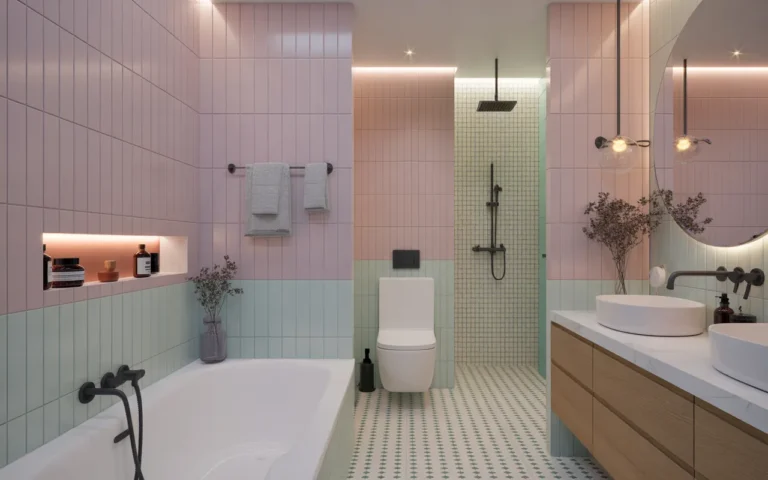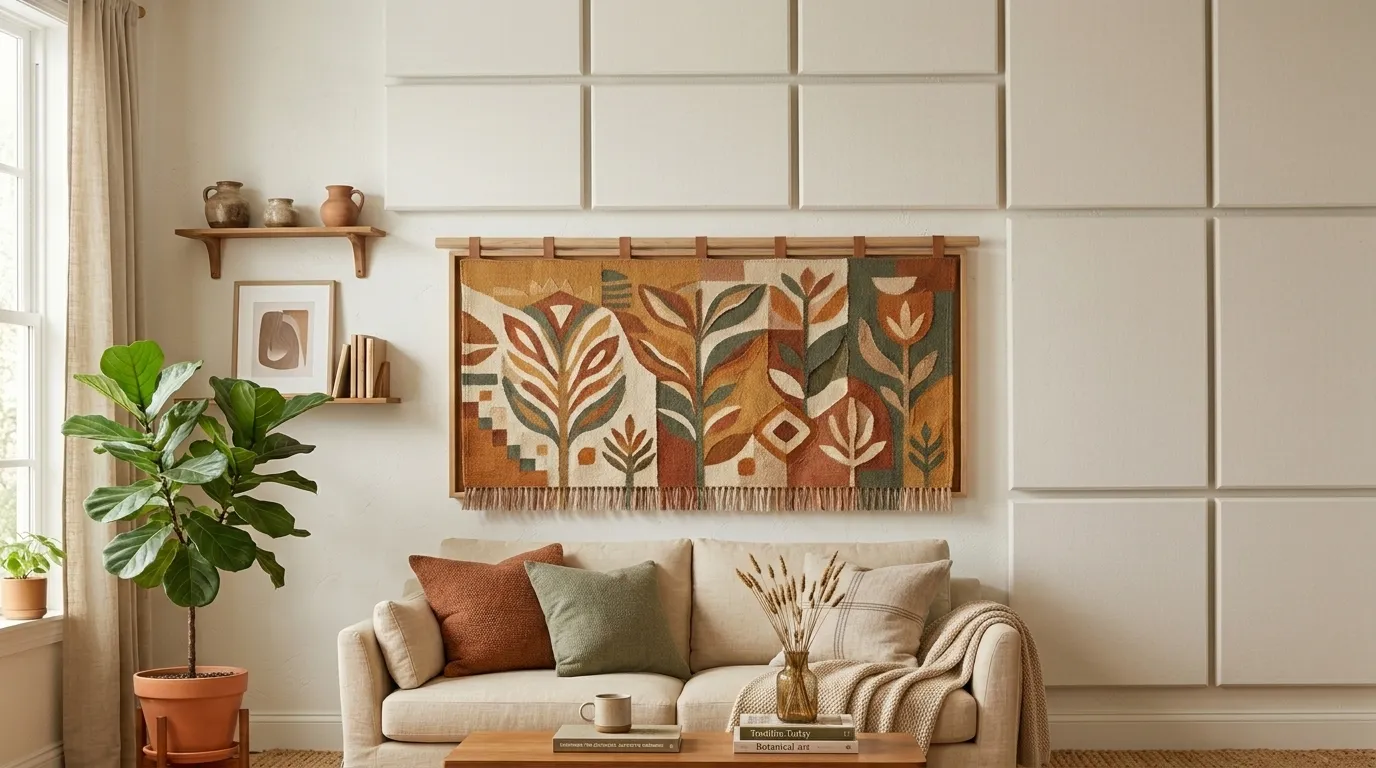
15 Aesthetic Wall Ideas That Transform Any Room
An aesthetic wall is a deliberately designed vertical surface — treated with paint, texture, material, art, or layered composition — that transforms a room’s character through intentional visual and tactile presence rather than functioning as a neutral background. This article gives you 15 aesthetic wall ideas across paint treatments, material applications, gallery arrangements, architectural detail, textile hanging, and small-space solutions so every wall in your home contributes actively to the room’s design rather than simply containing it.
A wall is the largest uninterrupted surface in any room and the one most consistently underused. Most rooms treat their walls as boundaries — the edges where the room stops — rather than as design participants. The rooms that feel genuinely considered, that photograph well and feel different to be inside, are almost always rooms where at least one wall has been treated with the same intentionality given to the best furniture and lighting. The difference between a room that feels finished and one that feels incomplete is frequently a single wall decision. Here are 15 ideas worth saving — and stealing.
Why Aesthetic Walls Transform Rooms So Effectively
The aesthetic wall’s transformative power draws from the basic perceptual fact that walls occupy more of the visual field than any other surface in a room — more than floors, more than furniture, more than ceilings. Environmental psychology research consistently demonstrates that vertical surfaces are the primary environmental stimuli that the brain processes first when entering any space, making the wall’s visual character the dominant first impression of a room regardless of how carefully the furniture and objects within it are chosen. A beautiful wall creates the context in which everything else in the room is read — a mediocre object in front of a beautiful wall reads as considered; the same object in front of a blank white wall reads as forgotten.
The material palette of aesthetic wall treatments is extraordinarily wide. Limewash and Roman clay create organic, layered texture with a depth that flat paint cannot approach. Venetian plaster produces a cool, marble-like surface quality that reflects light differently at every viewing angle. Natural clay plaster absorbs and releases humidity while providing the warm, matte texture of earth materials. Grasscloth and woven wall coverings bring textile warmth to the wall plane. Shiplap, board-and-batten, and tongue-and-groove paneling introduce architectural rhythm and depth. Removable peel-and-stick wallpaper patterns provide commitment-free pattern at any scale. Gallery walls of art and photography create a personal archive of visual intelligence. Tapestries and large-scale textiles soften acoustic harshness while adding color and hand-work. Each material creates a fundamentally different room experience — not just visually but acoustically, tactilely, and in terms of how the room’s light behaves.
The cultural appetite for aesthetic wall treatments has never been more pronounced. The departure from the all-white interior — the dominant residential aesthetic of the 2010s — toward rooms with color, texture, and material specificity has driven extraordinary growth in limewash, grasscloth, and architectural paneling applications. Pinterest searches for “aesthetic wall ideas,” “limewash wall,” and “gallery wall” have grown consistently as homeowners seek the specific quality that a designed wall provides: a room that feels genuinely inhabited rather than merely furnished.
Small rooms respond particularly powerfully to aesthetic wall treatments because any single wall occupies a proportionally larger share of the total visual field. A dark paint treatment on one wall of a small bedroom makes the room feel intimate and cocooning rather than small. A full-height gallery wall in a narrow hallway makes the corridor feel like a curated passage rather than a transitional space. A material wall treatment in a small bathroom creates spa-like quality that no amount of accessory styling can match.
Style at a Glance
| Element | Detail |
|---|---|
| Philosophy | The wall as active design participant — texture, color, material, and composition chosen with the intention of furniture |
| Key Materials | Limewash, Roman clay, grasscloth, shiplap, Venetian plaster, ceramic tile, natural clay plaster, tapestry |
| Key Colors | Warm white, dusty sage, deep forest green, warm charcoal, terracotta blush, indigo, burgundy |
1. Limewash Paint for Organic Layered Texture
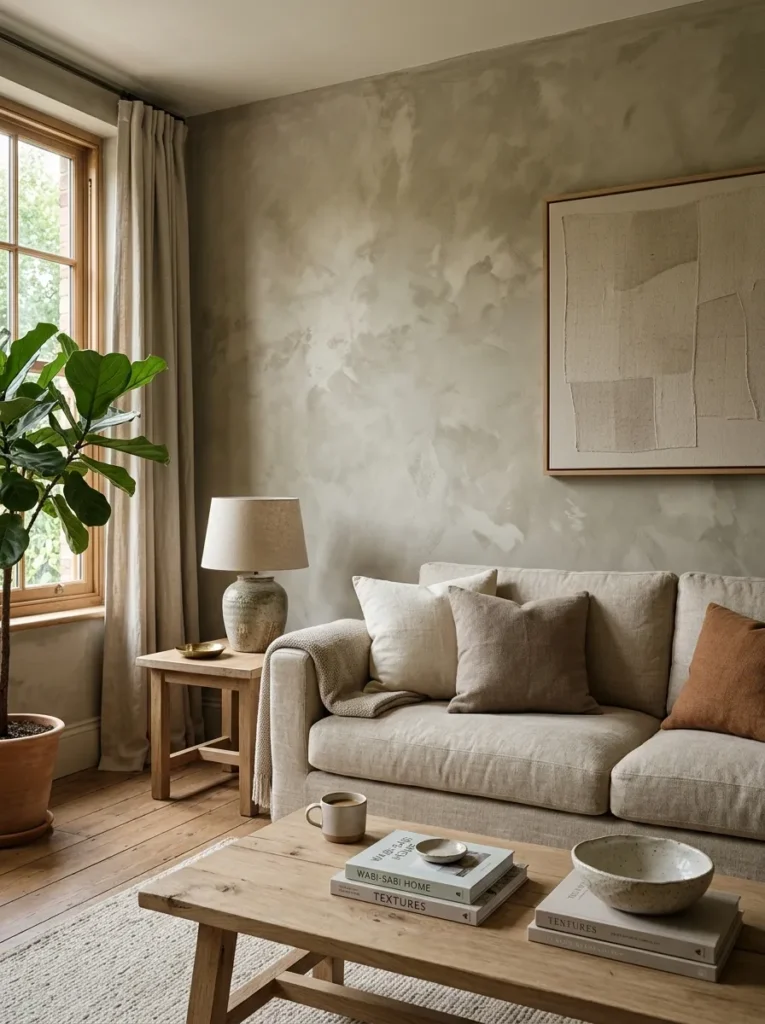
Vibe: The wall is alive — limewash paint with its organic tonal variation and layered depth creates a surface that looks fundamentally different in morning light than in evening light, and different again on overcast days, giving the room a visual dynamism that flat paint walls permanently lack.
Why it works: Limewash paint creates its characteristic organic texture through a process of applying multiple thin translucent layers of lime-based paint in varied directions, then partially distressing the surface before it fully dries — the result is a wall finish where the depth of color varies continuously across the surface, mimicking the aged plaster of old European buildings. This tonal variation is not random — it creates the visual equivalent of the color variation found in natural stone, aged wood, and weathered plaster, all of which the human eye reads as warm, natural, and evidence of time. The finish interacts with raking light (light arriving at a low angle from one side) in a way that flat paint cannot — the slightly raised areas of the textured surface catch light while the slightly recessed areas hold shadow, creating micro-contrast across the wall that makes the surface appear three-dimensional.
How to get it: Portola Paints Classico Limewash and Romabio Classico Limewash are the two most widely available professional-quality limewash products in the US market, both available at $65–$85 per gallon covering approximately 250–300 square feet. Application requires a wide natural bristle brush (not a roller) and a second-pass technique where the first coat is partially worked back while still wet with a dry brush in cross-hatching strokes. Coverage rate depends on desired texture intensity — light application creates subtle variation, heavy application creates dramatic movement.
Quick Win: Limewash can be applied over existing flat painted drywall without priming if the existing paint is in good condition — a single feature wall (behind the sofa or bed) can be limewashed in 3–4 hours including drying time between coats, at a total material cost of $40–$70 per wall for a standard bedroom or living room feature wall.
Shop The Look
- Limewash paint Portola or Romabio warm tone
- Natural bristle wide paint brush limewash
- Linen sofa natural oat modern
- White oak coffee table minimal
- Roman clay plaster sample comparison set
Also view: 21 Wellness Centered Homes That Feel Peaceful
2. Full-Height Dark Paint for Intimate Drama
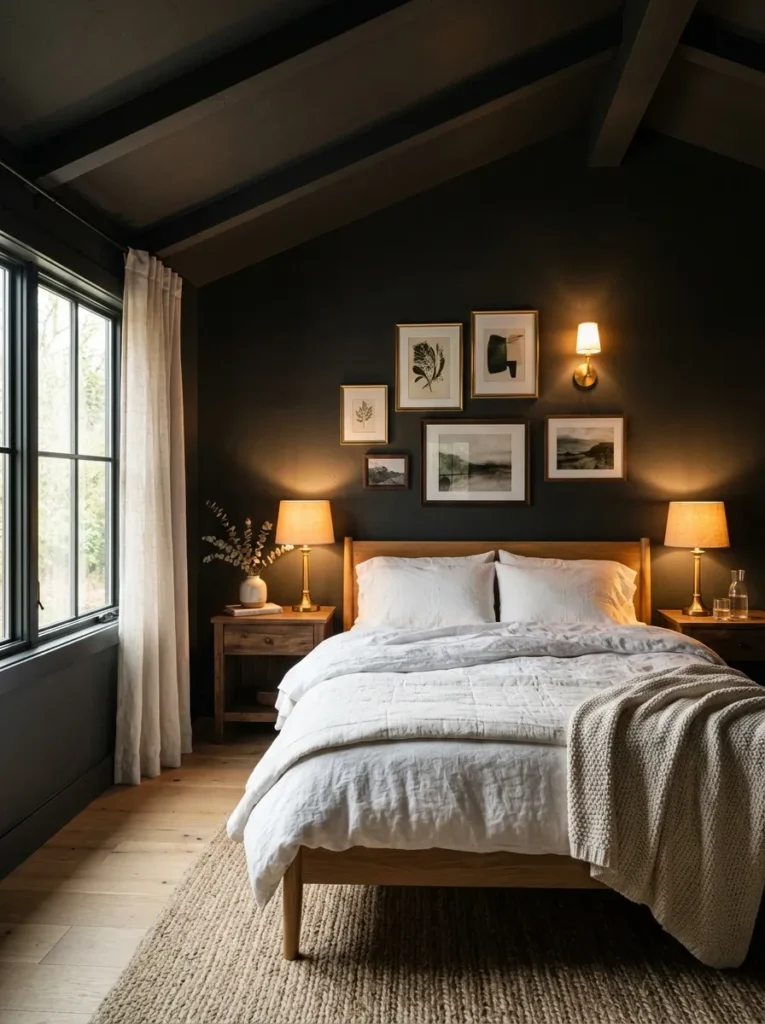
Vibe: The room is intimate — painting all four walls and the ceiling in a single deep tone creates the jewel-box bedroom quality where the enclosed dark surround makes everything inside the room appear more luminous, more warm, and more deliberate than the same objects in a white room.
Why it works: The jewel-box or all-dark-room technique works through simultaneous contrast — when the surrounding walls and ceiling are very dark, objects of any moderate value (white bedding, warm brass, honey wood) appear dramatically brighter and more saturated by comparison. This perceptual amplification means that the same white linen duvet that reads as simply white in a white room reads as glowing and luxurious in a dark room, and warm brass lamp light that reads as pleasant in a white room reads as cinematic in a dark one. Extending the dark paint to the ceiling is the critical decision that most people hesitate to make but that produces the most dramatically successful result — stopping the dark at the ceiling line creates a visual lid that reads as contained, while extending it to the ceiling creates the enveloping quality that makes a room feel genuinely designed.
How to get it: Choose a paint with warm undertones specifically — Farrow & Ball Railings No. 31, Benjamin Moore Black Forest Green, or Sherwin-Williams Peppercorn SW 7674 are warm-undertone deep tones that avoid the cold, corporate quality of blue-toned charcoals. Apply in a flat or matte finish — any sheen on dark paint amplifies light reflections in a way that reads as visually busy. Two coats on walls, two coats on ceiling, using a quality roller with a 3/8-inch nap for smooth drywall application.
Shop The Look
- Deep warm charcoal interior paint sample
- Forest green dark wall paint Farrow Ball
- Warm brass bedside table lamp pair
- White linen duvet cover set organic
- Natural wood low profile bed frame
3. Shiplap Accent Wall for Architectural Texture
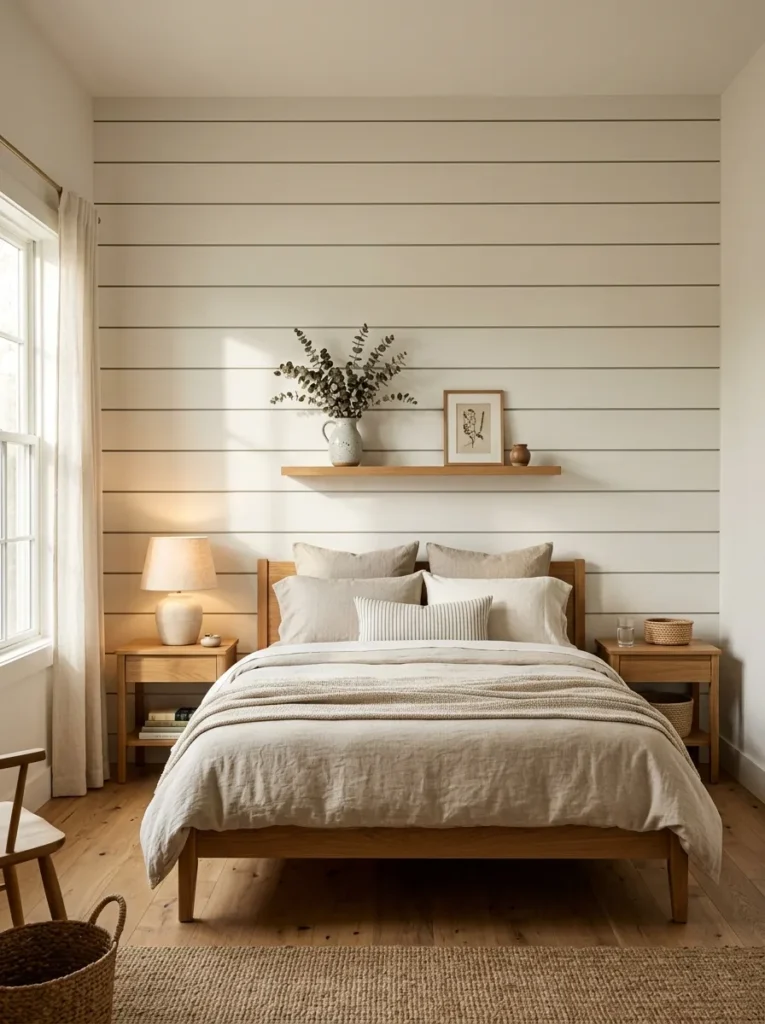
Vibe: The wall is architectural — shiplap’s horizontal boards introduce a rhythm and material specificity to a plain wall that reads as intentional craftsmanship, giving the room the quality of a designed interior rather than a furnished space.
Why it works: Shiplap creates wall interest through a simple but effective mechanism — the shadow reveal between each board (typically 1/8 to 1/4 inch) creates a continuous horizontal line that runs the full wall width, and the repetition of these lines at regular intervals (board width plus reveal, typically 5–6 inches total) creates the rhythm that the eye reads as architectural pattern. This pattern is specifically horizontal, which emphasizes room width and creates a relaxed, recumbent visual energy appropriate for bedrooms and living rooms. Painted in white or warm white, shiplap adds texture without color complexity; painted in a deep tone, shiplap creates dramatic material depth. The slight three-dimensionality of the individual boards (typically 3/4 inch thick) creates actual shadow rather than painted shadow, making the pattern genuine rather than applied.
How to get it: Real shiplap boards (pine or MDF tongue-and-groove in 4-inch or 6-inch widths) are installed with a consistent reveal gap maintained with pennies or popsicle sticks as spacers during installation. Peel-and-stick shiplap panels ($35–$80 per panel, covering approximately 8 square feet each) provide a non-destructive alternative for renters or those who want a commitment-free installation. For a full 12×9 foot bedroom feature wall using real shiplap, budget $120–$200 in lumber and $30–$50 in paint.
Shop The Look
- Peel stick shiplap wall panels white set
- Pine shiplap board 1×6 real wood install
- Warm white interior paint sample trim
- Floating wood shelf simple wall mount
- Ceramic object single minimal display
4. Gallery Wall of Personal Art and Photography
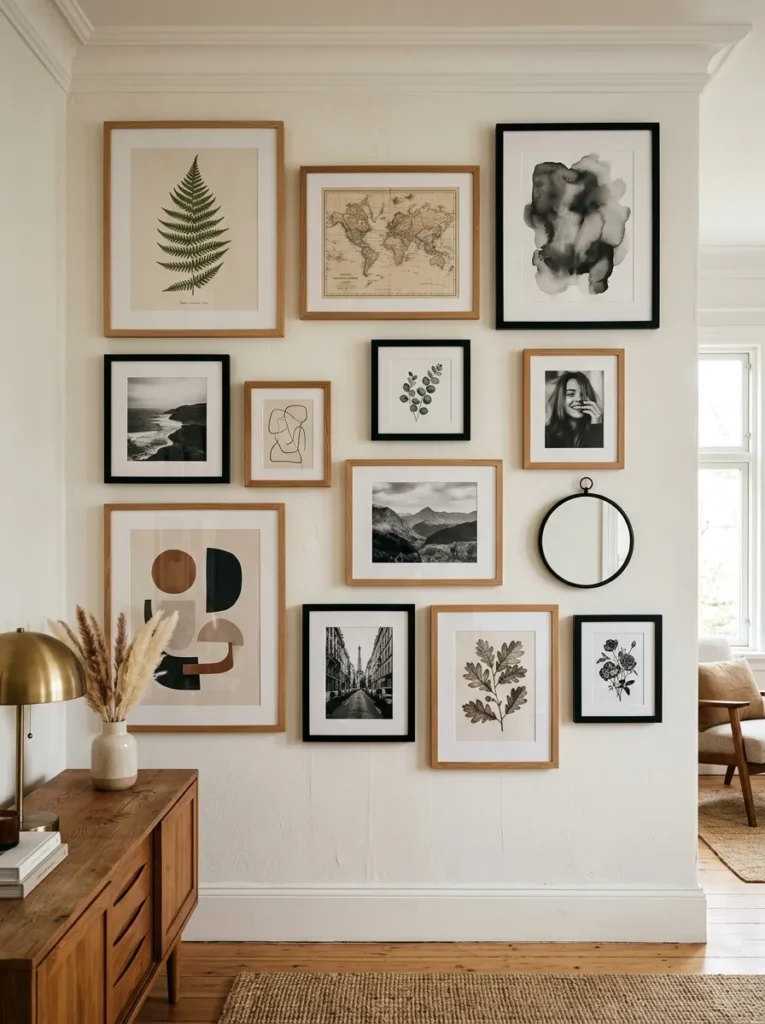
Vibe: The wall is personal — a well-composed gallery wall is the room element that most directly communicates who lives there, where a specific collection of art, photography, and objects has been assembled over time into a visual record of a particular life and particular aesthetic sensibilities.
Why it works: A gallery wall creates visual richness through density and variety — the combination of varied frame sizes, varied art types (photography, illustration, abstract, botanical), and the irregular but considered arrangement creates a composition that rewards sustained looking in a way that a single large artwork cannot. The design principle is controlled variety: variety in frame size (critical — at least three distinct sizes), variety in art type and content, but consistency in frame material family (all natural wood, or all matte black, or a curated mix of both — never more than two frame tones). The arrangement must have a visual center of gravity — typically the largest piece, or the piece with the most visual weight — around which the remaining pieces are organized. Consistent gaps between frames (2–3 inches throughout) create order within the varied arrangement.
How to get it: Plan the gallery arrangement on the floor first, photographing the final layout before hanging. Use a paper template system (trace each frame on kraft paper, cut out, and tape to the wall) to finalize positions before making holes. The single most common gallery wall failure is frames hung too high — the visual center of the arrangement should be at eye level (57–60 inches from the floor), not at the top of the arrangement.
Shop The Look
- Natural wood gallery frame set varied sizes
- Matte black picture frame set 8×10 5×7
- Botanical art print set neutral tones
- Black white photo print personal
- Gallery wall template paper planning kit
5. Roman Clay or Venetian Plaster for Mineral Luxury
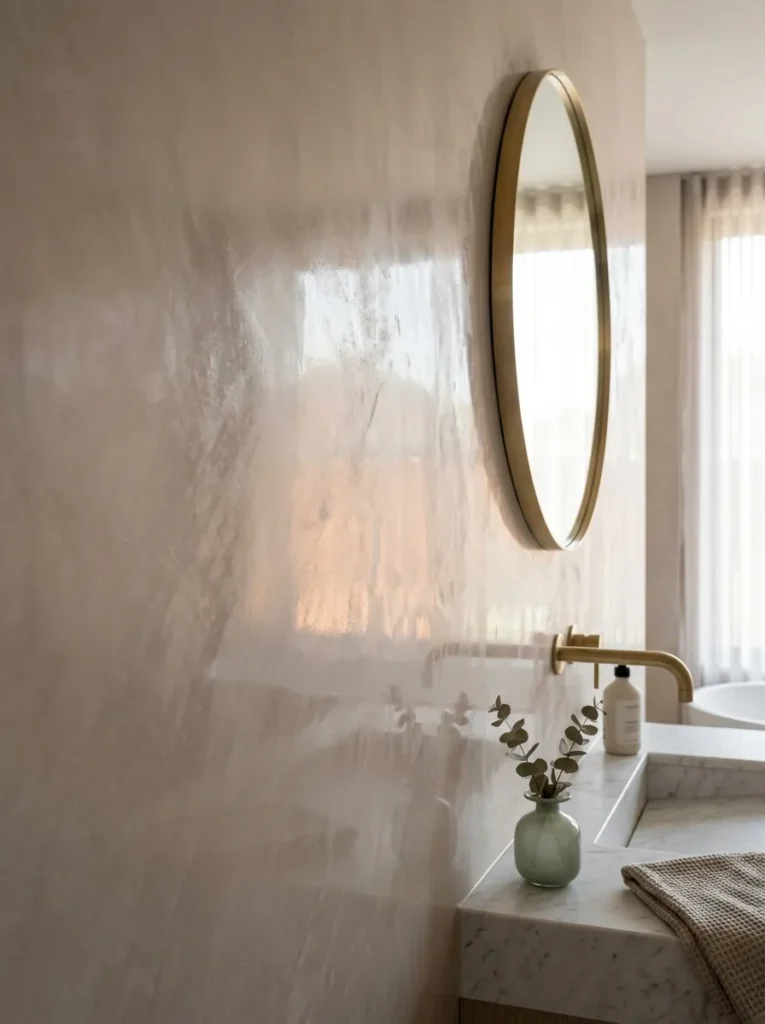
Vibe: The wall is luxurious — Roman clay or Venetian plaster creates a surface with the mineral depth and burnished sheen of polished stone at wall scale, producing the quality of a material that appears to come from the earth rather than from a paint can.
Why it works: Roman clay and Venetian plaster achieve their characteristic depth through a multi-layer application and burnishing process — each thin layer of plaster is applied and then burnished (compacted and polished) with a steel trowel while still slightly wet, which compresses the material and creates a partially reflective surface at the micro-level. This micro-polish means the surface reflects light slightly differently at every angle and every layer depth, creating the visual depth associated with polished marble or alabaster. Unlike flat paint, which sits on the wall’s surface, plaster penetrates the substrate slightly and creates a surface that reads as the wall itself rather than a coating applied to it — an important distinction for the quality of permanence that these materials communicate.
How to get it: American Clay, Portola Paints, and Pure & Original all make Roman clay products designed for DIY application — these differ from traditional Venetian plaster in that they are acrylic-modified, making them more forgiving in application while achieving a similar aesthetic result. Application requires a Japanese or European steel trowel, two or three thin coats, and a burnishing pass on the final coat while it is still at the leather-hard stage. Professional application ($4–$10 per square foot for labor plus materials) is recommended for large areas or for the high-sheen Venetian plaster result.
Shop The Look
- Roman clay plaster Portola warm greige
- Steel trowel Japanese blade plastering
- Venetian plaster finish coat professional
- Warm blush interior plaster paint
- Burnishing trowel wide steel blade
6. Grasscloth or Natural Fiber Wallpaper for Textile Warmth
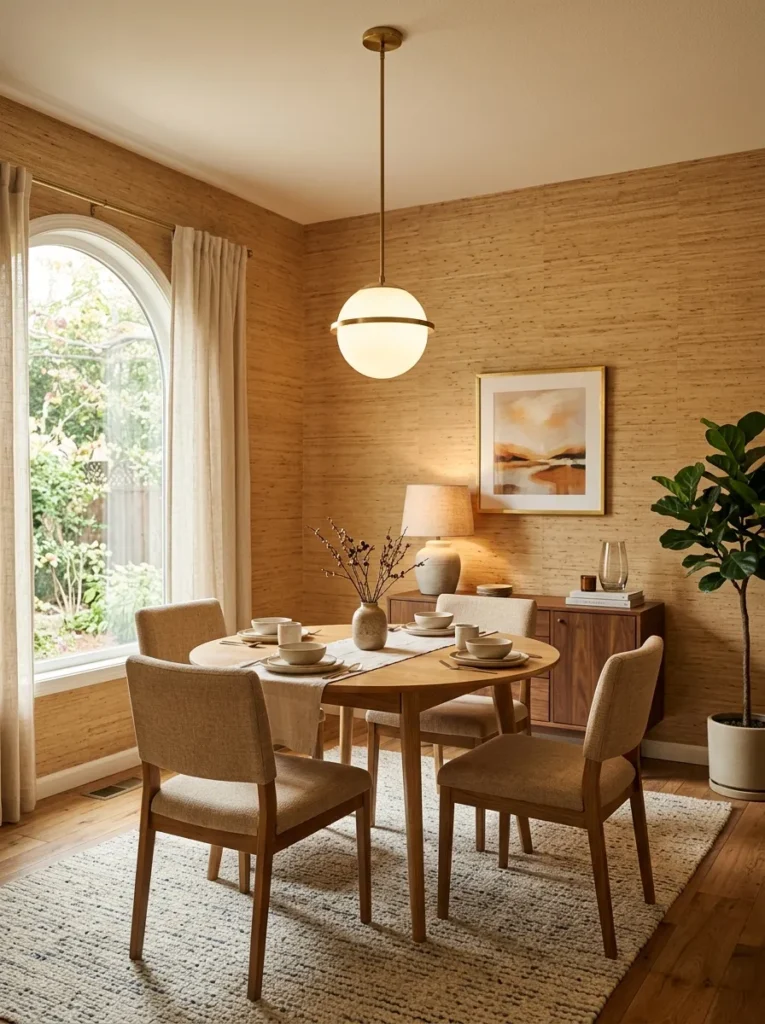
Vibe: The room is textile-rich — grasscloth on walls brings the warmth and tactile interest of woven fabric to the room’s largest surfaces, fundamentally changing the room’s acoustic quality as well as its visual character and creating an enveloping warmth that paint walls cannot approach.
Why it works: Grasscloth wallpaper brings three distinct qualities that paint cannot provide simultaneously: texture (the physical three-dimensionality of the woven fiber surface), acoustic absorption (natural fiber absorbs sound rather than reflecting it, measurably reducing room reverberation), and material warmth (the organic, handwoven quality of natural fiber reads as warm and collected in a way that manufactured materials do not). The slight irregularity of natural grasscloth — subtle tonal variation within a roll, slight unevenness in the fiber bundles — is a quality marker rather than a defect, confirming that the material is genuinely natural rather than a synthetic simulation. Grasscloth is particularly effective in dining rooms and bedrooms where the acoustic softening benefit is valuable and the textile warmth enhances the social and restorative character of those spaces.
How to get it: Natural grasscloth wallpaper runs $3–$12 per square foot installed, making it a meaningful investment compared to paint. Peel-and-stick grasscloth-texture wallpaper ($35–$60 per roll, covering approximately 28 square feet) provides a lower-cost alternative for renters or those who want commitment-free installation, though natural fiber versions have superior acoustic and tactile quality. Grasscloth requires paste-the-wall installation technique and seams must be carefully color-matched between rolls — professional installation is recommended for first-time applications.
Shop The Look
- Natural grasscloth wallpaper honey tan roll
- Grasscloth peel stick wallpaper natural
- Wallpaper paste professional formula
- Seam roller wallpaper installation tool
- Natural linen dining chair set modern
7. Oversized Statement Tapestry or Textile Wall Hanging
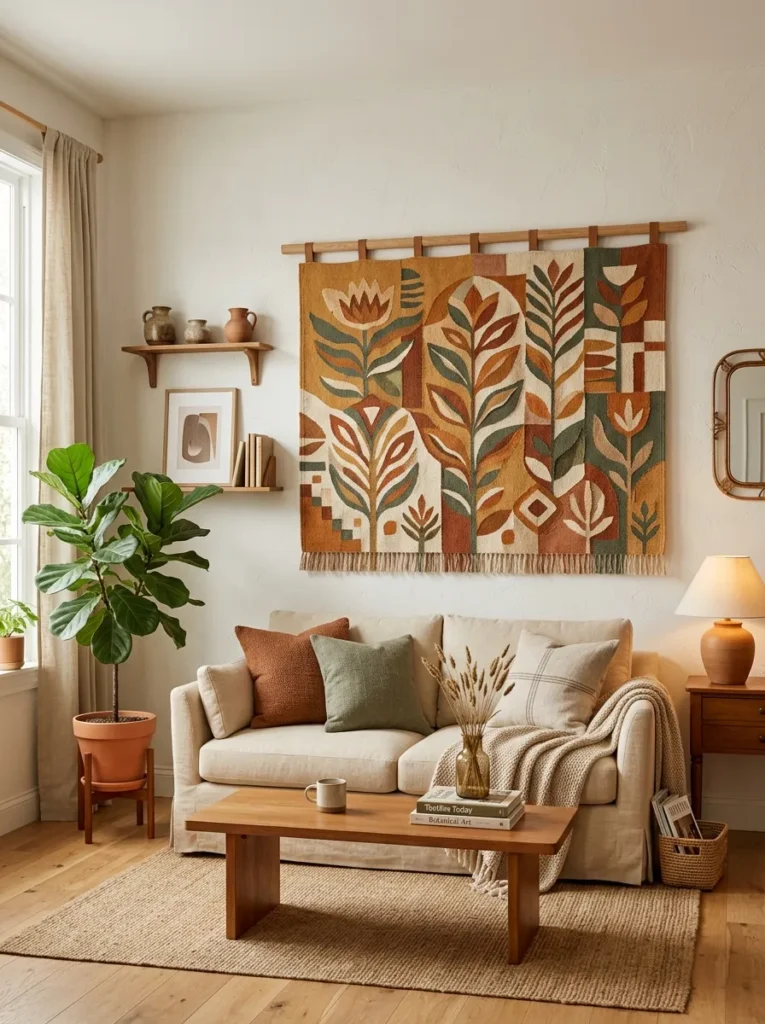
Vibe: The room is artistic — a large tapestry as a room’s primary wall element makes a design statement about the value of hand-work and textile art that no framed print can match, and its acoustic presence changes the room’s sound quality in a way that is physically perceptible.
Why it works: A large tapestry on a wall functions simultaneously as art, acoustic treatment, and material warmth — three qualities that a framed print provides only one of. Tapestries absorb sound rather than reflecting it, reducing the reverberation that makes hard-surfaced rooms feel cold and echo-prone. The textile surface provides tactile warmth that no other wall treatment matches at art scale — the physical texture of woven fibers is visible and implies the possibility of touch in a way that printed surfaces do not. Hanging with a visible wooden rod (rather than concealed behind a frame) makes the mounting mechanism part of the aesthetic, communicating that this is a textile object rather than a framed artwork — the distinction is important for the piece’s design register.
How to get it: Source large tapestries from independent textile artists (Etsy makers, art fairs, and gallery shows), import retailers specializing in Moroccan or Indian woven goods, or contemporary home decor retailers carrying printed tapestries. For wall mounting, a 3/4-inch diameter wooden dowel cut to tapestry width plus 2 inches, with natural rope or leather hanging loops on each end, is the most appropriate mounting method for textile pieces. Ensure the mounting hardware is anchored into wall studs for tapestries over 5 pounds.
Shop The Look
- Large woven tapestry wall hanging botanical
- Wooden dowel rod 3/4 inch natural mounting
- Natural rope hanging cord tapestry
- Linen sofa natural cream modern
- Large floor plant terracotta pot
8. Terracotta and Earthy Tone Paint for Warm Envelopment
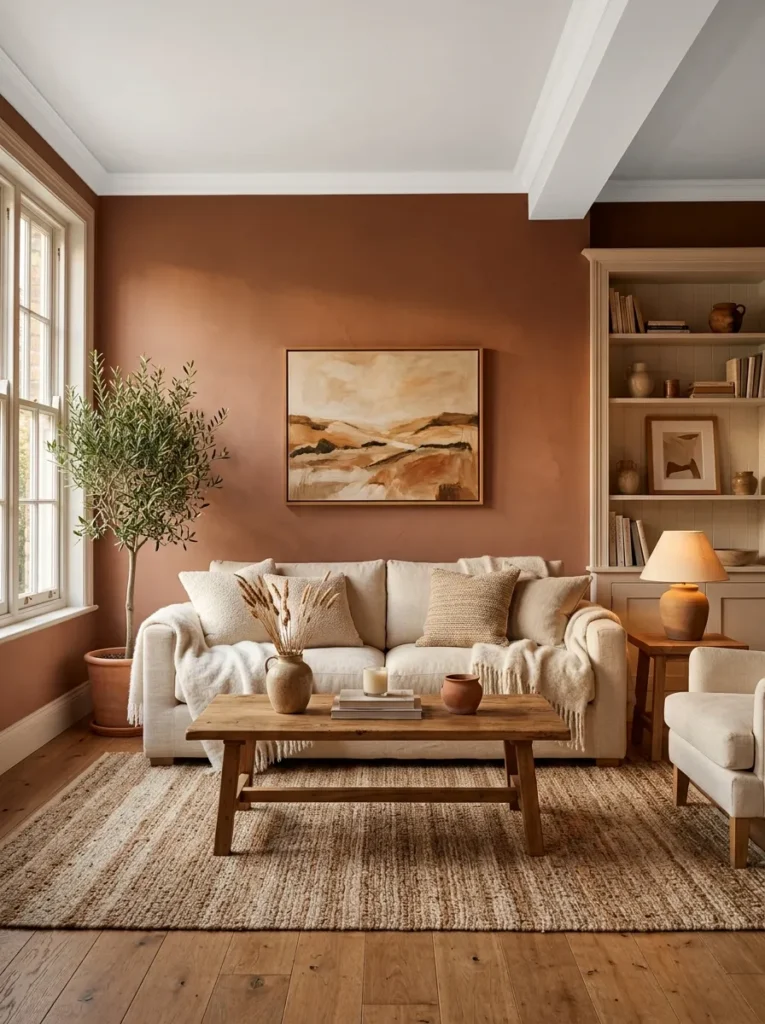
Vibe: The room is enveloping — terracotta walls surround the room’s occupants in the specific warmth of earth and clay, the color most associated in human evolutionary memory with shelter, warmth, and safety, producing a room quality of unusual comfort.
Why it works: Terracotta and clay tones (LRV range 20–40, warm red-yellow undertone) work through the simultaneous contrast effect — white and cream objects against a warm medium-toned wall appear warmer and more luminous than the same objects against cool white walls, because the warm wall tone amplifies the yellow component of warm whites and cream. This effect is most pronounced in rooms with warm afternoon light, where the light and wall tone share the same warm color temperature and amplify each other. The specific terracotta tone that works best for interiors is the dusty, sophisticated version — Sherwin-Williams Cavern Clay SW 7701, Benjamin Moore Earthen Jug 2164-20, or Farrow & Ball Red Earth No. 64 — rather than the bright, saturated orange that reads as primary color rather than earth tone.
How to get it: Test the terracotta tone in the room’s specific light across the full day before committing — terracotta shifts dramatically between morning cool light and afternoon warm light, and the tone that reads correctly at 3pm may read as too orange at 9am. Paint a 2×2 foot test patch and observe it across a full day’s light cycle. Apply in a flat or matte finish — sheen amplifies the color’s intensity in a way that can make terracotta walls feel overwhelming at full room scale.
Shop The Look
- Terracotta interior paint sample dusty clay
- Cavern Clay Sherwin Williams paint
- Cream linen sofa slipcover natural
- Warm honey wood coffee table
- White ceramic accessories minimal set
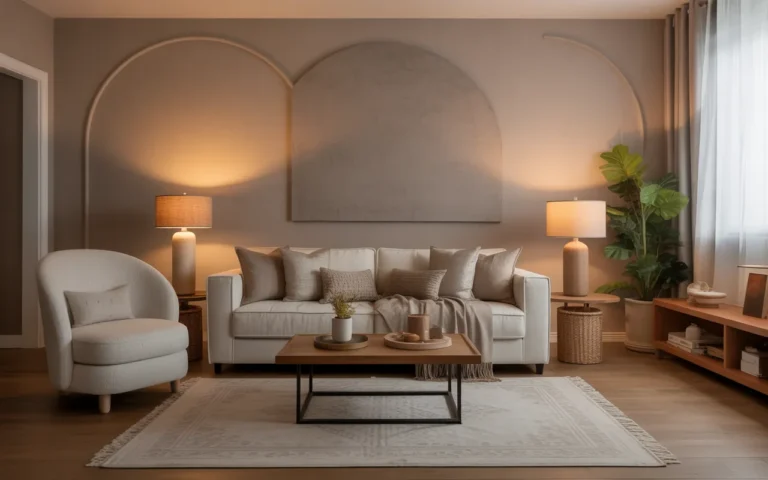
9. Arched Alcove with Painted Interior for Dramatic Depth
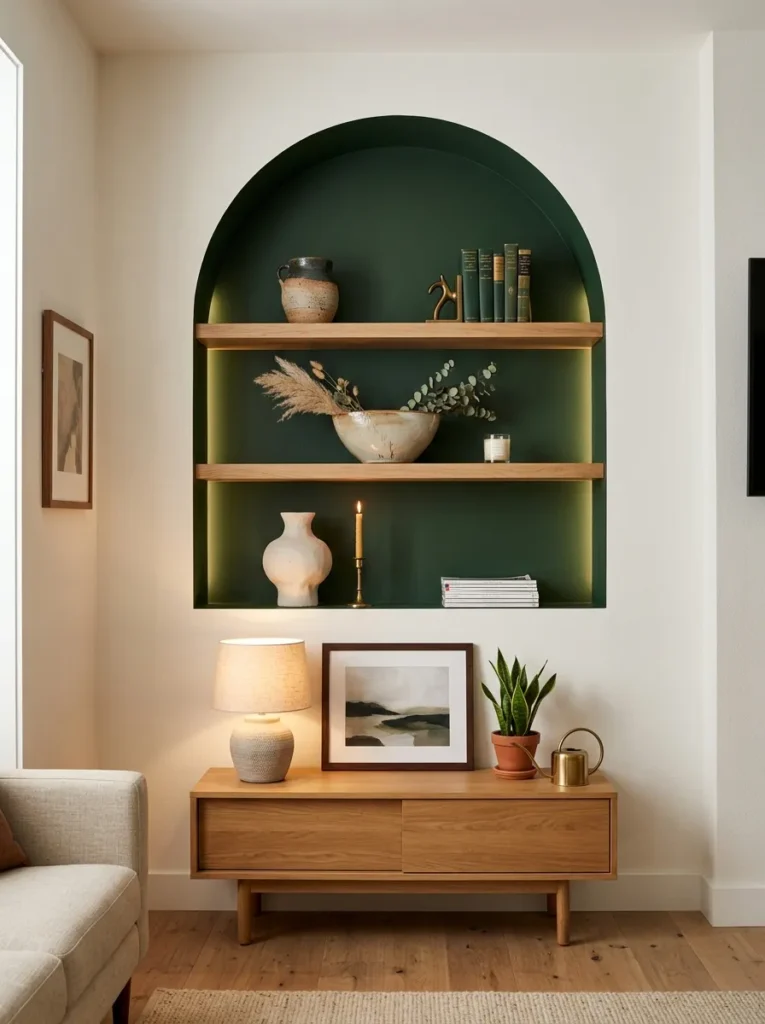
Vibe: The alcove is dramatic — a painted interior within an arched niche creates an architectural moment of depth and contrast that frames whatever is placed within it with the authority of a stage, making even a simple ceramic object appear as a considered installation.
Why it works: Painting the interior of an alcove, niche, or even a standard doorway surround in a contrasting deep tone creates a depth illusion — the darker interior appears to recede further into the wall than it physically does, creating the impression of genuine architectural depth. The arch form amplifies this effect because arches visually reference doorways, tunnels, and passages — forms the eye reads as leading somewhere. Any object placed within a deep-painted arch reads as deliberately displayed rather than casually positioned, because the contrast frame creates a presentation context. Even a shallow 4-inch-deep niche painted deep green with a single ceramic inside reads as a designed installation because the framing does the compositional work.
How to get it: For an existing alcove or niche, painting the interior in a contrasting deep tone requires only paint and a small brush for cutting in the arch curve — the work takes 1–2 hours and transforms the space immediately. For a room without an existing niche, an arched wall panel effect can be created using flexible MDF molding bent to an arch shape and attached to the wall, then painted in the deep interior tone within the arch boundary and warm white outside it — no actual depth required.
Quick Win: Painting the interior back wall and sides of a standard built-in bookshelf in a deep contrasting tone (dark forest green, warm charcoal, or deep navy) is the fastest version of this technique — it takes one hour, costs $10–$20 in paint, and dramatically changes how the shelf objects are read.
Shop The Look
- Flexible MDF molding arch shape craft
- Deep forest green interior paint small pot
- Floating shelf bracket minimalist wall
- Single ceramic object display arch
- Warm white wall paint trim compatible
10. Peel-and-Stick Geometric or Botanical Wallpaper
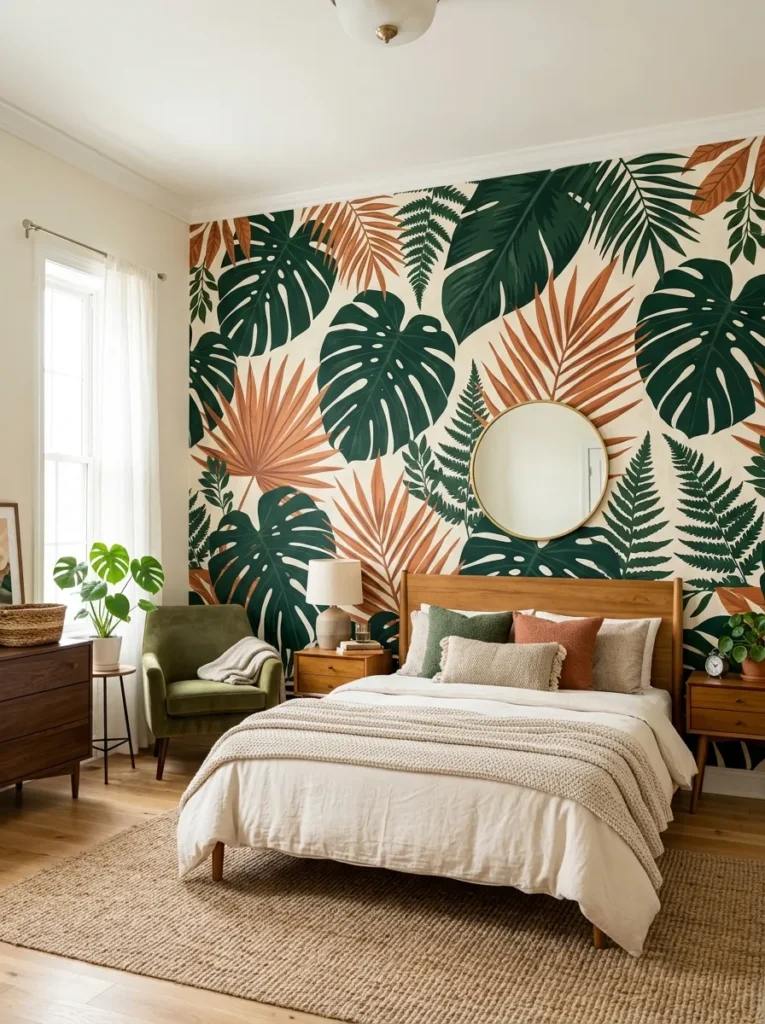
Vibe: The room is designed — a large-scale patterned wallpaper on one wall immediately communicates that a room has been given considered attention, and the scale of the pattern (oversized botanicals or large geometric repeats) reads as architectural confidence rather than decorative timidity.
Why it works: Large-scale patterns on walls work because they exploit the wall’s own scale — a pattern with a 24-inch repeat reads very differently on a wall than on a cushion or curtain because the wall’s dimensions allow the full pattern repeat to be seen in context, which is the condition for which the pattern was designed. Small-scale patterns on walls read as texture rather than pattern, which can create busyness without the clarity of a designed motif. Peel-and-stick wallpaper technology has made pattern walls accessible to renters and commitment-averse decorators — quality peel-and-stick products (Chasing Paper, Tempaper, Walls Need Love) remove cleanly from painted surfaces without damage, making the decision reversible.
How to get it: Calculate the wall area (width × height) and add 15% for pattern matching waste. Apply to a clean, smooth wall surface — peel-and-stick adheres best to flat or eggshell painted walls and struggles on textured or matte surfaces. Work from top to bottom, smoothing each strip with a wallpaper smoother tool before moving to the next to prevent air bubbles. Trim at ceiling and floor with a straight edge and craft knife.
Shop The Look
- Peel stick botanical wallpaper large scale
- Peel stick geometric wallpaper warm tones
- Wallpaper smoother tool installation
- Craft knife precision cutting set
- Metal ruler straight edge long
11. Full-Height Bookshelf Wall as Intellectual Aesthetic
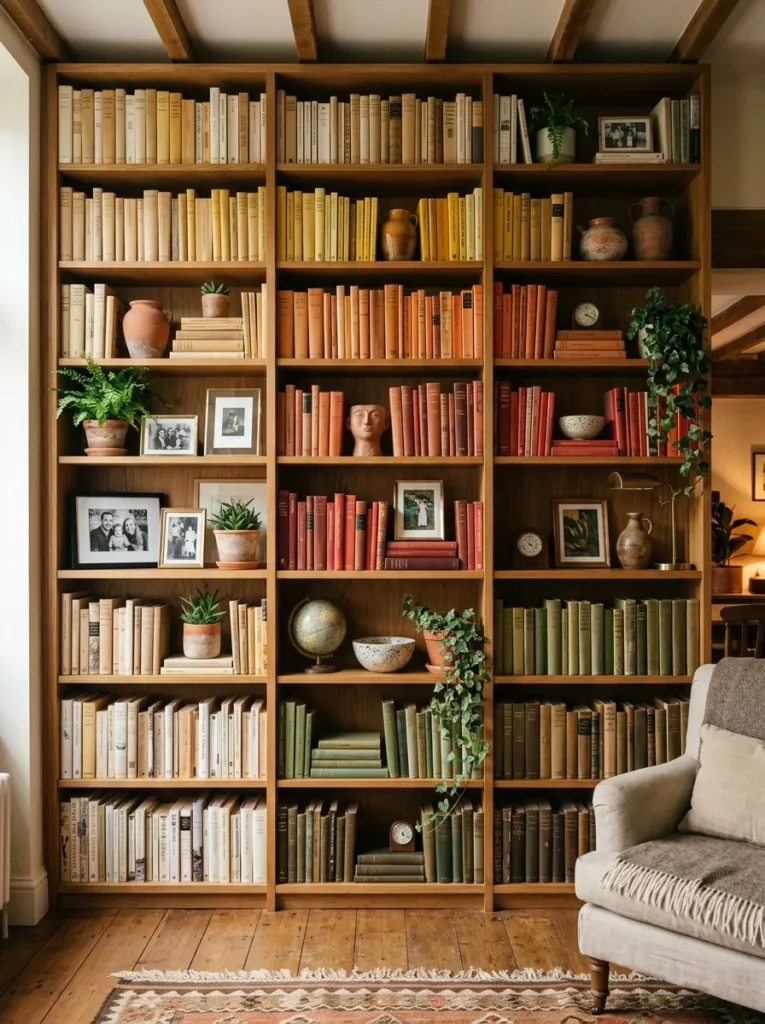
Vibe: The wall is intellectual — a floor-to-ceiling bookshelf wall communicates the presence of a reading, thinking person in the way that no decorative wall treatment can, and the combination of books, objects, and plants creates the specific quality of a room that is both beautiful and genuinely in use.
Why it works: A full-height bookshelf wall works as an aesthetic wall treatment because books are inherently visually rich — their varied spine heights, colors, and thicknesses create a dense, varied surface texture across the full wall. The design decision that elevates a bookshelf wall from storage to aesthetic wall is the organization principle: books arranged by spine color rather than by subject or author creates a gradient or color-family arrangement that reads as designed composition. Warm spine colors (ochre, rust, cream, brown, olive) create a palette consistent with warm interior design; cool spine colors (blue, grey, white) create a cooler, more graphic effect. Objects interspersed among books — ceramics, small plants, framed photographs — create visual rhythm and prevent the wall from reading as dense and heavy.
How to get it: Floating shelves in a floor-to-ceiling arrangement create the built-in look at lower cost than custom cabinetry ($15–$35 per shelf for IKEA LACK or similar, or $30–$80 per shelf for solid wood floating shelves). For the color organization: remove all books, sort by spine color into warm tone families, and rearrange. Position ceramics and plants at the end of shelves and at natural visual rest points within the arrangement. Ensure the highest shelves are accessible via a library ladder or step stool — a bookshelf wall that is partially inaccessible quickly becomes a display wall rather than a functional reading library.
Shop The Look
- Floating wall shelf set floor to ceiling
- Library ladder rolling wall mount track
- Ceramic bookend set minimal natural
- Small trailing plant bookshelf display
- Book organization by color styling kit
12. Painted Geometric Mural or Color Block for Graphic Impact
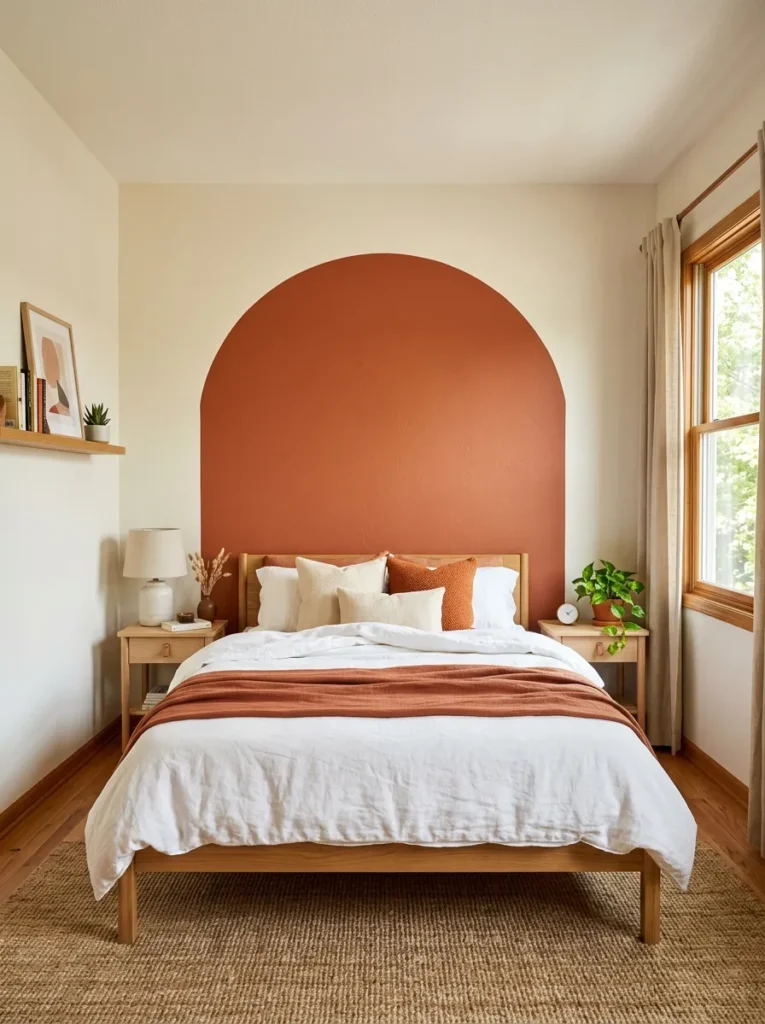
Vibe: The wall is graphic — a hand-painted geometric color treatment on a wall is the highest-confidence paint decision available, communicating that the room’s designer understands that a wall can carry a designed mark rather than requiring purchased art to provide visual interest.
Why it works: Painted geometric treatments on walls work because they create visual interest through composition rather than through pattern complexity — a simple arch shape, a horizontal color split, or a bold rectangle within a larger field requires only two colors and painter’s tape but produces a wall that reads as having been carefully designed. The arch form specifically (a large arch painted in a contrasting tone, with the flat side at the floor) references the architectural vocabulary of doorways and windows and creates the same depth illusion as the alcove treatment — the mind reads the arch as leading somewhere even when painted flat on a solid wall. Geometric treatments are infinitely revisable: painter’s tape and paint are the only materials required, and a new geometric interpretation can be applied over an old one in a single afternoon.
How to get it: Plan the geometric shape on paper first, including exact measurements. Apply painter’s tape precisely — the quality of the tape line is the quality of the finished treatment. For an arch, create the curve with a string-and-pencil compass using a tack at the arch’s center point as the pivot. Paint the interior of the geometric shape in the accent color, apply two coats, and remove tape while the second coat is still slightly wet for the cleanest edge line.
Shop The Look
- Painter’s tape sharp edge clean line
- Terracotta wall paint accent color small
- Sage wall paint accent color sample
- Wall paint arch template string compass
- Trim paint fine brush detail work
13. Ceramic Tile Feature Wall for Kitchen or Bathroom
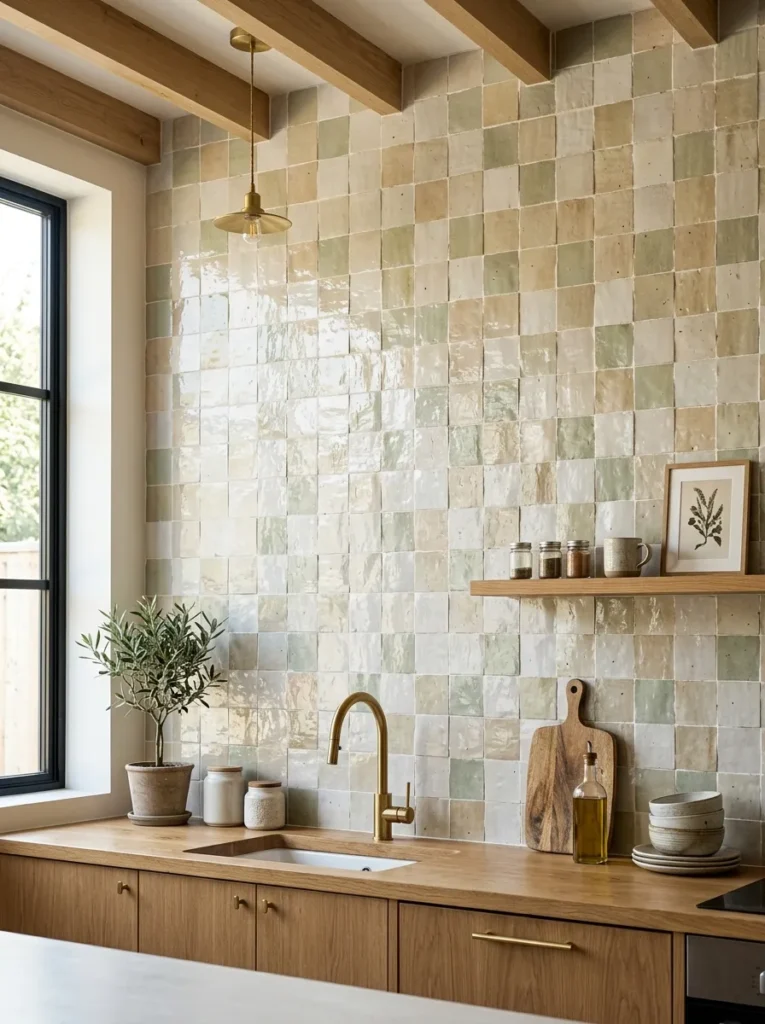
Vibe: The wall is material — a full ceramic tile wall in a kitchen or bathroom creates the specific quality of a surface made from earth-fired clay at architectural scale, and the material richness of genuine ceramic — particularly handmade zellige with its tonal variation — is the highest aesthetic wall achievement available in wet room contexts.
Why it works: Ceramic tile walls work as aesthetic statements when the tile choice has genuine material quality — handmade zellige tile (the North African glazed clay tile with characteristic surface variation and color depth) is the most visually rich ceramic wall option available, and its slight imperfection at each individual tile’s surface creates a composite wall surface with the depth and variation of natural stone. Full-wall tile coverage (floor to ceiling, or counter to ceiling) rather than partial coverage (backsplash only) is the decision that creates an aesthetic statement — partial tile coverage creates a functional surface, while full coverage creates an architectural environment. The grout width and color are as important as the tile choice — wide, warm-toned grout (cream or warm grey rather than bright white) integrates with handmade tile; narrow, bright-white grout creates a grid-dominant visual that competes with the tile’s individual character.
How to get it: Zellige tile is available from specialty tile retailers and Moroccan import suppliers at $15–$45 per square foot — a meaningful material investment for a kitchen backsplash or bathroom feature wall, but one that delivers a visual quality that no other wall treatment matches in wet room contexts. Large format minimal tile ($3–$8 per square foot) achieves a different but equally considered aesthetic at significantly lower cost. Professional installation is strongly recommended for both — proper substrate preparation and consistent tile layout are critical for long-term performance.
Shop The Look
- Zellige handmade ceramic tile warm cream
- Zellige tile soft green varied tone
- Large format concrete look wall tile grey
- Warm grey grout powder sanded
- Tile installation trowel notched
14. Wainscoting or Board-and-Batten for Classic
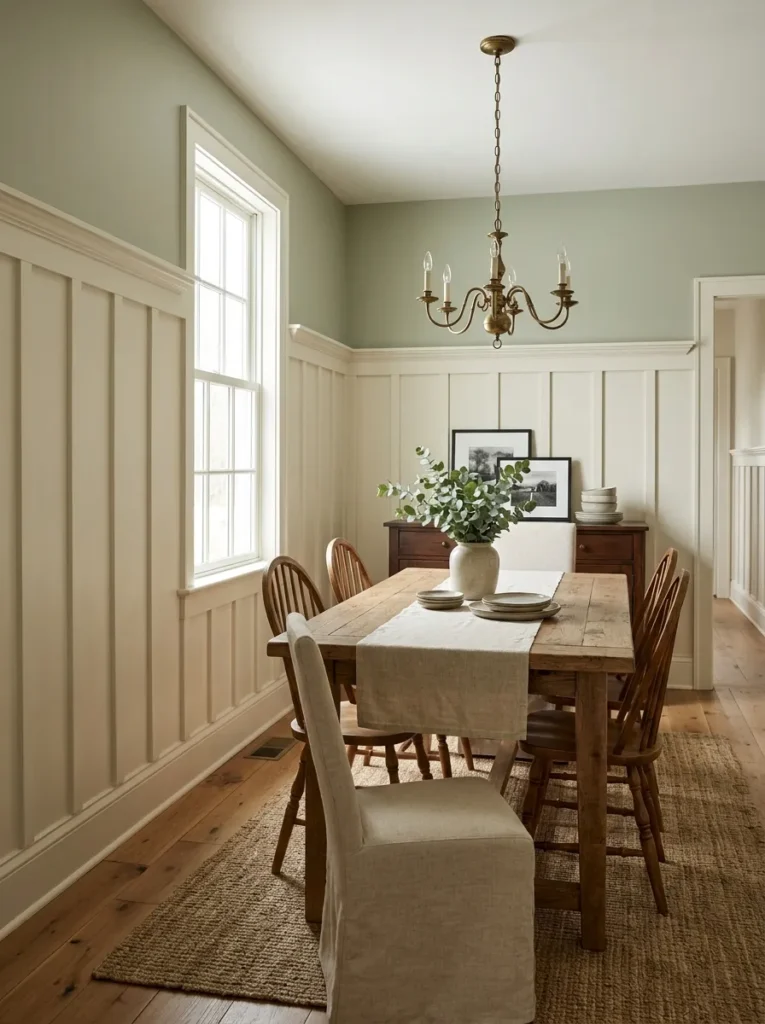
Vibe: The room is classic — board-and-batten wainscoting creates the architectural proportion and visual depth associated with traditional residential design of genuine quality, where the wall is not a blank surface but a composed architectural element with distinct lower and upper registers.
Why it works: Board-and-batten wainscoting creates wall interest through the same shadow-reveal principle as shiplap, but in the vertical orientation — the thin batten strips raised slightly above the flat board surface create a vertical shadow line on each side that introduces a geometric pattern running from floor to chair rail. This vertical rhythm has the opposite visual effect from shiplap’s horizontal rhythm: vertical lines emphasize room height and create a formal, upright quality appropriate for dining rooms, entryways, and bedrooms that benefit from architectural seriousness. The division of the wall into lower paneled section and upper plain section (at the chair rail line, typically 32–36 inches from the floor) creates a compositional proportion that relates to the human body — the lower section below chair back height, the upper section above — giving the room a scale relationship with its occupants.
How to get it: Board-and-batten can be created from 1×4 or 1×6 pine boards (the flat panels) and 1×2 pine strips (the battens) applied directly to existing drywall with construction adhesive and finish nails. Mark stud positions before installation for secure batten attachment. Batten spacing of 12–16 inches creates a balanced vertical rhythm. Finish the top edge with a flat cap rail (1×4 pine with a routed edge) that becomes the visual chair rail. Caulk all joints before painting for a clean, professional finish.
Shop The Look
- Pine board 1×4 wainscoting panel lumber
- Pine batten strip 1×2 vertical detail
- Cap rail molding chair rail profile
- Construction adhesive paneling wall
- Warm white semi-gloss paint trim work
15. Mirror Wall Treatment for Light and Spatial Expansion
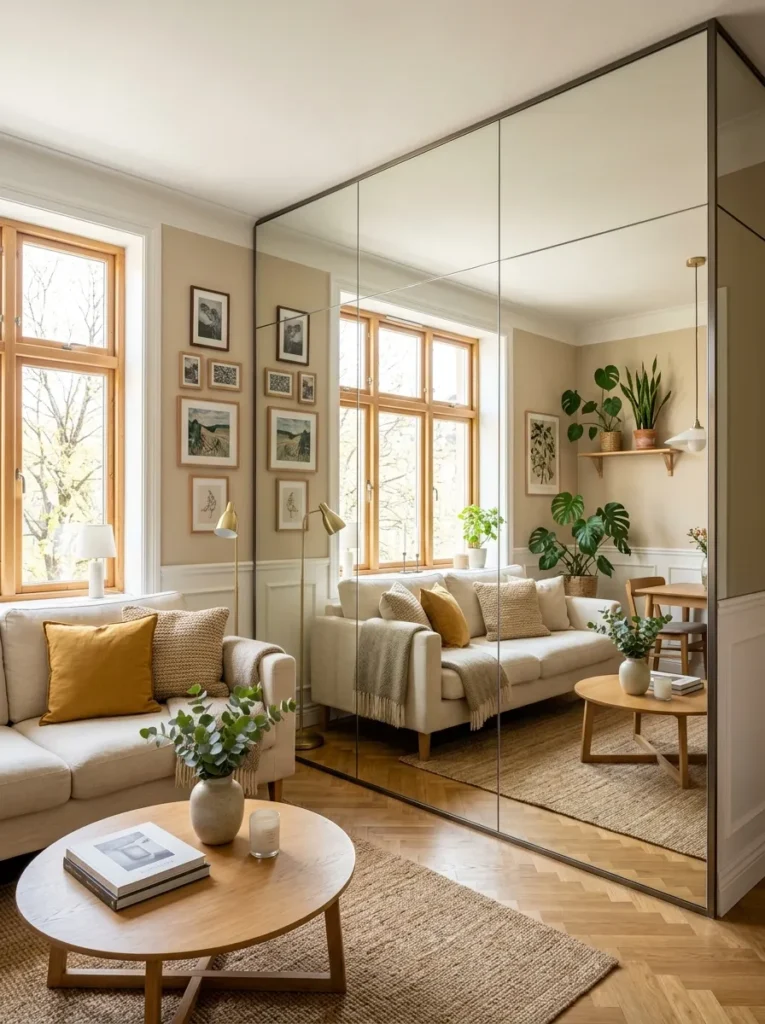
Vibe: The room is doubled — a full mirror wall collapses the perception of the wall as a boundary, replacing it with the reflected room, which makes the space feel twice its actual size and twice as bright with no structural change.
Why it works: A full mirror wall achieves the maximum possible spatial expansion effect available in residential design because it replaces the most visually definitive boundary element — the far wall — with a reflection of the room itself. The eye’s perception of room size is anchored by the identification of opposite walls, and when one wall becomes a mirror that reflects the opposite wall, this anchoring mechanism is disrupted — the brain cannot locate the room’s boundary and reads the space as extending beyond what is physically present. This effect is amplified when the mirror wall faces the room’s primary window, as the window light is reflected back into the room, doubling the perceived brightness. Mirror walls are most effective in small rooms (under 200 square feet) where the spatial expansion effect is most perceptually significant.
How to get it: Full wall mirror panels can be sourced as custom cut glass from a local glass supplier ($8–$15 per square foot for standard float glass with polished edges) or as pre-cut mirror tiles ($25–$60 per tile at standard sizes). Mirror panels are heavy — a 4×8 foot panel weighs approximately 40 pounds — and require mounting on a plywood backing panel adhered to the wall studs rather than direct adhesive application to drywall. Frameless installation with polished edges and J-channel trim at the perimeter creates the cleanest look; a thin frame of unlacquered brass or matte black channel adds design detail while concealing edge irregularities.
Shop The Look
- Custom cut mirror glass wall panel
- Mirror adhesive construction safe formula
- J channel mirror trim brass or black
- Mirror tile set beveled edge clear
- Mirror mounting clip set frameless
How to Start Your Aesthetic Wall Transformation
The single most important first decision in an aesthetic wall transformation is which wall to treat — and the answer is almost always the wall that the room’s primary seating or sleeping position faces. This is the wall that receives the most sustained visual attention from the room’s occupants, which means any aesthetic treatment applied to it has the highest visibility return. A gallery wall behind a sofa that faces away from the room’s seating looks designed from the entry but receives almost no visual attention from the people actually using the room; the same gallery wall on the wall the sofa faces is seen for every minute spent on that sofa. Design for the view from the room’s primary position.
The most common beginner mistake in aesthetic wall treatments is starting with the most visible wall and the most complex treatment simultaneously — attempting a full gallery wall, a limewash finish, or a full tile installation as a first project in the most prominent room. The fix is to begin with the treatment that has the lowest reversibility cost (paint rather than tile, removable wallpaper rather than grasscloth) in a secondary space (a bedroom or bathroom rather than the main living area) to develop confidence and technique before committing to a more permanent or complex treatment in the most-seen room. A limewash bedroom wall that doesn’t quite work costs a repaint; a limewash living room wall that doesn’t quite work costs more in both effort and visibility.
Three aesthetic wall upgrades under $50 that make an immediate visual transformation: painting the interior back wall of an existing bookshelf or alcove in a deep contrasting tone ($10–$20 in paint, 1–2 hours of work) that changes how every object on those shelves is read; creating a three-frame gallery cluster (three frames in the same material, same tone, different sizes) centered on the wall above a nightstand, console, or sofa ($15–$30 for frames plus printing costs) that establishes a wall composition without committing to a full gallery installation; and applying one roll of peel-and-stick wallpaper to a small bathroom or powder room wall ($35–$50) where the room’s small size means one roll covers the primary wall completely and the impact per square foot is the highest in the home.
A complete aesthetic wall transformation of a single room — feature wall in limewash or dark paint, gallery arrangement, or material treatment — is a realistic single weekend project for most paint and removable paper treatments. Tile and plaster applications require more time and typically professional installation for large areas. Total budget for a single transformative wall ranges from $20–$80 for paint-only treatments to $200–$600 for material applications including tile and grasscloth. The design return on investment for a single well-executed aesthetic wall — measured in the room’s photographic quality, its felt character, and the frequency with which visitors remark on it — consistently exceeds that of furniture and accessory purchases of equivalent cost.
Frequently Asked Questions About Aesthetic Wall Ideas
What is the easiest aesthetic wall idea for beginners?
Gallery walls are the most accessible aesthetic wall treatment for beginners because they require no special tools or skills beyond a level and picture hooks, are completely reversible, and can be built incrementally — starting with three frames and expanding over time. The three requirements for a successful beginner gallery wall are: odd number of frames (three or five, not two or four), consistent gaps between frames (2–3 inches throughout), and a visual center of gravity (the largest or most visually weighted piece at the arrangement’s center). Dark paint is the second most accessible treatment — the primary risk is choosing the wrong tone, which is mitigated by thorough testing before committing. Limewash and Roman clay are moderate in accessibility — they require technique development but are more forgiving than traditional plaster and can be DIY applied with one practice session on a scrap piece of drywall.
How do I choose between an accent wall and all-four-walls treatment?
The decision between accent wall and all-four-walls treatment depends on the room’s size and the treatment’s intensity. For dark paint and strong colors: all-four-walls treatment works best in rooms under 150 square feet (bedrooms, bathrooms, home offices) where the enveloping effect creates intimacy rather than claustrophobia; accent wall treatment works better in larger rooms where all-four-walls in a strong color would be overwhelming. For texture treatments (limewash, Roman clay, grasscloth): all-four-walls treatment creates the most immersive material experience and is appropriate at any room size when the tone is warm and medium in value. For architectural treatments (shiplap, board-and-batten): accent wall behind the primary furniture piece creates the maximum visual impact with minimum installation effort, while all-four-walls creates a more traditional full-room paneling effect appropriate for formal spaces.
Can aesthetic wall treatments work in a rental without damaging walls?
Yes — the majority of the most impactful aesthetic wall treatments are available in damage-free rental formats. Peel-and-stick wallpaper (Chasing Paper, Tempaper, Walls Need Love) removes cleanly from standard painted walls without damage. Peel-and-stick shiplap panels provide the shiplap aesthetic without screws or nails. Large gallery wall arrangements using Command strips avoid nail holes for frames under 8 pounds. Tapestries and textile wall hangings mount on a single large Command hook rather than requiring multiple picture hooks. The treatments that are not rental-appropriate without permission are: traditional wallpaper (requires paste and creates adhesion to the wall), limewash and Roman clay (alter the wall surface in a way that requires repainting to reverse), and tile (permanent installation). For renters who want maximum transformation within reversibility constraints, peel-and-stick wallpaper in a bold pattern on a single wall is the single most impactful damage-free wall treatment available.
How do I make a gallery wall look curated rather than random?
The difference between a gallery wall that looks curated and one that looks random is controlled variety — variety in the right variables (frame size, art content) and consistency in the controlled variables (frame material, gap spacing, and the wall’s visual center of gravity). Specifically: use a maximum of two frame tones (all natural wood, or natural wood and matte black, or all matte black — never three or more frame tones); maintain consistent 2–3 inch gaps between every frame throughout the entire arrangement (inconsistent gaps are the most common cause of a gallery wall looking random); establish one visual anchor (the largest piece, or the piece with the strongest color or contrast) and arrange all other pieces in relationship to that anchor rather than placing pieces independently. The paper template system — tracing each frame on kraft paper, cutting to size, and taping templates to the wall before hanging — is the single most reliable technique for achieving a curated gallery arrangement because it allows repositioning without making holes.
What wall treatment adds the most value to a home for resale?
Architectural treatments that add genuine structural and visual value — board-and-batten wainscoting, full-height built-in bookshelves, and ceramic tile feature walls — consistently add perceived and actual value to a home by creating the quality associated with custom, designed interiors rather than standard builder-grade finishes. Paint treatments (limewash, dark colors, geometric color blocks) add significant aesthetic value to the current occupant but are neutral to mildly negative for resale because buyers prefer to choose their own colors — a professional repaint in neutral tones is typically recommended before listing. Removable wallpaper and gallery walls are neutral for resale — they are removed before selling. The single highest-value wall investment for resale is a full-height ceramic tile treatment in a primary bathroom or kitchen — this is a permanent material upgrade that survives style cycles and adds genuine market value to the property.
Ready to Transform Your Walls?
These 15 ideas cover the full spectrum of what an aesthetic wall can be — from the organic living texture of limewash paint and the mineral luxury of Venetian plaster, to the intellectual warmth of a floor-to-ceiling bookshelf wall and the graphic confidence of a painted geometric treatment, from the textile softness of a large tapestry and the warm envelopment of terracotta walls to the spatial magic of a full mirror wall that doubles the room’s perceived size. You do not need all 15 — the most successful aesthetic wall transformations begin with a single wall, chosen for maximum visibility from the room’s primary use position, and treated with one technique applied with genuine care and material intention. Start this weekend by standing in the room’s primary seating or sleeping position and looking at the wall you spend the most time facing — that is the wall that deserves the first transformation, and every hour spent in that room afterward will be spent in the presence of that decision. A room with one genuinely beautiful wall is a fundamentally different experience from a room with none, and the investment required to create it is almost always smaller than the experience it delivers. Pin the treatments that made you want to repaint immediately — those are the ones your walls are already asking for.