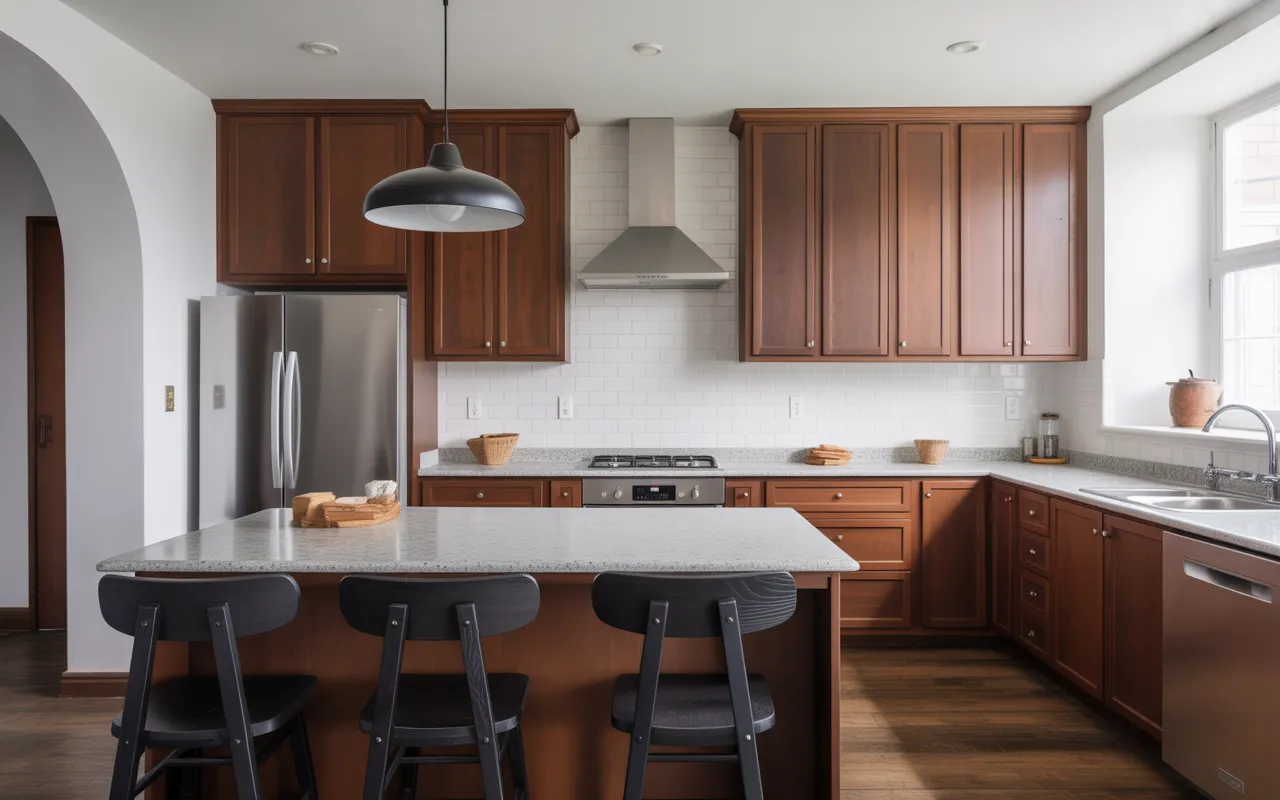
22 Brown Cabinets Kitchen Ideas That Look Rich
Brown cabinets are back in kitchens for a simple reason. They hide wear well, they suit both old houses and new builds, and the color range runs from pale oak tones to near black espresso. White cabinets still look clean, but brown adds depth that paint alone cannot give.
The 22 kitchens below cover the main ways people use brown. Some go dark on every cabinet, some keep brown only on the lowers or the island, and some pair it with marble, stone, or plain white walls. The hardware and lighting choices matter as much as the cabinet color itself.
As you go through the list, note the undertone of each brown. Warm browns lean red or gold, cool browns lean gray, and mixing the two in one room is where most kitchens go wrong. Pick one direction and carry it through the floor, the counters, and the metals.
This post contains affiliate links. If you buy through them, I may earn a small commission at no extra cost to you.
1. Dark Walnut Brown Cabinets with Gold Hardware

Dark walnut has a tight grain and a deep brown color that reads almost black in low light. Gold hardware warms it up and stops the run of cabinets from looking flat. This pairing suits larger kitchens or open plan rooms where the cabinets can carry some visual weight.
Pick the right gold: Go for brushed or satin gold rather than polished yellow gold, which can look harsh against walnut. Keep the same finish on the faucet and light fixtures so the metals read as one set. Handles need to be long enough for the drawer width, or the proportions look off.
Light it properly: Walnut absorbs light, so plan under cabinet strips and at least one ceiling light that spreads wide. Pale counters or a light backsplash keep the work area bright. Test a door sample at home in morning and evening light before you order.
- Order a walnut door sample and check it under your own lights
- Use one gold finish across handles, faucet, and pendants
- Add a light counter or backsplash to balance the dark wood
Shop This Look
2. Light Brown Cabinets with White Countertops
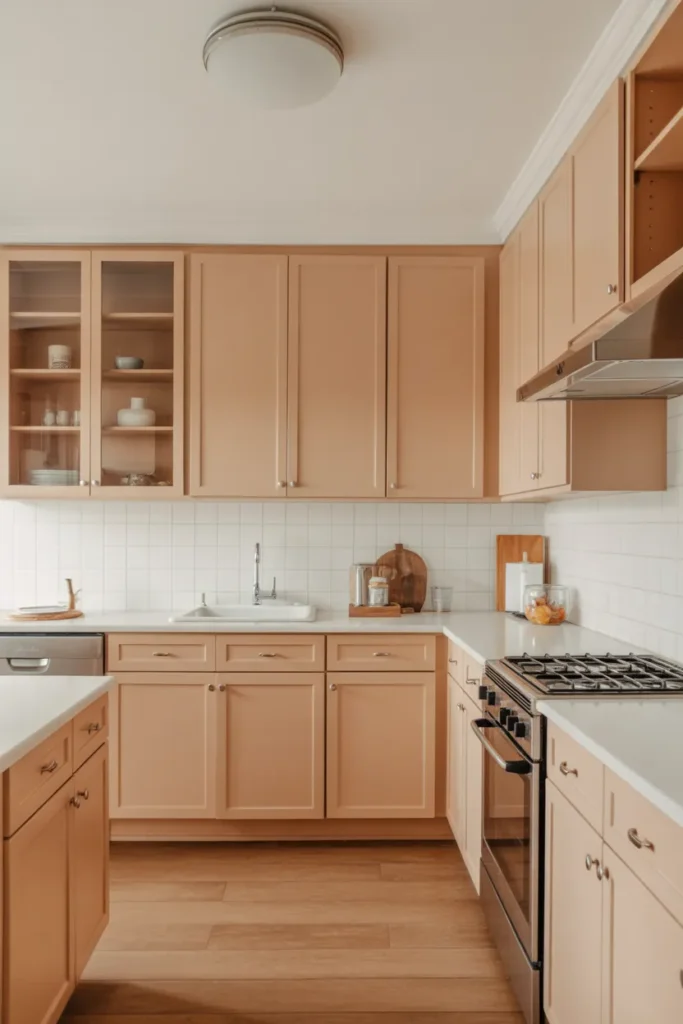
Light brown cabinets with white countertops is the safest combination on this list, and it works in small kitchens that get little daylight. The cabinets bring warmth, the white work surface bounces light back, and the room stays calm. Shaker or flat panel doors both suit it.
Choose the white carefully: Pure bright white can look blue next to warm wood. A soft white quartz or marble with faint warm veining sits better. Ask for counter samples and lay them on the cabinet door, not on a showroom shelf.
Keep the floor quiet: Mid tone wood floors or plain stone tiles work well here. A busy floor pattern fights with the simple cabinet and counter pairing. Grout in a soft gray hides marks better than white grout.
- Test soft white counter samples directly on the cabinet door
- Keep flooring plain so the cabinets stay the focus
- Use warm white bulbs, around 2700K to 3000K
Shop This Look
3. Brown Cabinets with Black Accents
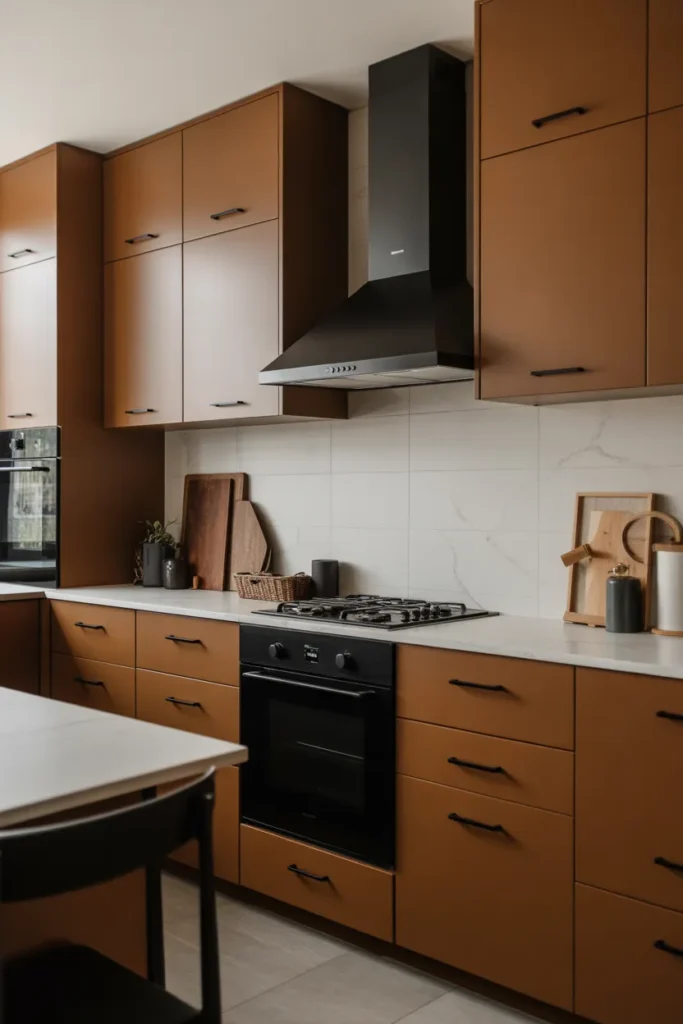
Brown cabinets with black accents give a kitchen a sharper edge without going full dark. Black handles, a black faucet, and black framed lights break up the wood and make the grain stand out. It suits modern and transitional kitchens best.
Use black in threes: Repeat black at least three times, for example handles, faucet, and pendant frames, so it looks planned. One black item on its own looks like a mistake. Matte black shows water spots less than glossy black.
Watch the balance: If the cabinets are dark brown and the accents are black, add a light surface somewhere, usually the counter or the backsplash. Too much dark on dark makes food prep areas gloomy. A pale floor can do the same job.
- Repeat matte black on handles, faucet, and lighting
- Add one light surface to lift the dark palette
- Wipe black fixtures with a dry cloth to stop water marks
Shop This Look
4. Rich Espresso Brown Cabinets with Warm Lighting
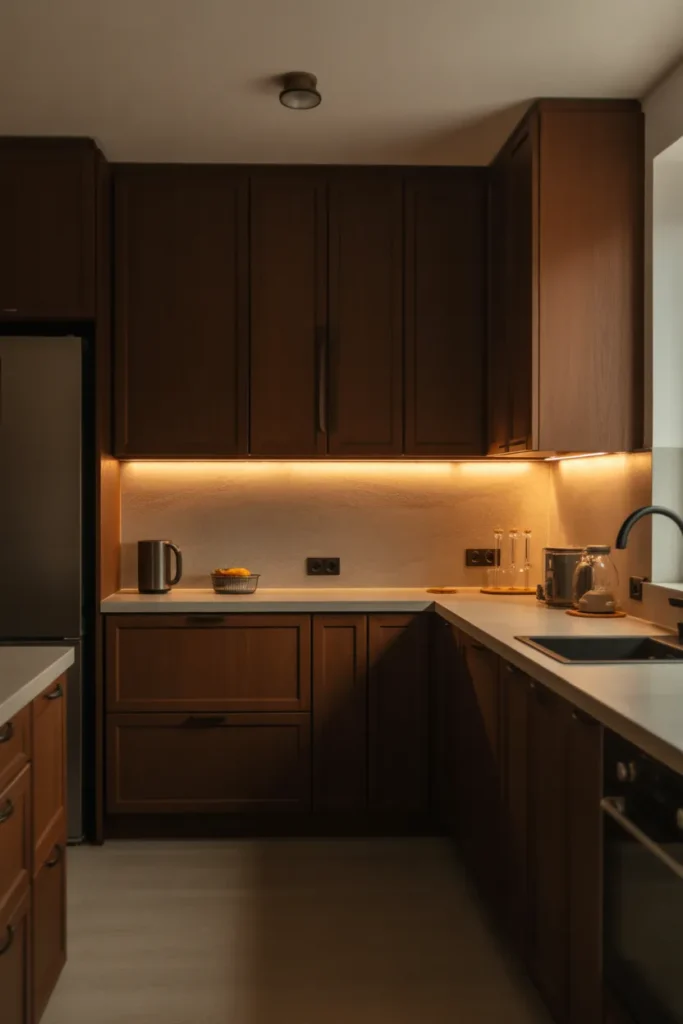
Espresso cabinets sit at the darkest end of brown, close to black but with a warm base. On their own they can feel heavy. Warm lighting changes that, bringing out the red and gold tones in the wood so the room feels snug rather than closed in.
Set the light temperature: Bulbs between 2700K and 3000K suit espresso best. Anything cooler turns the cabinets gray and dull. Put dimmers on the main lights so you can drop the level in the evening when the kitchen is not in use.
Add contrast at the counter: Cream, beige, or light stone counters stop espresso runs from merging into one dark block. A light backsplash helps too, especially behind the hob where light matters most. Keep small appliances light colored where you can.
- Fit 2700K to 3000K bulbs on dimmers throughout
- Pair espresso with cream or light stone counters
- Keep the hob area the brightest part of the room
Shop This Look
5. Brown Cabinets with Natural Wood Texture

Cabinets that show natural wood texture rely on grain, knots, and slight color variation instead of paint or stain tricks. Rift sawn oak and walnut are common picks. The look suits kitchens that lean rustic, Scandinavian, or Japanese in style.
Check grain direction: Grain should run the same way across a run of doors, or the cabinets look mismatched. Ask the maker how they sequence doors from the same boards. Book matched veneer costs more but gives a calmer result on wide doors.
Protect the surface: A clear matte finish protects wood without adding shine. Oiled finishes need reapplying every year or so, but small marks can be sanded out. Keep a spare offcut so you can test cleaners before using them on a door.
- Ask how doors are sequenced so grain lines up
- Choose a matte clear finish for a natural feel
- Keep an offcut to test cleaning products first
Shop This Look
6. Brown Cabinets with Marble Backsplash
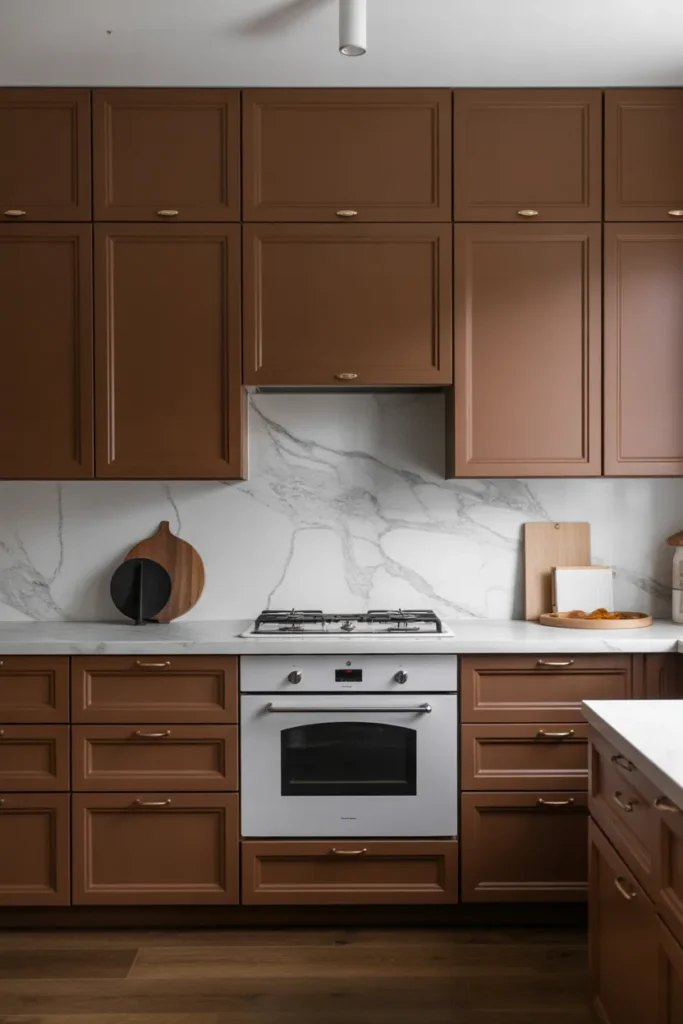
A marble backsplash lifts brown cabinets straight away. The white and gray veining gives the wood something bright to sit against, and the stone catches light across the day. It is a classic pairing in both period homes and new kitchens.
Seal it and mean it: Marble stains and etches, so seal it on fitting and again every six to twelve months. Wipe up red wine, turmeric, and lemon juice fast. If that upkeep sounds like too much, marble look porcelain gives a similar effect with far less care.
Match the veining tone: Warm cabinets suit marble with gold or beige veins. Cool gray veining can clash with red toned wood. Take a cabinet sample to the stone yard and view full slabs, because small tiles hide how strong the pattern really is.
- Seal marble on fitting and once or twice a year after
- View full slabs with a cabinet sample in hand
- Consider marble look porcelain if upkeep is a concern
Shop This Look
7. Two-Tone Kitchen with Brown Lower Cabinets
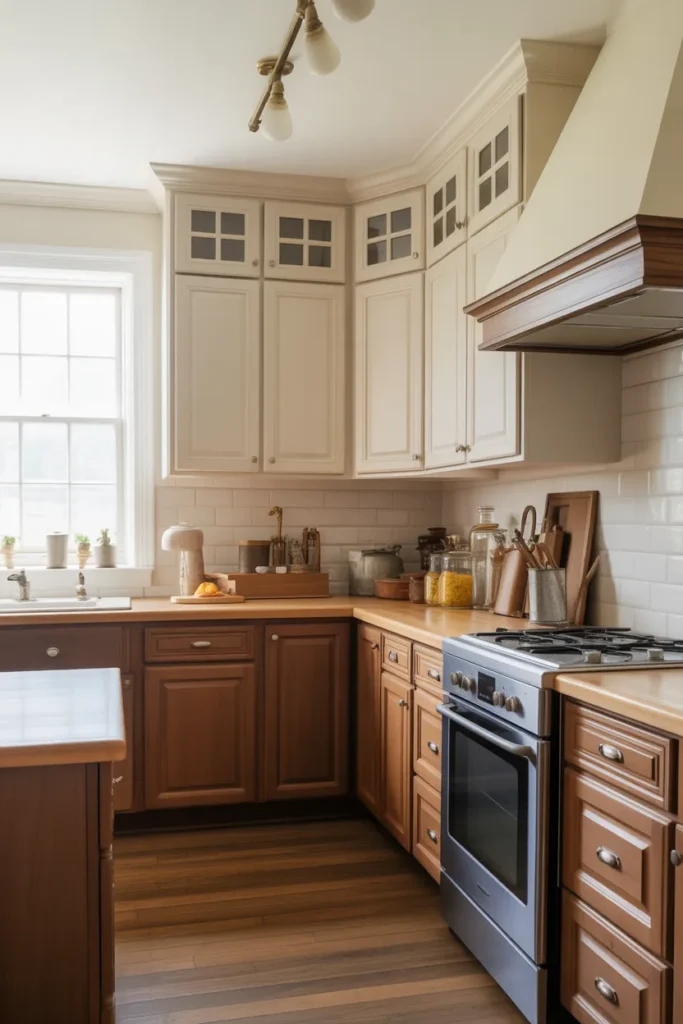
Two tone kitchens with brown lower cabinets and lighter uppers solve a common problem. Dark bases ground the room, pale uppers keep it bright, and you get storage above without a wall of dark wood at eye level. White, cream, or pale gray uppers all work.
Ground the room below: Lowers take the knocks from feet, bags, and vacuum cleaners, so brown is a practical choice there. Keep the island, if you have one, in the same brown as the lowers to tie the layout together.
Bridge the two colors: The counter and backsplash sit between the two cabinet colors, so they need to suit both. A mid tone stone or a tile with flecks of brown and white pulls the scheme together. Hardware in one finish across both colors also helps.
- Keep the island brown to match the lower cabinets
- Choose counters that contain both light and brown tones
- Use one hardware finish across uppers and lowers
Shop This Look
8. Brown Cabinets with Brass Fixtures
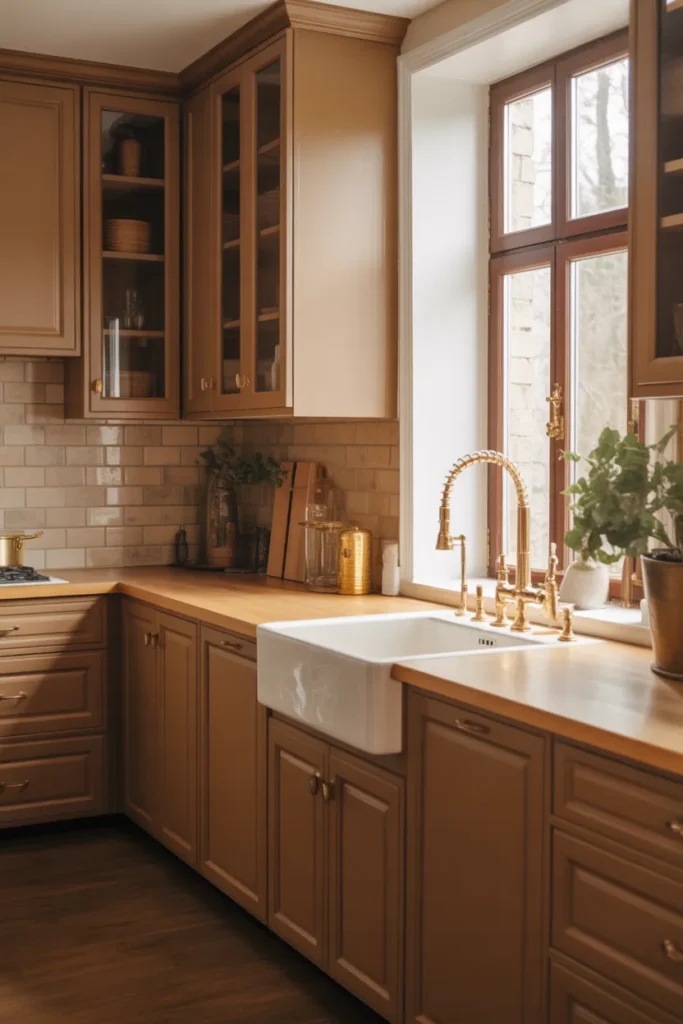
Brass fixtures against brown cabinets is a warm on warm scheme that suits traditional and transitional kitchens. Unlacquered brass changes color slowly with use, which many people like. Lacquered brass stays bright and needs less polishing.
Decide on lacquer early: Pick lacquered or unlacquered brass before you buy anything, because mixing the two looks untidy within a year. Unlacquered handles darken where hands touch them most. That variation is part of the appeal, but it is not for everyone.
Spread brass beyond handles: A brass faucet, brass rail, or brass framed pendants make the handles look deliberate. Keep stainless appliances if you have them, since brass and stainless can sit together when brass is repeated. Avoid adding chrome into the same room.
- Choose lacquered or unlacquered brass and stick to it
- Repeat brass on the faucet and lighting
- Polish unlacquered brass only if you want an even tone
Shop This Look
9. Matte Brown Cabinets for a Modern Look
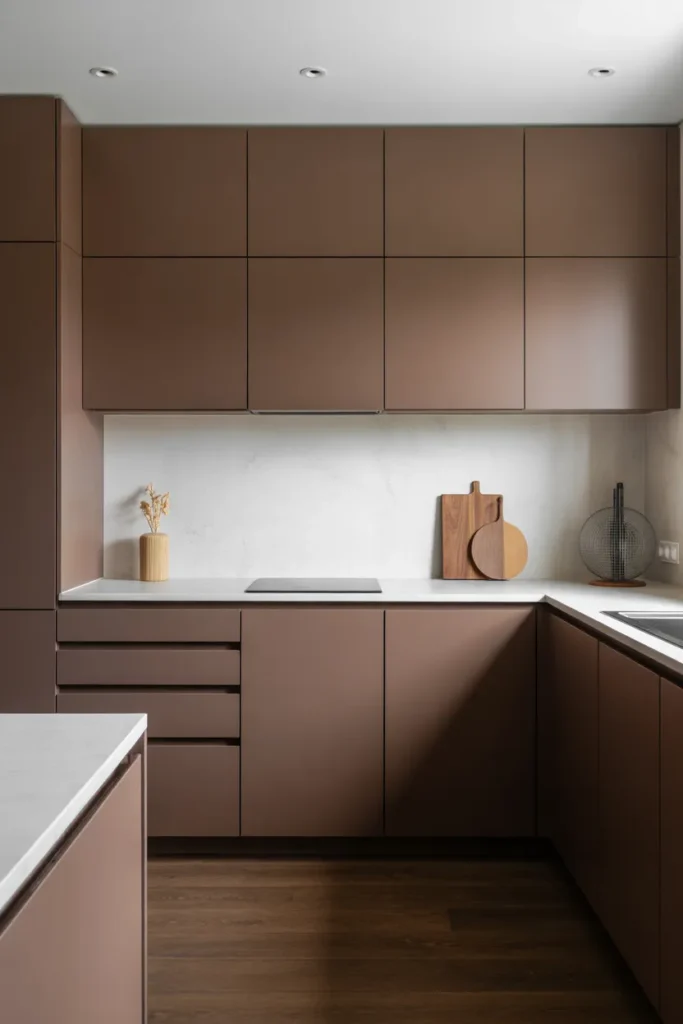
Matte brown cabinets give a modern kitchen a softer finish than gloss. There is no shine to bounce light around, so the color reads flat and even. Flat panel doors, hidden handles, and simple lines complete the look.
Plan for fingerprints: Matte surfaces show grease marks, especially around handles and the fridge door. Some makers offer anti fingerprint laminates, which are worth the extra cost in a busy house. Keep a microfiber cloth in a drawer for quick wipe downs.
Add texture elsewhere: Because matte cabinets are plain, the room needs interest from other materials. A rough stone backsplash, a ribbed glass door, or a wood slat panel stops the kitchen feeling flat. One textured feature is usually enough.
- Ask about anti fingerprint finishes for busy homes
- Add one textured feature such as stone or fluted glass
- Keep matte doors clean with a damp microfiber cloth
Shop This Look
| Anti Fingerprint Cabinet Film Samples | Microfiber Cloths for Matte Surfaces | Textured Stone Backsplash Tile |
10. Brown Cabinets with Open Shelving Accents

Brown cabinets with open shelving accents break up long runs of doors and give you a place for everyday dishes. Two or three shelves in matching or contrasting wood work better than a whole wall of shelves. The cabinets below still hide the clutter.
Place shelves with care: Shelves near the hob collect grease fast, so put them by the sink or coffee area instead. Keep what you use daily on them, since items stored for months just gather dust. Heavy stoneware needs proper brackets fixed to studs or solid blocking.
Style it simply: Group items in odd numbers and leave gaps, or shelves look like storage rather than display. Matching jars and plain white dishes photograph well and are easy to replace. Wood boards add warmth against the brown cabinets.
- Fix shelf brackets into studs for heavy dishes
- Keep shelves away from the hob to limit grease
- Leave gaps between groups so shelves do not look crowded
Shop This Look
11. Brown Cabinets with Quartz Countertops
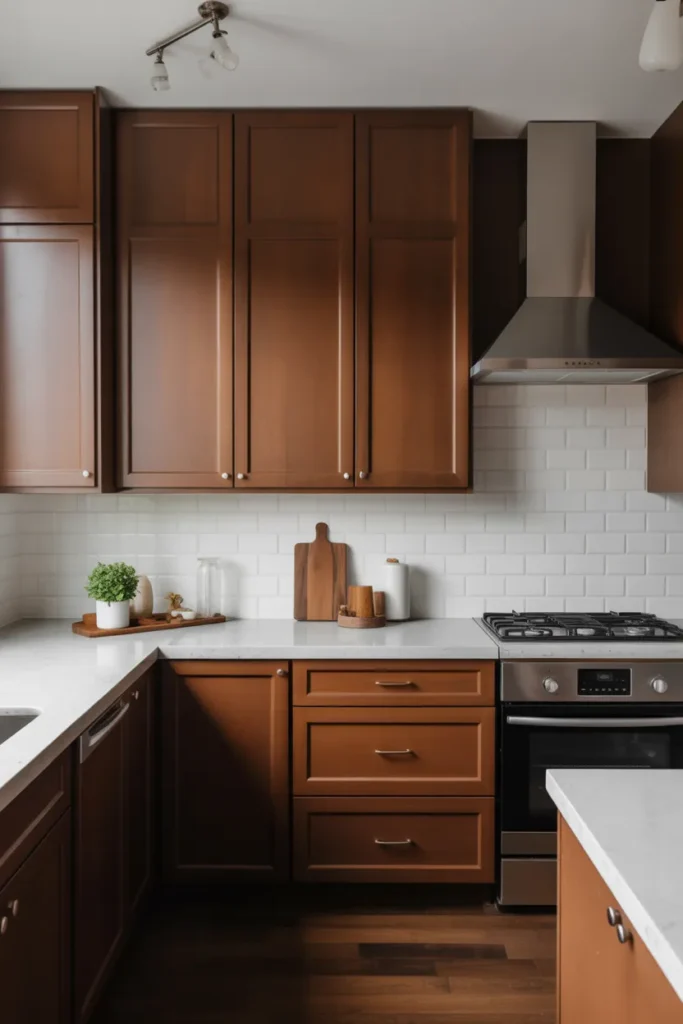
Brown cabinets with quartz countertops is a practical pairing for families. Quartz does not need sealing, it resists stains well, and it comes in plain colors as well as marble and concrete looks. The surface stays the same for years with basic care.
Pick the pattern scale: Large veining suits large kitchens and islands. In a small kitchen a fine, quiet pattern looks calmer and makes the room feel bigger. Always view a big sample or full slab photo, because small swatches hide the repeat.
Mind heat and cutting: Quartz resists stains but hot pans can damage the resin, so use trivets as a habit. Cut on boards, not on the counter, to protect both the surface and your knives. Clean with mild soap and water rather than abrasive pads.
- Use trivets under hot pans every time
- Choose a quiet pattern for a small kitchen
- Clean quartz with mild soap and a soft cloth
Shop This Look
12. Floor-to-Ceiling Brown Cabinets
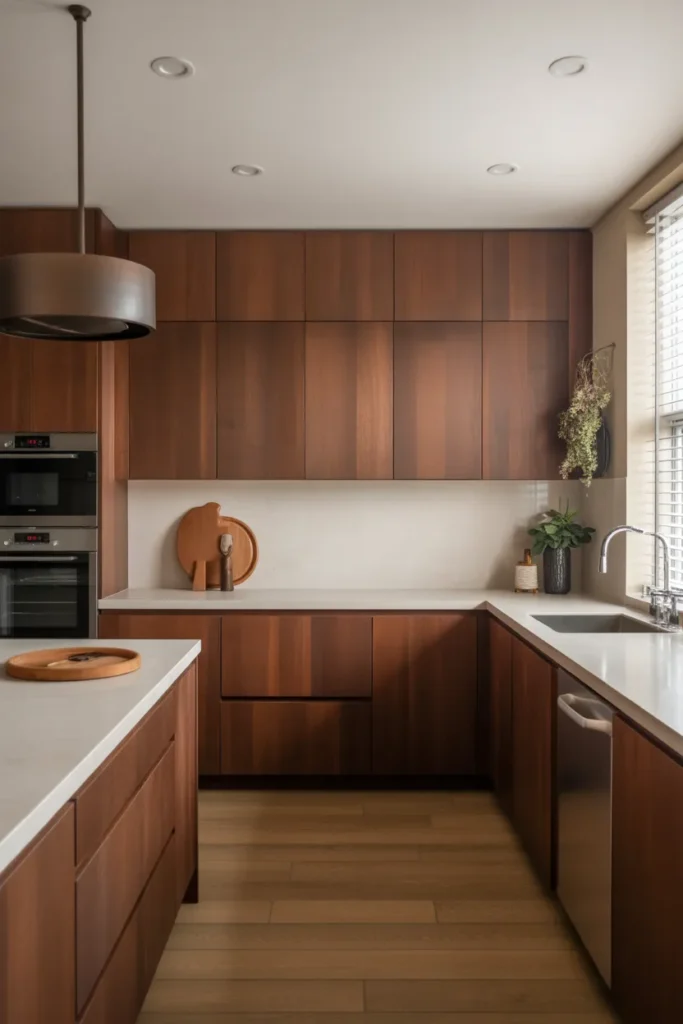
Floor to ceiling brown cabinets turn one wall into full height storage. Larders, ovens, and the fridge can all sit behind matching doors, so the kitchen looks like furniture rather than appliances. This suits open plan rooms where the kitchen shares space with seating.
Break up the height: A full wall of one wood can feel heavy. Glass doors on one section, a contrasting island, or a pale counter run at the base all help. Step ladders or a rail make the top cupboards usable rather than decorative.
Sort the internals: Tall units only work if the inside is planned. Pull out larders, deep drawers, and vertical tray slots get used daily, while plain deep shelves become dead space. Put rarely used items at the top from the start.
- Add pull out storage inside tall units
- Use glass or a contrasting section to lighten the wall
- Keep a stable step stool in the kitchen for top shelves
Shop This Look
13. Brown Cabinets with Stone Backsplash
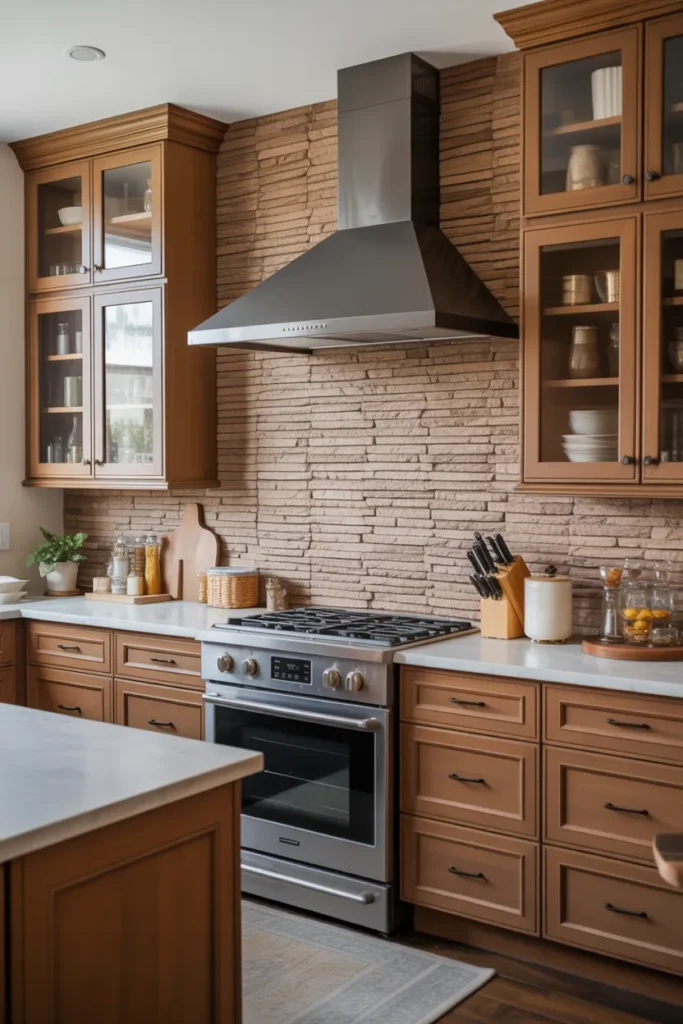
Brown cabinets with a stone backsplash bring two natural materials together. Stacked stone, slate, and travertine all add texture that flat tile cannot. The roughness of the stone also makes smooth cabinet doors look more refined by contrast.
Seal porous stone: Most natural stone needs sealing before grouting and again each year. Grout lines on rough stone are uneven, so a mid tone grout hides variation better than white. Behind the hob, a smooth stone slab section is easier to wipe than rough stacked stone.
Keep the palette tight: Pick stone that contains tones close to your cabinet color. A stone with strong orange or pink casts can fight warm brown wood. Order a sample box and live with the pieces against the cabinets for a few days.
- Seal stone before grouting and yearly after
- Use mid tone grout to hide variation
- Live with stone samples against the cabinets first
Shop This Look
14. Brown Cabinets with Glass Front Doors
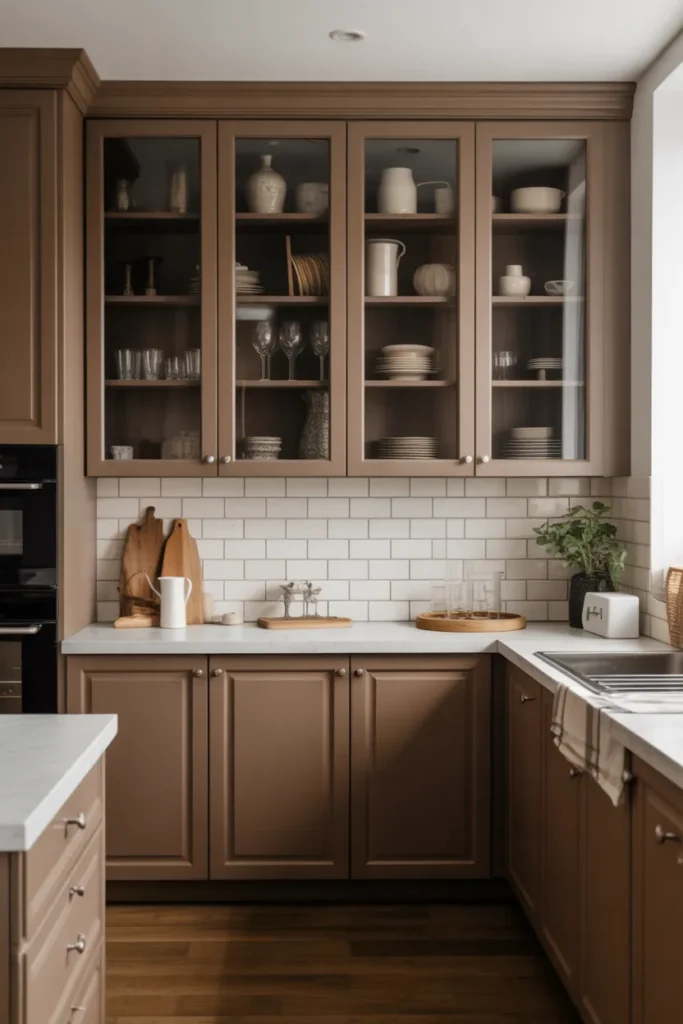
Glass front doors on some brown cabinets lighten the run and let you show glassware or plain dishes. Use glass on two or three uppers only, not the whole kitchen. Clear, fluted, and frosted glass give different levels of cover.
Choose glass by honesty: Clear glass only works if you keep shelves tidy. Fluted glass blurs shapes and is the forgiving middle option. Frosted glass hides almost everything while still letting light through, which suits cupboards near a window.
Light the inside: Small LED strips inside glass cabinets make a real difference at night. Paint or line the cabinet interior in a pale color so contents stand out against the brown frame. Match the interior to your wall color for a calm result.
- Use glass on a few uppers, not every cabinet
- Fit interior LED strips for evening use
- Paint cabinet interiors pale so dishes stand out
Shop This Look
15. Brown Cabinets with Neutral Tile Flooring
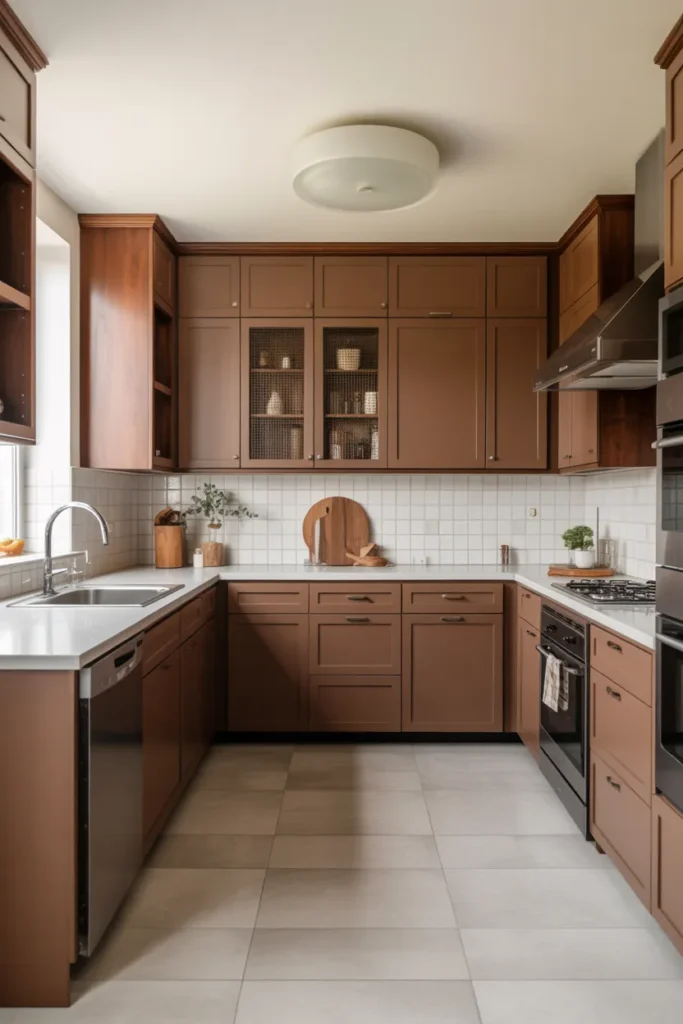
Neutral tile flooring under brown cabinets keeps the base of the kitchen calm. Beige, greige, and light stone tiles do not compete with the wood, and they cope with water and mud better than timber. Large format tiles mean fewer grout lines to clean.
Check the undertone match: Tiles lean warm or cool just like wood does. Lay tile samples next to a cabinet door in daylight before ordering. A cool gray tile under warm brown cabinets is a common and expensive mistake.
Think about comfort: Tile is hard and cold underfoot. Underfloor heating mats work well in kitchens and are cheaper to run in a small zone by the sink and hob. A washable runner softens the main standing area if heating is not an option.
- Compare tile and cabinet samples in daylight
- Use large tiles to cut down grout cleaning
- Add a washable runner where you stand most
Shop This Look
16. Brown Cabinets with Integrated Lighting
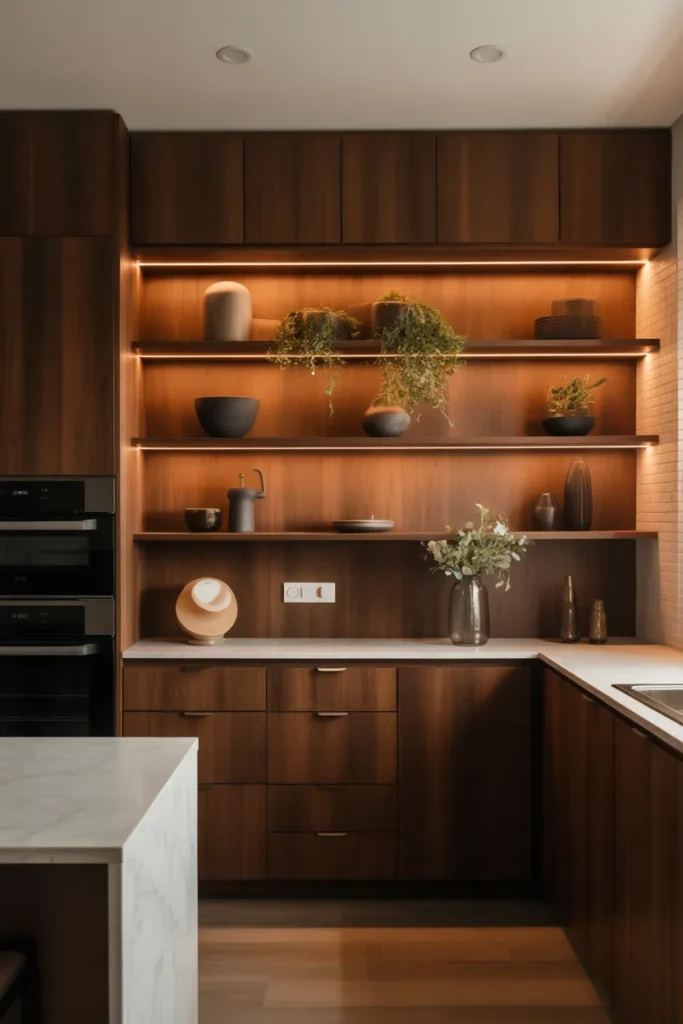
Integrated lighting built into brown cabinets means light strips under uppers, inside drawers, and along kick plates are planned from the start. Dark wood kitchens need this more than pale ones, because brown absorbs light instead of reflecting it.
Layer the light: Task light under the uppers is the base layer. Add in cabinet lights for glass doors and toe kick lights for night time. Each layer on its own switch or dimmer gives you control without rewiring later.
Hide the fittings: Recessed channels in the cabinet base hide LED strips and stop glare in your eyes while you cook. Match the light color across all fittings, because mixed temperatures look untidy. Warm white around 3000K suits brown wood best.
- Put each lighting layer on a separate dimmer
- Use recessed channels to hide LED strips
- Keep all fittings at one color temperature
Shop This Look
17. Brown Cabinets with High-Contrast White Walls
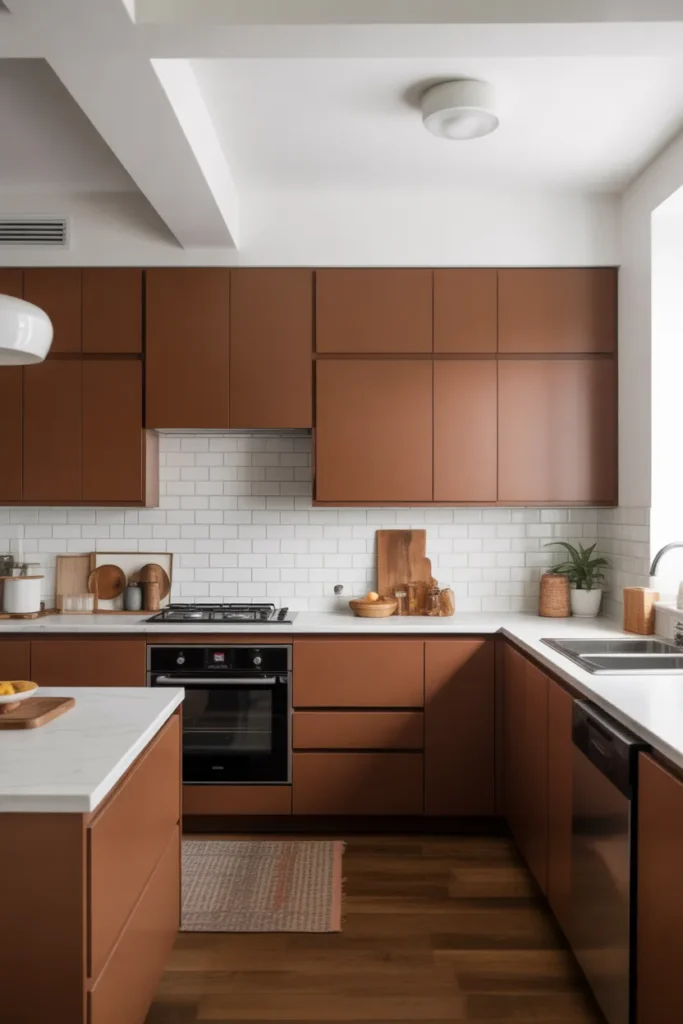
Brown cabinets against white walls is a high contrast scheme that makes the wood the clear feature of the room. It works in kitchens of any size and any period. The white also shows you the true color of the brown, with nothing else muddying it.
Pick a warm white: Stark blue white walls can make brown cabinets look orange by contrast. Warm whites with a hint of cream sit better with wood. Paint a large board and prop it behind a cabinet door before committing to gallons of paint.
Soften the contrast: If the contrast feels harsh, bring white down a notch with cream textiles, pale stone counters, or light wood stools. Black or brass handles give the eye a middle step between dark wood and white wall.
- Test warm white paint on a board behind a door
- Use pale counters to soften the contrast
- Add light wood stools to bridge the tones
Shop This Look
18. Brown Cabinets with Farmhouse Sink
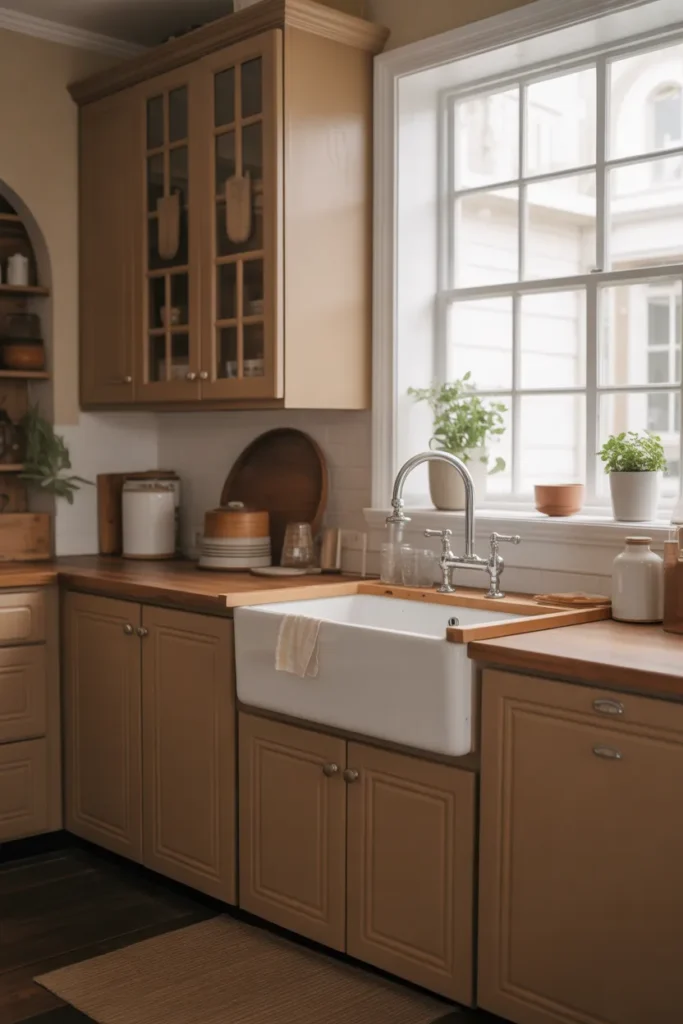
A farmhouse sink with brown cabinets suits country and traditional kitchens. The wide apron front in white or fireclay breaks up the wood at the sink run and gives you a deep basin for large pans and trays. It is practical as well as good looking.
Support the weight: Fireclay and cast iron sinks are heavy, and the cabinet below needs proper support built in. Tell your fitter the exact sink model early, because the cabinet may need altering. Silicone the joints well to keep water out of the wood below.
Match the tap style: Bridge taps and brass taps suit farmhouse sinks and brown wood. A very modern square tap can look out of place. Protect the apron front from belt buckles and buttons, which chip fireclay over time.
- Confirm cabinet support before the sink arrives
- Choose a bridge or brass tap to match the style
- Wipe the sink base dry to protect the wood below
Shop This Look
19. Brown Cabinets with Herringbone Backsplash
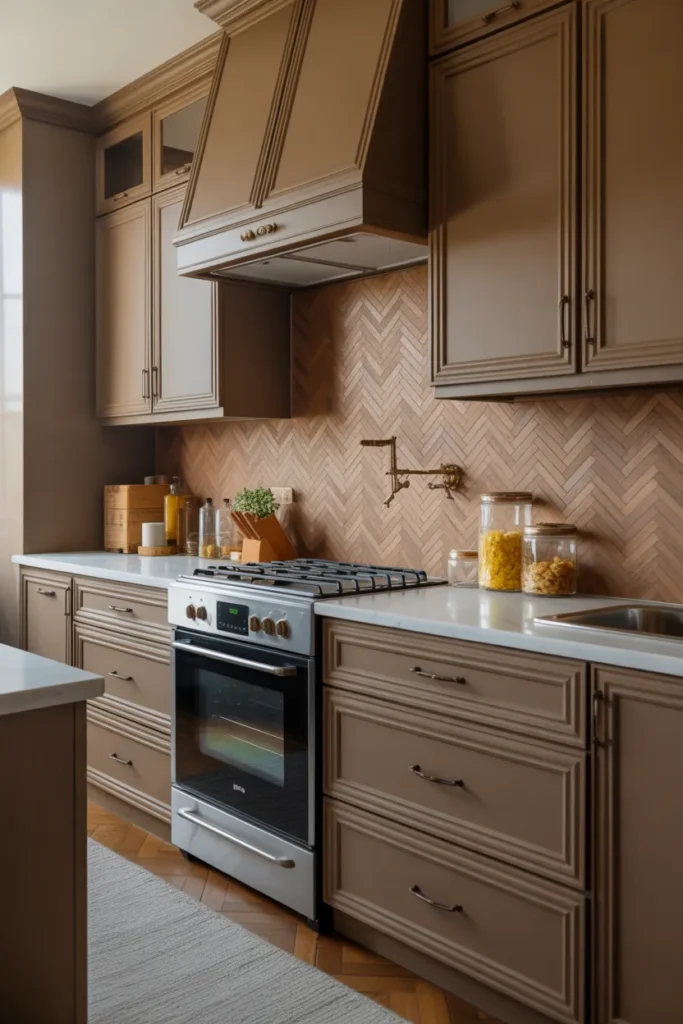
A herringbone backsplash adds pattern to brown cabinets without adding another strong color. The zigzag layout makes simple tiles look considered, and it draws the eye along the work surface. White, cream, or marble tiles in herringbone all pair well with wood.
Budget for cuts: Herringbone needs many cuts at the edges, so order extra tiles, usually 15 to 20 percent more. Lay the pattern out on the floor first to check the direction of the points. Most people run the points upward, which looks tidier.
Keep grout subtle: A grout color close to the tile keeps the pattern about shape rather than contrast. Dark grout on white herringbone can look busy against wood grain. Seal grout in the splash zone behind the hob and sink.
- Order 15 to 20 percent extra tiles for cuts
- Dry lay the pattern before fixing any tile
- Use grout close to the tile color for a calmer result
Shop This Look
20. Brown Cabinets with Minimalist Hardware

Minimalist hardware on brown cabinets keeps the focus on the wood itself. Slim bar pulls, edge pulls, or push to open doors all reduce visual clutter. This suits flat panel cabinets in modern kitchens where the grain is the decoration.
Test edge pulls first: Edge pulls look clean but some people find them awkward on heavy drawers. Fit one drawer with an edge pull and use it for a week if you can. Dishwasher and fridge doors need the most grip, so do not skimp there.
Keep finishes quiet: Brushed stainless, matte black, or color matched pulls suit this look. Shiny chrome draws the eye and defeats the point. Whatever you choose, use it on every door and drawer without exception.
- Trial an edge pull on one heavy drawer first
- Use one quiet finish across the whole kitchen
- Fit stronger pulls on appliance doors
Shop This Look
21. Brown Cabinets with Open Concept Island
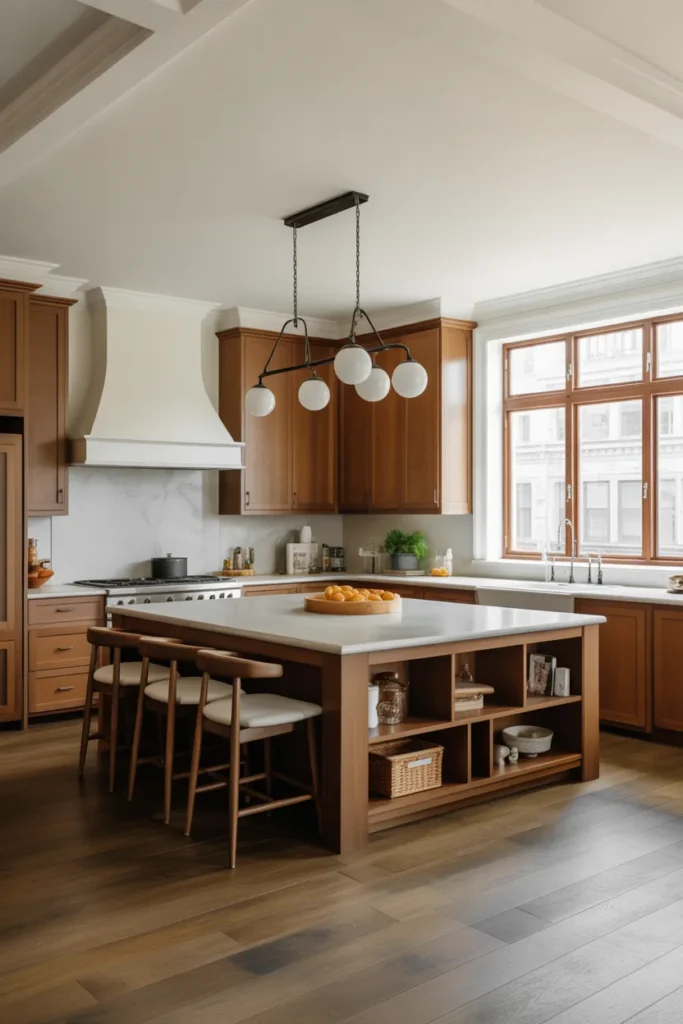
An open concept island in brown anchors a large kitchen living space. The island gives you prep space, seating, and storage, and the brown finish marks the kitchen zone without walls. It works best when the island is big enough to deserve the space it takes.
Leave proper walkways: Keep at least 90cm, and ideally 105cm, between the island and the runs behind it. Two cooks need the wider gap. Seat stools on the side away from the hob, with 60cm of width per person and knee space below the counter.
Face the island well: The side of the island that faces the seating area is seen all day. Panel it to match the cabinets, or use slatted wood for texture. Put sockets on the island ends for laptops and mixers, planned before the worktop goes on.
- Keep 90cm to 105cm walkways around the island
- Panel the seating side to match the cabinets
- Plan sockets on the island before fitting counters
Shop This Look
22. Brown Cabinets with Dark Countertops
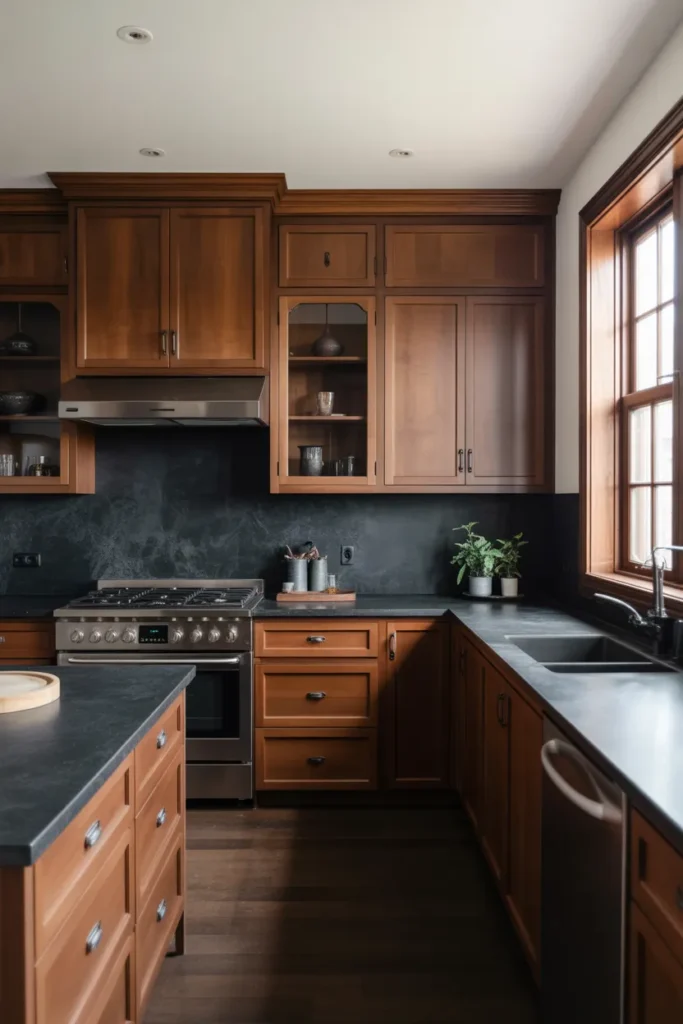
Brown cabinets with dark countertops is the boldest scheme here. Black granite, dark quartz, or soapstone over brown wood gives a moody, settled feel. It needs good light and at least one lighter element, such as a pale floor or light backsplash, to work.
Choose the dark surface well: Honed finishes show fewer marks than polished ones on dark stone. Soapstone darkens with oil and use, which adds character but changes the look over time. Dark quartz is the most even and predictable option.
Lift it with light: Under cabinet lighting is not optional in this scheme, it is what makes the work area usable. A light splashback behind the hob and pale stools or textiles stop the room tipping into gloom. Check the combination on a dull day, not only in sun.
- Pick honed dark counters to hide marks
- Fit strong under cabinet task lighting
- Add one pale element such as floor or stools
Shop This Look
How to Start
Start by deciding how much brown you actually want. All cabinets in brown is a commitment, while brown lowers or a brown island lets you test the color with less risk. Look at your light, your floor, and the size of the room before you look at door styles.
Order samples before anything else: Get at least three brown door samples, light, mid, and dark, and live with them for a week. Prop them against your current cabinets and check them morning and night. Floors change how brown reads, so always judge the sample on your own floor.
Build the scheme around the cabinets: Once the brown is fixed, choose counters, backsplash, hardware, and lighting in that order. Each choice should answer to the cabinet tone. Keep a photo of the sample on your phone so shop lighting does not trick you later.
- Order three door samples in light, mid, and dark brown
- Check samples in morning and evening light at home
- Choose counters and hardware only after the cabinet tone is set
Shop This Look
Common Mistakes
Most brown cabinet kitchens that disappoint share the same few errors. They are easy to avoid once you know what they are.
- Choosing brown from a showroom photo without testing a sample in your own light
- Mixing warm brown cabinets with cool gray floors or counters so the tones fight
- Going dark on cabinets, counters, and floor at once with no light surface to balance it
- Mixing metal finishes at random instead of repeating one finish across the room
- Forgetting task lighting, even though brown absorbs more light than pale cabinets
- Picking a busy backsplash and a strong wood grain that compete for attention
- Ordering hardware that is too small for wide drawers, so it looks lost and feels weak
Frequently Asked Questions
Do brown cabinets make a kitchen look dark?
Not on their own. Light counters, a pale backsplash, and proper under cabinet lighting keep a brown kitchen bright. Dark brown on every surface with poor lighting is what causes the problem, not the cabinet color itself.
What countertop colors go best with brown cabinets?
White and cream quartz, marble, and light stone are the safest matches because they lift the wood. Dark counters also work for a moodier result, but then the floor or backsplash should stay light. Mid tone wood counters suit light brown cabinets in rustic schemes.
Are brown cabinets in fashion or dated?
Brown wood cabinets have come back as people move away from all white kitchens. The current versions use flat or simple shaker doors, matte finishes, and restrained hardware. Heavy carved doors and orange toned stains are the ones that look dated.
How do I stop brown cabinets looking orange?
Choose stains with neutral or slightly cool bases and test them at home, because warm room lighting pushes brown toward orange. Avoid pine and honey oak finishes if orange is your worry. Walnut and white oak with a clear matte finish stay closest to true brown.
Can I mix brown cabinets with other cabinet colors?
Yes, and it is often the easiest way to use brown. Brown lowers with white uppers, or a brown island with painted cabinets around it, both work well. For more pairing ideas and layouts, see this guide to kitchen backsplash ideas and plan the tile and cabinet colors together.
The Finishing Touch
Brown cabinets reward small finishing choices. Swap plastic switch plates for metal ones that match your handles, put your nicest wood boards where they can be seen, and keep counters mostly clear. A kitchen with room to work always looks better than one covered in appliances.
If you want more examples before you commit, browse the brown kitchen cabinet photos on Houzz and save the ones where the light feels like your own kitchen. Pay attention to floor color in the photos you like, because it is usually doing more work than people realise.
Start with the sample doors and one honest look at your light. Get those two things right and the rest of the decisions get much easier. Brown is forgiving to live with, hides the marks of daily cooking, and suits more homes than most colors do.