25 Japandi Dining Room Designs Minimalist Style
Japandi, the meeting of Japanese minimalism and Scandinavian warmth, has become one of the most loved interior styles, and the dining room is where it shines. A Japandi dining room is calm without being cold, simple without being empty, and natural without being rustic. It is a room designed for slow meals and real conversation. This guide walks through 25 Japandi dining room ideas, from light wood tables and low pendant lights to shoji screens and textured walls, each with practical advice on materials, layout, and styling.
Every idea below explains what makes it work and how to get it right, including the small details that separate authentic Japandi from a pale imitation. You will find options for different budgets and room sizes, from a simple table runner swap to structural changes like sliding doors. The product picks under each idea are starting points for building the look. Many of these ideas combine well, so feel free to mix the lighting from one with the furniture from another.
This article is for anyone drawn to calm, natural interiors: homeowners refreshing a dining room, renters working with what they have, and minimalists who want warmth without clutter. You do not need a big budget or a designer. What you need is restraint, natural materials, and the willingness to remove more than you add. Start with the idea that speaks to you, then let the philosophy guide the rest.
This post contains affiliate links. If you buy through them, I may earn a small commission at no extra cost to you.
1. Minimalist Japandi Dining Room with Light Wood Table
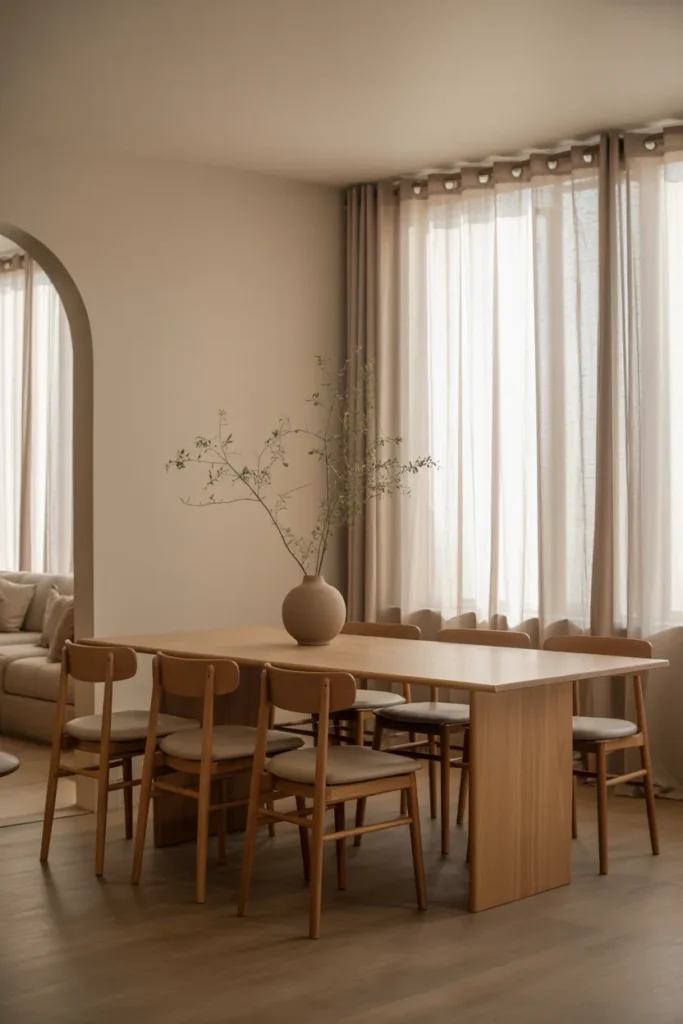
The light wood table is the heart of a Japandi dining room, and everything else orbits around it. Pale oak, ash, or beech brings the Scandinavian half of the style, while the simple, low silhouette nods to Japanese design traditions. The table should have clean lines and honest joinery, with no ornate details or unnecessary flourishes. A light wood top keeps the room feeling bright and airy, which matters enormously because Japandi rooms are intentionally spare and every surface shows. This single piece sets the tone for everything else in the room, so choose it with care. Look for solid construction that will last decades; a Japandi table is not disposable furniture. The finish should be matte and natural, letting the grain show through. When you run your hand across it, it should feel like wood, not plastic.
Choose honest materials: Japandi is built on material honesty, so choose a table made of real wood with a natural finish that celebrates the material. Veneer over particle board undermines the philosophy and rarely ages well, peeling and chipping within a few years. Look for solid tops with visible grain and simple legs, either tapered Scandinavian style or straight Japanese style. A matte oil or hardwax finish protects the wood while keeping it looking and feeling natural. Avoid high-gloss lacquers, which feel wrong in a calm, tactile room and show every fingerprint. The table should invite touch; if you do not want to run your hand across it, it is the wrong table. Check the joinery: well-made tables use proper joints, not just screws and glue. This is furniture meant to be kept, not replaced.
Keep the setting spare: A Japandi table needs very little around it to look complete, and that restraint is the point. Simple chairs in matching or complementary wood, a single low centerpiece, and nothing else. Resist the urge to fill the table with decor; negative space is part of the design and the room needs it to breathe. A small ceramic vase with one branch or a low handmade bowl is enough decoration for the entire table. The chairs should tuck neatly under the table when not in use, keeping the floor clear and the sightlines open. Avoid tablecloths, which hide the wood you chose so carefully; a simple runner is the most dressing this table needs. The finished room should feel like a deep breath: calm, ordered, and quietly beautiful.
- Choose solid light wood, oak, ash, or beech, with a matte natural finish.
- Keep the tabletop nearly clear; one low centerpiece is enough.
- Pick chairs that tuck fully under the table to keep the floor open.
Shop This Look
2. Japandi Dining Room with Black Accents
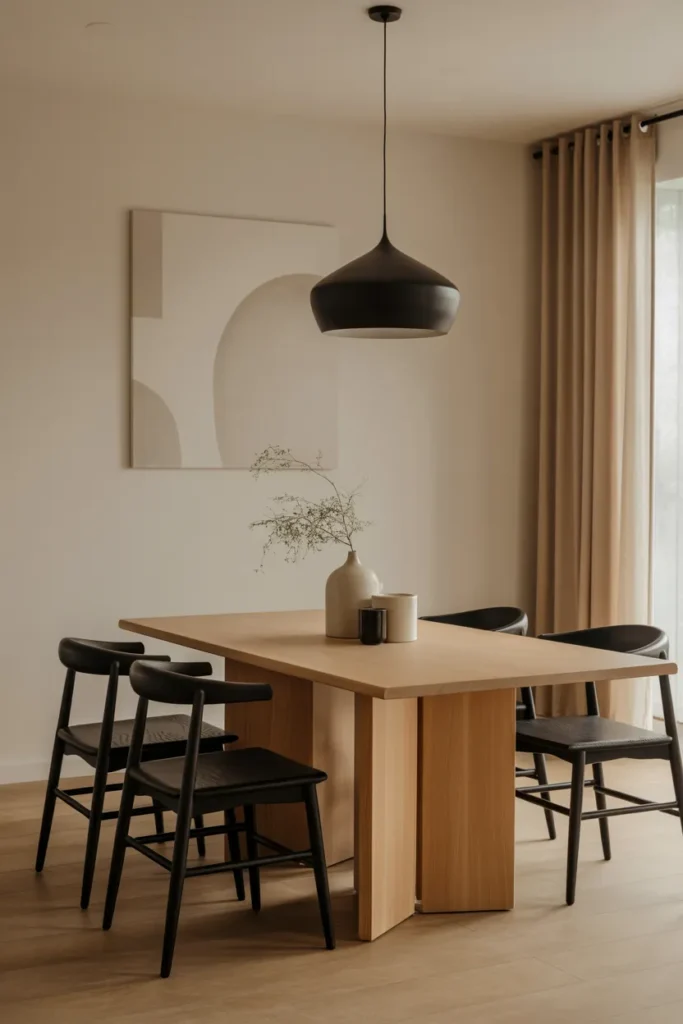
Black accents give a Japandi dining room its definition and prevent the calm palette from going flat. In a room of light wood and soft neutrals, small touches of black, chair frames, pendant cords, window frames, or a single dark vessel, create the contrast that keeps the room from feeling washed out. Japanese interiors have long used black as a grounding element, from ink paintings to charred wood, and Scandinavian design uses it for graphic punch. A little black goes a very long way here, which is why restraint matters. The black should feel like punctuation in a quiet sentence: necessary, precise, and minimal. Without it, the room risks feeling bland; with too much, it loses its serenity. Finding that balance is one of the subtle skills of the style.
Use black sparingly: The rule is accents, not fields, and it is worth repeating until it becomes instinct. Black chair legs, a black pendant shade, or black metal shelf brackets are enough to do the job. Avoid black walls or large black furniture, which overwhelm the calm palette and tip the room toward drama. Each black element should feel deliberate, placed with intention rather than accumulated by accident. Three to five small black touches across the room create rhythm without heaviness. If you are unsure, start with one piece and live with it for a week before adding more; you will quickly feel whether the room needs another note of black. The black elements should relate to each other in finish, all matte or all satin, so they read as a family.
Balance with warmth: Black needs warm companions to stay inviting rather than stark. Light wood, textured linen, and warm white walls keep the contrast friendly and human. A black pendant over a light wood table is the classic Japandi move: the dark shape anchors the composition while the wood glows warmly beneath it. Natural light softens black beautifully, so keep windows uncovered and let daylight do its work. In the evening, warm lamplight keeps black accents feeling cozy rather than severe. Avoid pairing black with cool grays, which can make the combination feel cold and corporate. The result should feel balanced and calm, with the black adding depth and definition rather than drama. It is the quiet backbone of the room.
- Limit black to small accents: chair frames, pendant shades, or brackets.
- Pair black elements with light wood and warm whites.
- Start with one black piece and add more only if the room needs it.
Shop This Look
3. Japandi Dining Room with Natural Materials
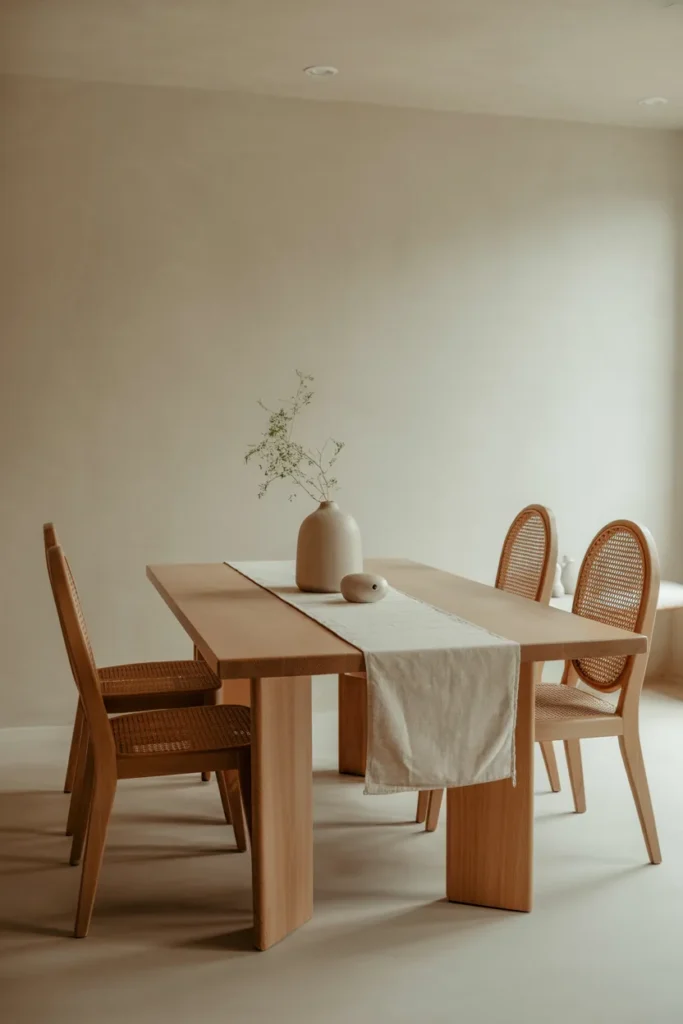
Natural materials are the soul of Japandi style, more important than any single furniture piece. Wood, stone, linen, rattan, clay, and wool bring texture and warmth that manufactured materials cannot match, no matter how clever the imitation. A dining room built from these elements feels grounded and calm, connected to the natural world in a way that soothes. The Japanese concept of wabi-sabi, finding beauty in imperfection, means natural variation is celebrated rather than hidden; the grain, the slub, the uneven glaze are all features. Every material should look and feel like what it actually is. This honesty is the philosophical core of the style, and it is what separates real Japandi from a pale beige imitation. When you touch the materials in the room, they should feel alive.
Layer the textures: The magic is in combining textures so the room feels rich despite its simplicity. Smooth wood with nubby linen, cool stone with warm rattan, rough clay with soft wool: each pairing adds depth. Every material should be touchable and honest, inviting the hand as well as the eye. A wood table, linen chair cushions, a jute rug, and handmade ceramic dishes create a rich tactile experience that makes the room feel luxurious without any actual luxury. Avoid synthetic lookalikes completely; Japandi is about authenticity, and fake wood grain or plastic rattan breaks the spell instantly. Keep the color palette in the natural family, woods, stones, sands, and clays, so the varied textures harmonize instead of competing. Texture, not color, is what makes this room interesting.
Let imperfection show: Wabi-sabi means embracing the handmade and the slightly irregular as beautiful. A hand-thrown bowl with an uneven rim, a wood table with visible grain and knots, linen with a natural slub, these are features to celebrate, not flaws to hide. Avoid anything too perfect, too polished, or too uniform; machine perfection feels dead in a Japandi room. This mindset also makes the style forgiving in daily life: small marks and patina add character over time rather than ruining the look. Choose pieces that will age gracefully and look better in five years than they do today. A table that shows the marks of family dinners is more beautiful, not less. This is sustainability as aesthetics: buy once, buy well, and love the wear.
- Combine at least three natural textures: wood, linen, and stone or clay.
- Avoid synthetic imitations; authenticity is central to the style.
- Choose pieces with handmade character that will age gracefully.
Shop This Look
4. Minimalist Japandi Dining Room with Low-Profile Furniture
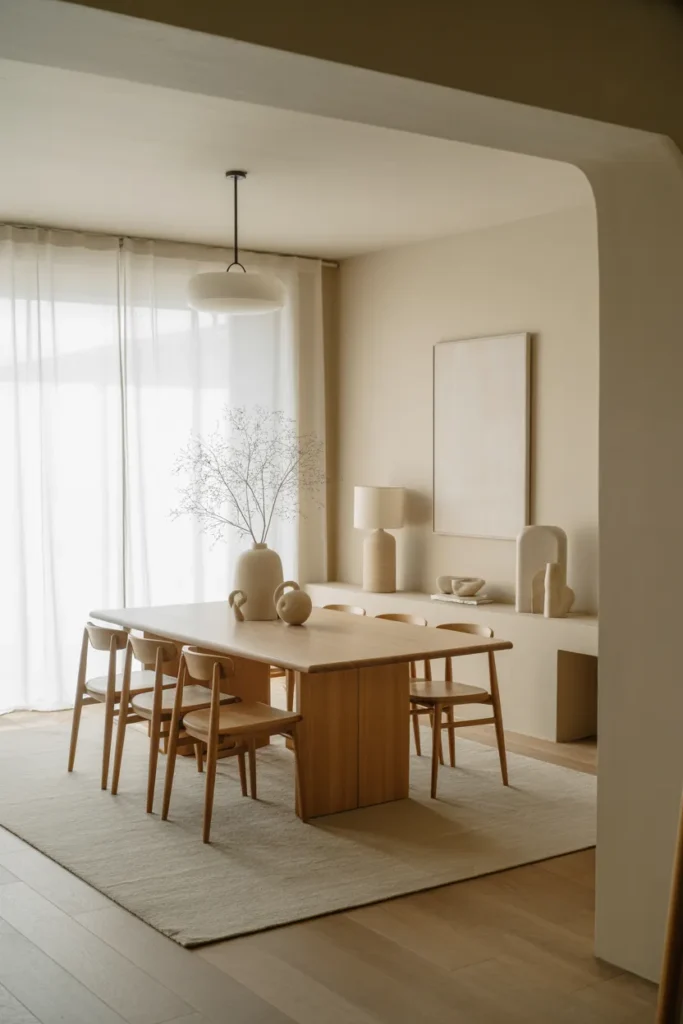
Low-profile furniture is the Japanese contribution to Japandi dining, and it changes the room in ways you feel before you understand. Tables and chairs sit lower than Western norms, which transforms the whole feeling: ceilings seem higher, the space feels more grounded, and the atmosphere becomes meditative and calm. Low furniture also keeps sightlines open across the room, making small dining rooms feel significantly larger. This is not necessarily about floor seating, just a lower, more relaxed posture that brings you closer to the earth. The effect is subtle but powerful, and once you experience it, standard-height dining can feel oddly formal. The lowered perspective is also more flattering to the room itself, hiding clutter and emphasizing the architecture.
Mind the proportions: Standard dining tables are 30 inches high; Japandi-style tables often sit at 28 inches or lower, with correspondingly low chairs to match. Those two inches change how the room feels more than you would expect. Make sure chair seat heights match the table properly: roughly 12 inches between seat and tabletop for comfortable dining. Low-profile does not mean uncomfortable, so test the seating before committing, especially if you host long dinners. Cushions add comfort without raising the visual height much, keeping the low silhouette intact. Check that the table still works with your existing chairs or plan to replace both together; mismatched heights ruin the ergonomics. The goal is relaxed and grounded, not cramped or awkward.
Keep sightlines open: Low furniture’s superpower is open sightlines, and you should design around it. From a low chair, you see across the room instead of into furniture backs, which makes the space feel expansive and connected. Enhance this by keeping the tabletop clear and choosing chairs with low or open backs that do not block views. Avoid tall hutches or high shelving nearby, which defeat the purpose by reintroducing vertical bulk. A low sideboard for storage continues the horizontal line and keeps everything in the same calm register. Keep window sills low or uncovered so the eye travels outward. The room should feel wide and calm, with everything resting close to the earth in quiet horizontal layers.
- Look for tables around 28 inches high with correspondingly low chairs.
- Keep 12 inches between chair seat and tabletop for comfort.
- Choose low or open-back chairs to preserve open sightlines.
Shop This Look
| Low-Profile Solid Wood Dining Table | Low Wooden Dining Chairs, Set of 2 | Minimalist Low Sideboard Cabinet |
5. Japandi Dining Room with Sliding Doors
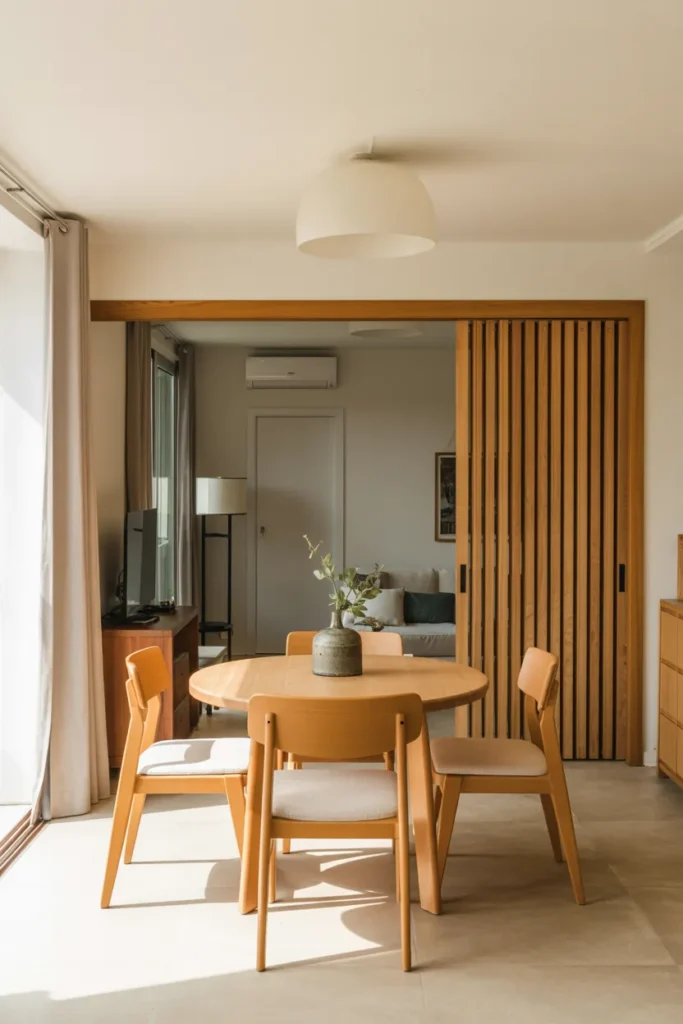
Sliding doors bring Japanese architectural tradition into the dining room in the most functional way. They save floor space, since no swing clearance is needed, and they create flexible boundaries between rooms that can change with the occasion. A sliding door between the dining room and kitchen or living area lets you open the space for large gatherings or close it for intimate dinners. The doors themselves become a design feature, especially in wood with simple, well-made frames. This is functional beauty at its best: every element works hard and looks beautiful doing it. In open-plan homes, sliding doors give you the best of both worlds, openness when you want it and separation when you need it. They are one of the most transformative single additions you can make.
Choose the right style: Sliding doors range from full shoji-style with translucent panels to solid wood slabs on visible hardware, and the choice shapes the room. For Japandi, simple wood frames with frosted or rice-paper-look panels hit the right note of tradition and calm. The hardware should be minimal and quiet: recessed pulls and smooth-gliding tracks that operate with one finger. Avoid rustic barn-door styles with chunky black hardware, which clash with Japandi’s refinement and quiet. The doors should glide effortlessly and feel light, not industrial or agricultural. Consider whether you want the doors to disappear into the wall or remain visible; pocket doors need planning during construction but give the cleanest result. Visible tracks can look beautiful if they are slim and well-finished.
Plan the track: The track system determines how the doors look, sound, and work every day. Ceiling-mounted tracks keep the floor completely clear and look the cleanest, with nothing to trip over or collect dirt. Wall-mounted tracks are easier to retrofit into existing rooms. Make sure the track is perfectly level and the doors overlap enough for visual privacy when closed; gaps defeat the purpose. Soft-close mechanisms prevent slamming and feel premium, worth the small extra cost. Choose tracks rated for the door weight with margin to spare, since undersized hardware sags over time. Test the glide before finalizing; a door that sticks or rattles will annoy you daily. Good hardware is invisible in use, which is exactly what you want.
- Choose simple wood frames with frosted panels for an authentic Japandi feel.
- Use ceiling-mounted tracks for the cleanest look and clear floors.
- Add soft-close mechanisms for quiet, premium operation.
Shop This Look
6. Japandi Dining Room with Floating Shelves
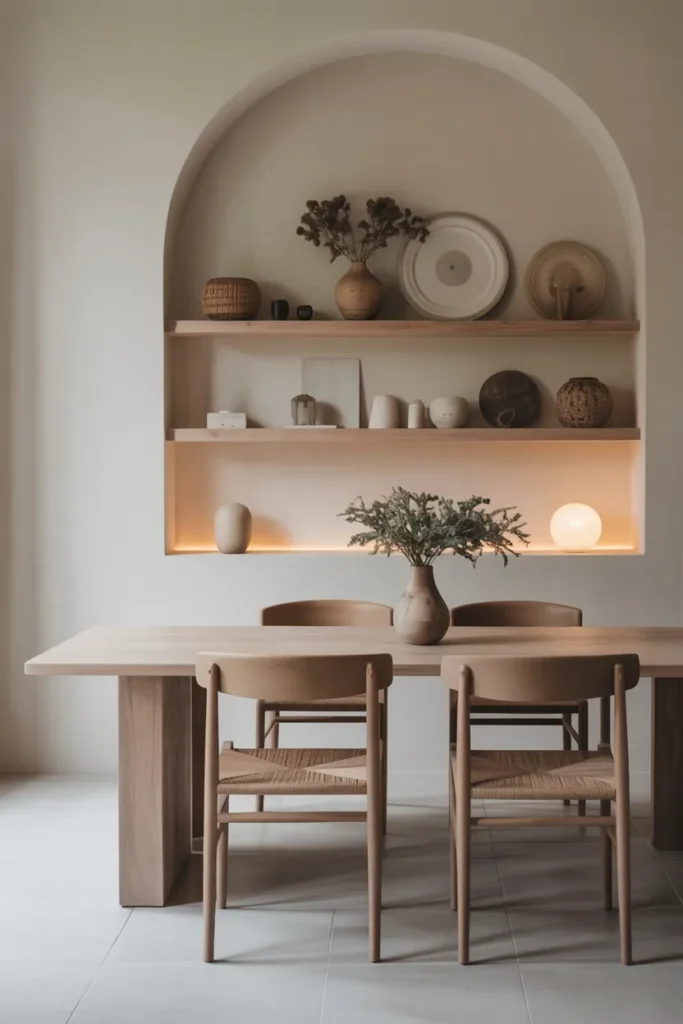
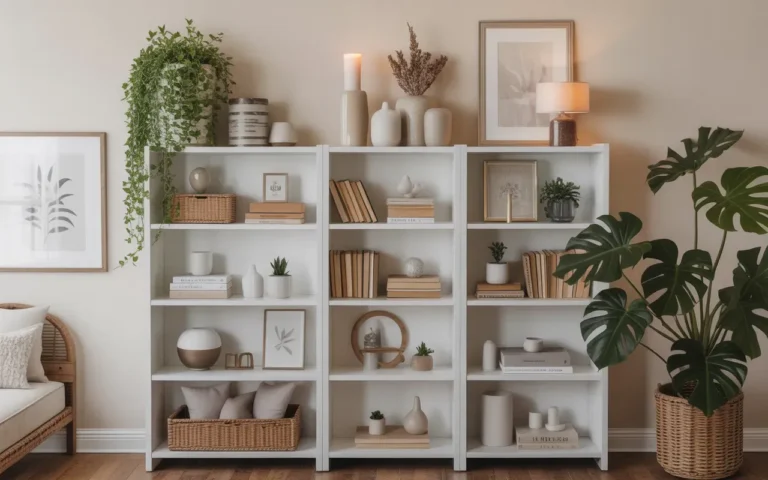
Floating shelves in a Japandi dining room hold a few beautiful objects and nothing more, and that discipline is the point. The shelves themselves are simple wood planks on hidden brackets, and what sits on them is carefully chosen: handmade ceramics, a small plant, a stack of linen napkins. Open shelving replaces bulky hutches and sideboards, keeping the room light and airy. The practice of styling them is part of the Japandi philosophy; every object must earn its place through beauty or use, preferably both. The shelves become a living composition that you tend over time, removing what no longer belongs. This is not storage; it is a daily exercise in restraint and appreciation.
Style with restraint: Japandi shelf styling follows strict rules that keep it from sliding into clutter. Group objects in small numbers, leave plenty of empty space around each group, and choose only natural materials that belong to the palette. Three to five objects per shelf is plenty; more than that and the calm breaks. Vary the heights for visual interest but keep the colors quiet and related. A handmade bowl, a small trailing plant, and a folded textile make a complete composition that needs nothing added. If a shelf starts looking cluttered, remove half the objects rather than rearranging; the answer to clutter is always less. The empty space is as important as the objects, giving each piece room to be appreciated. Step back and squint: the shelf should feel calm at a glance.
Keep it practical: Dining room shelves should hold things you actually use, not a museum of untouched objects. Everyday ceramics, glassware, or serving pieces are ideal, since regular use keeps them dust-free and justifies their presence. Avoid purely decorative collections that gather dust and serve no purpose; they contradict the style’s honesty. Keep the shelves within easy reach and not too high; Japandi is about ease and daily use, not display. One or two shelves are enough for most dining rooms; more than that starts to feel like a shop. Use hidden brackets rated well above the actual load, since ceramics are heavy. The goal is a living, useful wall that happens to be beautiful, not a beautiful wall that happens to hold things.
- Style with three to five natural-material objects per shelf, plus empty space.
- Store everyday ceramics you actually use, not just decor.
- Use hidden brackets and simple wood planks for the shelves.
Shop This Look
7. Japandi Dining Room with Glass Accents
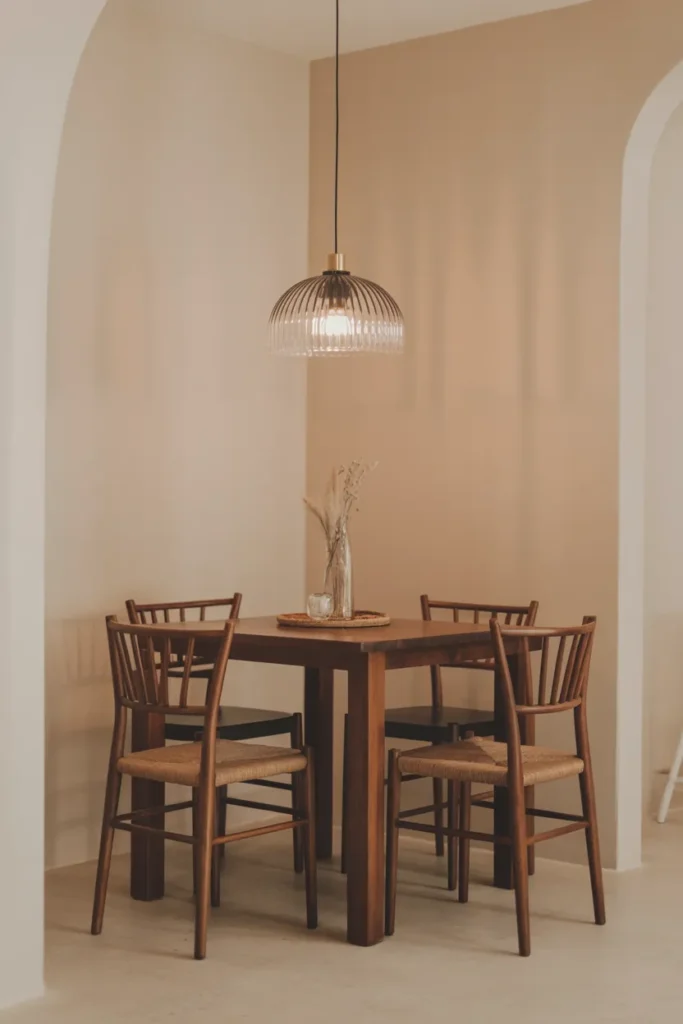
Glass accents keep a Japandi dining room feeling light and prevent the natural materials from becoming too dense. A glass pendant shade, simple glassware on open shelves, or a glass vase with branches adds transparency that balances the solidity of wood and stone. Glass catches light beautifully, creating subtle sparkle and reflection without any visual heaviness. In a style built on calm and restraint, glass is the quiet element that keeps things from feeling too earthy or closed in. Use it sparingly for the best effect; a little transparency goes a long way. The contrast between solid wood and clear glass is one of the most pleasing in the Japandi palette, and it costs very little to achieve.
Keep it simple: Japandi glass should be simple and honest, without decoration or pretense. Clear or lightly smoked glass with clean, simple shapes suits the mood; avoid cut crystal, colored glass, or ornate forms, which clash with the minimalist calm. A single glass pendant with an exposed bulb, a few handmade-look tumblers on a shelf, or one sculptural vase with branches is enough for the whole room. The glass should feel like frozen water: clear, simple, and calm. Less is genuinely more here, and one well-chosen glass piece has more impact than a collection. Keep the shapes organic or geometric but always simple; the material itself is the interest.
Mind the maintenance: Glass shows dust and fingerprints, so place it where it will be used or easily cleaned without resentment. Glassware on open shelves gets handled regularly, which keeps it clean naturally through use. A glass pendant needs an occasional wipe; choose one you can comfortably reach with a cloth. Smoked or textured glass hides smudges better than perfectly clear glass and can be the practical choice for high-touch pieces. Avoid placing glass where it will be constantly fingerprinted by children if that will bother you. With a little routine care, glass accents stay beautiful and keep the room feeling light, open, and quietly refined.
- Choose clear or lightly smoked glass with simple, clean shapes.
- Use glass where it gets handled regularly to stay naturally clean.
- One glass pendant or vase is enough; do not overdo it.
Shop This Look
8. Japandi Dining Room with Neutral Rug
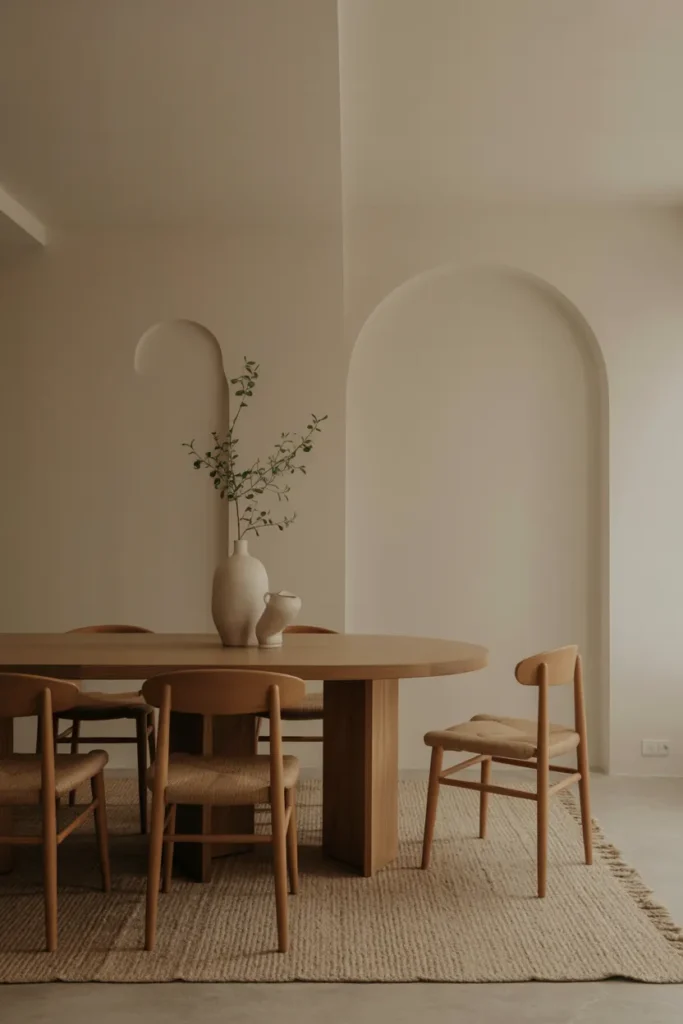
A neutral rug anchors the dining table and softens the room in ways bare floors cannot. In Japandi style, the rug should be flat-weave or low-pile in natural fibers: wool, jute, or cotton in beige, gray, or warm white. The rug defines the dining zone, especially in open-plan spaces where the dining area needs visual boundaries. It adds warmth underfoot and softens the acoustics, making conversation more pleasant. Pattern should be minimal or absent; texture does the decorative work here. The rug is the quiet foundation the table stands on, and it should feel inevitable rather than decorative. Choose it after the table, making sure the tones harmonize with the wood.
Size it right: The rug must be large enough that chairs stay on it when pulled out, or the whole arrangement looks wrong. Measure your table, then add at least 24 inches on every side; this is the minimum for comfortable chair movement. For a typical six-seat table, that usually means an 8 by 10 foot rug. Too small is the most common rug mistake in dining rooms, and it makes even beautiful furniture look cramped and awkward. The rug should extend well beyond the chair legs in their pushed-out position, not just when tucked in. When in doubt between two sizes, go larger; oversized rugs look generous while undersized ones look like mistakes. Measure twice, because large rugs are expensive to get wrong.
Choose natural fibers: Natural fibers suit both the style and the function of a dining room rug. Wool is soft, durable, and naturally stain-resistant, making it the ideal choice under a dining table where spills happen. Jute and sisal add beautiful texture but show spills badly, so they work better in low-mess households or under console tables. Flat-weave cotton is affordable and washable, a practical choice for families. Whatever you choose, use a quality rug pad underneath to prevent slipping, protect the floor, and add a little cushioning. Vacuum regularly with suction only, no beater bar on natural fibers. Address spills immediately by blotting, never rubbing, with a damp cloth.
- Add 24 inches beyond the table on all sides so chairs stay on the rug.
- Choose wool for durability and natural stain resistance under the table.
- Use a rug pad to prevent slipping and protect floors.
Shop This Look
9. Japandi Dining Room with Pendant Lighting
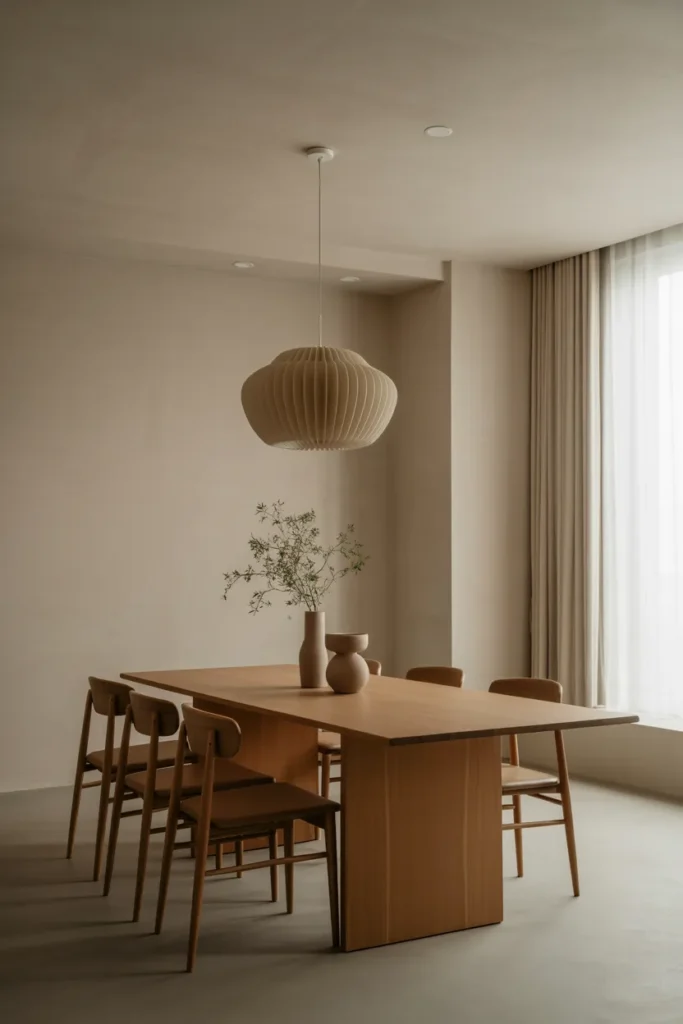
Pendant lighting is the jewelry of a Japandi dining room, the one decorative flourish the style allows. A single statement pendant, or a small cluster over a long table, hangs above the table and defines the space architecturally. Japandi pendants favor natural materials: paper, rattan, wood, or simple metal in black or brass. The light should be warm and dimmable, creating an intimate pool of light over the table that draws people together. The pendant is often the room’s only decorative object, so choose it carefully and invest in quality. It needs to look beautiful both off and on: sculptural by day, glowing by night. A great pendant elevates the entire room; a wrong one undermines it.
Hang it right: The bottom of the pendant should sit 30 to 36 inches above the tabletop for standard installations. Too high and the light feels disconnected from the table, floating uselessly near the ceiling. Too low and it blocks sightlines across the table, forcing guests to peer around it. For long tables, use two or three smaller pendants spaced evenly instead of one large one; the rhythm looks better and the light distributes more evenly. Center the pendant over the table, not the room, since tables are not always centered in the space. A dimmer switch is absolutely essential; bright, undimmable pendants ruin the calm mood Japandi aims for. Test the height temporarily before final installation, since adjusting afterward is annoying.
Choose natural materials: Paper lanterns, woven rattan, and light wood shades all suit the style beautifully. They diffuse light softly, add organic texture, and look handmade in the best way. Black metal pendants work too, providing the classic Japandi contrast against light wood and pale walls. Avoid chrome, crystal, or colorful shades, which fight the calm palette and introduce visual noise. The shade should direct light downward onto the table while glowing softly outward; fully opaque shades create harsh pools while fully bare bulbs glare. Consider the bulb itself: a warm Edison-style LED adds to the look when visible. It is worth investing in this one piece, because the pendant defines the room’s character more than any other single object.
- Hang pendants 30 to 36 inches above the tabletop.
- Use two or three small pendants for long tables.
- Install a dimmer switch to control the mood.
Shop This Look
10. Japandi Dining Room with Indoor Plants
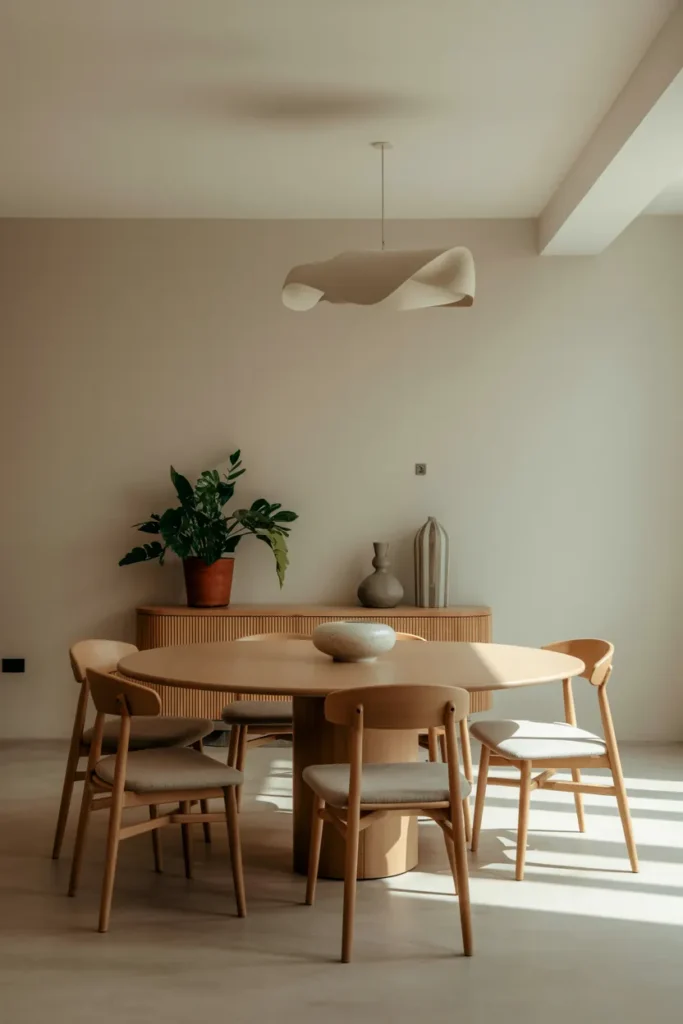
Plants bring living nature into the Japandi dining room, which is essential to the style’s philosophy rather than mere decoration. A single sculptural plant, an olive tree, a fiddle-leaf fig, or a large monstera, adds life and softness to the minimalist room. Japanese design has always honored nature as a participant in the interior, and Scandinavian homes use plants to survive long, dark winters with life intact. One great plant beats five small ones in this style; restraint applies to greenery too. The plant should feel like a deliberate choice, not an afterthought grabbed at the garden center. Its form should echo the room’s calm: architectural, simple, and quietly alive. A healthy plant glows with life and completes the room in a way no object can.
Choose sculptural forms: Japandi favors plants with strong, simple shapes that read as living sculpture. Architectural leaves, clean lines, and natural asymmetry suit the style; avoid fussy flowering plants or anything too colorful or wild. The plant should look serene, almost meditative in its form. Place it in a simple ceramic or clay pot, never plastic, because the container is part of the composition. A tall plant in an empty corner balances the room’s horizontal lines and fills vertical space beautifully. A small plant on a shelf or sideboard adds life at eye level without demanding attention. Keep the total count low; two or three plants maximum for most dining rooms. Each one should have room to breathe and be appreciated individually.
Keep them healthy: A dying plant ruins the calm faster than almost anything else in the room, so choose honestly for your conditions. Most dining rooms have medium, indirect light, which suits olive trees, ZZ plants, and snake plants well. Do not buy a sun-lover for a north-facing room and hope for the best. Water on a consistent schedule, and dust the leaves occasionally with a damp cloth so they can breathe and photosynthesize properly. Learn your plant’s specific needs rather than treating all greenery the same. If you travel often, choose something forgiving that tolerates neglect. The plant is a living commitment, so pick one you can genuinely keep thriving. A thriving plant is the ultimate Japandi accessory.
- Choose one sculptural plant over many small ones.
- Use simple ceramic or clay pots, never plastic.
- Match the plant to your actual light conditions.
Shop This Look
11. Japandi Dining Room with Two-Tone Wood
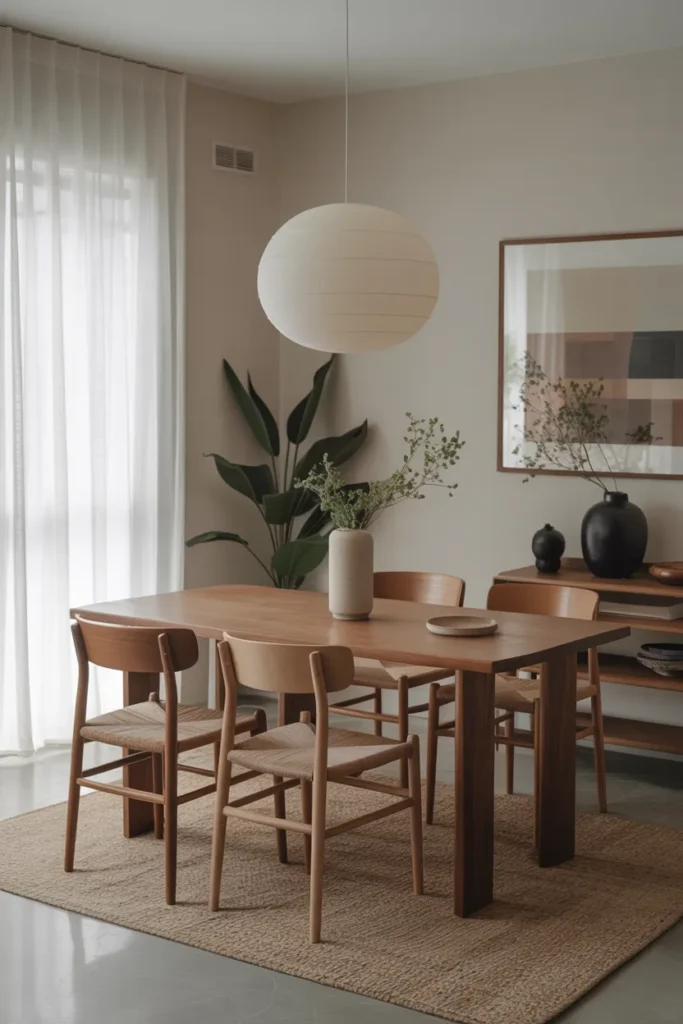
Two-tone wood adds depth to a Japandi dining room without adding a single drop of color. Pairing light oak with dark walnut, for example, creates the contrast the style loves while staying entirely in the natural family. The combination might be a light table with dark chairs, or dark beams against light floors, or a walnut sideboard against oak flooring. The interplay of tones gives the room richness and prevents the light palette from feeling flat or monotonous. It is a sophisticated move that rewards careful pairing and elevates the room beyond single-tone simplicity. The contrast also gives the eye places to rest and details to discover, which keeps the minimalist room interesting over time. When done well, guests feel the richness without being able to name its source.
Pair with intention: Two wood tones should look deliberate, not accidental, and that takes intention. Choose tones with clear, confident contrast: pale ash with dark walnut, or light oak with ebonized black wood. Avoid two similar mid-tones, which look like a matching mistake rather than a design choice. Repeat each tone at least twice in the room so both feel intentional and integrated; a single dark chair among light furniture looks lost. The darker tone typically works best on smaller elements, chair frames, shelf brackets, a sideboard, while the lighter tone covers larger surfaces like the table and floor. This balance keeps the room light overall while adding the depth that makes it interesting. Photograph the combination to check it objectively.
Keep finishes consistent: Both wood tones should share the same finish type for the combination to feel unified. Both matte, or both satin; mixed sheens look disjointed even when the colors work. Matte oil finishes suit Japandi best, keeping both woods looking natural and touchable rather than coated. Test the combination in your actual light before committing, since wood tones shift significantly with lighting and what works in the store may fail at home. The two tones should harmonize like instruments in a duet: distinct voices contributing to one song. When it works, the room gains a quiet richness that single-tone wood cannot match. Take your time finding the right pairing; it is worth the effort.
- Pair clearly contrasting tones, like pale ash with dark walnut.
- Repeat each tone at least twice so both feel intentional.
- Keep the same finish type, preferably matte, on both woods.
Shop This Look
12. Japandi Dining Room with Sliding Shoji-Style Doors
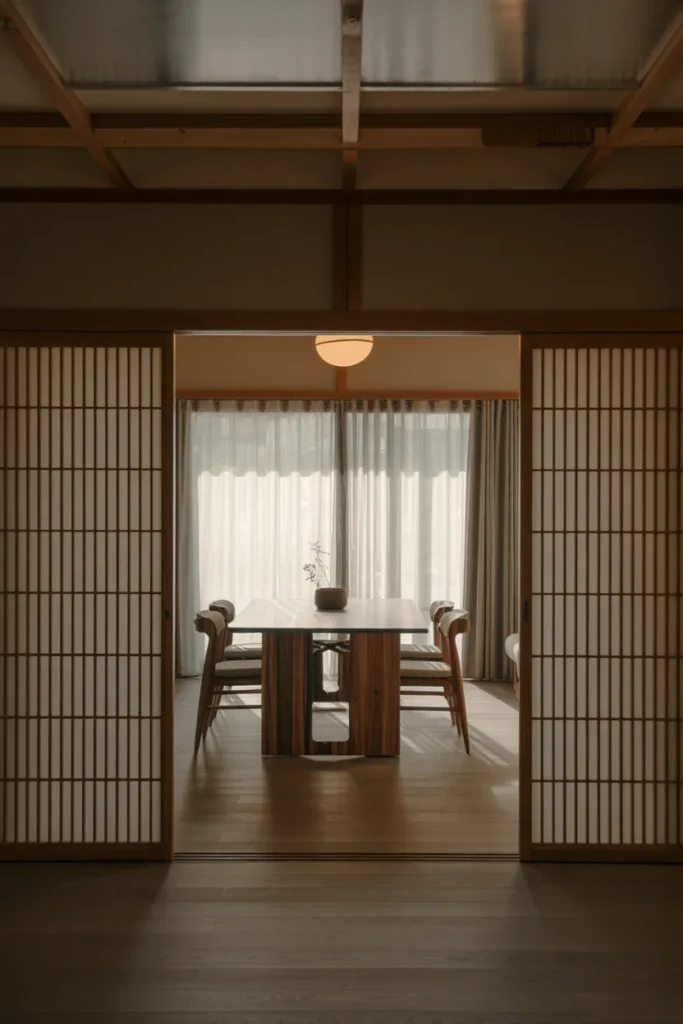
Shoji-style doors are the most recognizably Japanese element you can add to a dining room, carrying centuries of craft tradition. The wood lattice with translucent panels filters light beautifully, creating a soft, diffused glow that transforms the room’s entire atmosphere. Real shoji use handmade rice paper, but modern versions use durable translucent acrylic or frosted glass that withstands daily life. Used as a room divider, closet front, or window covering, shoji brings authentic Japanese craft directly into the space. It is functional art: a door that is also a lantern, a wall that is also a window. The lattice grid itself is beautiful, a study in proportion and rhythm that rewards close looking. Few elements say Japandi as clearly as well-made shoji.
Honor the craft: Real shoji doors are handmade with precise traditional joinery, and good modern versions respect that heritage. Look for doors with real wood frames and clean, even lattice work, not printed imitations that fake the grid. The translucent panels should diffuse light evenly without hot spots or visible seams. Traditional proportions, with the lattice grid sized harmoniously to the door, look best; oversized or undersized grids feel wrong. If you are handy, shoji kits let you build custom sizes for unusual openings. The craftsmanship is the entire point, so do not settle for flimsy versions with stapled-together frames. Run your hand along the lattice; it should feel precise and smooth, a testament to the maker’s skill. This is one area where quality is visible and worth paying for.
Use light wisely: Shoji’s magic is what it does with light, so placement determines everything. Positioned where daylight passes through, the panels glow softly and fill the room with diffused brightness that no lamp can replicate. As a divider between the dining room and a brighter space, shoji borrows light beautifully while providing visual privacy. At night, backlight a shoji screen with a warm lamp behind it for a lantern effect that transforms the evening room. Avoid placing shoji where it will be handled roughly or bumped by chairs; the panels are delicate by nature and design. Treat it as the precious crafted element it is, and it will reward you with beauty for decades. Keep a small repair kit for the paper panels if you choose the traditional material.
- Choose real wood frames with translucent panels, not printed imitations.
- Place shoji where daylight passes through for the glowing effect.
- Backlight shoji screens at night for a lantern-like glow.
Shop This Look
13. Japandi Dining Room with Bench Seating
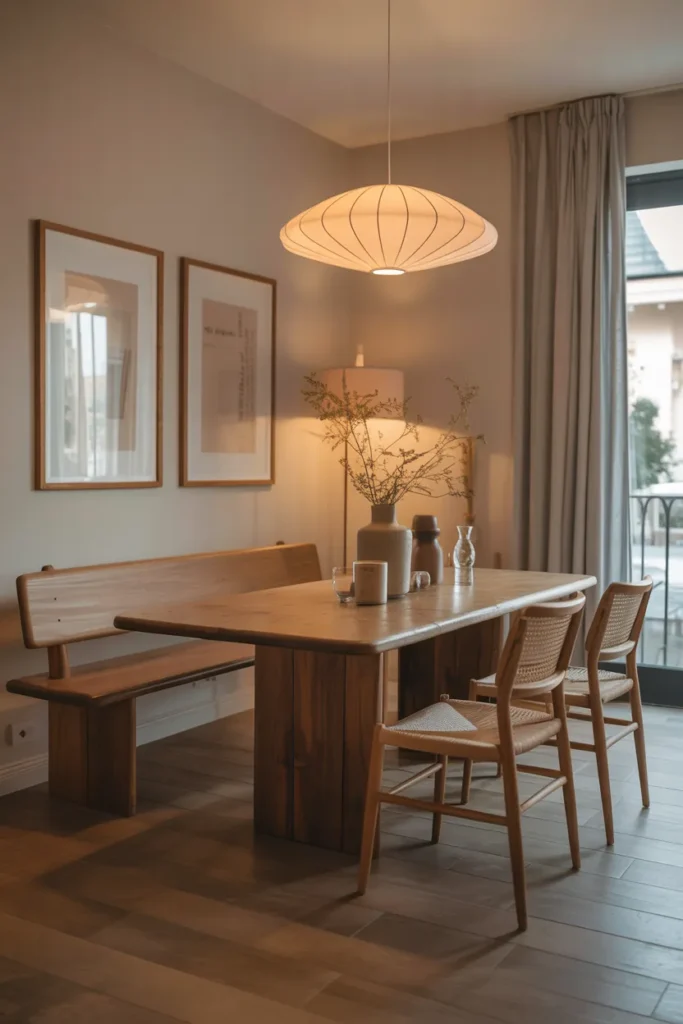
Bench seating on one side of the table is practical, space-saving, and perfectly Japandi in spirit. A simple wood bench tucks neatly under the table when not in use, saving the floor space that chair backs would permanently occupy. It seats more people flexibly than individual chairs, which suits the style’s welcoming, communal spirit. The bench’s long horizontal line echoes the table and reinforces the calm, linear aesthetic that defines the room. Paired with chairs on the other side, it creates an inviting, informal mix that feels collected rather than matched. The bench also suits the Japanese influence toward low, simple forms. For families, the flexibility is practical: squeeze in an extra guest without finding another chair.
Mix with chairs: The classic arrangement is a bench on one long side and chairs on the other, with chairs at the table ends completing the set. This mix looks intentional and relaxed, avoiding the formality of all-matching chairs. Match the bench wood to the table for cohesion, or use the two-tone approach with a darker bench against a light table. Add a long cushion or individual seat pads for comfort; bare wood benches get hard during long dinners and discourage lingering. The cushion should be simple linen in a neutral tone that belongs to the palette. The mix of bench and chairs keeps the room from feeling too formal or too casual; it hits the comfortable middle that Japandi aims for. Make sure the bench height matches your chairs so everyone sits level.
Mind the comfort: Benches need backs or cushions for real comfort over a full meal. A bench placed against the wall can use the wall as a backrest with the addition of cushions, which is the most comfortable arrangement. A freestanding bench in the middle of the room benefits from thick seat pads and perhaps a low backrest. The bench height should match your chair seat height, roughly 18 inches, so everyone at the table sits at the same level and no one feels like a child at the grown-up table. Test the arrangement before committing, since some people genuinely dislike bench seating for daily use. For occasional dining, flexible seating, and a relaxed look, though, it is hard to beat. The bench can also serve as extra seating elsewhere when needed.
- Pair a bench on one side with chairs on the other for a relaxed mix.
- Add linen cushions for comfort during long meals.
- Match bench height to chair seat height, roughly 18 inches.
Shop This Look
14. Japandi Dining Room with Low Pendant Lights
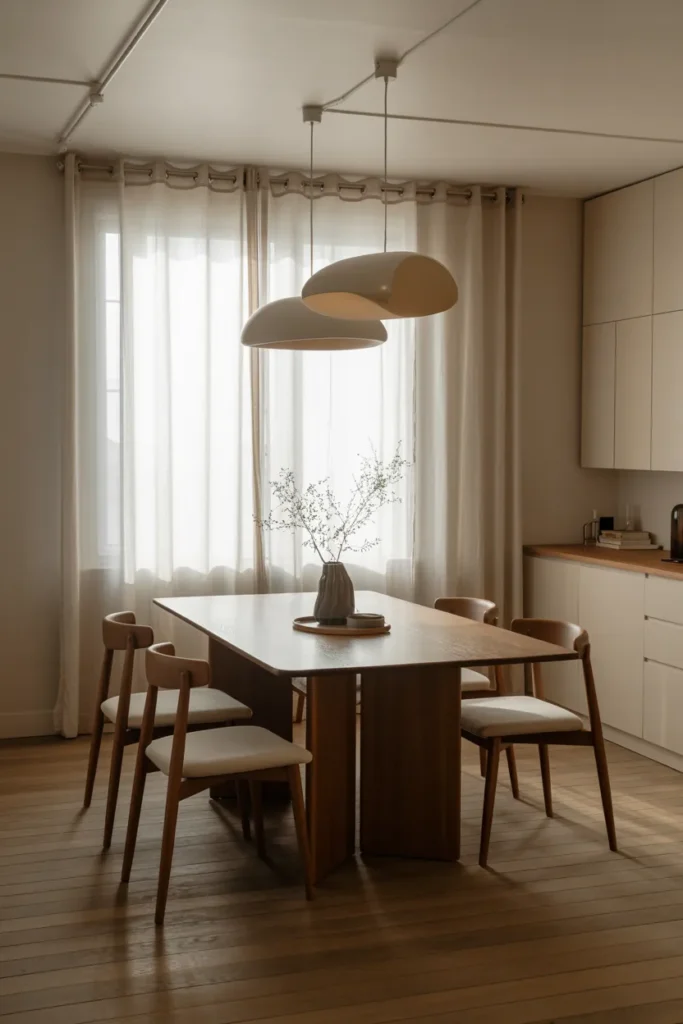
Low pendant lights hang closer to the table than standard fixtures, creating an intimate pool of light that draws people together physically and socially. In Japandi dining rooms, where atmosphere matters as much as function, this closeness is the entire point. The pendants become part of the tablescape itself, almost like sculptural centerpieces that happen to glow. Paper, rattan, or frosted glass shades diffuse the light softly, avoiding any harshness. The effect is candlelit intimacy with modern convenience: all the romance, none of the dripping wax. When the pendant hangs low, the rest of the room falls into soft shadow, and the table becomes a small, glowing world of its own. This is how ordinary weeknight dinners start feeling like occasions.
Get the height right: Low pendants typically hang 24 to 30 inches above the tabletop, noticeably lower than the standard 30 to 36 inches. At this height, the shade enters the sightline across the table, so choose one that looks good from the side and below, not just from standing height. Make sure seated guests can see each other comfortably under the shade; the bottom edge should clear eye level for average seated adults. For glare-free light, choose shades that direct light downward onto the table or diffuse it fully through paper or frosted glass. Test the height with the pendant temporarily hung before final installation, since adjusting hardwired fixtures afterward is annoying and expensive. Consider the tallest regular guest when setting the height.
Create intimacy: Low pendants work because they shrink the perceived room down to the table, creating intimacy through light. The surrounding space falls into soft shadow while the table glows warmly, focusing all attention on the food and the company. This is ideal for evening meals and long conversations that stretch late. Use warm bulbs, 2200 to 2700 Kelvin, for the most flattering light on both food and faces; cooler bulbs destroy the effect. A dimmer lets you adjust from practical brightness for serving to full intimacy for lingering. Keep the surrounding room lighting minimal so the pendant’s pool of light dominates the experience. Dinner becomes an event rather than just a meal, which is exactly what a dining room should do.
- Hang low pendants 24 to 30 inches above the tabletop.
- Ensure the shade clears seated eye level for conversation.
- Use warm 2200K to 2700K bulbs with a dimmer for intimacy.
Shop This Look
15. Japandi Dining Room with Open Shelving
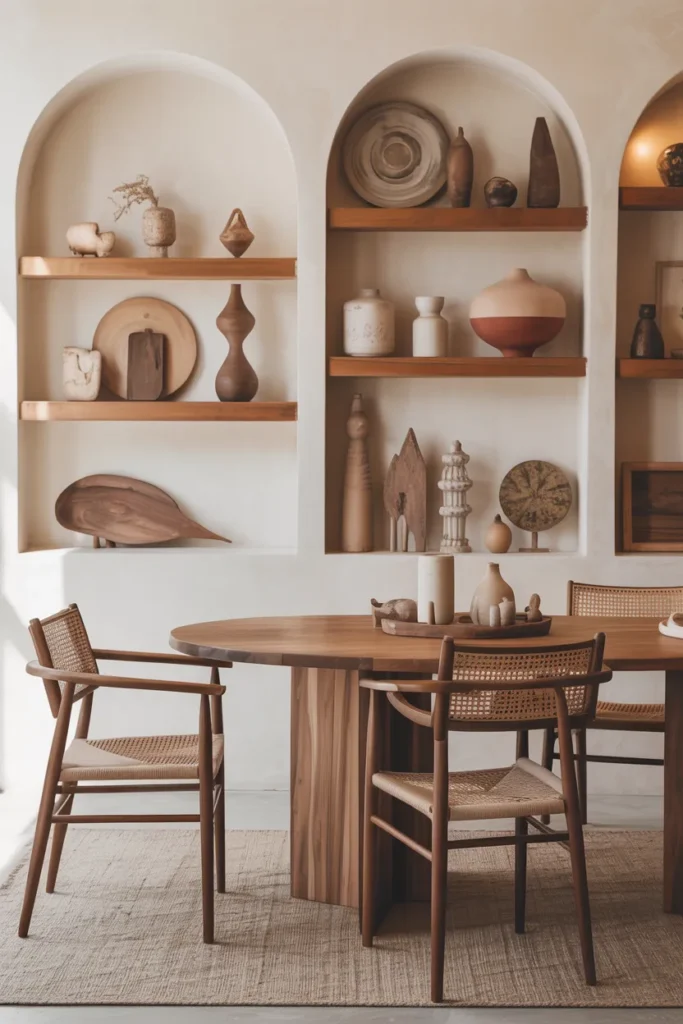
Open shelving in a Japandi dining room replaces closed storage with breathing room and visual calm. Simple wood shelves on a bare wall hold everyday dishes and a few beautiful objects, keeping everything visible, accessible, and honest. The openness suits the style’s airy philosophy, and it enforces the discipline Japandi requires: only beautiful, useful things earn shelf space, because everything is on display. Done well, the shelves are as much a design feature as a storage solution, a living composition that evolves. Done poorly, they become cluttered chaos that undermines the entire room. The difference is entirely in curation and maintenance. Open shelves are a commitment to the lifestyle, not just a look.
Curate carefully: Open shelves are a daily practice in restraint, and they will test yours. Every item should be something you use regularly or genuinely love looking at, preferably both. Mismatched, chipped, or ugly items have no place here; they are visible all the time and there is nowhere to hide. Group similar items together for calm: stacks of bowls, rows of cups, a small cluster of ceramics in related tones. Leave generous empty space between groups so each one can breathe and be appreciated. If the shelves ever start looking cluttered, that is a signal to edit ruthlessly, not to add more storage. The shelves should look calm at a glance, even from across the room. Photograph them occasionally to see them with fresh eyes.
Keep it clean: Open shelves collect dust and kitchen grease, so they demand regular wiping that closed cabinets never need. Store everyday items you use often; frequent handling keeps them clean naturally and justifies their prominent place. Keep shelves away from the stove if the dining room connects to the kitchen, since airborne grease is the enemy. A quick weekly wipe with a damp cloth maintains them with minimal effort. Choose shelf finishes that wipe easily, like sealed wood or oiled surfaces that resist moisture. Be honest about your tolerance for this maintenance before committing; if weekly wiping sounds miserable, choose closed storage instead. The airy result is worth it for those who enjoy the ritual.
- Display only beautiful, useful items you reach for regularly.
- Leave generous empty space between groups of objects.
- Wipe shelves weekly to prevent dust and grease buildup.
Shop This Look
16. Japandi Dining Room with Textured Wall
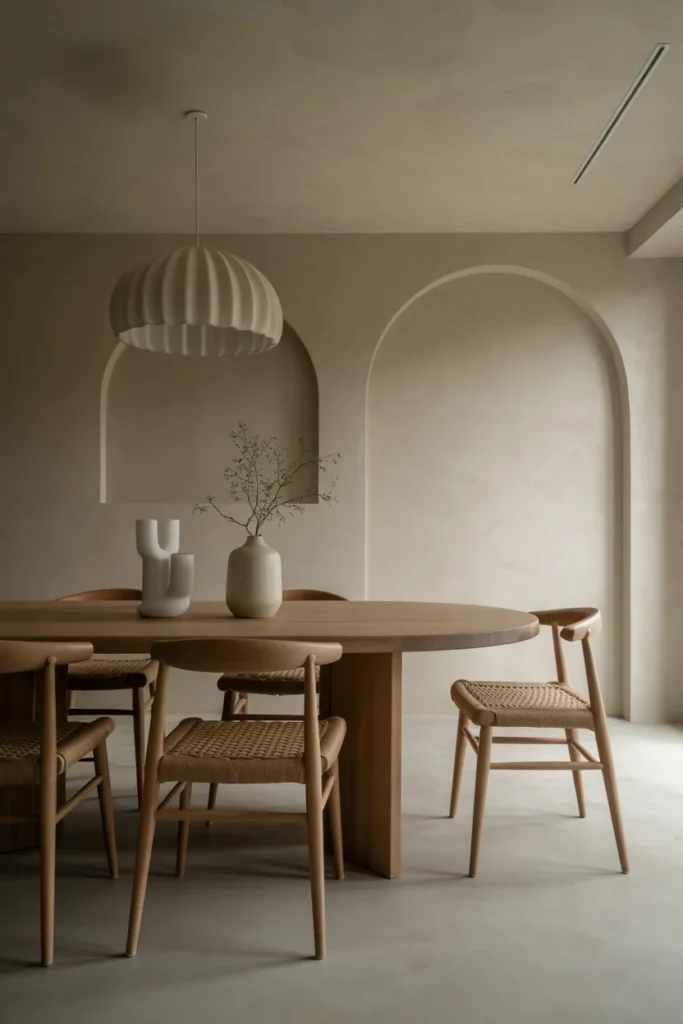
A textured wall gives a Japandi dining room depth without adding a single drop of color or pattern. Limewash, clay plaster, or subtle fluted paneling creates a surface that shifts with the light, adding quiet interest to the minimalist room. The texture should be felt more than seen: a soft movement across the wall rather than a bold statement demanding attention. This is wabi-sabi made architectural, beauty found in the imperfect, handmade surface. The wall becomes a backdrop that rewards lingering looks without ever shouting. In a style defined by restraint, the textured wall is how you add richness without adding things. It is the most architectural idea on this list, and it changes the room’s feeling fundamentally.
Choose subtle texture: The best Japandi wall textures are barely there, whispering rather than speaking. Limewash in warm white creates soft, cloud-like movement that shifts through the day. Clay plaster adds earthy depth with natural variation. Fine fluted paneling adds gentle rhythm without noise. Avoid heavy textures like rough stucco or bold 3D panels, which fight the calm and dominate the room. The wall should reward a second look, not demand a first one; if guests comment on the wall before anything else, it is too much. Sample the finish on a large board and live with it for several days before committing to the whole wall. Check it in different lights, since texture reveals itself through shadow and changes constantly.
Light it softly: Texture needs the right light to show itself, or the effort is wasted. Soft, indirect light raking across the wall reveals the surface gently, like morning sun across a landscape. Harsh downlights create unflattering shadows and hot spots on textured walls. Natural daylight is ideal; position the textured wall where it catches window light through the day. In the evening, a floor lamp aimed at the wall from the side creates a warm, glowing effect. The texture becomes a living part of the room, changing through the day and the seasons. It is subtle luxury: the kind of detail you feel more than see, and the kind that makes a room feel expensive without any expensive objects.
- Choose barely-there textures like limewash or clay plaster.
- Sample on a large board before committing to the wall.
- Light textured walls softly with indirect or natural light.
Shop This Look
17. Japandi Dining Room with Round Table
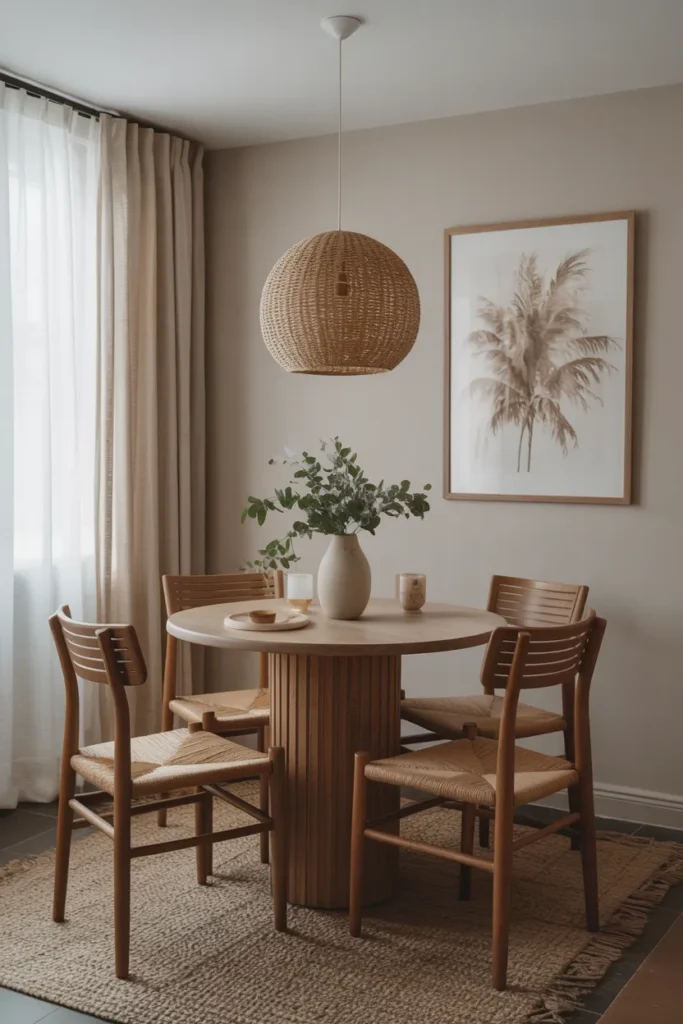
A round table changes the social dynamics of a dining room in ways rectangular tables cannot. Everyone faces each other equally, with no head of the table and no one stuck at the far end. Conversation flows naturally around the circle, and the room feels more intimate and egalitarian. In Japandi style, a round wood table with simple legs is a beautiful centerpiece that softens the room’s many straight lines. Round tables also suit smaller dining rooms practically, since they have no corners to bump into and fit more flexibly into tight or awkward spaces. The soft geometry is welcoming in a way rectangles rarely are. For households that value togetherness, the round table is the most social choice.
Size it wisely: Round tables seat fewer people than you might expect, so size carefully. A 48-inch round seats four comfortably; a 60-inch round seats six without crowding. Measure your room and leave at least 36 inches between the table edge and the walls for comfortable chair movement. A pedestal base maximizes legroom and looks clean and modern, while four legs suit the Japandi aesthetic better with their crafted feel. Consider an extendable round table if you host occasionally; it stays compact for daily use and grows for gatherings, the best of both worlds. Check the extension mechanism in person; cheap ones stick and wobble. The table should feel solid at every size.
Center the composition: A round table wants a centered pendant above it and ideally a round rug beneath it. This concentric composition feels settled and intentional, with every element echoing the central geometry. The pendant should be round or spherical to continue the theme; a linear pendant over a round table looks disconnected. Keep the tabletop styling minimal: one low centerpiece that does not block sightlines across the circle. A small bowl, a low plant, or a simple candle grouping is enough. The roundness softens the room’s geometry and invites gathering in a way that feels natural. It is the most social table shape, which suits Japandi’s welcoming spirit perfectly. Guests will linger longer around a round table.
- Allow 36 inches between table edge and walls for chair movement.
- Pair with a round rug and centered pendant for a settled composition.
- Consider an extendable round table for flexible hosting.
Shop This Look
| 48-Inch Round Solid Wood Dining Table | Round Jute Rug for Under Dining Table | Spherical Paper Pendant Light |
18. Japandi Dining Room with Layered Lighting
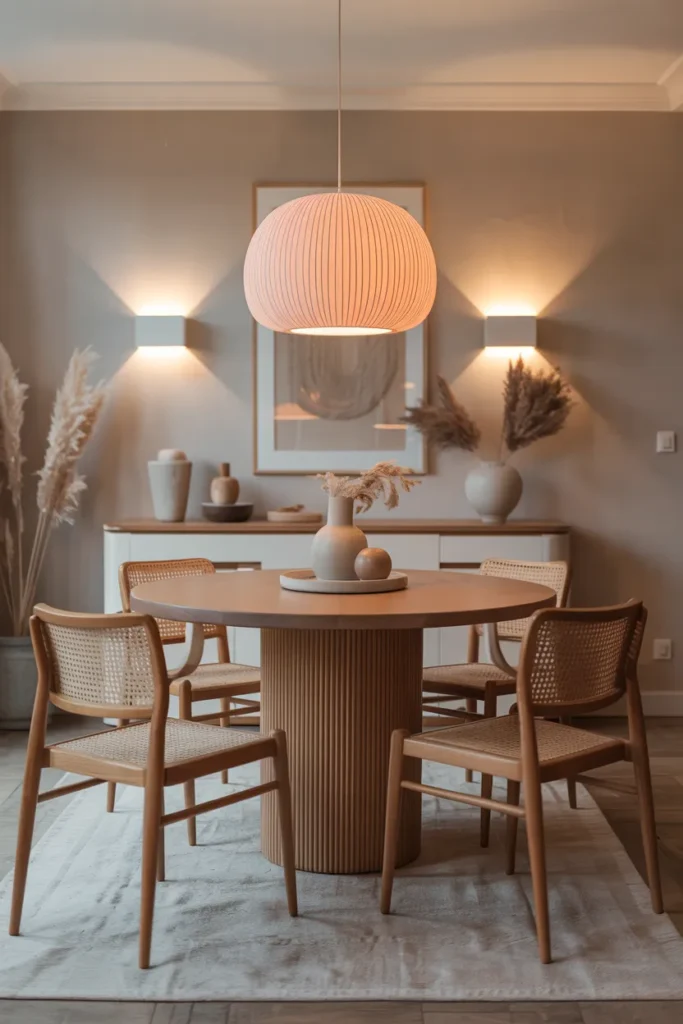
Layered lighting means the dining room never relies on a single source, and the difference is transformative. A pendant over the table, a floor lamp in the corner, and perhaps candles or a small table lamp create overlapping pools of warm light at different heights. Each layer serves a mood: bright enough to see the food clearly, dim enough to feel intimate and relaxed. Japandi rooms, with their calm neutral palettes, come alive under layered light in a way flat overhead lighting can never achieve. The room should glow from multiple sources, not glare from one. Lighting design is the invisible architecture of atmosphere, and layering is its most important principle. Get this right and the room feels magical; get it wrong and it feels like an office.
Build three layers: The three layers are task, ambient, and accent, and each has a job. The pendant provides task light over the table where you need to see food and faces. A floor lamp or wall light gives ambient fill that softens shadows and lights the room’s edges. Candles or a small table lamp add accent warmth, the flickering life that makes a room feel inhabited. Each layer should be dimmable and warm, 2200 to 3000 Kelvin, so they harmonize. Avoid overhead recessed lights as the main source; they flatten the calm atmosphere and create unflattering downward shadows. The layers let you tune the room from practical family dinner to intimate gathering with a few simple adjustments. Put each layer on its own switch or smart control.
Keep it warm: Warm light is non-negotiable in Japandi dining, not a preference but a requirement. Cool white bulbs make wood look gray, linen look dingy, and faces look tired; they destroy everything the style builds. Every bulb in the room should be warm white, and dimmers on every layer let you fine-tune the mood precisely. Smart bulbs that shift warmer as they dim mimic candlelight beautifully and are worth the investment. Test the full setup at night before finalizing anything; lighting design is fundamentally an evening activity and daylight tells you nothing. The goal is a room that feels like golden hour whenever you eat, warm, soft, and flattering to everything in it.
- Combine pendant, floor lamp, and candles for three light layers.
- Use warm 2200K to 3000K bulbs throughout, all dimmable.
- Test the full lighting setup at night before finalizing.
Shop This Look
19. Japandi Dining Room with Neutral Flooring
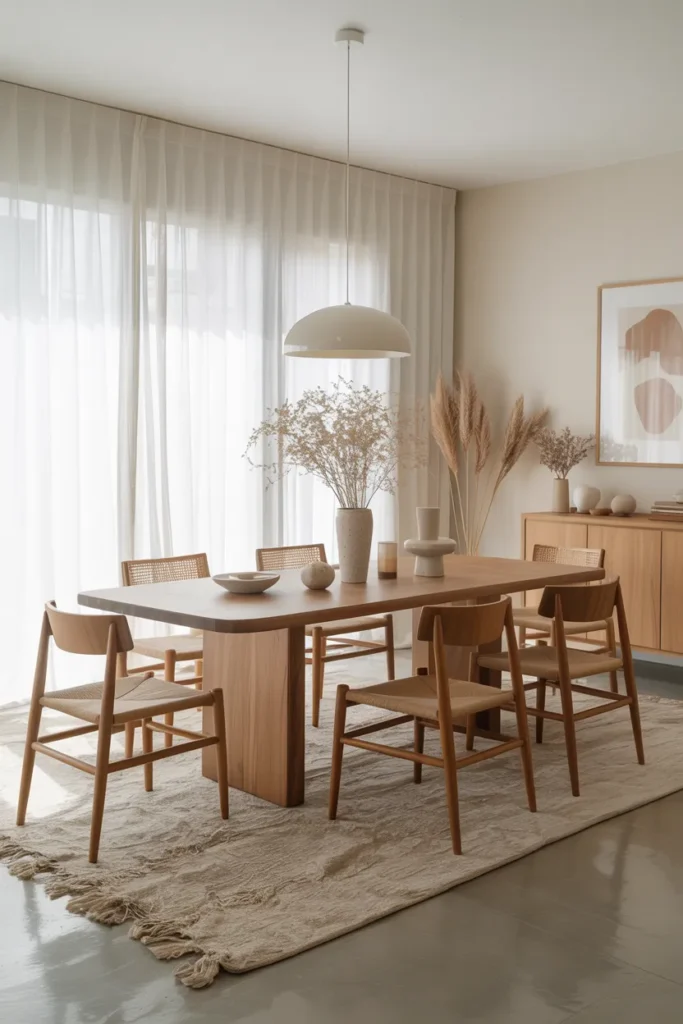
Neutral flooring is the quiet foundation of a Japandi dining room, the largest surface and the calmest. Light wood, pale concrete, or natural stone in soft tones lets the furniture and the light take center stage without competition. The floor should feel continuous and serene, with minimal pattern, contrast, or visual interruption. In open-plan homes, running the same neutral floor through the dining area unifies the space and makes it feel larger. The floor is the canvas everything else sits on, so its calmness sets the tone for the entire room. A busy floor fights every furniture choice; a quiet floor supports them all. This is the least exciting decision and one of the most important.
Keep it continuous: Continuity is the key principle for Japandi floors. The same flooring flowing from living to dining areas makes the whole space feel larger, calmer, and more intentional. Avoid busy patterns, high contrast borders, or multiple flooring changes, which chop up the calm into visual fragments. Light oak, pale limestone-look tile, or polished concrete all work beautifully. The finish should be matte or satin, never glossy; shine feels wrong in this style and shows every mark. Keep grout lines minimal with large-format tiles, and run wood planks in the longest direction of the space. The quiet floor lets the room breathe and gives the furniture the stage. When the floor disappears into calm, the room succeeds.
Mind the practicality: Dining room floors take serious abuse: chair scrapes, dropped food, spills, and daily traffic. Choose flooring that handles real life gracefully, not just showroom conditions. Sealed wood with a hardwax finish resists stains and can be spot-repaired without refinishing the whole floor. Large-format tile with minimal grout lines is nearly indestructible and easy to clean. Add felt pads to every chair leg immediately; this single habit prevents most floor damage. A washable rug under the table adds warmth, protects the floor, and can be cleaned after messy meals. The floor should look good in ten years, not just on installation day. Choose for the long term, because floors are the hardest thing to change.
- Run the same neutral floor through connected spaces for continuity.
- Choose matte or satin finishes, never glossy.
- Add felt pads to chair legs and a washable rug under the table.
Shop This Look
20. Japandi Dining Room with Large Window Focus
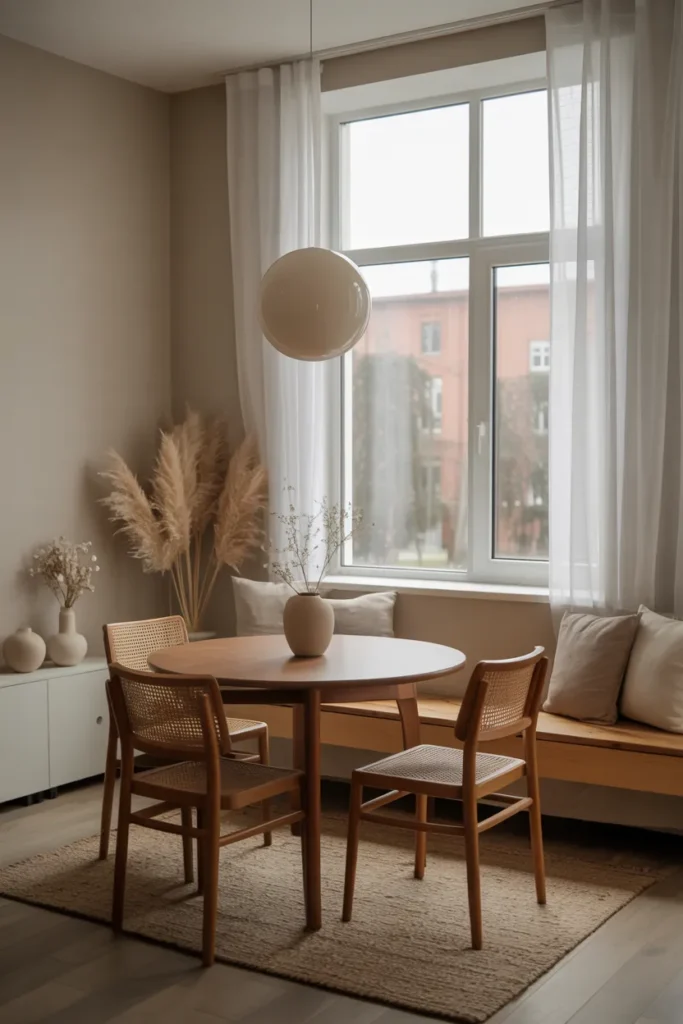
A large window is the best decoration a Japandi dining room can have, better than any art or object. Natural light is central to both Japanese and Scandinavian design traditions, and a generous window fills the room with it generously. Position the table to enjoy both the view and the daylight; the window connects the room to nature, changing with the weather, the seasons, and the time of day. In Japandi philosophy, this living connection matters more than any object you could place in the room. The window is a dynamic artwork that never repeats itself. Rooms with great windows need less of everything else, which is the essence of the style. If you have one, celebrate it; if you are renovating, prioritize it.
Frame the view: Treat the window as the room’s primary artwork and frame it with care. Keep the frame itself simple: light wood or slim black metal, with minimal mullions that do not chop up the view. Avoid heavy curtains that block precious light; sheer linen panels or simple roller blinds preserve brightness while providing privacy when needed. Keep the sill clear or hold a single plant; cluttered sills ruin the effect. The furniture should orient toward the window, not away from it; arrange seating so diners can enjoy the view. The view does the decorating work, so everything else in the room can stay minimal and quiet. This is the easiest Japandi win: let nature do the heavy lifting.
Manage the light: Large windows bring glare and heat as well as beauty, so manage them thoughtfully. Sheer linen curtains diffuse harsh direct sun while keeping the room bright and airy. Position the table so diners are not squinting into direct sun; side light is far more flattering than backlight for faces and food. In hot climates, low-E glass or discreet window film controls heat without darkening the room noticeably. Consider the sun’s path through the seasons; a window that is perfect in winter may need shading in summer. The goal is abundant, comfortable daylight throughout the year. A well-managed large window makes the dining room feel boundless, connected to the outdoors in every season.
- Orient the table toward the window to enjoy view and daylight.
- Use sheer linen curtains to diffuse harsh sun.
- Keep the windowsill clear or hold just one plant.
Shop This Look
21. Japandi Dining Room with Minimal Artwork
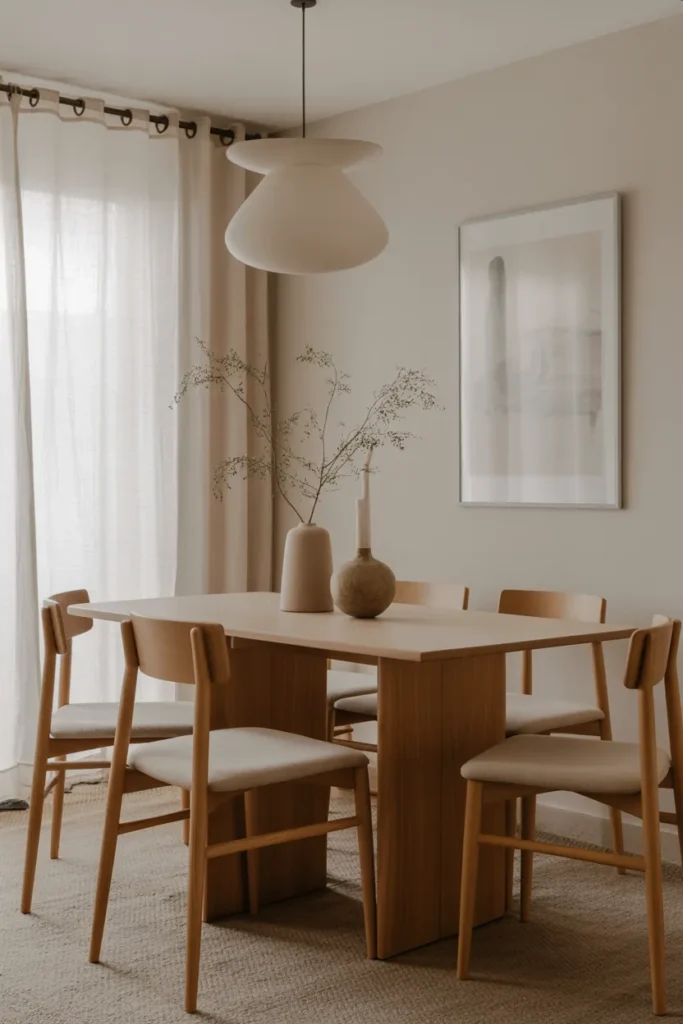
One piece of minimal artwork is all a Japandi dining room needs, and choosing it is a meaningful decision. A single large abstract print, a simple ink drawing, or a textile wall hanging gives the eye a resting place without adding visual noise. The artwork should share the room’s palette: neutrals, soft blacks, natural tones, nothing that shouts. Japanese ink painting and Scandinavian minimalism both favor restraint, so the art should whisper rather than speak. One strong, quiet piece beats a gallery wall here every time. The artwork is the room’s single decorative statement, which gives it real power. Choose something you love deeply, because you will look at it every day and it needs to reward that attention.
Choose with restraint: The artwork should feel inevitable, like it could belong nowhere else. Abstract landscapes, simple botanical studies, textural fiber pieces, or calligraphy all work within the vocabulary. Avoid bright colors, busy compositions, or ironic pop art, which shatter the calm the room works so hard to create. The frame matters enormously: light wood, thin black metal, or no frame at all keep the focus on the work. Size it generously; a single large piece has far more impact than several small ones scattered about. Hang it at eye level where it can be appreciated from the table, roughly 57 inches to center. The art should feel like a window into calm, not a decoration applied to a wall.
Let it breathe: Give the artwork generous empty wall around it, because the negative space is part of the composition. The emptiness lets the piece command quiet attention and gives the eye room to rest. Avoid hanging art on every wall; one wall with art and the rest deliberately bare is the Japandi way. The artwork should be the room’s single decorative exclamation in a room of quiet sentences. Everything else serves function: the table, the chairs, the light. This discipline is what makes the room feel curated rather than decorated, intentional rather than accumulated. When guests enter, their eye should find the art naturally and rest there peacefully.
- Choose one large, quiet piece over several small ones.
- Keep the palette neutral: blacks, beiges, and natural tones.
- Surround the art with generous empty wall space.
Shop This Look
22. Japandi Dining Room with Scandinavian-Japanese Fusion
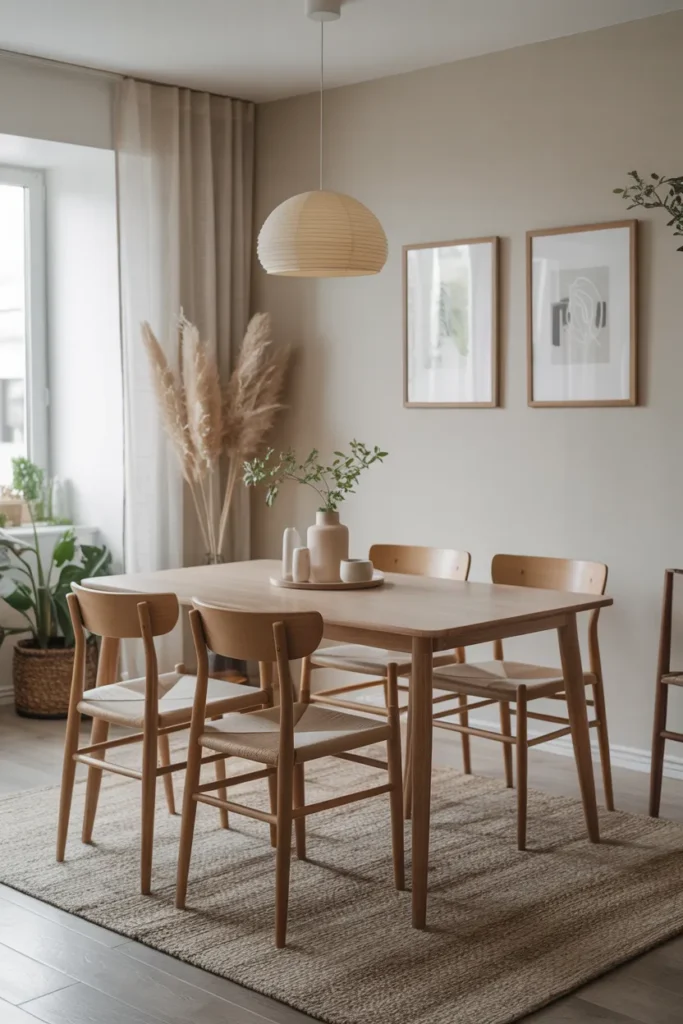
This idea is Japandi in its purest form: the deliberate, thoughtful fusion of Scandinavian and Japanese design traditions. From Scandinavia come light woods, cozy textiles, functional comfort, and the hygge pursuit of everyday warmth. From Japan come low profiles, natural materials, masterful craftsmanship, and the wabi-sabi embrace of imperfection. The fusion works so well because both traditions independently arrived at the same values: simplicity, craftsmanship, natural materials, and calm. A dining room that honors both feels balanced in a way neither tradition achieves alone. It is warm without being cluttered, minimal without being cold. Understanding both roots helps you make better choices, because you can ask of each element which tradition it serves and whether the balance holds.
Honor both traditions: Give each tradition its moment rather than letting one dominate. Scandinavian hygge might appear in a sheepskin draped over a chair, candles glowing on the table, or a soft wool throw within reach. Japanese influence shows in the low table profile, a shoji-inspired screen, handmade ceramics with visible craft, or an ikebana-inspired branch arrangement. Neither tradition should dominate the room; the test is whether the space feels both cozy and serene simultaneously. Warm enough to linger for hours, calm enough to breathe deeply. When guests cannot tell where one tradition ends and the other begins, the fusion has succeeded. The room should feel like a natural meeting place of two old friends, not a forced marriage.
Keep the balance: Balance is the ongoing practice of this style, not a one-time achievement. Too much Scandinavian and the room feels like a generic Nordic interior you have seen a hundred times; too much Japanese and it can feel austere or like a themed restaurant. Check the balance seasonally and adjust: add warmth in winter with extra textiles and candlelight, strip back in summer for coolness and air. The fusion is not a formula but a feeling you develop over time. Trust your instincts about what the room needs; if it feels cold, add hygge, if it feels cluttered, apply wabi-sabi editing. A well-balanced fusion dining room quietly becomes the calmest, most loved place in the house.
- Include elements from both traditions: hygge textiles and Japanese ceramics.
- Aim for cozy and serene in equal measure.
- Adjust the balance seasonally with textiles.
Shop This Look
23. Japandi Dining Room with Indoor Greenery
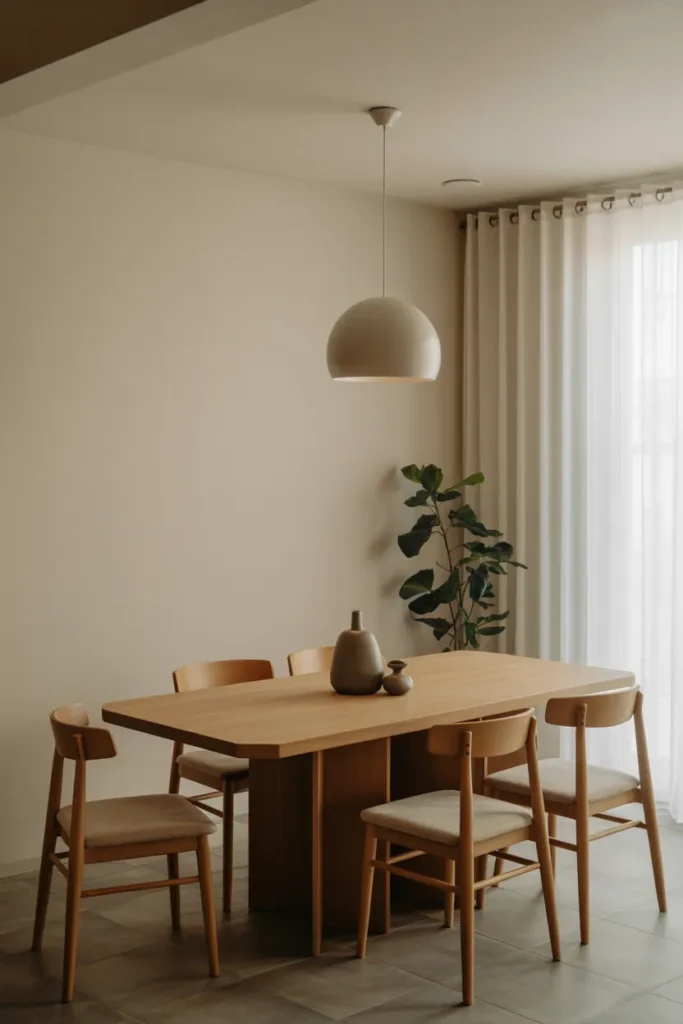
Indoor greenery in a Japandi dining room means living plants chosen for calm, not for color or drama. Think olive trees, ferns, and ornamental grasses rather than flowering tropicals or variegated showpieces. Greenery softens the room’s straight lines and brings the outdoors inside, which is central to both design traditions behind the style. A large plant in the corner or a restrained row of small pots on a shelf adds life without adding clutter. The green should feel like a breath of fresh air moving through the room. Plants are the one decorative element the style enthusiastically embraces, because they are alive rather than accumulated. Choose them with the same care you would choose art.
Choose calm greens: Not all plants suit the style’s quiet mood, so choose with intention. Select varieties with simple forms and muted, calm greens: olive trees, kentia palms, ferns, snake plants, or grasses. Avoid variegated leaves, bright flowers, or anything too wild and jungle-like, which introduces visual noise. The plants should look serene, almost architectural in their simplicity. Group them sparingly for the best effect: one large statement plant commanding a corner, or a small cluster of three related plants on a shelf. The greenery should complement the room’s calm, not compete with it for attention. Each plant needs space around it to be appreciated; crowding plants together creates the clutter the style avoids.
Style the pots: The pots matter as much as the plants themselves, since they are always visible. Simple ceramic, clay, or stone containers in neutral tones keep the focus on the greenery where it belongs. Avoid patterned, colorful, or novelty pots, which add visual noise and fight the calm. Vary the heights for natural interest but keep the materials consistent so the group feels related. A large floor plant in a handmade ceramic pot is the signature move of the style. Water and care for the plants on a real schedule; healthy greenery glows with life, while neglected, yellowing plants drag the whole room down. The plants are living commitments, and their health is visible proof of the care the room receives.
- Choose simple-formed plants: olive trees, ferns, or snake plants.
- Use neutral ceramic or clay pots, never patterned ones.
- Group sparingly: one large plant or a cluster of three.
Shop This Look
24. Japandi Dining Room with Textured Table Runner
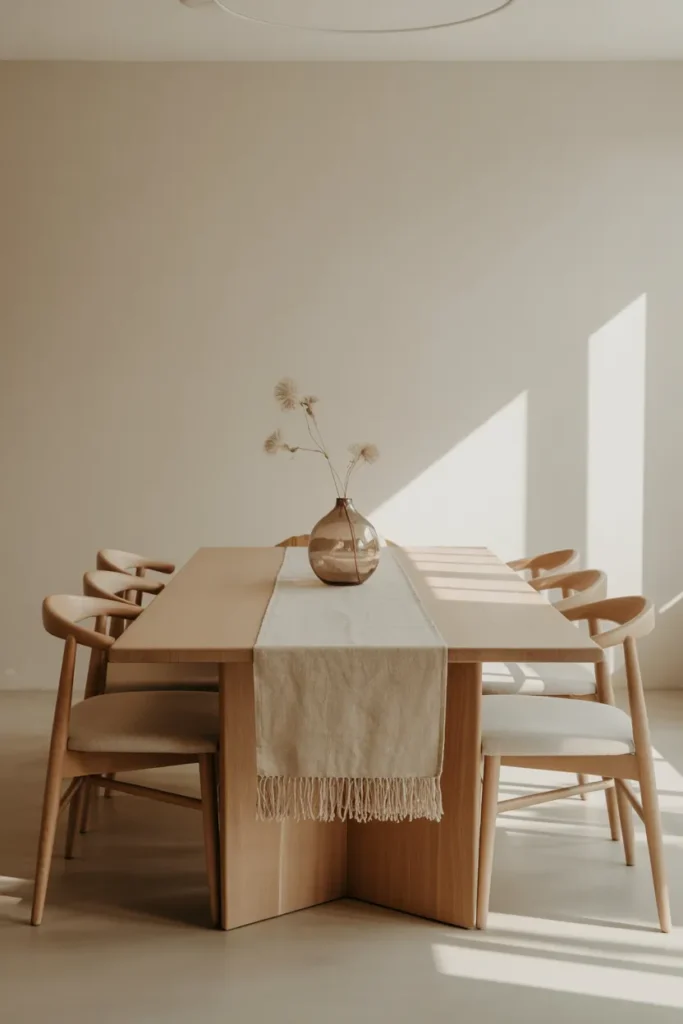
A textured table runner is the gentlest way to dress a Japandi dining table, adding softness without formality. Linen, cotton, or jute in a natural tone brings texture and warmth without the stiffness of a full tablecloth. The runner protects the wood where dishes sit and gives the table a finished, cared-for feeling. It should look relaxed rather than pressed: a little rumple is part of the charm and very much in the wabi-sabi spirit. This small textile makes a surprisingly big difference in how the table feels, softening the hard wood surface. It is also the easiest, cheapest way to try the style; a single runner can shift a plain table toward Japandi immediately. Keep it simple and let the texture speak.
Choose natural texture: The runner’s texture is the entire point, so choose fabrics with visible, touchable weave. Slubby linen, coarse cotton, or woven jute in natural, undyed tones, oatmeal, flax, soft gray, suit the palette best. Avoid shiny, patterned, or synthetic runners, which clash with the organic mood and look cheap against real wood. The runner should be long enough to hang over the table ends slightly, softening the hard edge, but not so long it interferes with chairs or looks fussy. A simple hemmed edge looks best; skip tassels, fringe, and decorative borders that add visual noise. The width should leave generous wood visible on both sides; the runner is an accent, not a cover. When in doubt, narrower and simpler is better.
Keep it effortless: A Japandi table runner should look effortless, never styled or fussy. Lay it slightly off-center for a relaxed, lived-in feel, or perfectly centered for calm symmetry; either works as long as it looks natural rather than arranged. Do not iron it into crisp submission; soft wrinkles are welcome and appropriate. Wash it regularly, since linen softens beautifully with washing and looks better over time. Keep a spare so the table is never bare during laundry day, maintaining the finished feeling. This humble textile embodies the entire style philosophy: simple, natural, functional, and quietly beautiful. It proves that the smallest choices, made with care, shape how a room feels.
- Choose slubby linen or woven jute in natural, undyed tones.
- Let the runner hang slightly over the table ends.
- Keep a spare runner for laundry days.
Shop This Look
25. Japandi Dining Room with Multi-Functional Storage
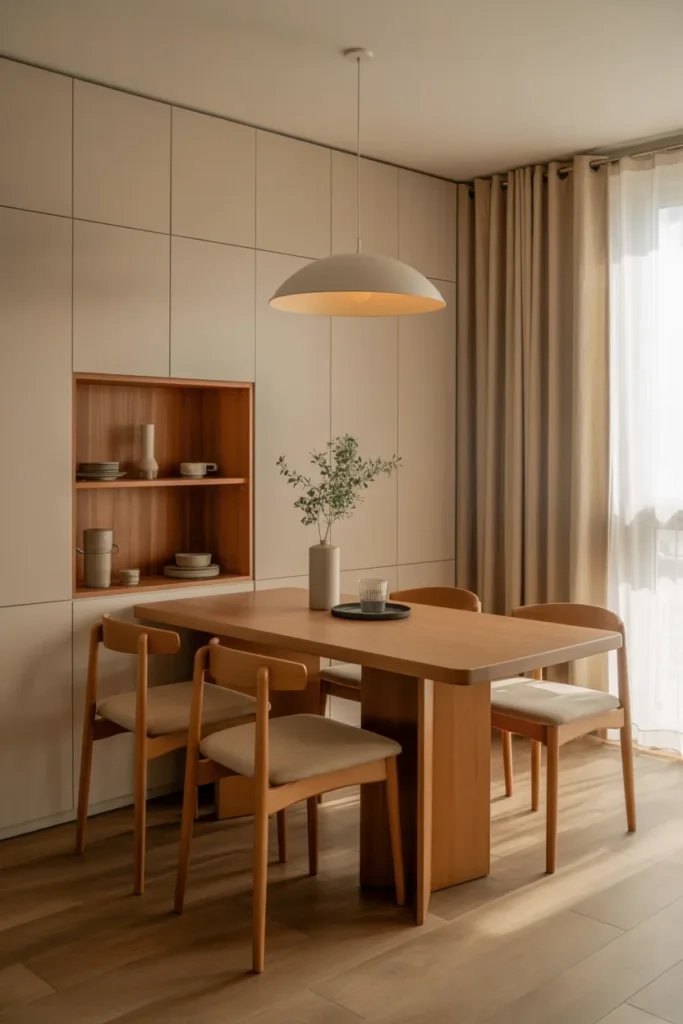
Multi-functional storage keeps a Japandi dining room calm by hiding what does not need to be seen. A sideboard that holds dishes, linens, and serving pieces; a bench with hidden storage inside the seat; a low cabinet that doubles as a serving surface during gatherings. Every piece works twice, which means fewer pieces overall and less visual weight. In a style built on restraint, furniture that does double duty is not just practical, it is philosophical: own less, use it more. The hidden storage is what makes the minimalist look livable rather than punishing. Without it, the discipline of clear surfaces becomes a daily burden; with it, tidiness is almost effortless. This is the practical engine behind the serene appearance.
Hide the clutter: The goal is clear surfaces and hidden contents, always. Choose storage with clean, quiet fronts: sliding doors, push-to-open drawers, or simple hinged doors with minimal hardware. Inside, organize with boxes and dividers so everything has a designated place and putting things away takes seconds. The sideboard top should hold almost nothing, perhaps one beautiful object or a small plant, never a landing strip for mail and keys. When everything is put away, the room achieves the deep calm that defines the style. Establish the habit of returning things immediately; the storage only works if used consistently. This is not about perfection but about systems that make calm the default state rather than a special effort.
Choose pieces that serve twice: Every storage piece should earn its floor space twice over, or it does not belong in a Japandi room. A sideboard stores dishes and serves as a buffet during dinners. A storage bench seats guests and holds table linens inside. A simple bar cart, kept strictly minimal, stores glassware and serves drinks when needed. Avoid single-purpose storage that just holds clutter out of sight; hidden clutter still weighs on a room energetically. The fewer pieces, the calmer the room, so make each one work hard. Multi-functional furniture is the practical secret behind the serene Japandi look that photographs so well. It is how real families live minimally without suffering for it.
- Choose storage with clean fronts: sliding or push-to-open doors.
- Keep storage tops nearly clear; one object at most.
- Pick pieces that serve twice, like a storage bench or buffet sideboard.
Shop This Look
How to Start
Start by removing, not adding. Japandi begins with editing: clear the dining room of everything non-essential and live with the empty space for a day. Notice what you miss and what you do not. This exercise reveals what the room actually needs versus what habit put there. Most dining rooms need far less than they hold. The calm you feel in the cleared room is the feeling you are designing toward.
Next, establish your foundation: the table, the chairs, and the light. These three elements define the room. Choose a simple wood table, comfortable chairs that tuck in, and a warm pendant hung at the right height. Get these three right before adding anything else. They carry 80 percent of the style. Everything after this is refinement, not foundation.
Finally, add texture and life in small doses. A neutral rug, one plant, a table runner, and a single piece of art complete the room. Add one element at a time and pause between additions. If the room still feels calm after each addition, keep going. The moment it starts feeling decorated rather than serene, stop. That line is the essence of Japandi.
- Clear the room completely first and notice what you actually miss.
- Establish table, chairs, and pendant light before adding anything else.
- Add texture and life one element at a time, stopping when calm turns to decorated.
Shop This Look
Common Mistakes
- Adding too much decor. Japandi is defined by restraint; every extra object weakens the calm. When in doubt, remove.
- Using synthetic materials. Fake wood, plastic rattan, and polyester everything break the style’s promise of authenticity.
- Choosing cool white lighting. It makes wood look gray and kills the warmth; every bulb should be warm white.
- Hanging the pendant too high. A disconnected pendant leaves the table feeling unanchored; get it low and centered.
- Mixing in clashing styles. Industrial, boho, or glam elements fight Japandi’s calm; keep the vocabulary consistent.
- Forgetting comfort. Minimalism should never mean uncomfortable chairs; test seating before committing.
- Buying a rug that is too small. Chairs sliding off the rug edge ruins the composition; size up generously.
Frequently Asked Questions
What is Japandi style in simple terms?
Japandi blends Japanese minimalism with Scandinavian warmth. From Japan it takes low profiles, natural materials, craftsmanship, and the wabi-sabi appreciation of imperfection. From Scandinavia it takes light woods, cozy textiles, functionality, and hygge comfort. The result is calm, natural, uncluttered interiors that feel serene rather than stark.
What colors work in a Japandi dining room?
The palette is neutral and natural: warm whites, soft beiges, light grays, and pale wood tones, with black as an accent. Muted greens from plants add life. Avoid bright colors, high contrast, or anything saturated. The colors should feel like they came from nature: stone, wood, sand, clay, and linen.
Is Japandi style expensive to achieve?
It can be, since the style favors quality natural materials and craftsmanship. But the minimalist philosophy also means buying fewer things, which saves money. Start with a simple wood table and warm lighting, then add pieces slowly. Secondhand wood furniture and handmade ceramics from local makers keep costs down while honoring the style’s values.
How is Japandi different from regular minimalism?
Regular minimalism can feel cold and stark; Japandi adds warmth through natural materials, texture, and the Japanese acceptance of imperfection. Where minimalism might demand perfect white surfaces, Japandi welcomes wood grain, handmade ceramics, and linen texture. It is minimalism you can relax in. For more dining room inspiration in a classic vein, see our elegant dining room designs.
Can I do Japandi in a small dining room?
Small rooms suit Japandi beautifully, since the style is about doing more with less. Choose a round or extendable table, keep furniture low-profile, use a large mirror or window to borrow light, and resist filling the walls. A small Japandi dining room feels intentionally serene rather than cramped.
The Finishing Touch
A finished Japandi dining room has a particular stillness to it. The table is clear, the light is warm, the materials are honest, and there is nothing to distract from the meal and the company. Take a moment to sit in the room before calling it done. If you feel your shoulders drop, the style is working. Small seasonal adjustments, a different branch in the vase, a warmer textile in winter, keep it alive.
For a deeper look at the style’s principles, Houzz’s piece There’s a New Trend in Town: Japandi explains how the fusion works, from blending light and dark timbers to choosing soft accent colors. It is a useful reference when you want to understand the why behind the look, not just the what.
Whatever ideas you chose, the philosophy stays the same: fewer, better things, natural materials, warm light, and room to breathe. A Japandi dining room does not shout for attention. It quietly becomes the most peaceful room in the house. Start with the clearing-out, and let the calm build from there.