24 Small Living Room Ideas Maximize Every Inch
A small living room can feel like a design puzzle. Every inch matters, and one wrong choice can make the whole space feel cramped and dark. But it does not have to be that way. With the right approach, a compact room can feel open, comfortable, and surprisingly functional. The trick is choosing pieces that do more than one job and keeping the visual weight low.
This article walks you through 24 practical ideas for making the most of a small living room. You will find tips on color palettes, furniture shapes, storage solutions, lighting, and layout tricks that designers use every day. Each idea comes with real product suggestions so you can shop the look without spending hours searching.
These ideas work for renters and homeowners, for studio apartments and for family homes with a modest sitting area. You do not need a big budget or a full renovation. Most of these changes can be done in a weekend. Pick the ideas that fit your room, start with the easiest wins, and build from there.
This post contains affiliate links. If you buy through them, I may earn a small commission at no extra cost to you.
1. Light Color Palette with Minimal Furniture

A light color palette is the fastest way to make a small living room feel bigger. Whites, soft beiges, pale grays, and muted creams reflect light instead of absorbing it, which opens up the walls visually. When you keep the furniture minimal on top of that, the room gets room to breathe. You do not need much to make this work: a light sofa, a couple of small side pieces, and uncluttered surfaces are enough. The goal is to let light move through the space without hitting visual obstacles. Paint is the biggest lever here. A fresh coat of warm white on the walls can change the whole feel of the room in a single day. If you want a little contrast, add it through a rug or cushions rather than large furniture pieces. Keep the largest items in the room light-toned so they do not anchor the space down. This approach also makes it easier to add seasonal color later without clashing. It is simple, affordable, and it works in almost every small living room.
Pick the right white: not all whites behave the same on walls. A pure bright white can feel cold and clinical in a room with little natural light. Warm whites with a hint of cream or beige tend to feel softer and more inviting. Test samples on the wall at different times of day before committing. South facing rooms can handle cooler whites, while north facing rooms usually look better with warmer tones. If you are renting and cannot paint, use light slipcovers, throws, and curtains to shift the palette without touching the walls. The same principle applies to furniture: a cream loveseat reads larger than a charcoal one in a tight room. Pair light walls with light floors where possible, because a dark floor can cut the room in half visually.
Keep surfaces clear: minimal furniture only works if the surfaces stay uncluttered. Limit each table or shelf to two or three objects. Group small items on a tray so they read as one tidy cluster instead of scattered clutter. Store remotes, chargers, and other daily items in a lidded basket or inside a cabinet. The eye needs open space to rest, and that rest is what makes the room feel larger. This does not mean the room has to look empty or sterile. One piece of art, a plant, or a textured throw can add personality without adding bulk. Rotate decor seasonally if you like variety. The habit that matters is putting things back at the end of the day, which takes two minutes and keeps the light palette doing its job.
- Test paint samples on the wall at three different times of day before buying gallons.
- Keep large furniture pieces in light tones and save darker shades for small accents.
- Use a tray to group small objects so surfaces read as tidy clusters.
Shop This Look
2. Wall-Mounted Shelves for Vertical Storage
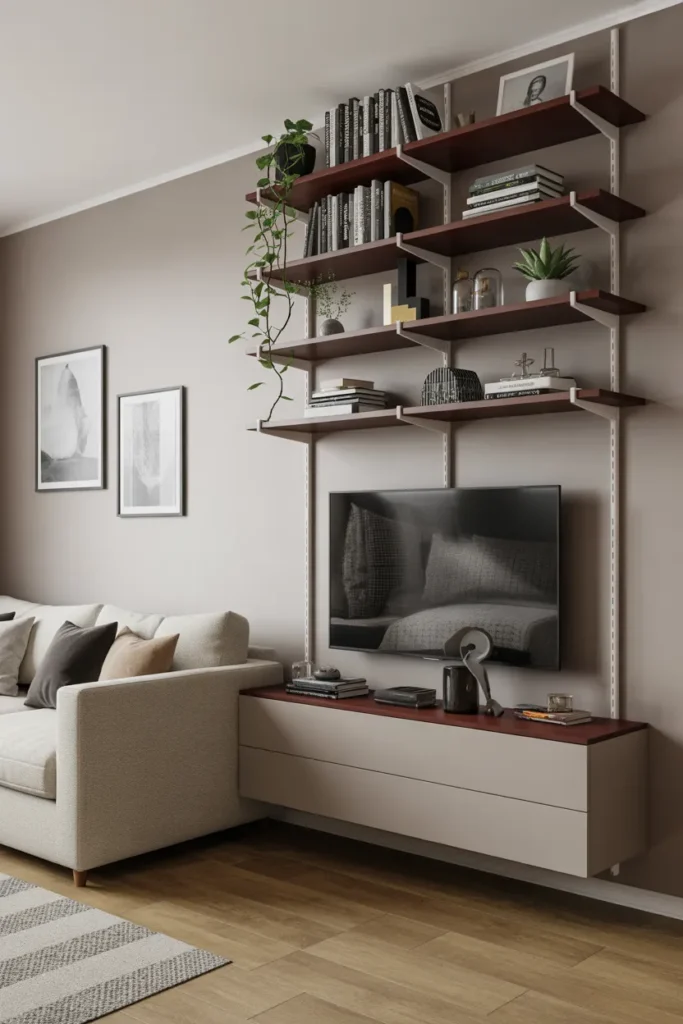
Wall mounted shelves give you storage and display space without taking up a single inch of floor. In a small living room, the floor plan is precious, but the walls are usually underused. Floating shelves can hold books, plants, framed photos, and baskets while keeping the ground clear for movement. They also draw the eye upward, which makes the ceiling feel higher. The best spots are above the sofa, beside the TV, or along a short hallway wall that connects to the room. You can install a simple ledge shelf for framed art or go deeper with bracket shelves that hold baskets and storage boxes. The key is to keep them shallow enough that they do not make the wall feel like it is leaning into the room. Twelve inches is a practical maximum depth for most living rooms. Group shelves in pairs or trios rather than scattering single shelves, because grouped shelves look intentional and balanced. This is one of the cheapest storage upgrades you can make, and it changes how functional a small room feels.
Mount them properly: a falling shelf is worse than no shelf. Always anchor shelves into wall studs when the shelf will hold anything heavy like books. If you cannot find a stud, use heavy duty wall anchors rated well above the weight you plan to store. Check the shelf rating on the box and keep the load comfortably below it. Use a level during installation so shelves sit straight; a tilted shelf is noticeable from across the room. If you are renting, look for damage free mounting options or ask the landlord about small screw holes, which are usually easy to patch. Space the shelves about 12 to 15 inches apart vertically so books and baskets fit without cramming. Leave the top shelf for lighter decor since reaching it is harder.
Style with restraint: shelves that are stuffed full stop looking like storage and start looking like clutter. Aim for about two thirds full, with breathing room between objects. Mix functional items like books and baskets with one or two decorative pieces. Baskets and boxes on the lower shelves hide the messy stuff while keeping it reachable. Keep the heaviest items on the lowest shelf for safety and visual balance. On the highest shelf, place lighter decor or a trailing plant that softens the edge. If the shelves sit above your sofa, keep the styling simple so the display does not overwhelm the seating area. Less is more here, and restraint is what keeps the wall feeling airy instead of crowded.
- Anchor every shelf into a stud or use heavy duty anchors for books and heavier items.
- Keep shelves about two thirds full so they read as styled rather than stuffed.
- Use baskets on lower shelves to hide remotes, chargers, and other small items.
Shop This Look
3. Multi-Functional Furniture Solutions
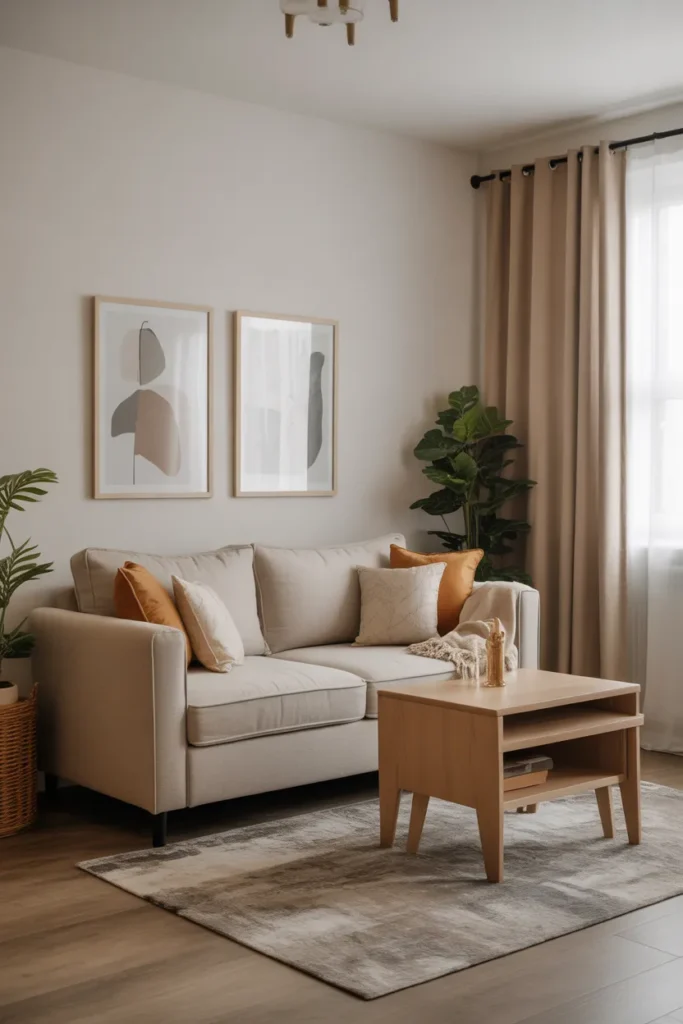
Multi functional furniture is the backbone of every well designed small living room. When one piece can serve two or three purposes, you need fewer pieces overall, and fewer pieces means more open space. Think of a storage ottoman that works as a footrest, a coffee table, and a place to stash blankets. Or a sleeper sofa that hosts overnight guests without requiring a guest room. Even a side table with a drawer pulls its weight by holding remotes and chargers out of sight. The trick is to buy these pieces with intention instead of collecting them by accident. Before you buy, list the jobs the piece needs to do. A coffee table should probably also store things or convert into extra seating. A console behind the sofa can double as a desk or a dining surface for one. When each piece earns its footprint, the room feels planned rather than crowded. This approach also saves money in the long run, since one good piece replaces two or three cheaper ones.
Choose convertible pieces: the best multi functional pieces change shape or purpose with little effort. A drop leaf table can be a console against the wall on weekdays and a dining table for four on weekends. A daybed serves as a sofa by day and a bed by night. Look for mechanisms that are simple to operate, because a clever feature you never use is just extra weight. Test the conversion in the store or read reviews about how easy it is. Check that the piece looks good in both configurations, not just one. Storage beds with drawers underneath are excellent for small living rooms that double as guest space. Nesting tables are another winner: they tuck together when you need floor space and fan out when guests arrive.
Measure twice, buy once: multi functional furniture tends to be bulkier than single purpose pieces, so measuring is critical. Map the piece on the floor with painter tape before ordering, including the space it needs when fully extended. A sofa bed needs clear floor space in front of it for the pull out section. A drop leaf table needs room for chairs on the sides when open. Check door swing and walkway clearance too, because a piece that blocks a path will drive you crazy. Also measure your doorways and stairwells for delivery. Many returns happen because a great piece simply does not fit through the front door. A few minutes with a tape measure saves weeks of frustration.
- List the two or three jobs a piece must do before you shop for it.
- Tape out the full footprint, including extended positions, on your floor first.
- Test conversion mechanisms in reviews or in store so you know they are easy to use.
Shop This Look
4. Mirrors to Create Visual Space
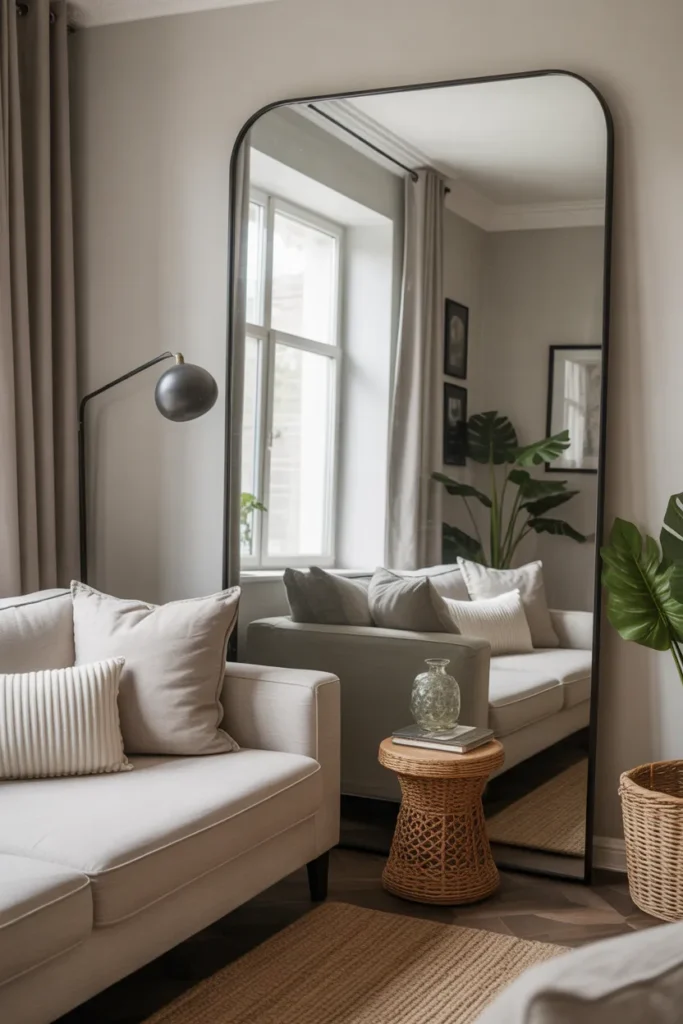
Mirrors are one of the oldest tricks for making a small room feel larger, and they still work. A mirror bounces light around the room and creates the illusion of depth, so walls feel farther away than they are. Place a large mirror opposite a window and you effectively double the natural light in the room. Even a medium sized mirror on a side wall can open up a tight corner. The effect is strongest with large mirrors, so go as big as the wall and your budget allow. A floor leaning mirror behind a plant or beside a bookshelf adds both light and style. Framed mirrors double as wall art, which means you get decor and function from a single piece. Just be mindful of what the mirror reflects. A mirror that faces a cluttered corner will double the clutter. Angle it toward something pleasant like a window, a plant, or a clean stretch of wall. This one change can make a dim, boxy room feel noticeably brighter within minutes of hanging.
Place them strategically: placement matters more than size with mirrors. Opposite a window is the gold standard because it doubles daylight. Across from a lamp or pendant light, a mirror amplifies the glow in the evening. On a narrow wall, a horizontal mirror makes the wall feel wider. In a dark corner, a mirror with a candle or small lamp in front of it creates a warm pocket of light. Avoid placing mirrors where they reflect the television, since the glare will fight with the screen. Also avoid mirror walls that face each other across a tiny room, which can feel disorienting. One or two well placed mirrors beat a whole gallery of small ones scattered randomly.
Match the frame to your style: the frame is what makes a mirror look like decor instead of a bathroom fixture. Thin black metal frames suit modern rooms. Warm wood frames work with cozy and farmhouse styles. An arched mirror softens a room full of straight lines, while a round mirror breaks up a wall of rectangular furniture. If your style is minimal, a frameless mirror with a beveled edge looks clean. For renters, lean a large mirror against the wall instead of drilling, which avoids holes and lets you move it around. Group a medium mirror with art on a gallery wall so it reads as part of the arrangement. The right frame ties the mirror into the room so it feels chosen, not just functional.
- Hang the largest mirror opposite your biggest window to double the daylight.
- Avoid mirrors that reflect the TV or a cluttered corner.
- Choose a frame that matches your room style so the mirror reads as decor.
Shop This Look
5. Open Layout with Defined Zones
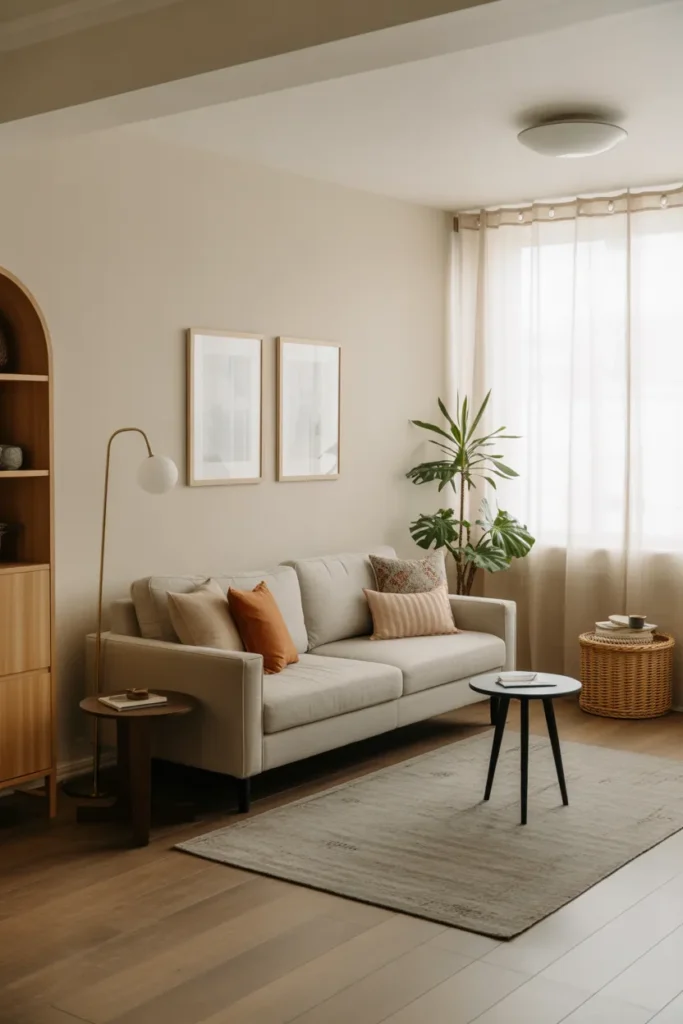
An open layout with defined zones is how you make a small living room feel spacious while still serving real life. Knocking the room into one flowing space removes visual barriers, but without zones it can feel like one undefined blob. The fix is to define areas with rugs, furniture placement, and lighting instead of walls. A rug under the seating area says this is the conversation zone. A floor lamp and a small chair in the corner says this is the reading spot. The eye reads these cues and understands the room as several comfortable places rather than one cramped box. This works especially well in studio apartments and open plan homes where the living room shares space with the kitchen or dining area. You do not need partitions or screens. In fact, solid dividers usually make small rooms feel smaller. Low furniture backs, open shelving units, and area rugs create separation while letting light pass through. The result is a room that flows but still feels organized.
Use rugs as dividers: a rug is the simplest zoning tool you own. Place one under the coffee table and front legs of the sofa to anchor the seating zone. In an open plan space, a second rug under a dining table or desk marks a different zone without any walls. Keep the rug large enough that furniture sits on it comfortably; a rug that is too small actually makes the zone feel cramped. Leave some bare floor between zones so the room still reads as open. Stick to a consistent color family across rugs so the zones feel connected rather than competing. Flat weave or low pile rugs work best in high traffic spots because chairs slide over them easily.
Float the furniture: pushing every piece against the wall is a common small room habit, and it usually backfires. Pulling the sofa a few inches off the wall creates breathing room and makes the layout feel intentional. A console table behind a floating sofa adds a surface for lamps and books while defining the zone edge. Angle a chair slightly toward the conversation area instead of lining everything up against the walls. This creates a natural gathering shape that feels cozy rather than pushed aside. Leave clear pathways of at least 30 inches between zones so movement feels easy. Floating furniture also makes cleaning simpler, which is a real benefit in a small space that shows dust quickly.
- Anchor each zone with a rug large enough for the front legs of the furniture.
- Float the sofa a few inches off the wall to create a natural zone edge.
- Keep walkways at least 30 inches wide between zones for easy movement.
Shop This Look
6. Slim Furniture with Raised Legs
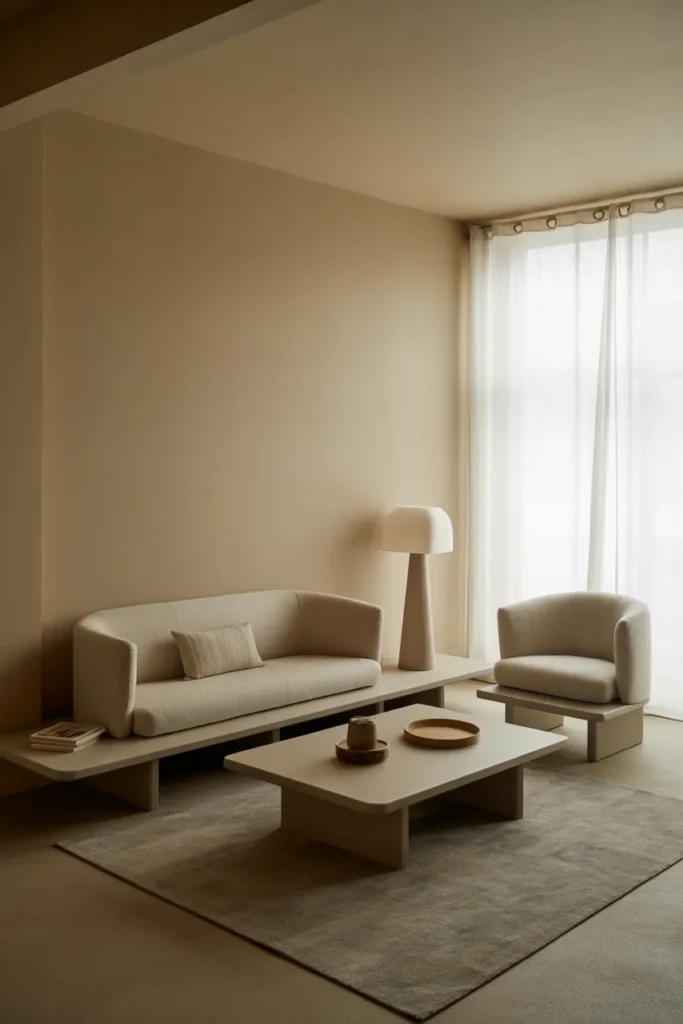
Slim furniture with raised legs is a classic small room strategy for good reason. When you can see floor underneath a sofa or chair, the room reads as larger because the eye travels through the space instead of stopping at a bulky base. Raised legs also make cleaning easier and let light flow under the furniture. Look for sofas, armchairs, and media units that sit on tapered or splayed legs rather than solid plinth bases. The visual difference is immediate. A slim profile means narrower arms, shallower depth, and less overhang. Apartment sized sofas are usually 68 to 72 inches wide instead of the standard 84 plus, and that difference can free up a whole walkway. Mid century inspired pieces are natural winners here because the style was designed for smaller post war homes. You do not have to go full retro; plenty of modern brands make slim legged furniture in current fabrics. Pair slim seating with a glass or open base coffee table to keep the center of the room feeling light.
Check the seat depth: slim furniture should still be comfortable, and seat depth is where comfort lives. A seat depth of 20 to 22 inches works for most adults without swallowing the room. Sit in the piece before buying if you can, or check the listed dimensions carefully online. Pay attention to seat height too; lower seats can make a room feel more open but harder to get out of for some people. If you love deep cozy seating, compromise with one deeper chair instead of a whole deep sofa. Cushion firmness matters as much as dimensions: a firm slim sofa supports better than a saggy one. Read reviews about long term comfort, not just first impressions.
Mind the leg style: legs are a design detail that pulls double duty. Tapered wood legs add warmth and suit Scandinavian or mid century rooms. Slim black metal legs read modern and industrial. Splayed legs give a retro feel. Make sure the legs are sturdy and the attachment is solid; wobbly legs on a daily use sofa are miserable. If you have rugs, choose leg tips that will not snag the fibers. Felt pads on the feet protect hard floors and make it easier to shift furniture for cleaning. Some sofas come with removable legs, which helps with tight delivery through narrow doors. Small detail, big difference in daily life.
- Look for apartment sized sofas around 68 to 72 inches wide with raised legs.
- Check seat depth of 20 to 22 inches for comfort that does not overwhelm.
- Add felt pads to leg tips to protect floors and ease moving.
Shop This Look
7. Built-In Seating for Space Efficiency
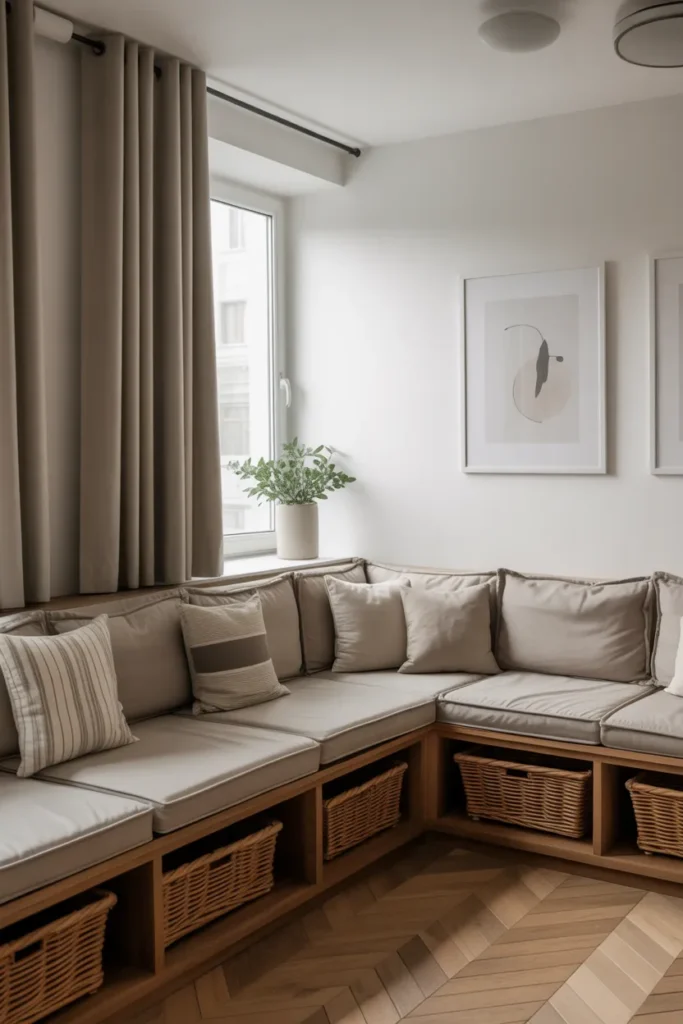
Built in seating squeezes function out of space that would otherwise go to waste. A window seat with storage underneath turns a dead wall into a reading nook. A banquette along one wall can seat more people than chairs in the same footprint. Even a simple built in bench in an entryway corner of the living room gives you a place to perch and a place to hide shoes. Because built ins are custom to the wall, they fit exactly and leave no awkward gaps. You do not need a contractor for every version of this idea. A sturdy low bookshelf laid on its side with a cushion on top becomes a window bench. Two cube storage units pushed together with a padded top make a banquette style seat. The key is to make it look intentional: a fitted cushion, matching fabric, and trim details elevate a simple hack. Add throw pillows to make it inviting, and keep the storage inside organized with bins so it stays useful.
Plan the cushion right: the cushion is what makes built in seating comfortable instead of just a hard ledge. Aim for a seat cushion at least 3 to 4 inches thick with dense foam so it does not bottom out. Outdoor grade foam resists moisture if the seat is under a window that gets condensation. Choose a fabric that can handle daily use; performance fabrics and washable covers are worth the extra cost. Measure the base exactly and order the cushion slightly snug so it does not slide. Piping along the edge gives a custom upholstered look. For a banquette, add a back cushion or a row of throw pillows so people can lean back comfortably.
Use the hidden storage: the storage inside built in seating is the whole point, so use it well. Under a window seat, store off season throws, board games, or rarely used electronics. In a banquette base, keep table linens, placemats, and serving pieces close to the dining zone. Use bins or dividers so the space does not become a jumble. Label the bins if the household shares the space. Hinged lids work for deep benches; drawers are better for daily access items. Add soft close hinges to lids so fingers stay safe and the seat closes quietly. Every cubic foot inside that bench is storage you did not have to find floor space for.
- Use 3 to 4 inch dense foam for cushions so the seat stays comfortable.
- Choose washable or performance fabric for daily use seating.
- Organize the interior with bins and soft close hinges for safety.
Shop This Look
8. Neutral Base with Layered Textures
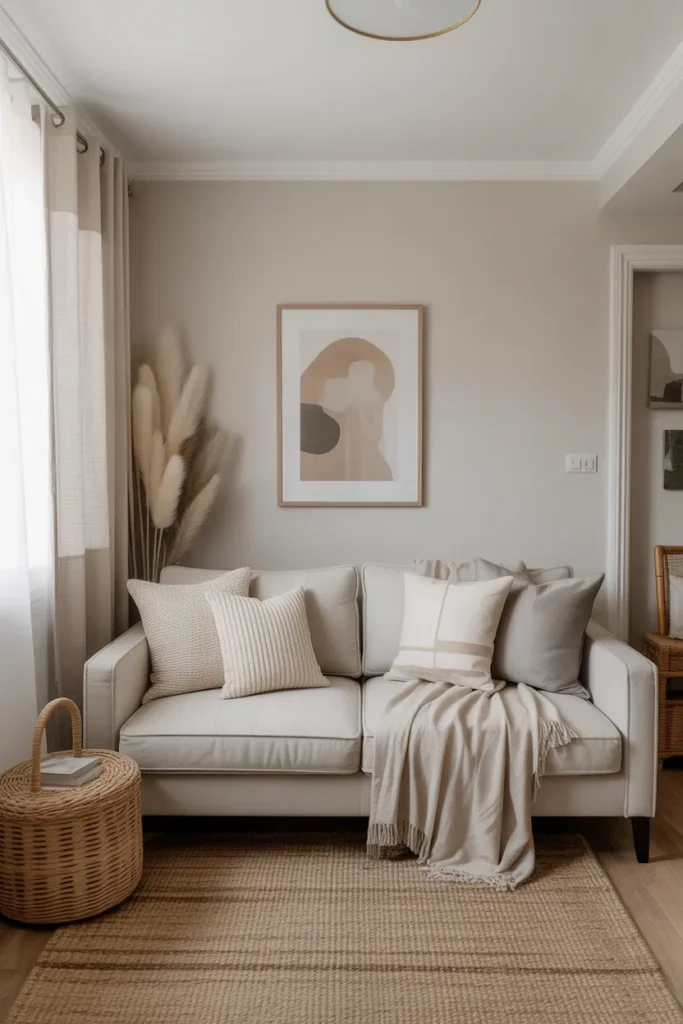
A neutral base with layered textures is how small living rooms feel rich without feeling busy. When the walls, sofa, and rug sit in the same neutral family, the room feels calm and cohesive. Texture is what keeps it from looking flat. Mix a nubby wool throw with smooth linen cushions, a jute rug with a soft velvet chair, and the room gains depth without adding visual noise. This works because texture catches light differently across surfaces, creating subtle variation that the eye finds interesting. Start with your largest surfaces in neutrals: walls, sofa, rug. Then layer in texture through throws, cushions, baskets, and curtains. Natural materials are your friends here: wood, wool, cotton, rattan, and stone all add tactile interest. Keep the color story tight, maybe three neutrals plus one muted accent, so the layers feel collected rather than random. The result is a room that feels warm and finished even though nothing in it is loud.
Layer in this order: build texture from the ground up so the room feels grounded. Start with the rug, which is the biggest texture surface after the sofa. A natural fiber rug like jute or wool adds instant warmth. Next, the sofa gets cushions in two or three different fabrics: linen, knit, and maybe a subtle pattern. Then add a throw draped over one arm or the back, choosing a chunkier weave for contrast. Finally, small doses: a woven basket, a ceramic vase, a wood tray. Each layer should be a different material from its neighbors. If everything is the same weave, the effect flattens out. Step back after each layer and check that you can still see the neutral base underneath.
Add one quiet accent: a single muted accent color keeps the neutral room from feeling monotonous. Sage green, dusty blue, warm terracotta, or soft ochre all work without shouting. Introduce it in small doses: two cushions, a piece of art, a plant pot. Repeating the accent in three spots around the room makes it feel deliberate. Keep the accent desaturated rather than bright, because a loud color will dominate a small room fast. If you get tired of it, swapping two cushions and a throw changes the whole mood for very little money. This is the easiest seasonal refresh you can do.
- Start with neutral walls, sofa, and rug, then layer different textures on top.
- Mix materials like wool, linen, jute, and wood for tactile variety.
- Add one muted accent color in three small doses around the room.
Shop This Look
9. Compact Coffee Table Alternatives
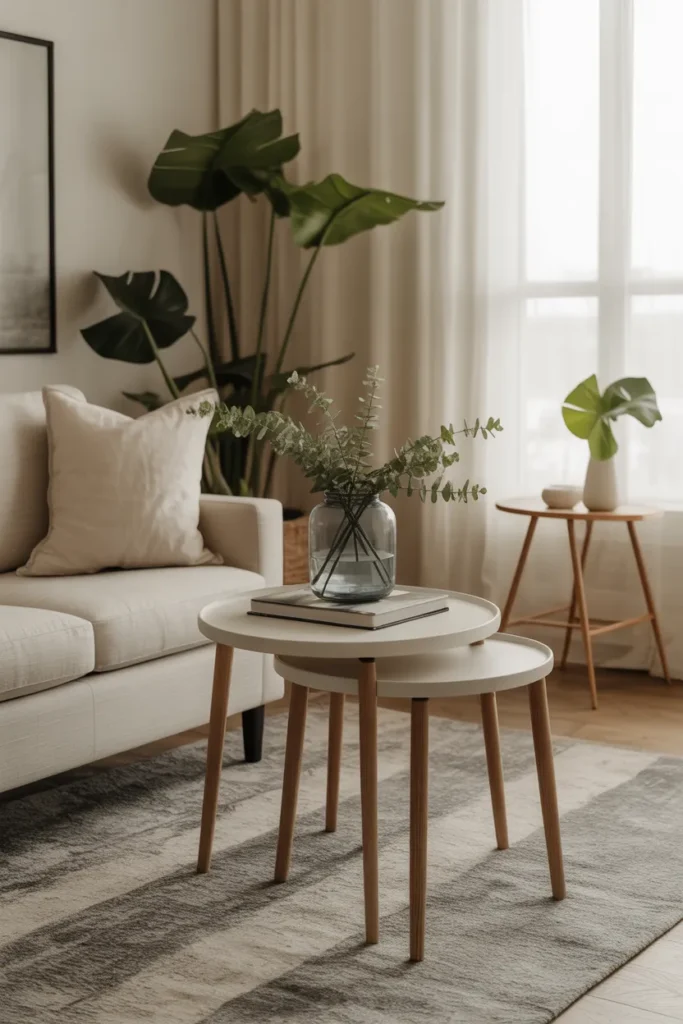
A compact coffee table alternative can free up surprising space in a small living room. A traditional coffee table is often the biggest piece in the middle of the room, and it locks the layout in place. Replace it with a nesting set, a large ottoman, or even a pair of small side tables, and the center of the room becomes flexible. Pull a nesting table out when you need a surface, tuck it back when you need floor space. An ottoman doubles as extra seating for guests. A C shaped side table slides over the sofa arm and gives each seat its own surface without a table hogging the middle. The visual benefit is real too: less furniture in the center means longer sight lines across the room, which reads as more space. Choose pieces with storage inside for bonus function. And keep the footprint small enough that you can walk around comfortably on all sides.
Try a storage ottoman: a storage ottoman is probably the hardest working coffee table alternative there is. It gives you a footrest, extra seating for two, a flat surface for a tray, and hidden storage for throws and games. Choose one with a firm flat top so drinks sit steady; some ottomans come with a reversible tray top for exactly this purpose. Size it to about two thirds the length of your sofa so the proportions look right. Round ottomans soften a room full of straight lines and are easier to walk around in tight spaces. Look for performance fabric or faux leather that wipes clean. When guests arrive, the ottoman becomes seating, and nobody has to drag a chair across the room.
Go tray friendly: whatever you choose, a tray makes it work as a table. A sturdy tray on an ottoman creates a stable surface for coffee cups and remotes. It also corrals small items so they do not slide off soft surfaces. Choose a tray with handles for easy carrying and a raised edge to stop things rolling. Wood, rattan, or metal trays each add their own texture to the room. Size the tray to leave some soft surface visible around it so the ottoman still looks like seating. When you want the ottoman back as a footrest, lift the tray off in one move. This tiny accessory is what makes the flexible setup feel polished instead of improvised.
- Size an ottoman to about two thirds of your sofa length for good proportions.
- Pick a firm flat top or reversible tray top so drinks sit steady.
- Use a nesting set when you want surfaces that disappear on demand.
Shop This Look
10. Curtains Hung High to Elevate Space
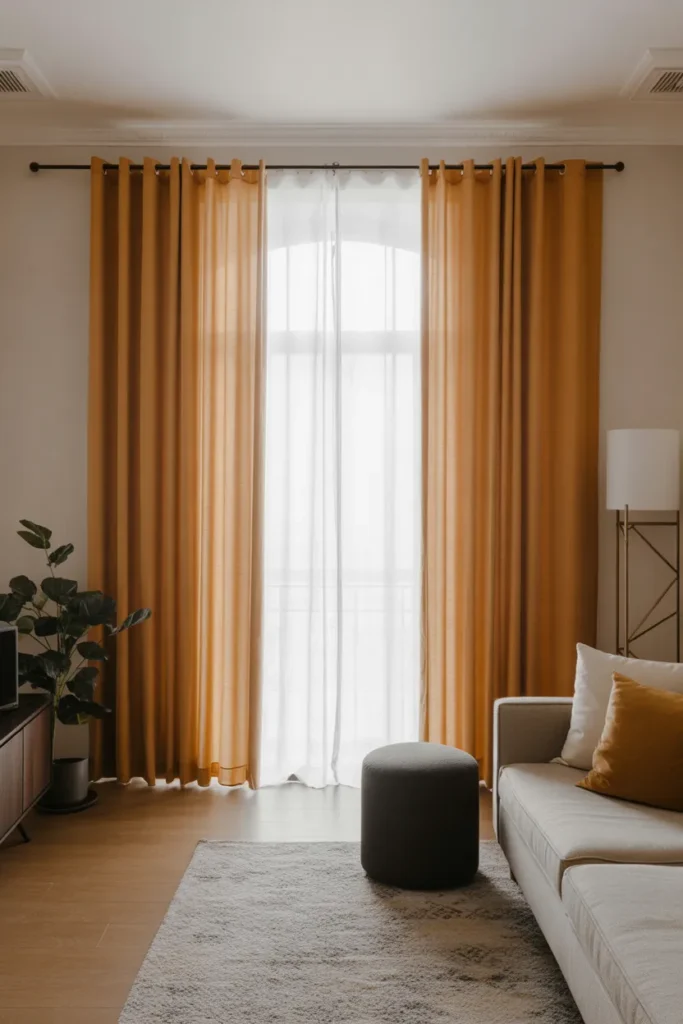
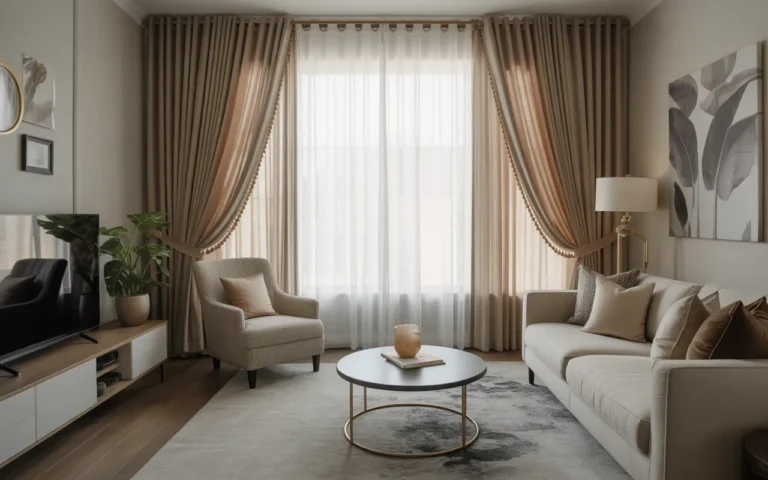
Hanging curtains high and wide is a designer trick that makes windows and ceilings look taller in one move. Mount the rod close to the ceiling, about 4 to 6 inches below it, instead of right above the window frame. Extend the rod 6 to 12 inches beyond the frame on each side so the panels stack over the wall rather than covering the glass. This does two things: it exposes more of the window so more light comes in, and it creates long vertical lines that draw the eye upward. The room instantly feels grander. Choose curtains that just kiss the floor or break slightly on it for a tailored look. Avoid short curtains that end at the sill, because they cut the wall in half visually. Light, airy fabrics keep the effect bright; heavy fabrics can work too if the color stays light. This is a weekend project with outsized impact, and it costs far less than new windows.
Measure before you buy: curtain sizing is where this trick succeeds or fails. Measure from the rod position down to the floor and buy panels at least that long, ideally an inch or two longer for a soft break. Standard lengths are 84, 96, 108, and 120 inches; pick the next size up from your measurement rather than the closest. For width, the total panel width should be 1.5 to 2 times the rod width so the fabric gathers nicely. Skimpy panels that pull flat look cheap and let light leak around the edges. If you are between sizes, longer is almost always better. Hemming is cheap at a tailor, but you cannot add length back.
Pick the right fabric: fabric choice sets the mood. Sheer linen panels filter light beautifully and keep a small room feeling airy, though they offer little privacy at night. Light cotton or linen blends give privacy while still feeling soft. If you need darkness for sleep or movie nights, layer blackout panels behind sheers on a double rod. Stick to solid colors or very subtle patterns in a small room; bold prints on large panels can overwhelm. Match the curtain color closely to the wall color for a seamless look that stretches the walls, or go slightly darker for gentle contrast. Washable fabrics save headaches in homes with kids or pets.
- Mount the rod 4 to 6 inches below the ceiling and extend it past the frame.
- Buy panels longer than you need; the next size up looks more expensive.
- Use sheers for airiness and layer blackout panels behind them when needed.
Shop This Look
11. Floating Media Unit to Save Floor Space
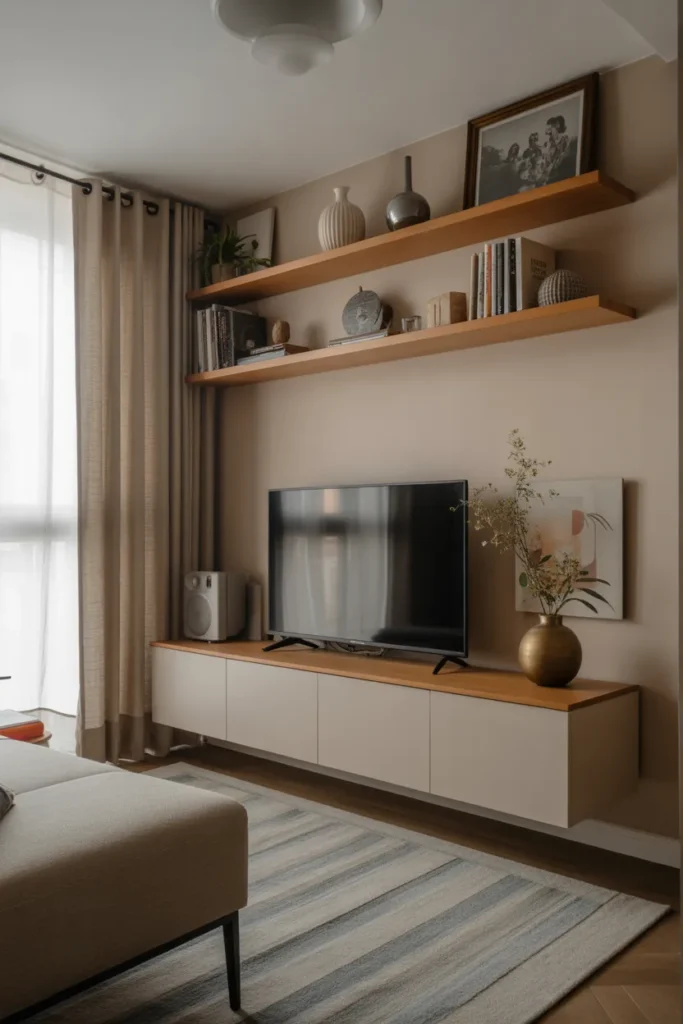
A floating media unit keeps the TV area sleek while leaving the floor underneath completely clear. That visible strip of floor makes the whole wall feel lighter and the room feel larger. Wall mounted consoles also let you set the exact height that works for your seating, which usually means the screen center sits at eye level when you are seated. Cables can be hidden inside the wall or run through a cord cover painted to match, so the setup looks clean from every angle. Choose a unit with closed storage to hide consoles, remotes, and media clutter. A floating shelf style unit with drawers gives you the storage of a traditional credenza without the bulk. Keep the unit slightly narrower than the wall section it sits on so there is breathing room on each side. This works in rentals too if you use a very sturdy French cleat or ask the landlord; otherwise a slim legged console gives a similar airy feel without drilling.
Get the height right: the right height makes viewing comfortable and the room balanced. The center of the TV screen should sit roughly at eye level from your main seat, which is usually 42 to 48 inches from the floor to screen center. Mount the floating unit so its top sits 6 to 12 inches below the bottom of the TV. Leave enough clearance underneath for a robot vacuum or easy sweeping, at least 8 to 10 inches. If the unit holds a soundbar, make sure the soundbar does not block the bottom of the screen. Sit in your actual seat and check the sightline before drilling. A second pair of hands helps hold the unit in place while you mark holes.
Hide the cables: visible cables ruin the floating effect, so plan for them. An in wall cable kit routes power and HDMI behind the drywall for the cleanest look; many are renter friendly with paintable covers. A simple cord cover raceway painted the wall color works well and takes ten minutes to install. Bundle the cables behind the unit with velcro ties so nothing dangles below. Plug everything into a single surge protector inside the unit if there is room. Label the cables while you are at it, because future you will thank present you. The goal is a wall that looks like the TV simply floats there.
- Set screen center at seated eye level, about 42 to 48 inches from the floor.
- Leave 8 to 10 inches of clearance under the unit for cleaning.
- Route cables through the wall or a paintable cover for a clean float.
Shop This Look
12. Corner Furniture for Unused Areas
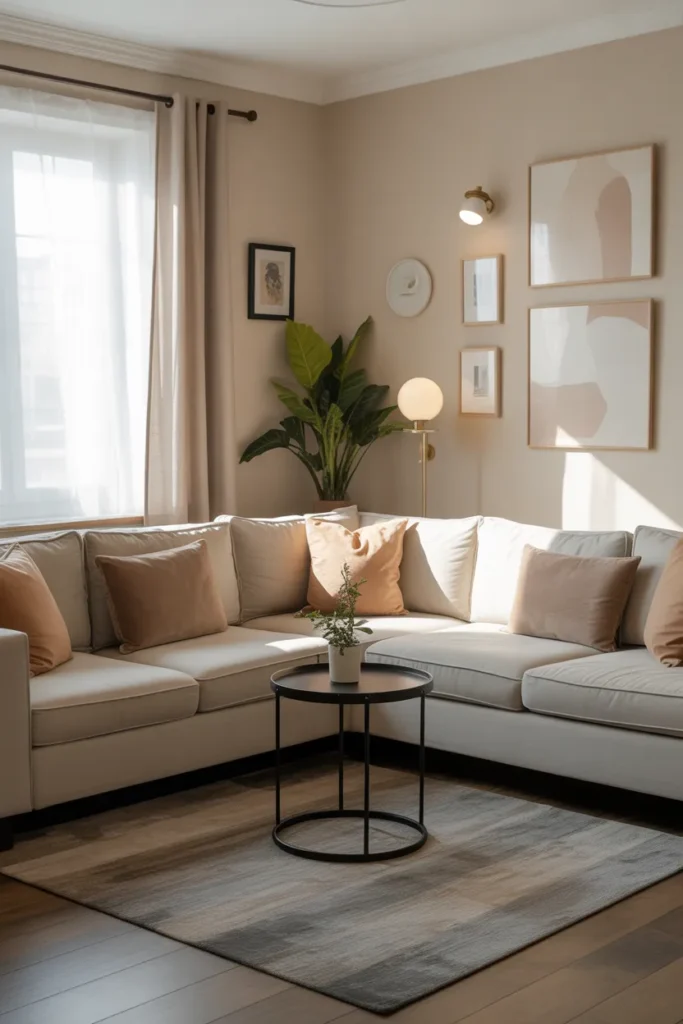
Corners are the most wasted space in a small living room, and corner furniture puts them to work. A corner sofa or sectional can seat more people than a straight sofa in the same wall length. A corner bookshelf or curio cabinet turns a dead angle into storage and display. Even a small corner chair with a floor lamp creates a reading nook that would not exist otherwise. The key is choosing pieces actually shaped for corners rather than shoving square furniture into the angle and leaving gaps. Look for true corner sectionals, corner desks, and triangular or curved shelves. Measure the corner carefully, including baseboards and any vents or outlets that need clearance. A corner piece that fits exactly looks built in and intentional. Done well, the corners stop being dead zones and start being some of the hardest working spots in the room.
Choose true corner shapes: furniture designed for corners uses the space far better than regular pieces pushed into one. A corner sectional follows the walls with no wasted triangle behind it. Corner shelving units are cut to fit the angle so every shelf is usable. A round corner table fills the angle without sharp edges jutting into walkways. Avoid putting a standard square bookcase diagonally across a corner; it eats floor space and looks awkward. If you are buying online, check the product dimensions diagram for corner specific measurements. Read reviews from people with similar room sizes to confirm the fit. The right shape makes the corner feel like it was designed, not just filled.
Light the corner: corners tend to go dark, and dark corners make a room feel smaller. Add a floor lamp, a wall sconce, or even a small table lamp on the corner piece itself. Light draws the eye into the corner and makes it feel like part of the room instead of a shadowy afterthought. A tall plant in a lit corner adds life and softens the angle. If the corner holds a reading chair, a swing arm wall lamp gives focused light without taking floor space. Warm white bulbs keep the corner cozy. This one addition can transform a corner from dead space into a favorite spot.
- Buy furniture actually shaped for corners, not square pieces pushed diagonally.
- Measure baseboards, vents, and outlets before ordering corner pieces.
- Add a lamp or sconce so the corner stays bright and inviting.
Shop This Look
13. Low-Profile Seating for Open Feel
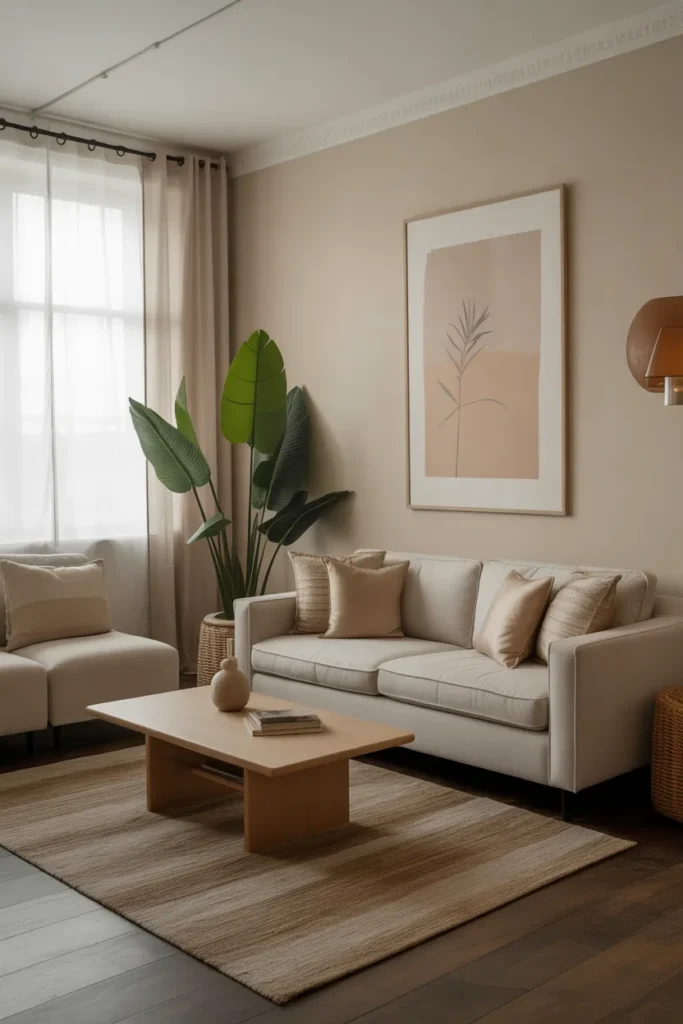
Low profile seating keeps sight lines open across a small living room, which makes the whole space feel more expansive. When the backs of your sofa and chairs sit low, you can see over them to the far wall, and that uninterrupted view reads as spaciousness. Platform style sofas, low lounge chairs, and floor cushions all create this effect. This style also suits modern and minimalist rooms beautifully. The trade off is that very low seating can be hard to get out of for some people, so consider who uses the room. A seat height around 15 to 17 inches is low but still manageable for most adults. Pair low seating with a low coffee table or ottoman so the proportions stay balanced. If the whole room sits low, hang art slightly lower too, so the composition feels connected. Add a tall plant or floor lamp to give the room some vertical variety, because an all low room can feel flat without one taller element.
Balance low with tall: a room full of low furniture needs at least one or two vertical accents to feel complete. A tall arc floor lamp, a large plant, or a floor to ceiling curtain gives the eye somewhere to travel upward. Without that, the room can feel squat and unfinished. Place the tall element in a corner or beside the seating so it frames the arrangement. A tall bookshelf works too and adds storage. Keep the tall pieces slim so they do not undo the openness you gained. One strong vertical is usually enough; two is plenty. The contrast between low seating and one tall accent is what makes the style look deliberate.
Keep comfort in mind: low does not have to mean uncomfortable. Look for low sofas with supportive cushions and a seat depth that fits your body. Test the sit if you can, paying attention to lower back support. Add lumbar pillows to fill the gap behind your back. A soft rug underfoot makes low seating feel intentional and cozy rather than just low. If older family members visit often, keep one standard height chair in the mix so everyone has a comfortable option. Comfort is personal, so prioritize how the piece feels over how it photographs. A beautiful room you avoid sitting in is a failed room.
- Choose seat heights around 15 to 17 inches for an open feel that stays usable.
- Add one tall plant or floor lamp for vertical balance.
- Hang art slightly lower so it connects visually with low seating.
Shop This Look
14. Hidden Storage to Reduce Clutter
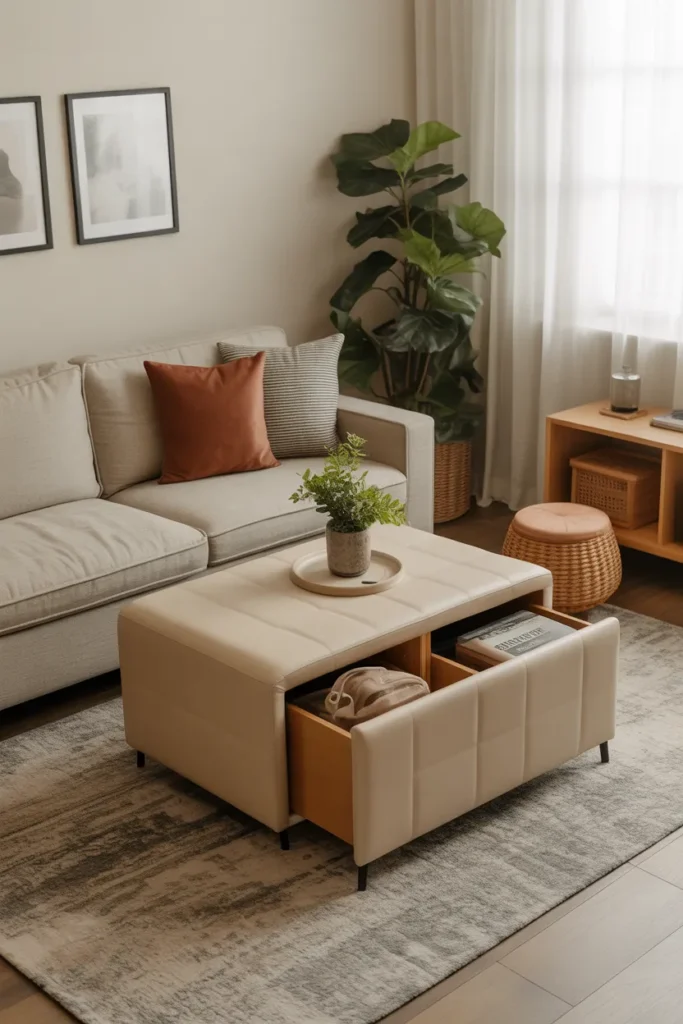
Hidden storage is what separates a small living room that looks calm from one that looks chaotic. Every visible object adds visual weight, so tucking the everyday stuff out of sight has an outsized effect. Storage ottomans, coffee tables with lift tops, sofas with hidden compartments, and benches with interiors all hide clutter in plain sight. The rule is simple: if you use it daily, it needs a home with a lid or a door. Open baskets are fine for throws, but remotes, chargers, mail, and toys need closed storage. Walk through your room and list everything that sits out because it has nowhere else to go. Then match each item to a hidden spot. This audit usually reveals that you need fewer new pieces than you think; often one good storage coffee table solves half the problem. The result is a room that stays tidy with almost no effort, because everything has a place.
Audit your clutter: you cannot fix storage until you know what needs storing. Spend ten minutes listing every item that lives on your surfaces: remotes, chargers, magazines, kids toys, pet supplies, blankets. Group them by how often you use them. Daily items need the most accessible spots, like a drawer in the coffee table. Weekly items can go in an ottoman or bench. Rarely used items belong in a closet, not the living room. Measure the bulky items so your storage pieces actually fit them. This quick audit tells you exactly what kind of hidden storage to buy instead of guessing. Most people discover their clutter falls into just three or four categories.
Choose lids over open bins: open storage still shows everything, which defeats the purpose in a small room. Lidded boxes, drawers, and cabinets hide the visual noise completely. A lidded basket on a shelf looks tidy even if the inside is messy. Lift top coffee tables reveal storage with one motion and close just as fast. If you already own open bins, add lids or replace them with lidded versions. The exception is decorative storage: a beautiful throw in an open basket adds texture. But functional clutter like cables and chargers should always be behind a lid or door. Your eye will thank you every time you walk in.
- List everything sitting on surfaces, then match each item to a closed spot.
- Prefer lidded boxes, drawers, and lift tops over open bins.
- Put daily items in the most accessible storage and rare items in closets.
Shop This Look
15. Statement Lighting Without Bulk
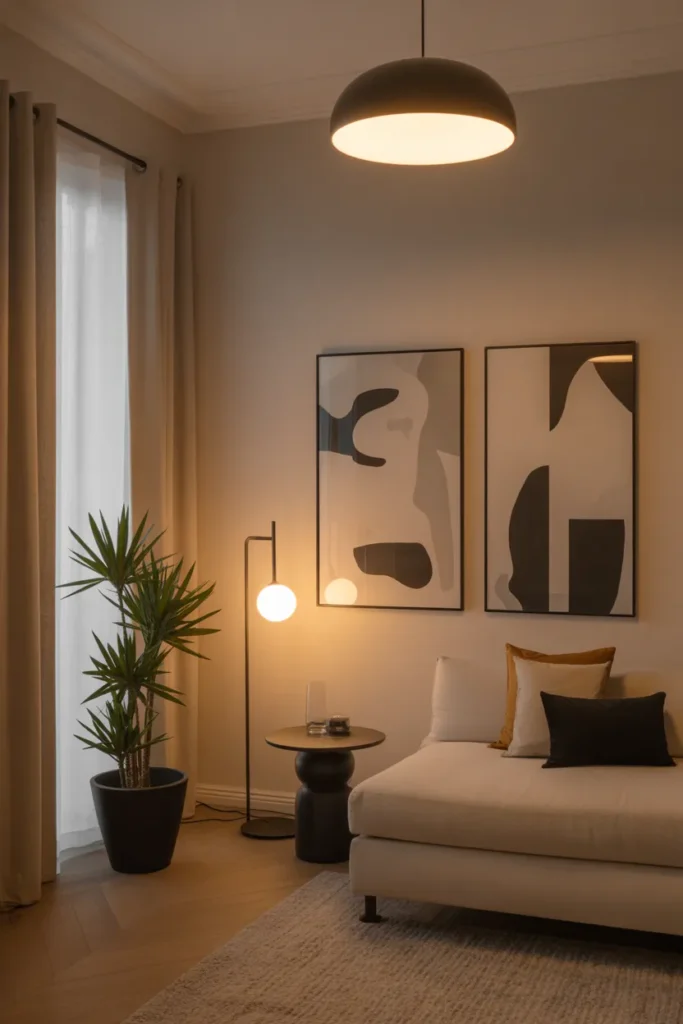
Statement lighting gives a small living room personality without eating floor space. A bold pendant, an interesting chandelier, or a sculptural flush mount draws the eye up and becomes the jewelry of the room. Because it hangs from the ceiling or mounts to the wall, it adds drama with zero footprint. This is the one place where going big is fine in a small room: an oversized pendant over a seating area creates a focal point that makes the room feel designed. Just keep the scale in proportion to the seating below it, not the room; a pendant should be about half to two thirds the width of the table or area beneath it. Choose a style that echoes your decor, whether that is a woven rattan shade, a brass mid century globe, or a modern geometric fixture. Good lighting also changes how the room feels at night, adding warmth and depth that overhead boxy lights never deliver.
Size it to the zone: the fixture should relate to the furniture beneath it. Over a coffee table or seating area, the pendant width should be roughly half to two thirds of the area width. Hang it 30 to 36 inches above a table surface, or at least 7 feet above the floor in a walkway. In a seating zone with no table, center the fixture over the conversation area. If the ceiling is low, choose a flush or semi flush mount so nobody bumps their head. A very large shade in a small room works when it is the only statement piece; two competing fixtures will fight. When in doubt, one confident fixture beats three timid ones.
Layer the light: a statement fixture is the star, but it needs supporting players. Add a floor lamp for reading, a table lamp for ambient glow, and maybe LED strips behind a shelf for depth. Aim for light at three heights: ceiling, eye level, and low. This layering eliminates harsh shadows and lets you set different moods. Put the statement light and at least one lamp on dimmers so you can shift from bright daytime to cozy evening. Warm white bulbs around 2700K flatter skin tones and make small rooms feel inviting. The combination of one bold fixture plus soft layers is what makes a small room feel finished.
- Size the fixture to the furniture below it, not to the room.
- Hang pendants 30 to 36 inches above tables and 7 feet above walkways.
- Layer ceiling, eye level, and low light, with dimmers for mood control.
Shop This Look
16. Glass Furniture for Visual Lightness
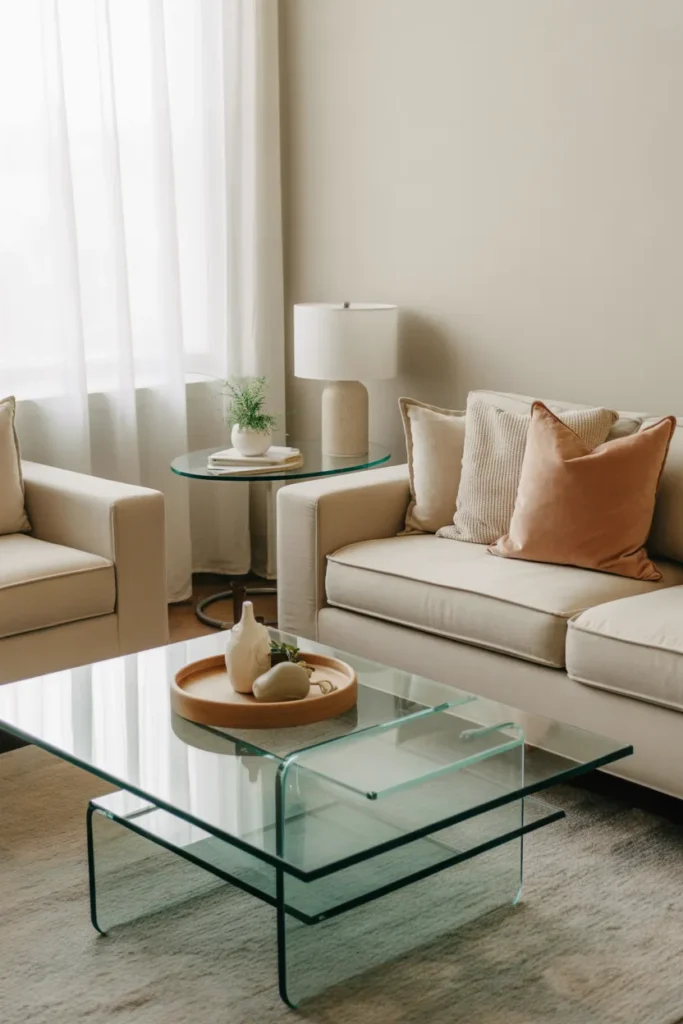
Glass furniture brings function to a small living room while staying visually light. A glass coffee table or glass side table holds your drink and your book but lets the eye pass straight through it. That transparency means the furniture barely registers in the room, which keeps sight lines long and the space feeling open. Glass works especially well in the center of the room, where a solid table would be the biggest visual block. Pair a glass top with slim metal or wood legs for stability and style. Tempered glass is the safety standard for furniture; check that any piece you buy uses it. Keep a microfiber cloth handy, because glass shows fingerprints, but a quick wipe keeps it pristine. If full glass feels too stark, try acrylic: it has the same see through effect with a slightly warmer look. Either way, you get the surface you need without the visual weight.
Choose tempered glass: safety matters with glass furniture, especially in homes with kids or pets. Tempered glass is heat treated so it is stronger than regular glass and breaks into small blunt pieces rather than sharp shards. Check the product listing for the word tempered before buying. Look for polished or beveled edges, which are safer and look more finished. A thickness of at least 8 to 10 millimeters feels solid for a coffee table. Avoid placing very hot items directly on the glass; use coasters or a trivet. With these basics covered, glass furniture is as safe as any other material and much lighter visually.
Style underneath it: the space under a glass table is visible, so treat it as a display zone. A beautiful rug underneath becomes part of the look. A low stack of coffee table books or a flat woven basket under the table adds interest without clutter. Keep it minimal: one or two items max. Avoid storing messy everyday things underneath, because they will be on display. This is actually a benefit in disguise; the visibility forces you to keep that zone tidy. Rotate the underneath styling seasonally for a fresh look. Done right, the area under the glass becomes one of the prettiest spots in the room.
- Buy only tempered glass with polished edges for safety.
- Keep the area under the glass styled and minimal since it stays visible.
- Wipe with a microfiber cloth to keep fingerprints under control.
Shop This Look
17. Accent Wall to Add Depth
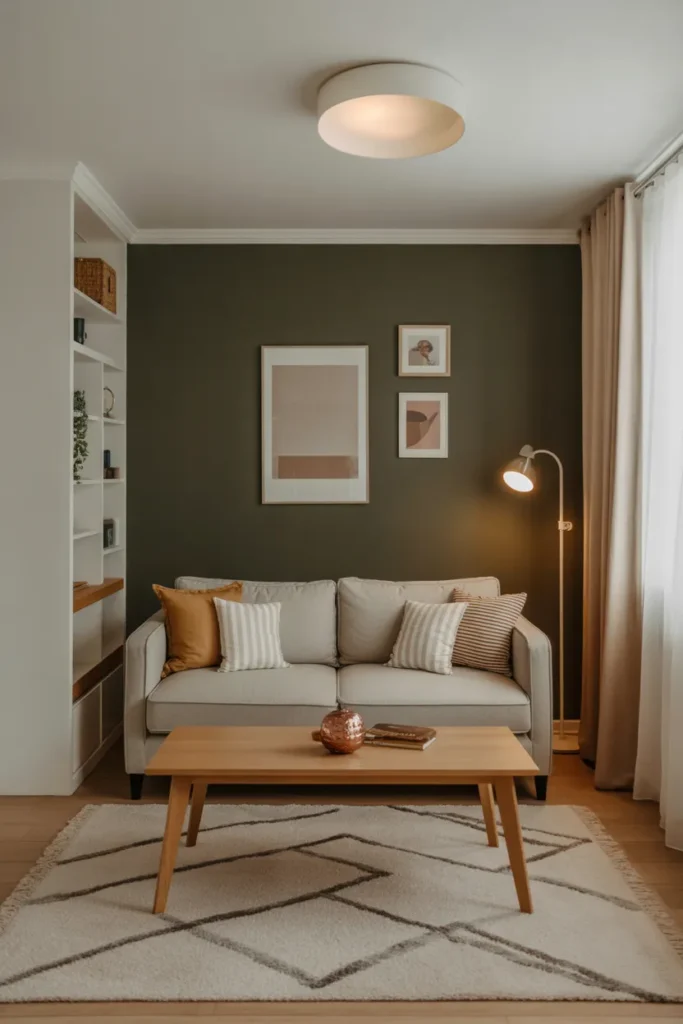
An accent wall adds depth and character to a small living room without closing it in. One wall in a deeper color, a textured finish, or a subtle wallpaper gives the room a focal point and makes the other walls feel farther away by comparison. This contrast creates a sense of dimension that flat, single color rooms lack. The key is restraint: one wall only, and a color that is rich but not neon. Deep greens, warm terracotta, navy, or a textured limewash all work beautifully. The accent wall should usually be the one your sofa sits against or the one with the fireplace or TV, because the eye naturally lands there. Keep the other three walls light so the room stays bright. Art and shelves pop against a darker wall, so this is also a great backdrop for a gallery. It is a bold move that pays off fast, and repainting one wall is a one afternoon job.
Choose the right wall: the accent wall should be the natural focal point of the room. In most living rooms that is the wall behind the sofa, the fireplace wall, or the TV wall. Avoid accenting a wall with a lot of doors or windows, because the breaks chop up the effect. Also avoid the longest wall if the room is very narrow; darkening it can make the tunnel feeling worse. Instead, accent a short end wall to visually pull it closer and make the room feel more square. Stand in the doorway and notice where your eye goes first; that is your wall. If you are unsure, the sofa wall is almost always a safe bet.
Keep the color grounded: the best accent colors for small rooms have depth without being loud. Look at deep, muted shades: forest green, ink navy, warm clay, charcoal with brown undertones. Test a large swatch on the wall and live with it for a day before committing. The color will look different in morning and evening light. Pair the accent with light trim and ceiling so the contrast stays crisp. Repeat the accent color in small doses elsewhere, like a cushion or a vase, to tie the room together. If you rent, peel and stick wallpaper or large fabric panels give the same effect without paint. One confident wall beats four timid ones.
- Accent the natural focal wall, usually behind the sofa or fireplace.
- Pick deep muted shades like forest green or warm clay, not brights.
- Repeat the accent color in two small accessories to tie the room together.
Shop This Look
18. Foldable or Stackable Seating
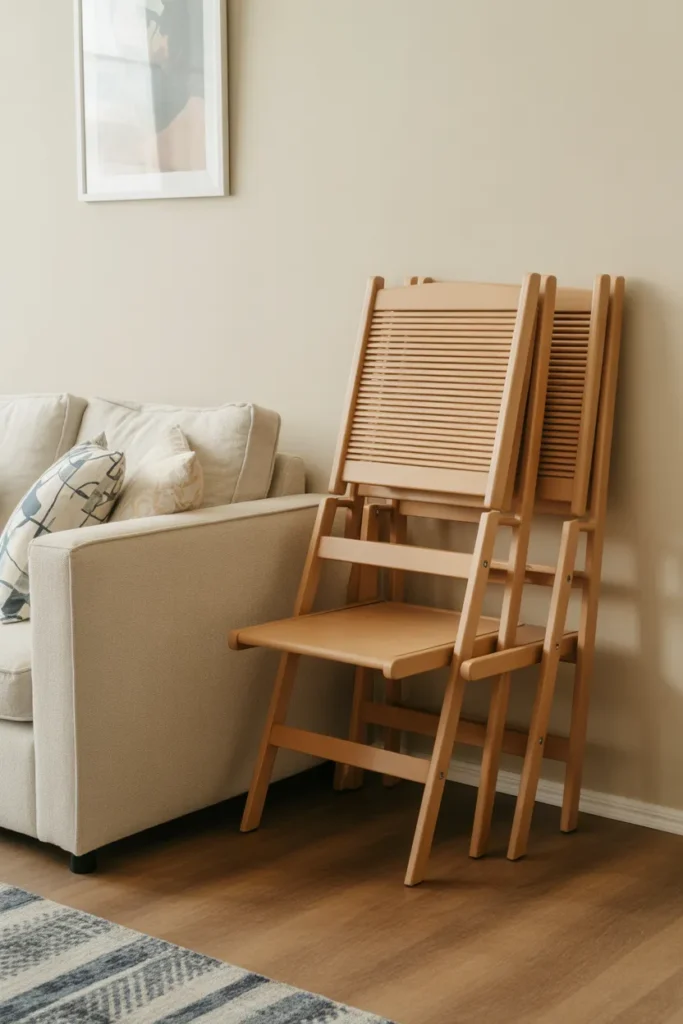
Foldable or stackable seating is the secret weapon for small living rooms that host guests. Most days you need seating for two or three, but when friends come over you need five or six. Folding chairs, stacking stools, and floor cushions bridge that gap without permanently eating floor space. Modern folding chairs have come a long way from the metal banquet look; you can find wood, rattan, and upholstered versions that look like real furniture. Stacking stools tuck into a corner or closet when not in use. Floor cushions stack on a shelf and pull out for casual movie nights. The trick is choosing pieces that look good enough to leave out sometimes, so they do not feel like embarrassing backup seating. Store them somewhere accessible, because seating you have to dig out of the garage will not get used. A nearby closet, under a console, or behind a curtain all work.
Pick good looking pieces: the whole point fails if the extra seating looks like an afterthought. Choose folding chairs with real design: wood frames, woven seats, or upholstered pads. Acrylic folding chairs are nearly invisible when stored against a wall. Stacking stools in wood or molded plastic look intentional in a corner. Check the weight rating, especially for stools, and make sure the folding mechanism locks securely. Comfort matters for an evening of sitting, so add a thin cushion to hard seats. When the design is good, guests will not realize the chair folds until you show them, and that is exactly the effect you want.
Store them smart: accessible storage is what makes flexible seating actually get used. A folding chair that lives behind the bedroom door is one you will grab; one in the attic is one you will skip. Dedicate a slim closet section or a corner behind a curtain. Stacking stools can live under a console table or beside the sofa as a side table when not needed as seats. Floor cushions stack neatly on a closet shelf or in a large basket. Some ottomans open to store folded chairs inside, which is brilliantly efficient. Measure your storage spot before buying so the folded dimensions fit. If it is easy to grab, you will actually use it.
- Choose folding pieces with real design so guests never feel like an afterthought.
- Store them within arm’s reach of the living room, not in the attic.
- Add thin cushions to hard folding seats for evening comfort.
Shop This Look
19. Rugs to Define and Expand Space
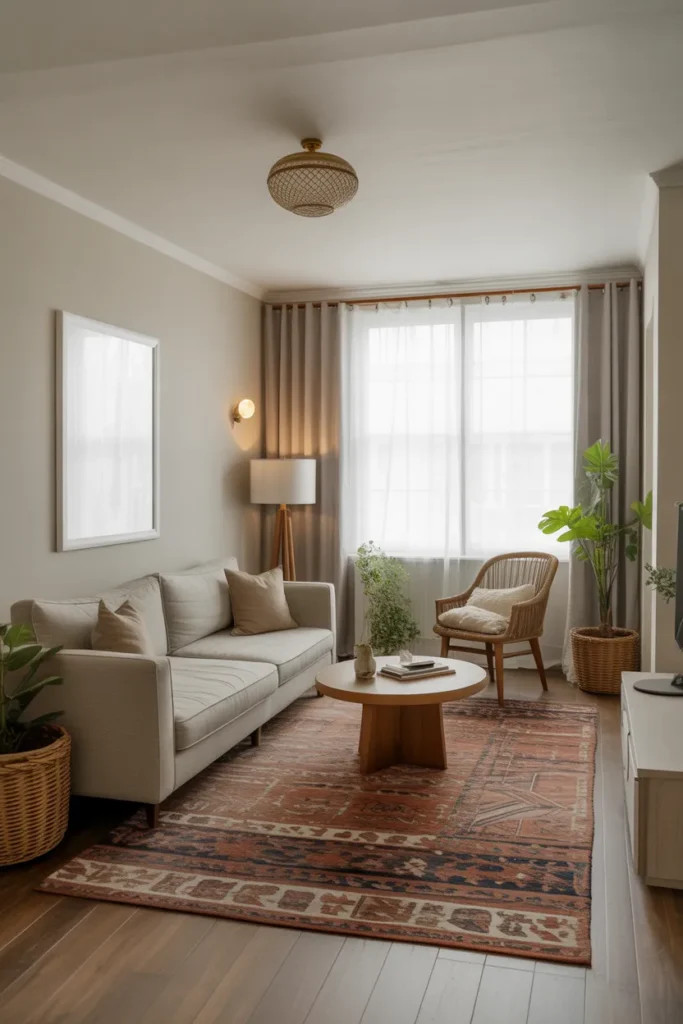
Rugs do more than warm your feet in a small living room; they define zones and can make the space feel larger. A rug that fits the seating area properly pulls the furniture into a cohesive group instead of letting pieces float separately. The eye reads that defined group as an intentional arrangement, which feels more spacious than scattered furniture. For the expanding effect, choose a rug large enough that the front legs of the sofa and chairs sit on it. A rug that is too small has the opposite effect, making everything look cramped. In open plan rooms, rugs are the main tool for saying where the living room ends and the dining area begins. Light colored rugs bounce light and feel airy, while a subtle pattern hides everyday wear. Layer a smaller textured rug over a large flat weave one for depth without bulk.
Size it generously: the number one rug mistake in small rooms is buying too small. For a seating area, the rug should extend at least 6 to 8 inches beyond the furniture on each side. In most small living rooms, a 5×7 or 6×9 rug is the sweet spot. All four legs of the coffee table should sit on the rug, and the front legs of the sofa and chairs too. If the budget is tight, buy the largest simple rug you can afford rather than a small fancy one. Measure the seating footprint with tape before shopping. A generous rug anchors the room; a skimpy one makes everything look like it is floating in the wrong place.
Choose the right pile: pile height affects both comfort and practicality. Low pile or flat weave rugs are best under furniture that moves, like dining chairs or a rolling ottoman. They are also easier to vacuum and show less wear. Medium pile adds softness underfoot in the main seating zone. High pile shag looks cozy but traps dust and makes a small room feel visually heavy. In homes with pets, choose a low pile rug in a pattern that hides hair. Washable rugs are a game changer for small living rooms that double as play areas. Pick the pile for how you actually live, not just how it looks in the store.
- Buy a rug large enough for front legs of all seating, usually 5×7 or 6×9.
- Use low pile under moving furniture and washable rugs with kids or pets.
- Layer a small textured rug over a large flat weave for depth.
Shop This Look
20. Minimal Decor with Purpose
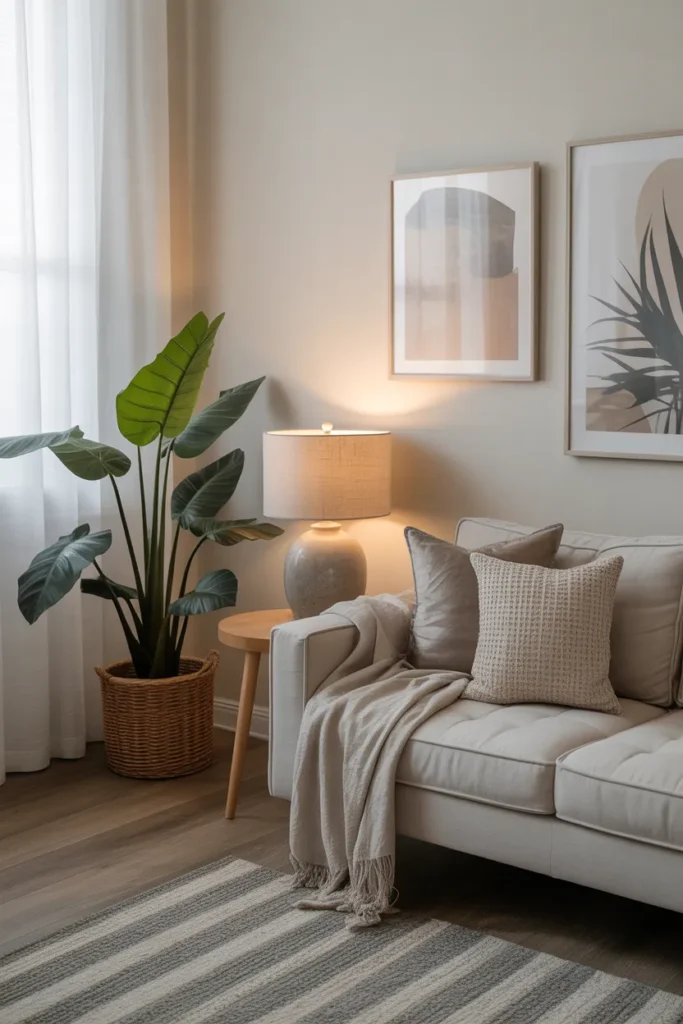
Minimal decor with purpose is the finishing philosophy that keeps a small living room feeling calm. Every object on display should earn its place by being beautiful, useful, or meaningful. That does not mean bare walls and empty shelves; it means edited shelves and intentional walls. Choose a few pieces you genuinely love rather than filling space with filler. A single large piece of art has more impact than ten small frames scattered around. One sculptural vase beats a crowd of knickknacks. This approach also makes cleaning faster and the room easier to live in. When everything visible is something you chose deliberately, the room feels personal rather than sparse. Rotate pieces seasonally to keep it fresh without accumulating more. The goal is a room that feels curated, where the empty space is as considered as the objects.
Edit ruthlessly: editing is a skill, and it starts with taking everything off the shelves. Put it all on the table, then put back only what you love or use. Box up the rest for a month; if you do not miss it, donate it. Keep surfaces to a few objects each: a stack of books, one plant, one decorative object is a complete vignette. Leave negative space on shelves and walls; the emptiness is what makes the kept pieces stand out. Apply the same rule to walls: one strong piece of art per wall is plenty. This is not about deprivation. It is about giving your favorite things the spotlight they deserve instead of burying them in clutter.
Make it personal: minimal does not mean generic. The few pieces you keep should say something about you. Family photos in matching frames, a travel souvenir, a handmade bowl, a plant you have kept alive for years. These are the objects that make a small room feel like home rather than a showroom. Display them with breathing room so each one gets noticed. A single framed photo on a shelf has more presence than six crowded together. Rotate personal items occasionally to keep the display feeling alive. When every visible object has a story or a purpose, the room feels rich even though it holds very little.
- Take everything off shelves, then put back only what you love or use.
- Limit each surface to a small vignette: books, plant, one object.
- Give personal pieces breathing room so each one gets noticed.
Shop This Look
21. Wall-Mounted Lighting to Free Surfaces
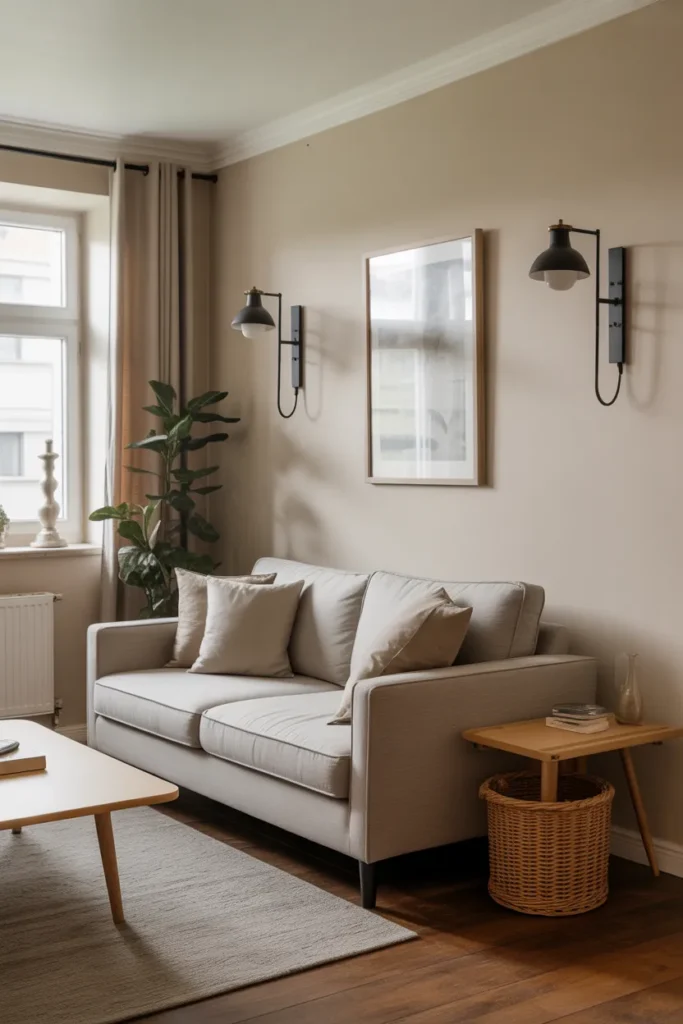
Wall mounted lighting frees up every surface in a small living room. Table lamps need tables, and floor lamps need floor space, but sconces and swing arm wall lights need nothing but a wall. That means your side tables stay clear for drinks and books, and your floor stays open for movement. Sconces beside the sofa give perfect reading light. A swing arm lamp over a chair creates a cozy corner without a floor lamp base in the way. Picture lights over art add gallery polish. Many wall lights now come in plug in versions, so renters can get the look without an electrician. Run the cord down the wall in a paintable cover and it nearly disappears. Hardwired versions look cleanest if you own the home. Either way, moving light to the walls is one of the most effective ways to declutter a small room while actually improving how it is lit.
Try plug in sconces: plug in wall sconces are the renter friendly hero of small room lighting. They mount with a couple of screws or even heavy duty adhesive, and the cord plugs into the nearest outlet. Choose a cord cover that matches your wall color and run it straight down; from a few feet away it vanishes. Look for sconces with an on off switch on the cord or a pull chain for convenience. Swing arm plug in versions give adjustable reading light beside a chair or bed. Pair them with warm dimmable bulbs for evening ambiance. When you move, they come down with two small holes to patch. No electrician, no commitment, all the benefit.
Flank key spots: sconces work best in pairs or in deliberate single placements. Flank the sofa with two sconces for balanced reading light on both ends. Put one swing arm lamp beside your reading chair. Add a picture light above the main art piece to make it glow in the evening. Beside a mirror, a pair of sconces doubles the light effect. Keep the style consistent across the room so the fixtures feel like a set. Match the metal finish to your other hardware for a pulled together look. Wall lighting at eye level also flatters faces better than harsh overhead light, which is a nice bonus when the room is full of people.
- Use plug in sconces with cord covers for a renter friendly install.
- Flank the sofa or reading chair for balanced, useful light.
- Match sconce finishes to your other hardware for a cohesive look.
Shop This Look
22. Tall Storage Units for Vertical Use
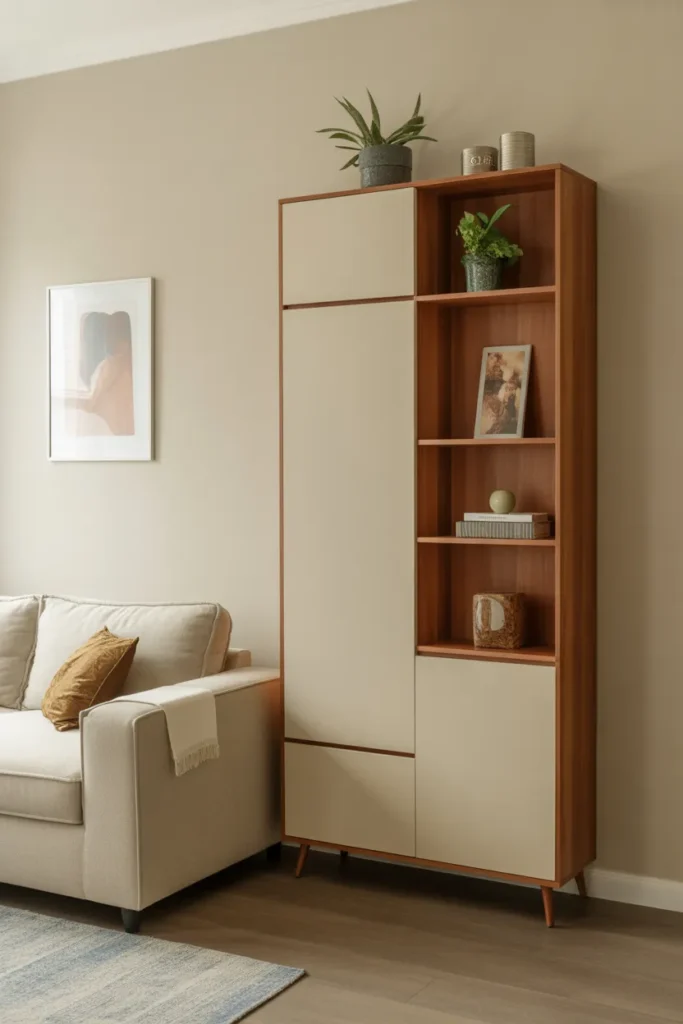
Tall storage units use the vertical space that small living rooms usually waste. A narrow bookcase that reaches the ceiling holds as much as a wide low one while using half the floor. Tall cabinets hide clutter behind doors from floor to ceiling. Even a tall ladder shelf in a corner adds display and storage without spreading out. The trick is to go tall and narrow rather than short and wide. Measure your ceiling first; most living rooms fit 72 to 84 inch units comfortably. Anchor every tall unit to the wall, because a top heavy bookcase is a real hazard, especially with kids or in earthquake zones. Style the top shelves with lighter items and keep heavy books lower for stability. Paint or choose units in a color close to your walls so they blend in rather than looming. Vertical storage keeps the floor clear and the room feeling open while swallowing an impressive amount of stuff.
Anchor everything: any storage unit taller than it is wide must be anchored to the wall. This is non negotiable with kids, pets, or in earthquake prone areas, but it is smart practice everywhere. Most bookcases include anti tip straps or brackets; use them. Find a stud for the strongest hold, or use heavy duty anchors. It takes ten minutes and prevents a genuinely dangerous accident. While you are at it, anchor the TV if it sits on a stand rather than mounted. Check the anchors once a year to make sure they are still tight. Safety is the least glamorous part of small room design and the most important.
Style top to bottom: a tall unit is a big visual element, so style it deliberately. Keep the top shelf light and airy with a plant or a single object, since heavy items up high look precarious. Group books both vertically and in horizontal stacks for variety. Use baskets on the middle shelves to hide the messy categories. Leave some shelves partly empty so the unit breathes. If the unit has doors on the lower section, that is your hidden storage for the ugly but necessary stuff. Step back and check the overall balance; the unit should feel like part of the wall, not a tower dropped into the room.
- Go tall and narrow, 72 to 84 inches, to maximize storage per square foot.
- Anchor every tall unit to a stud with the included anti tip hardware.
- Keep top shelves light and use baskets on middle shelves for hidden storage.
Shop This Look
23. Sliding Doors Instead of Swing Doors
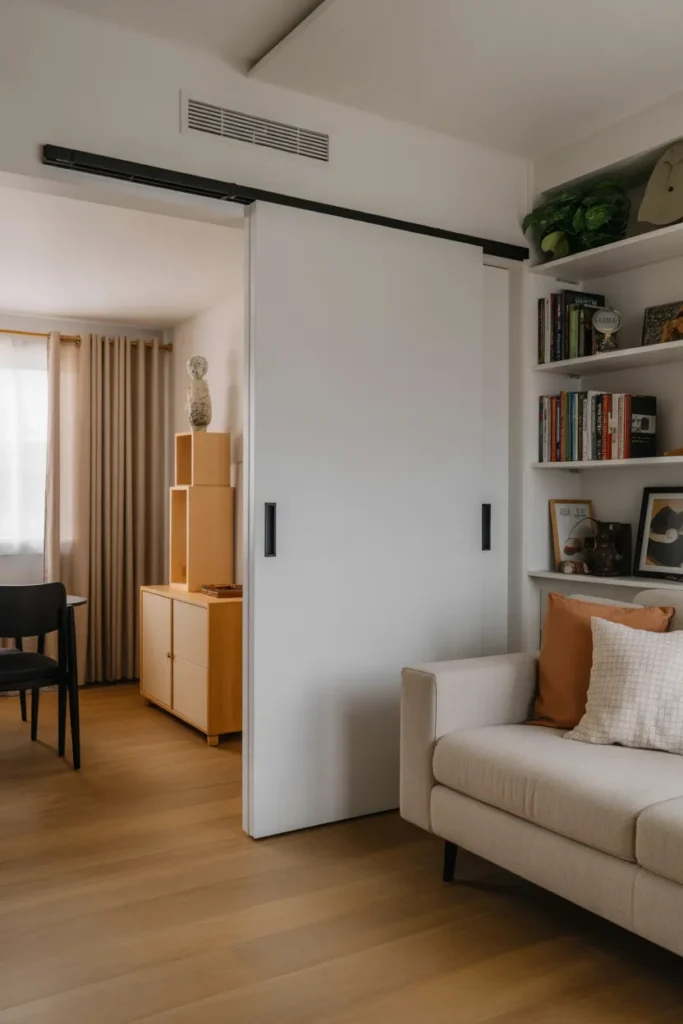
Sliding doors save the swing space that hinged doors waste, and in a small living room every square foot counts. A standard interior door needs about 9 square feet of clear floor just to swing open. Replace it with a sliding barn door or a pocket door and that space becomes usable. This matters most for doors into the living room from hallways, closets, or adjoining rooms. A barn door on an exposed track adds character while it saves space. A pocket door disappears into the wall entirely, which is the cleanest look but needs wall cavity space. Even swapping a hinged closet door for a sliding one frees the area in front of the closet. If full replacement is too much, consider removing a door entirely where privacy is not needed and using a curtain instead. The floor space you reclaim can hold a chair, a plant, or simply stay open so the room breathes.
Choose barn or pocket: barn doors and pocket doors solve the same problem differently. A barn door hangs on a visible track above the doorway; it is easier to install because it needs no wall demolition, and the hardware becomes a design feature. It does need clear wall space beside the doorway for the door to slide over. A pocket door slides into the wall cavity and disappears completely, but installing one means opening the wall, so it suits renovations. For closets, bypass sliding doors are the simplest swap. Measure the doorway and the adjacent wall before choosing. Renters can sometimes swap a door and store the original, but check with the landlord first.
Mind the gaps: sliding doors have trade offs to plan for. Barn doors do not seal as tightly as hinged doors, so they block less sound and light around the edges. This is fine for closets and living room entries but less ideal for bathrooms. Add a soft close mechanism so the door does not slam. Make sure the track is level and rated for the door weight; a sagging track makes the door drag. Keep the floor track area clear of rugs with thick pile that could catch. For pocket doors, confirm there is no plumbing or wiring in the wall cavity first. A well installed sliding door should glide with one finger.
- Reclaim about 9 square feet per door by switching from hinged to sliding.
- Barn doors need clear adjacent wall space; pocket doors need an empty wall cavity.
- Add soft close hardware and check the track is level and weight rated.
Shop This Look
24. Consistent Color Scheme for Flow
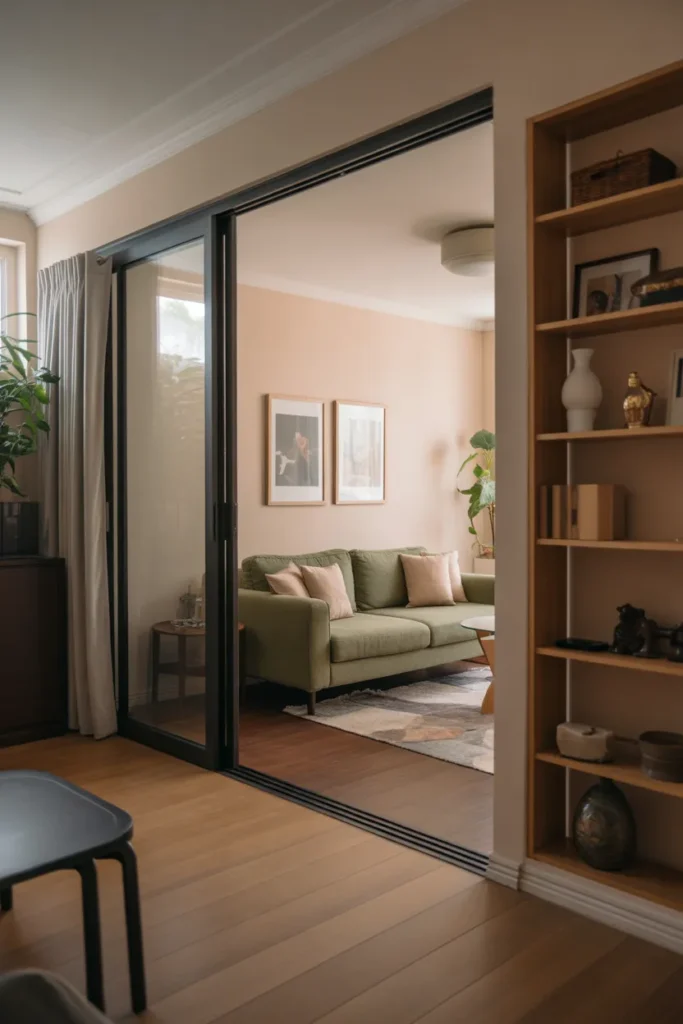
A consistent color scheme is the quiet glue that makes a small living room feel larger and calmer. When the walls, large furniture, rug, and curtains all sit in the same color family, the eye moves through the room without stopping at visual breaks. Fewer breaks mean the room reads as one continuous space rather than a collection of competing pieces. This does not mean everything must match exactly; it means staying within a tight palette of maybe three to four related tones. Warm whites with beiges and light woods, or cool grays with soft blues and silver accents, both work. The consistency extends to finishes too: repeating the same wood tone or metal finish keeps things cohesive. When you bring in pattern, keep it in the same palette so it adds texture without adding noise. This discipline is what makes small rooms feel designed instead of assembled from leftovers.
Build a palette first: start with three to four colors before you buy anything. Pick a dominant neutral for walls and big pieces, a secondary tone for the rug and curtains, and one accent for cushions and art. Write them down or save swatches on your phone so you can check new purchases against the palette. When everything you bring home fits the scheme, the room builds itself coherently over time. This also stops impulse buys that clash. If you already own pieces in different colors, use slipcovers, throws, and paint to pull them into the palette. A ten dollar throw can rescue a clashing chair. The palette is your decision filter for every future purchase.
Repeat finishes too: color is only half of consistency; finishes are the other half. Pick one wood tone and one metal finish and repeat them around the room. If your frames are black metal, make the curtain rod and lamp bases black metal too. If the coffee table is oak, let the shelf and side table be oak as well. This repetition creates rhythm, and rhythm feels calm. When you do want contrast, make it deliberate: one brass lamp in a black and oak room becomes a focal point precisely because everything else matches. Consistency first, then one confident exception.
- Define a 3 to 4 color palette before buying anything new.
- Check every purchase against saved swatches on your phone.
- Repeat one wood tone and one metal finish throughout the room.
Shop This Look
How to Start
Start with the room as it is, not as you wish it were. Measure the walls, note the windows and doors, and photograph the space in daylight. Write down what bothers you most: is it clutter, darkness, or a layout that does not work? That complaint becomes your priority list. Pick the three ideas from this article that address your biggest pain points and do those first. Small wins build momentum, and momentum is what carries a room makeover to the finish.
Work in layers from biggest to smallest. Paint and rugs come first because they set the palette for everything else. Then place the large furniture, then add lighting, then style the shelves and surfaces last. This order prevents you from buying decor that clashes with a rug you choose later. Keep receipts and buy from stores with good return policies, because even careful measuring sometimes surprises you. Live with each layer for a day or two before adding the next.
Finish by editing. Once everything is in place, remove one thing from each surface. Small rooms punish excess, and the last edit is usually what makes the room feel right. Take new photos and compare them with your before shots. You will be surprised how far a weekend of focused changes can take a small living room.
- Measure the room and list your top three complaints to set priorities.
- Work from large to small: paint and rug first, decor last.
- Edit at the end by removing one item from every surface.
Shop This Look
Common Mistakes
- Buying furniture before measuring the room, the doorways, and the delivery path.
- Choosing a rug that is too small for the seating area, which makes the room look cramped.
- Pushing every piece of furniture flat against the walls, which wastes the center and looks unintentional.
- Using only one overhead light instead of layering ceiling, eye level, and low lighting.
- Blocking natural light with heavy dark curtains hung right at the window frame.
- Skipping wall anchors on tall bookcases and floating shelves, creating a safety hazard.
- Filling every surface with decor instead of leaving breathing room, which adds visual clutter.
Frequently Asked Questions
What colors make a small living room look bigger?
Light neutrals like warm white, soft beige, and pale gray reflect light and make walls feel farther apart. Keep the largest pieces in light tones and add deeper color only in small accents. If you love dark colors, use them on a single accent wall rather than all four walls. For more palette ideas, see these small living room decor ideas for inspiration.
How should I arrange furniture in a small living room?
Float the main seating a few inches off the walls, anchor it with a rug, and keep walkways at least 30 inches wide. Use the corners for reading chairs or storage, and let one piece do double duty wherever possible. Avoid lining everything up against the walls, which makes the room feel like a waiting area.
Is a sectional okay in a small living room?
Yes, if it is sized for the room. A compact corner sectional can seat more people than a sofa plus chairs in the same footprint. Measure carefully, keep the chaise on the side with more space, and choose raised legs so light flows underneath. Skip oversized deep sectionals that swallow the floor.
How can I add storage without making the room feel crowded?
Use vertical storage like tall narrow bookcases, floating shelves, and furniture with hidden compartments. Storage ottomans, lift top coffee tables, and benches with interiors hide clutter in plain sight. Keep storage in colors close to your walls so it blends in.
What lighting works best in a small living room?
Layer three heights: a ceiling fixture for overall light, sconces or table lamps at eye level, and low accents like LED strips. Wall mounted sconces free up surfaces and floor space. Use warm white bulbs around 2700K and put key lights on dimmers for evening mood.
The Finishing Touch
A small living room rewards thoughtful choices more than big spending. The ideas in this article all share one principle: every piece should earn its footprint, either by doing double duty or by staying visually light. Start with the changes that cost the least, like rearranging furniture and editing clutter, before you spend on new pieces.
As you shop, keep your palette and measurements with you so every purchase fits the plan. It is tempting to buy a beautiful piece that is slightly too big, but in a small room that extra two inches matters. Trust the tape measure over your eyes in the store.
For more professional perspective, designers share their own small space strategies in How Designers Make the Most of a Small Living Room on Houzz. Take what fits your room, skip what does not, and enjoy the process. A small room done well feels more personal and more comfortable than a large room done carelessly.