14 Attic Room Ideas That Transform Unused Space
An attic room is any finished or semi-finished upper-floor space tucked beneath a sloped roofline — repurposed from dead storage into livable square footage. This article gives you 14 attic room ideas spanning color, materials, lighting, furniture, layout, and small-space strategy so you can finally put that overlooked space to work.
There’s something quietly powerful about a room that feels hidden from the rest of the house. Attic spaces carry a particular intimacy — low ceilings that press warmth inward, dormers that pool light at golden angles, and the soft architectural drama of a sloped roofline overhead. Whether you’re imagining a reading nook tucked under eaves or a full bedroom suite with exposed beams, attic living has a character no ground-floor room can replicate. Here are 14 ideas worth saving — and stealing.
Why Transforming Attic Space Works So Well
Attic room design draws from a long tradition of “found space” architecture — the European practice of converting loft and garret rooms into habitable quarters dates to the 17th century, when Paris imposed height restrictions that pushed living space upward. Today’s attic rooms blend that heritage with modern interior sensibilities: exposed structural elements are celebrated rather than hidden, and the constraints of sloped ceilings become the room’s most distinctive design feature.
The material palette that thrives in attic rooms is specific: whitewashed or natural Douglas fir tongue-and-groove paneling, unfinished white oak flooring, warm linen textiles, matte black or antique brass hardware, and rattan accent pieces. Color-wise, the most successful attic rooms stay within a narrow warm-neutral range — warm white (think Benjamin Moore Chantilly Lace OC-17), greige, aged linen, and dusty sage — with occasional deep charcoal or forest green as a grounding contrast on a knee wall or built-in.
The trend is unmistakably current. Post-pandemic shifts in how people use their homes — with more remote work, dedicated reading time, and a renewed appetite for “rooms with purpose” — have made attic conversions one of the fastest-growing home improvement categories. Pinterest searches for “attic bedroom ideas” and “attic office conversion” have grown significantly, reflecting a widespread desire for spaces that feel both intentional and retreat-like.
Small attic spaces are absolutely achievable with thoughtful prioritization. The most important move is to work with the slope rather than against it — low-profile furniture under the eaves, taller pieces only where the ceiling peaks, and built-ins tucked into knee wall cavities. Skylights are transformative for dark attic rooms; even one can change the entire character of the space.
Style at a Glance
| Element | Detail |
|---|---|
| Philosophy | Celebrate structural constraints; make the hidden feel intentional |
| Key Materials | White oak, tongue-and-groove pine, linen, rattan, matte black steel |
| Key Colors | Warm white, greige, dusty sage, aged linen, deep charcoal |
1. Whitewashed Shiplap Sloped Ceiling Bedroom
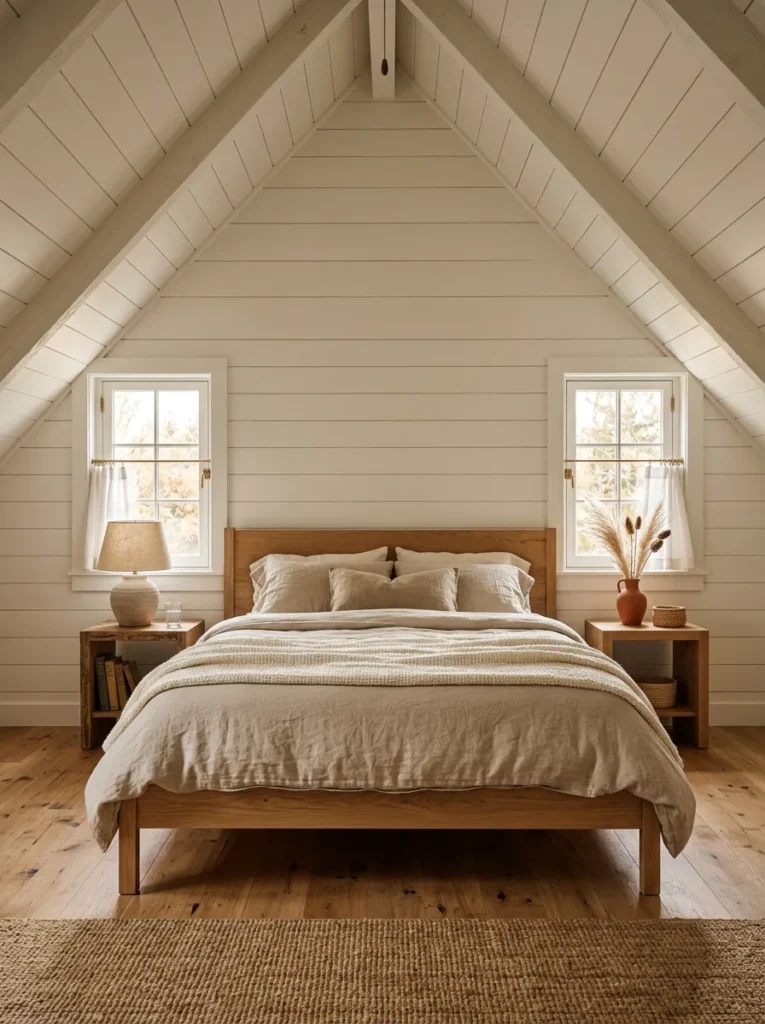
Vibe: This bedroom is hushed — the kind of room where morning light moves slowly across planked walls and you feel no urgency to leave.
Why it works: Whitewashing the shiplap ceiling unifies the angular planes of the roof into a single cohesive surface, reducing visual fragmentation that bare rafters can create. The horizontal planks emphasize the room’s width rather than its limited ceiling height, a principle called axis emphasis in residential design. Warm white, rather than cool bright white, prevents the abundant wood texture from feeling sterile.
How to get it: Install 1×6 tongue-and-groove pine boards directly onto existing roof framing and finish with a diluted whitewash — one part Benjamin Moore Chantilly Lace OC-17 latex to one part water, wiped with a cloth for a translucent, wood-grain-showing effect rather than a fully opaque painted look.
Quick Win: A set of oat-linen pillowcases costs under $30 and instantly keys the bedding to the warm white of the ceiling — no repainting required.
Shop The Look
| Product |
|---|
| Whitewash tongue-and-groove pine wall paneling kit |
| Oat linen duvet cover set queen |
| Low-profile platform bed frame natural oak |
| Terracotta ceramic table lamp matte |
| Dried pampas grass arrangement neutral decor |
Also view: 14 Hotel Style Bedding Ideas for Cozy Bedrooms
2. Exposed Dark Beam Contrast Against Bright Walls
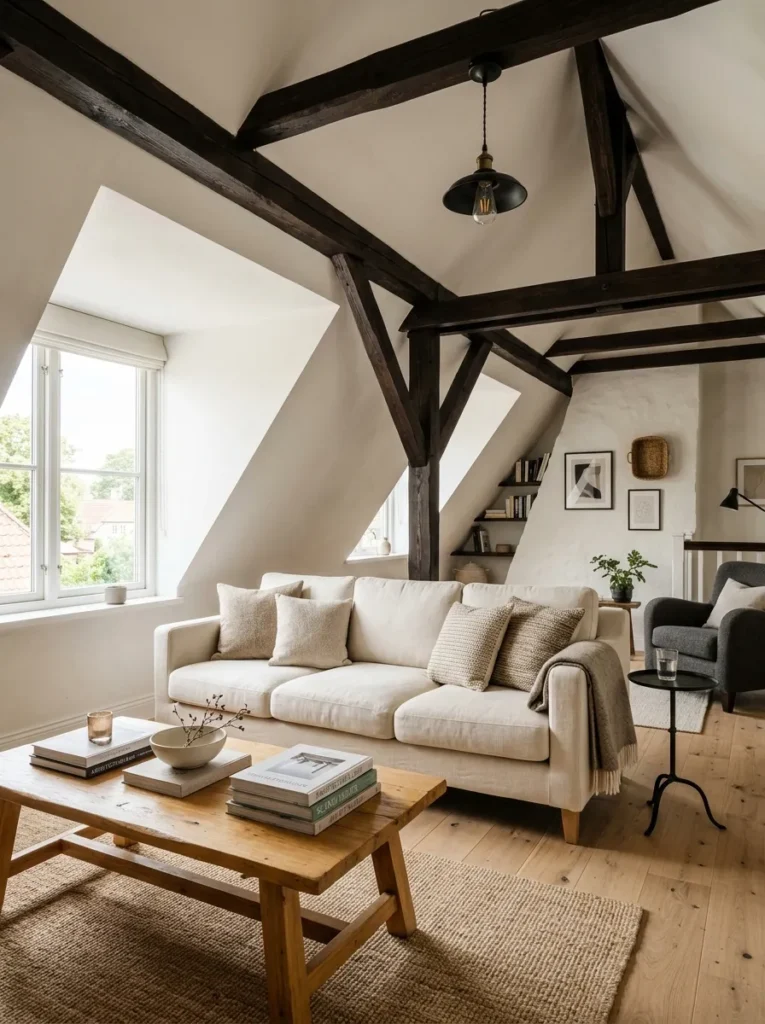
Vibe: The room feels grounded — the dark beams give visual weight to a space that might otherwise float away into all-white lightness.
Why it works: The principle of contrast anchoring is doing the heavy lifting here: dark structural elements against bright walls create tonal depth that gives a small attic room a sense of architectural permanence. The beams also draw the eye upward, making the sloped ceiling feel like a design feature rather than a ceiling limitation. This contrast mimics the palette of traditional Scandinavian and Alpine interiors, both of which evolved under similar low-ceiling constraints.
How to get it: If your existing beams are unfinished or painted over, sand them back and apply a dark walnut gel stain (General Finishes Java Gel is excellent for this). If the beams are hidden behind drywall, decorative faux beams in dark stain provide the same effect without structural work — mount them on simple cleats screwed to the ceiling joists.
Shop The Look
| Product |
|---|
| Dark walnut faux wood beam set decorative ceiling |
| Cream linen sofa living room modern |
| Black iron pendant light adjustable cord |
| Wide plank light oak laminate flooring |
| White ceramic decorative bowl neutral modern |
3. Dormer Window Reading Nook with Built-In Bench
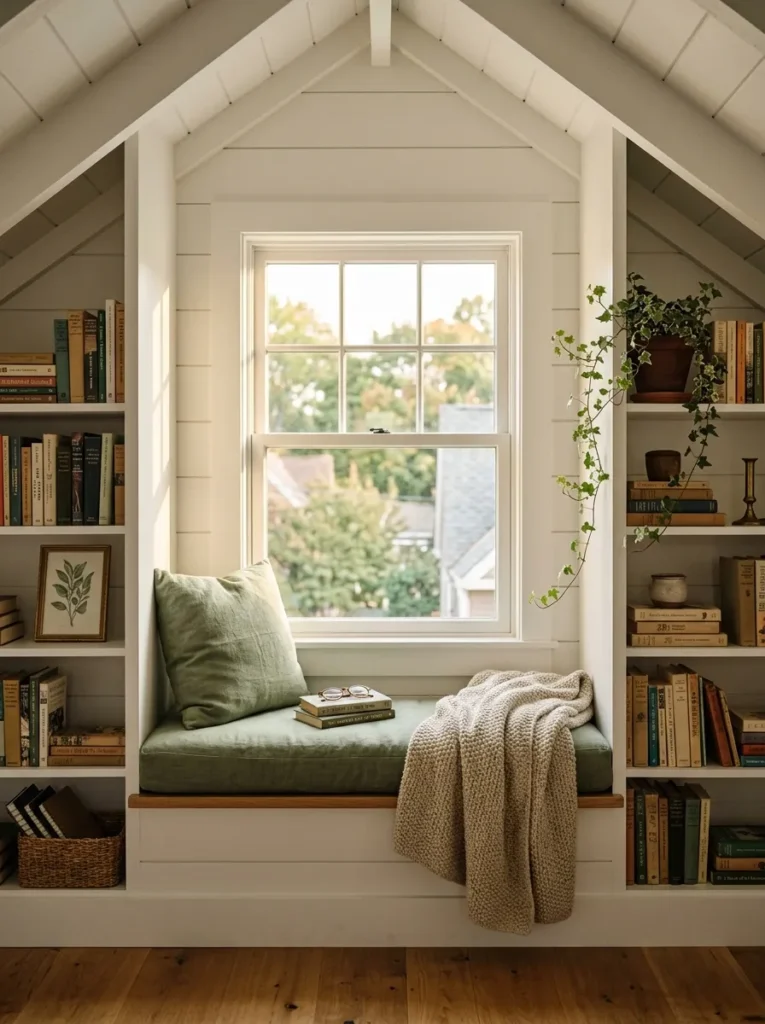
Vibe: It’s still — a dormer nook that operates as a room within a room, sealed from the rest of the house by its own geometry.
Why it works: Dormers are natural alcoves, and alcoves are natural seats — the proportions almost always match a standard bench depth of 20–24 inches. Building flanking shelves into the knee walls on either side of the dormer creates a sense of enclosure that amplifies the reading-nook feeling without any physical walls added. The sage green cushion introduces color in a way that feels botanical and grounded against white-painted wood.
How to get it: Frame a 24-inch-deep bench platform from 3/4-inch birch plywood, hinge the top for toy or blanket storage, and wrap the seat with a custom-cut foam cushion (3-inch density foam from Foam Factory, cut to size) upholstered in an outdoor-grade sage linen for durability.
Quick Win: An IKEA KALLAX unit turned on its side beneath a dormer window functions as an instant built-in bench with storage cubbies — add a foam cushion cut to 16×47 inches and you have a reading nook under $200.
Shop The Look
| Product |
|---|
| Sage green linen bench cushion window seat |
| White floating wall bookshelf set built-in style |
| Chunky knit throw blanket oat neutral |
| Trailing potted ivy artificial realistic |
| Hinge lid storage bench white wood |
4. Knee Wall Accent in Deep Forest Green
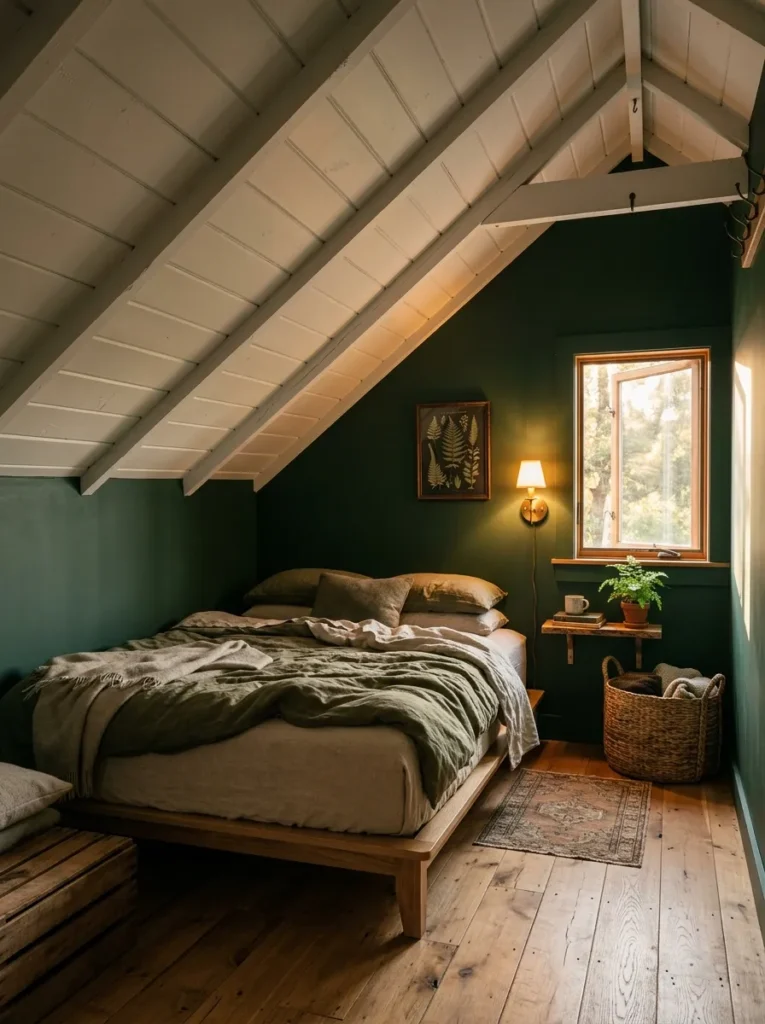
Vibe: The room feels wrapped — the green knee walls create a low, continuous color band that cocoons the lower half of the room in a way flat ceiling color never could.
Why it works: Painting only the knee walls (the short vertical sections below where the slope begins) in a deep color uses the room’s unusual architecture to define a color zone without overwhelming the space. This two-tone approach — dark below, light above — follows the visual weight principle that heavier colors belong at the base of a space, mimicking the way earth-and-sky landscapes are naturally arranged. Farrow & Ball Studio Green No. 93 or Sherwin-Williams Rookwood Antique Green both work beautifully here.
How to get it: Use a high-quality matte finish specifically — eggshell or flat — on the knee walls, as sheen amplifies the dramatic color in a way that can feel overwhelming in small attic rooms. Prime with a grey-tinted primer first so the deep green achieves full saturation in two coats rather than three.
Shop The Look
| Product |
|---|
| Forest green matte interior paint sample set |
| Antique brass wall sconce hardwired bedroom |
| Natural linen platform bed frame low profile |
| Seagrass storage basket with handles |
| Framed botanical print set neutral |
5. Skylights as the Primary Lighting Strategy
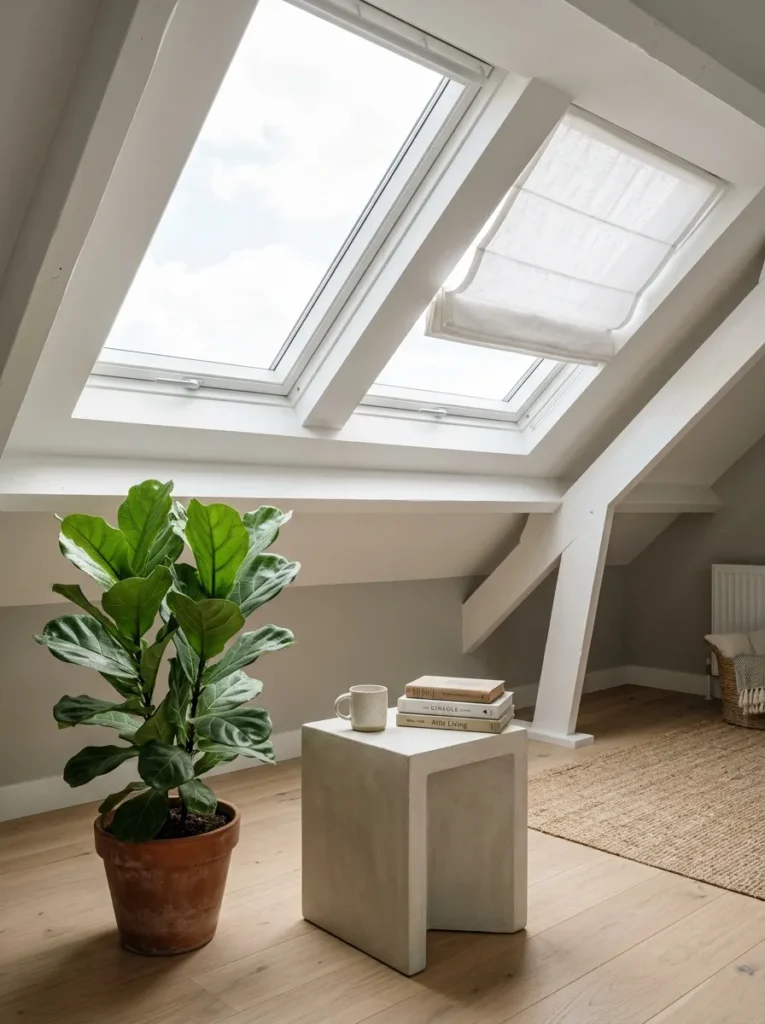
Vibe: The space is luminous — overhead light from skylights has a quality no wall window matches, filling shadow corners and making the ceiling feel like an asset.
Why it works: Skylights provide 30% more light than a vertical window of equivalent size because of the direct overhead angle — light enters more of the room’s surfaces rather than washing one wall. In an attic room where dormers may be small or few, a skylight is the single highest-impact architectural intervention possible. The diffuse, even quality of overhead daylight also minimizes the hard shadows that low dormer windows cast across sloped ceilings.
How to get it: If a full skylight installation isn’t in the budget, solar-powered tubular skylights (Solatube 160DS, approximately $650 installed) require only a 14-inch roof penetration and no structural modification — they deliver daylight equivalent to a 150-watt bulb from a south-facing roof section.
Quick Win: Install a skylight-specific white linen roller shade (VELUX-compatible models run $60–$100) to soften harsh midday light without losing brightness — this turns a flat skylight into a softbox effect.
Shop The Look
| Product |
|---|
| Velux skylight white linen blackout shade |
| Large fiddle leaf fig artificial realistic indoor |
| Pale concrete round side table modern |
| White oak engineered hardwood flooring plank |
| Tubular skylight daylight kit 10 inch |
6. Low-Profile Japanese Platform Bed Under the Eaves
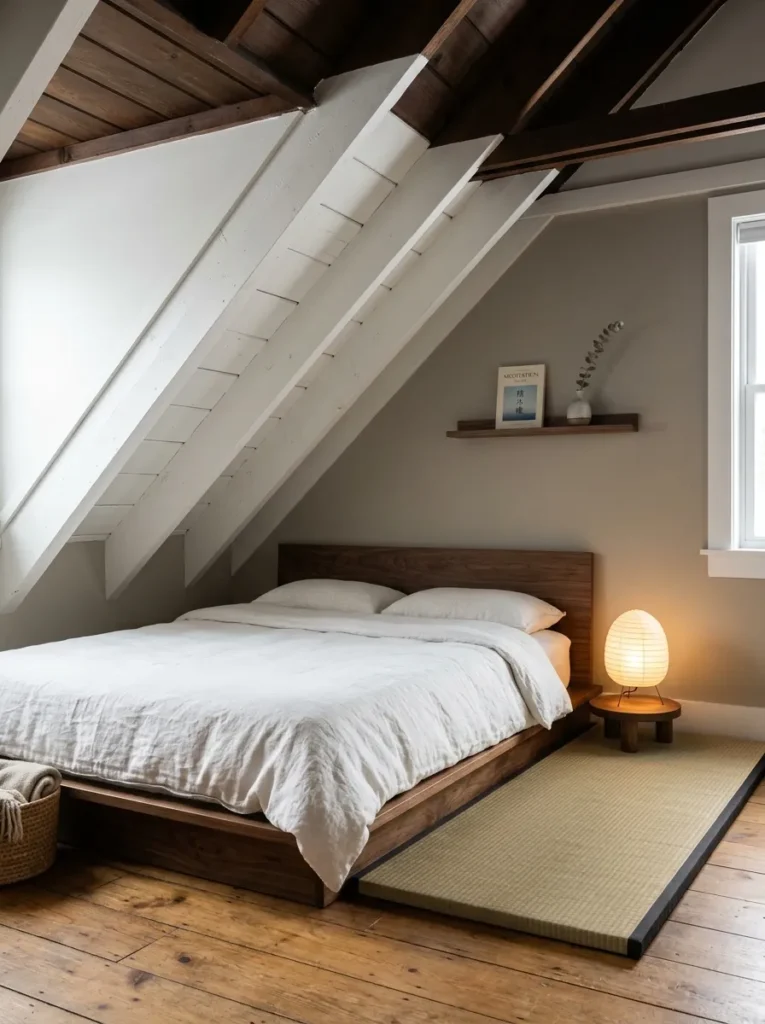
Vibe: The room is meditative — the low bed fits the sloped eave so precisely it seems the room was designed around it.
Why it works: A platform bed frame 10–14 inches high solves the attic’s core furniture challenge: standard bed frames at 24–30 inches tall collide with sloped ceilings. The Japanese-influenced platform profile uses negative space brilliantly — a low bed in a low-ceilinged room creates horizontal emphasis that makes the room feel wider, not cramped. The warm walnut finish at floor level grounds the pale linen bedding visually.
How to get it: Look specifically for beds with a maximum frame height of 12 inches (platform height, not including mattress) — Floyd Platform Bed and Article Carra are two options that meet this spec. If the slope starts at 5 feet on your knee wall, a 12-inch frame plus an 8-inch mattress keeps the sleeping surface at 20 inches, well below the usable ceiling zone.
Shop The Look
| Product |
|---|
| Low profile Japanese platform bed frame walnut |
| White linen duvet cover set minimalist |
| Washi paper table lamp low modern |
| Dried botanical stem single bud vase |
| Walnut wood floating wall shelf minimal |
7. Warm Edison Bulb String Lights Along Ridge Beam
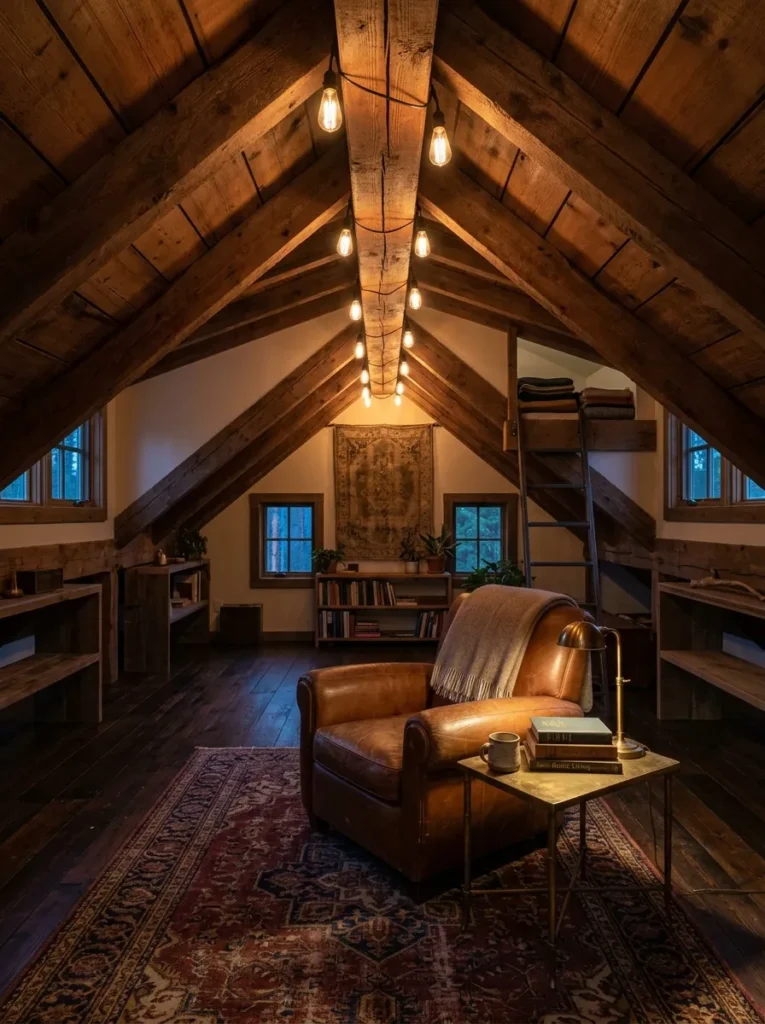
Vibe: The room glows amber at dusk — string lights along a ridge beam turn the highest architectural element into a warm, continuous light source.
Why it works: Draping Edison string lights along the ridge beam exploits the room’s central spine as a lighting armature, directing warm light downward at an angle that flatters both the sloped ceiling and the faces of people below. Warm-toned Edison bulbs (2200K color temperature) counteract the cool blue daylight that often fills attic rooms through north-facing dormers. This is ambient layering in its simplest form — no electrical work, just the geometry of the room doing the work.
How to get it: Use G40 globe string lights (not café lights — G40 globes have a softer diffusion) with 2200K vintage Edison-style LED bulbs, run along the ridge beam and secured with small brass cup hooks screwed every 18 inches. Run the cord discreetly down one beam end to a switched outlet.
Quick Win: A 48-foot G40 string light set runs under $35 on Amazon — enough to span most attic ridge beams twice for the layered look, with a warm dimmer plug-in adapter for $12 extra.
Shop The Look
| Product |
|---|
| G40 globe Edison bulb string lights indoor 48ft |
| Worn cognac leather reading chair accent |
| Vintage Persian style area rug 5×8 |
| Brass small table lamp vintage |
| Brass cup hooks pack decorative |
8. Rattan and Natural Fiber Texture Layering
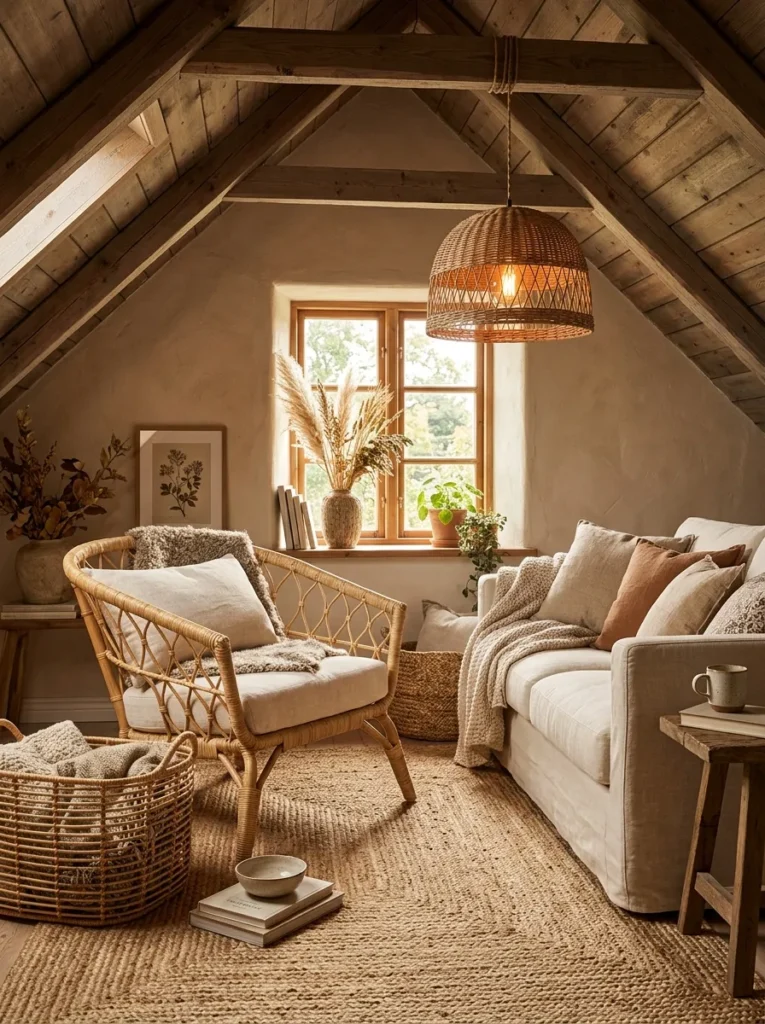
Vibe: The room is sun-warmed — all natural fibers absorb and reflect warm tones rather than bouncing cool light, giving the space a quiet organic richness.
Why it works: Texture layering in a single tonal family (naturals — rattan, jute, sisal, linen, seagrass) creates visual complexity without color contrast, which is the correct approach for small attic rooms where introducing many colors would read as busy. Each material has a different light-reflectance value (LRV) — wicker is matte, linen is softly sheen, polished rattan is semi-gloss — so the room shifts in quality as light moves through the day.
How to get it: Start with a flat-weave jute rug as the base layer (it reads as a “ground”), add a rattan or cane-back accent chair as the main texture focal point, and layer linen textiles for softness. Avoid mixing wicker and rattan in the same piece — choose one natural weave structure and repeat it across two or three pieces for cohesion.
Shop The Look
| Product |
|---|
| Rattan accent lounge chair natural indoor |
| Jute flat weave area rug 6×9 natural |
| Wicker pendant lamp shade natural fiber |
| Linen throw pillow covers set natural cream |
| Seagrass woven basket with lid storage |
9. Built-In Knee Wall Bookshelves and Storage Cabinets
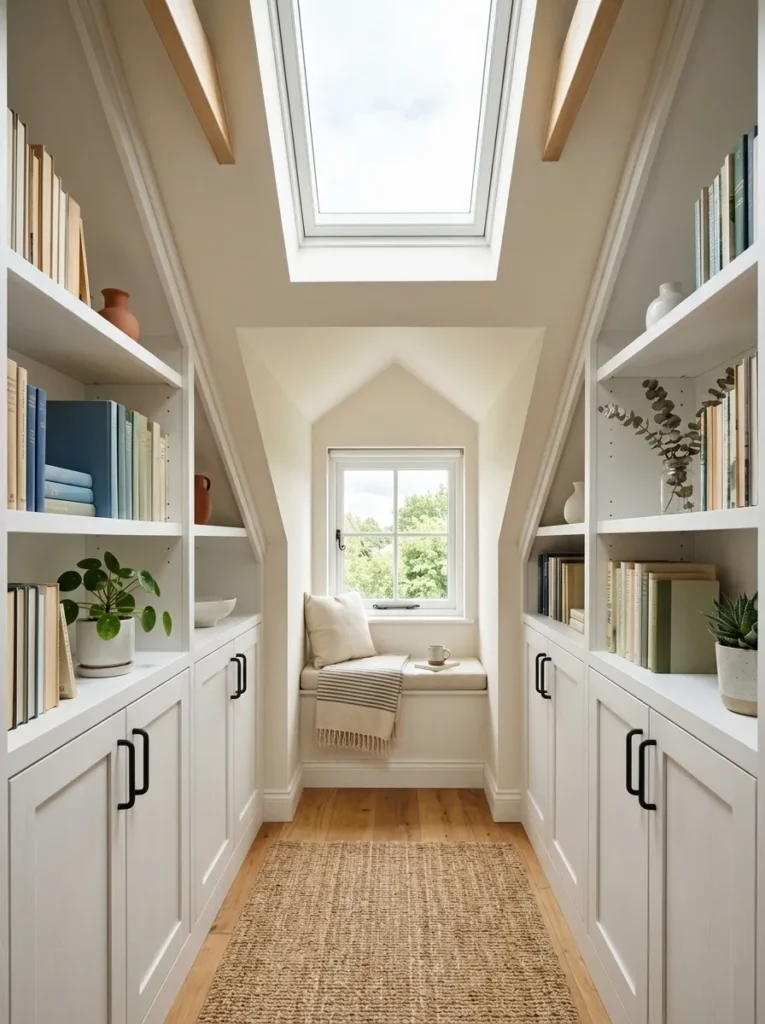
Vibe: The room feels resolved — every knee wall cavity converted into purpose, with nothing wasted and nothing awkward.
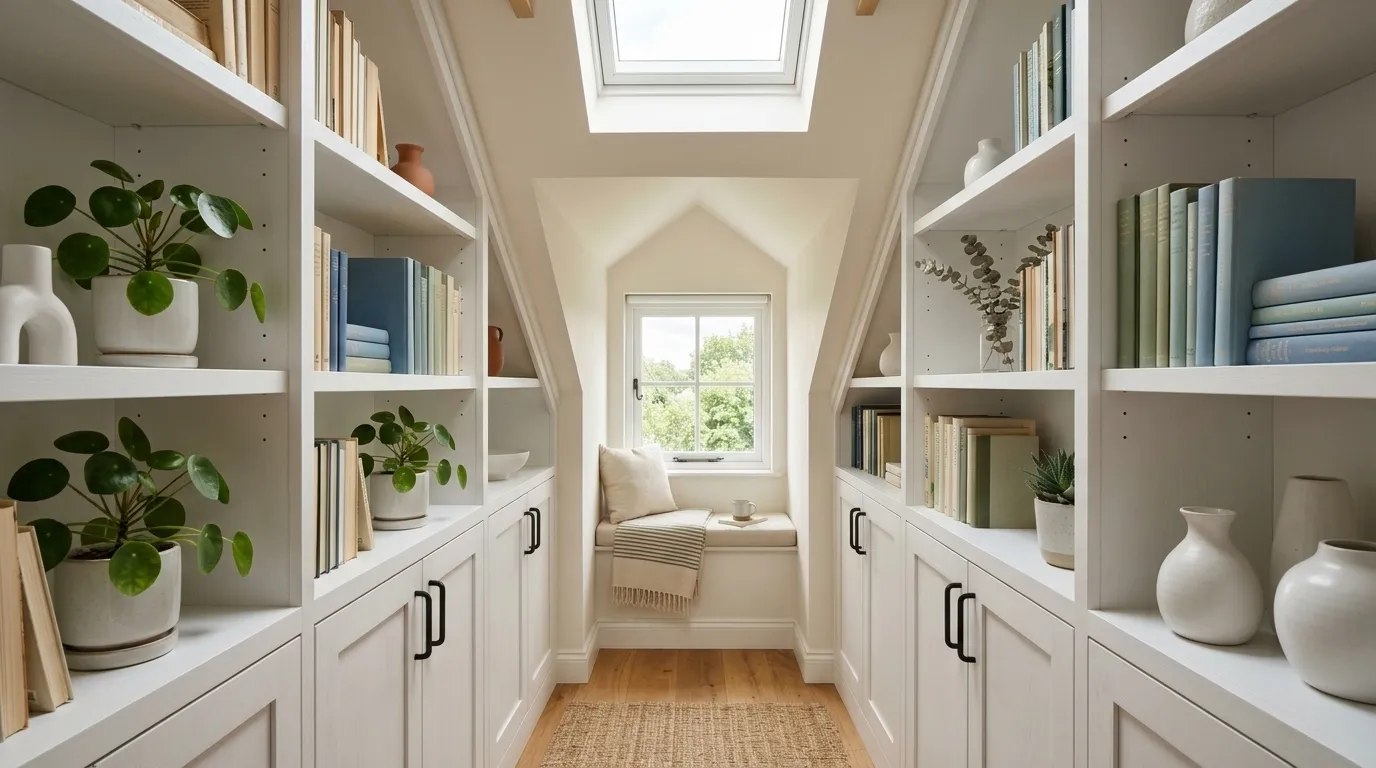
Why it works: Knee walls are architectural dead zones: the triangular cavity behind them is otherwise inaccessible, unconditioned, and wasted. Converting that cavity into flush built-in storage solves three problems simultaneously — it provides storage, eliminates the visual interruption of a blank knee wall, and adds significant architectural value. Open shelves above the cabinet line allow display, while closed doors below conceal seasonal storage cleanly.
How to get it: Frame the knee wall cavity in 3/4-inch birch plywood, mount adjustable shelf pins for flexibility, and finish with Shaker-style MDF cabinet faces. Paint with Benjamin Moore Advance alkyd-hybrid paint in semi-gloss — it dries to a hard, wipeable finish that handles years of shelf rearranging far better than standard latex.
Quick Win: Open IKEA BILLY bookcase units (depth 11 inches) fit into many knee wall cavities — push them flush to the knee wall opening and trim the edges with simple painted MDF casing for a built-in appearance at under $100 per unit.
Shop The Look
| Product |
|---|
| White Shaker style cabinet door pair MDF |
| Adjustable shelf bracket pin set 50 pack |
| Matte black cabinet pull handle set |
| White ceramic bookend set minimal |
| Adjustable bookshelf white wood storage |
10. Sloped Ceiling Attic Home Office with Skylight Desk
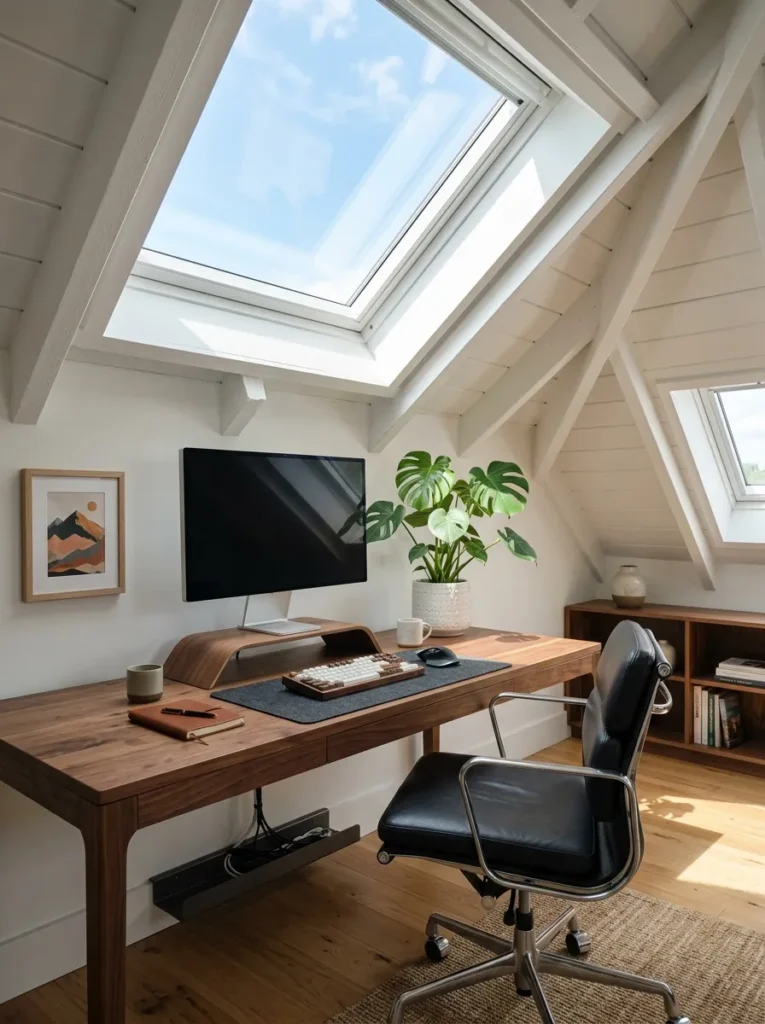
Vibe: The workspace is focused — overhead natural light from the skylight eliminates screen glare from side windows while providing the most productive light quality for task work.
Why it works: Positioning a desk directly below a skylight places the highest concentration of natural light exactly where it’s needed for work — on horizontal surfaces — rather than washing a wall. Research consistently shows that overhead natural light improves focus and reduces eye fatigue more effectively than lateral window light for seated desk work. The slope of the attic ceiling creates an automatic privacy screen that traditional office spaces lack.
How to get it: To maximize this setup, use a floating desk mounted directly to the wall below the skylight peak (no legs to encroach on leg room), and choose a monitor arm rather than a monitor stand so the desk surface stays clear for natural light to reach it.
Shop The Look
| Product |
|---|
| Solid walnut floating wall-mount desk shelf |
| Monitor arm dual mount adjustable black |
| Black leather ergonomic office chair modern |
| Wood monitor riser desk organizer walnut |
| White ceramic planter small modern desk |
11. Warm Terracotta and Cream Color Palette
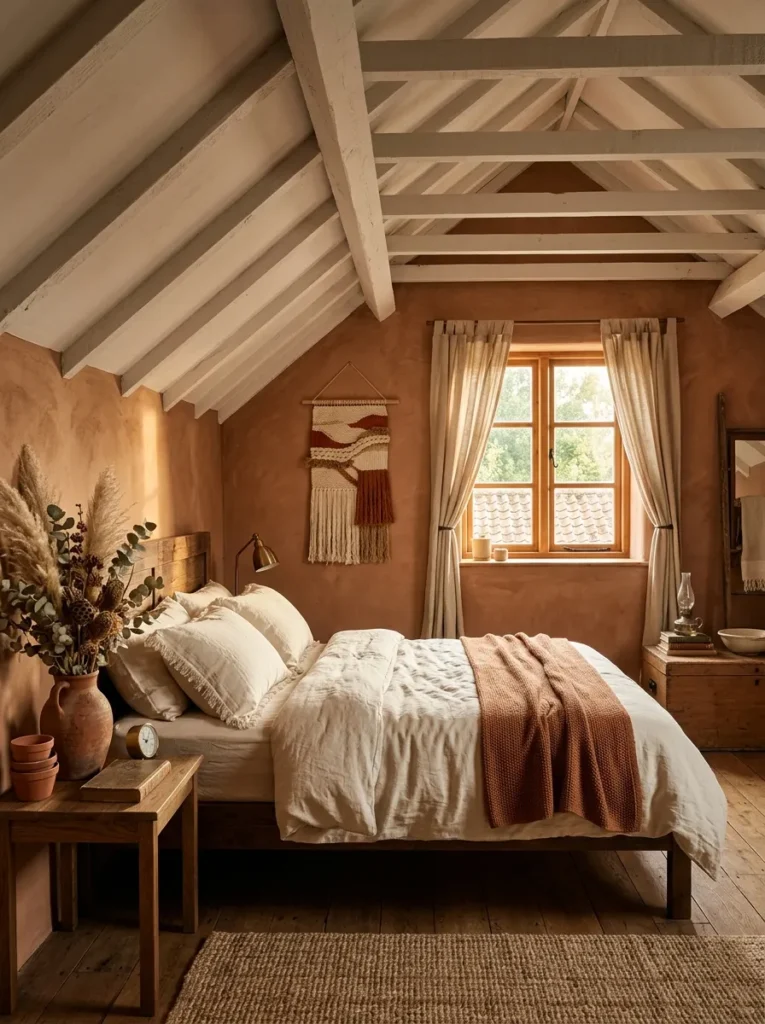
Vibe: The room is earthy — terracotta and cream together create a warmth that no neutral grey palette achieves, particularly in a space where natural light can be limited.
Why it works: Terracotta tones (LRV range 20–35) absorb light rather than reflect it, which gives a room warmth even in low natural light conditions — a critical quality in attic rooms that may face north or receive only morning light. The cream and white accents prevent the terracotta from reading as too dark by providing reflective relief. This palette draws from Mediterranean and Southwestern residential traditions, both of which evolved practical color responses to similar light challenges.
How to get it: Try Sherwin-Williams Cavern Clay SW 7701 or Benjamin Moore Earthen Jug 2164-20 — both deliver the authentic terracotta warmth without tipping into orange. Test the paint in your specific attic light at multiple times of day before committing; terracotta shifts dramatically between morning and evening light.
Shop The Look
| Product |
|---|
| Terracotta matte wall paint sample |
| Cream linen curtain panel rod pocket set |
| Dried flower arrangement large neutral |
| Earthenware ceramic vase terracotta large |
| Woven wall hanging tapestry neutral cream rust |
12. Mirror and Glass Strategy for Expanding a Narrow Attic
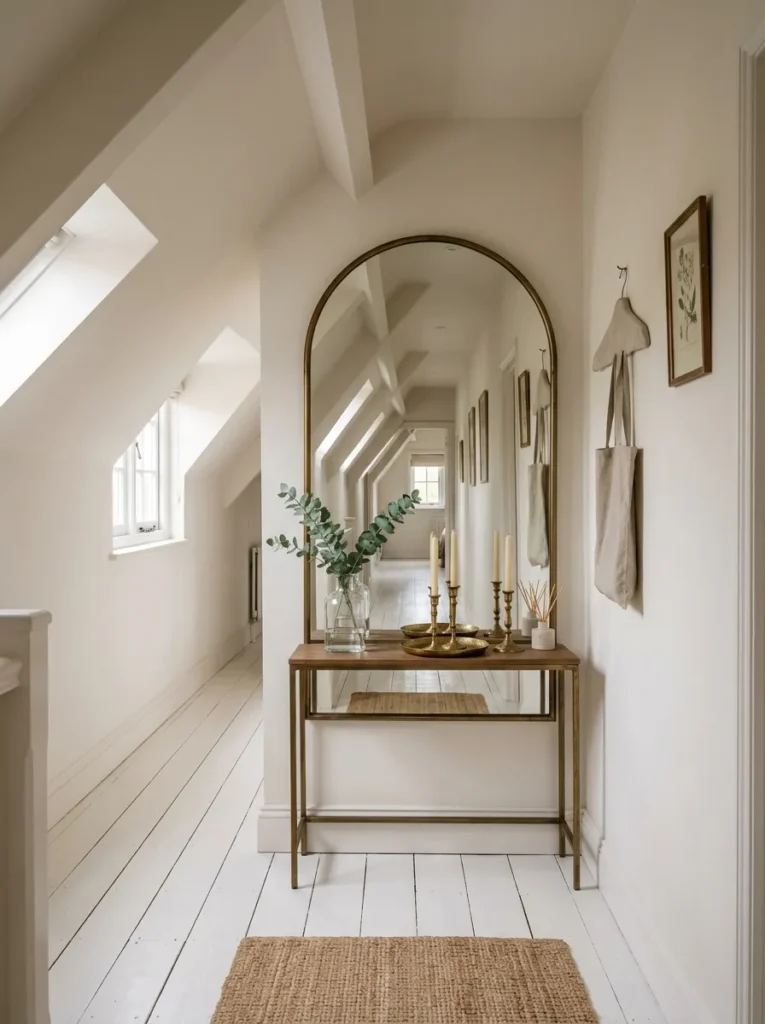
Vibe: The narrow space feels doubled — a well-placed mirror in an attic hallway or bedroom collapses the sense of constriction.
Why it works: Mirrors work by reflection doubling — a mirror at the end of a narrow room bounces the room’s light and dimension back toward the viewer, effectively creating the visual impression of twice the depth. In attic rooms where width is often constrained to 10–12 feet, a large leaning mirror (minimum 48×24 inches) at the end wall is the single most effective spatial illusion available without construction. An arched mirror frame references the curve of dormer windows and visually ties the mirror to the room’s existing architecture.
How to get it: Position the mirror to reflect the room’s best feature — typically a window or a piece of furniture, not a wall switch or closet door. Mount with anti-tip wall straps even when leaning, as attic rooms can shift with seasonal temperature changes.
Quick Win: An arch-top leaning mirror in thin gold or brass finish (widely available under $180) achieves the full spatial doubling effect for a fraction of the cost of built-in mirrors or glass doors.
Shop The Look
| Product |
|---|
| Large arched leaning floor mirror brass frame |
| Slim console table white wood narrow |
| Brass tray decorative vanity display |
| Brass candlestick holder set two |
| Clear glass bud vase set minimalist |
13. Cozy Attic Lounge Zone with Layered Rugs
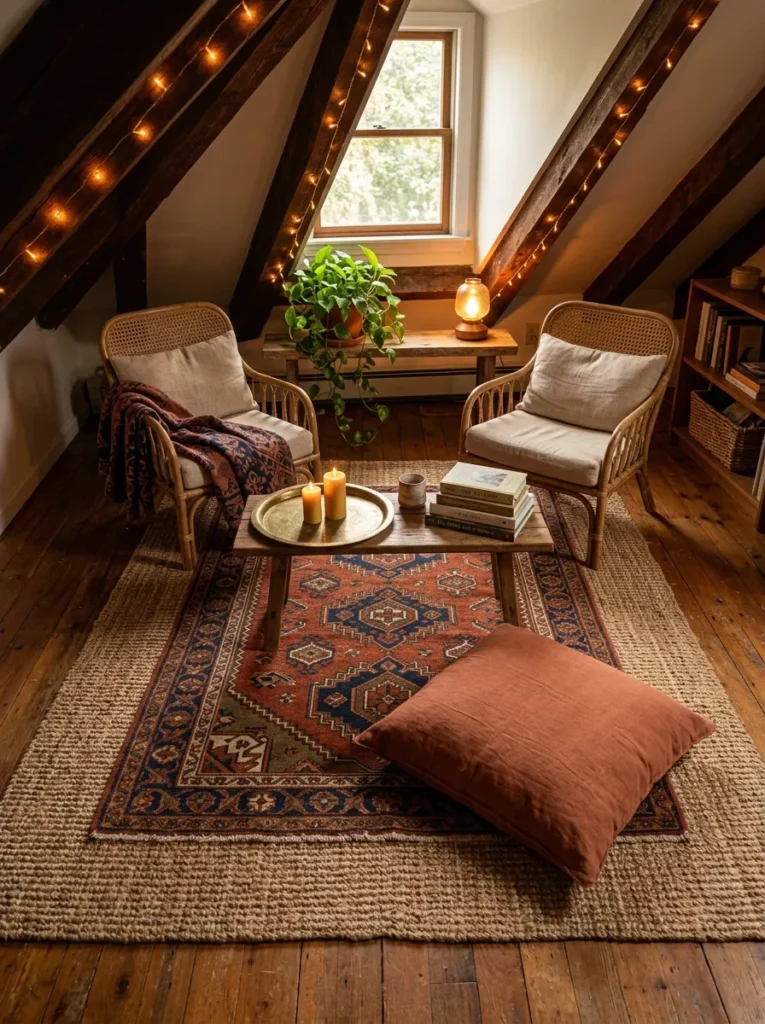
Vibe: The lounge zone is layered — the two rugs together define the seating area so distinctly it reads as a room within the room.
Why it works: Layering rugs solves a persistent attic room problem: a single rug in a slope-bounded irregular floor plan can look oddly placed against angled walls. A large base rug (jute or sisal) covers the full usable floor and neutralizes the irregular geometry, while the smaller layered rug defines the seating cluster with a specific color and pattern. This technique, drawn from Moroccan and Turkish interior traditions, creates visual depth that flat single-rug arrangements lack.
How to get it: The base layer should always be flat-weave and natural (jute, sisal, or cotton) so the decorative top rug doesn’t slide. Use a rug gripper mesh between layers. Size the top rug so its edges fall within the furniture cluster — front legs of all seating pieces should sit on it.
Shop The Look
| Product |
|---|
| Natural jute area rug 8×10 flat weave |
| Vintage style kilim rug 4×6 rust navy |
| Low rattan lounge chair outdoor indoor |
| Terracotta linen oversized floor cushion |
| Brass decorative tray vintage round |
14. Attic Bathroom with Wet Room Shower Under Slope
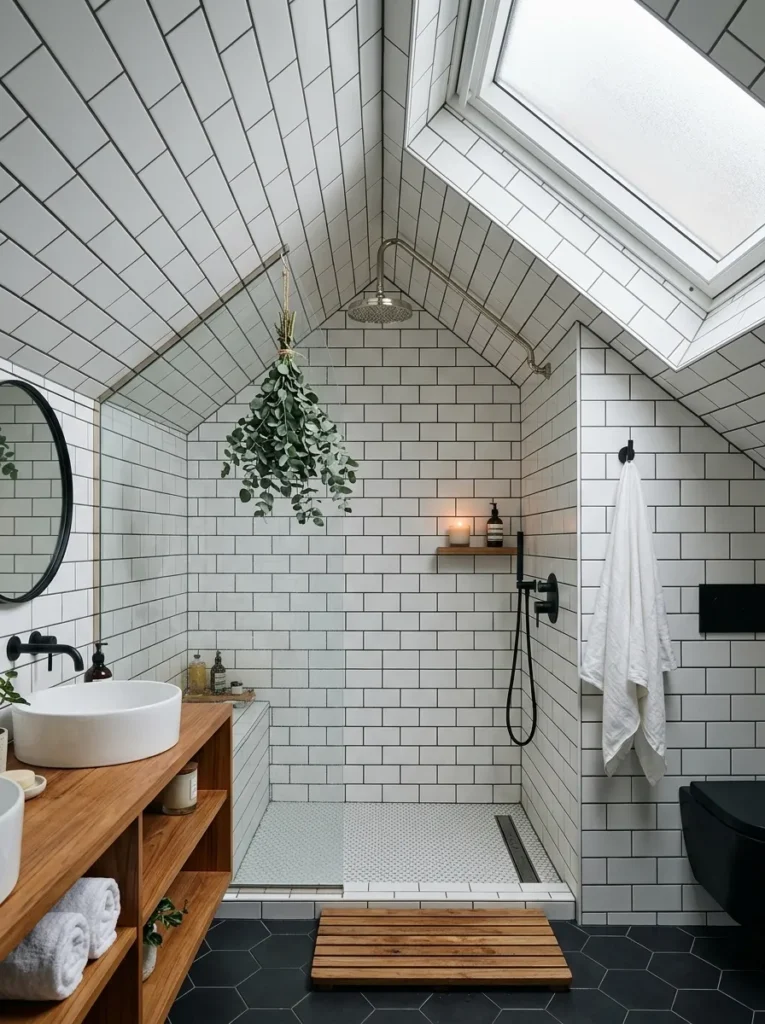
Vibe: The bathroom is spa-like — a wet-room shower framed by the slope overhead transforms a functional constraint into architectural drama.
Why it works: The wet-room format (waterproofed floor-to-ceiling with no shower screen or door) is the ideal solution for low-slope attic bathrooms because it eliminates the shower door’s enclosure, which would otherwise reduce an already tight space further. The rain shower head mounted at the ceiling’s highest point uses the slope to create a natural enclosure effect — water falls in one defined area without any glass partition needed. White subway tile with dark grout is the correct choice here: the tile’s reflective surface bounces light through a room that may have no window inside the shower.
How to get it: Waterproofing is everything in a wet-room build — use Schluter KERDI membrane rather than standard cement board, which can trap moisture in sloped ceiling spaces with limited ventilation. Pair with a linear floor drain positioned at the room’s lowest point for efficient drainage.
Quick Win: A fresh eucalyptus bundle hung from the shower head at the start of the week releases essential oils with the steam and costs under $10 at most farmers markets — instant spa atmosphere in 30 seconds.
Shop The Look
| Product |
|---|
| White subway tile 3×6 glossy bathroom wall |
| Matte black rain shower head ceiling mount |
| Teak shower mat anti-slip natural wood |
| Dark charcoal grout sanded tile joint |
| Matte black bathroom towel hook set |
How to Start Your Attic Room Transformation
The single most important first move in any attic room project is to choose your paint color for the ceiling plane before touching anything else. The ceiling in an attic is not a background — it’s the dominant surface, and every furniture and textile decision you make will be calibrated against it. Start with Benjamin Moore Chantilly Lace OC-17 in a flat finish: it reads as warm white (not stark blue-white) against both natural and artificial light, works with every natural material palette, and gives you flexibility to go darker on walls or accents later without the ceiling fighting the change.
The most common beginner mistake in attic rooms is choosing furniture to the standard room scale rather than attic scale. A sofa or bed that looks proportionate on a showroom floor will overwhelm an attic room where the ceiling drops to 6 feet at the perimeter. The fix is specific: measure your usable ceiling height at multiple points and purchase furniture whose highest point (including cushions on sofas) stays 12 inches below the ceiling slope at its shallowest point in the room.
Three items under $50 that make an immediate difference: a set of warm-white G40 string lights ($35) draped along a beam for ambient warmth, a single terracotta pot with a trailing pothos ($18 at most garden centers) for organic life, and a flat-weave jute table runner ($22) to ground a surface and introduce texture without commitment.
A weekend transformation is realistic for color, lighting, and textiles — new paint, a string light installation, and new bedding can completely reorient a room in two days. A full attic conversion (built-ins, new flooring, skylight) is a 3–6 month project with a realistic entry budget of $8,000–$15,000 for a 200–300 sq ft space, rising to $25,000+ for full finish with skylights and plumbing.
Frequently Asked Questions About Attic Room Design
What is the difference between an attic room and a loft room?
An attic room is specifically located within the pitched roof structure of a house, typically accessed by a dedicated staircase and characterized by sloped ceilings following the roofline. A loft room is an open upper level within a larger space — a mezzanine above a living room, for example — that may have flat or vaulted ceilings. Attic rooms have the additional constraints of limited ceiling height and dormer windows; loft rooms typically enjoy more vertical clearance and open-plan connections to the floor below. Both benefit from similar design strategies, but attic rooms require more deliberate furniture scaling.
What paint colors work best in a dark attic room?
Warm whites consistently outperform cool whites in attic rooms with limited natural light. Benjamin Moore Chantilly Lace OC-17 and Sherwin-Williams Alabaster SW 7012 are the two most reliable choices — both have warm undertones (slightly creamy rather than blue-grey) that prevent the walls from looking dingy when daylight is limited. Avoid stark whites with cool or purple undertones (like Benjamin Moore White Dove paired with a north-facing dormer) as they tend to read as grey in low-light attic conditions. If you want to add a second color, keep it to the knee walls only and choose warm earth tones — Cavern Clay, sage, or deep forest green.
How much does it cost to finish an attic room?
A basic attic finishing project — insulation, drywall, flooring, and paint — typically runs $15,000–$30,000 for a 200–300 sq ft space when professionally contracted in the United States. Adding a skylight adds $1,500–$3,500 per unit installed; a full bathroom adds $8,000–$15,000. DIY finishing of an already-framed attic (just flooring, paint, and fixtures) can be done for $2,000–$5,000 in materials. The biggest variable is insulation: spray foam between rafters, while expensive ($3–$7 per sq ft), is the only option that fully controls condensation in a fully finished attic room used year-round.
Can attic rooms work as permanent bedrooms?
Yes, with specific considerations. Building code in most U.S. jurisdictions requires a minimum ceiling height of 7 feet 6 inches over at least 50% of the floor area for a room to qualify as a legal bedroom. Many attic rooms meet this at the ridge while sloping down at the perimeter. Additionally, code requires at least one egress window — minimum 5.7 square feet of net openable area — for fire escape purposes. Dormers typically qualify; small fixed windows do not. Beyond code, attic bedrooms work well year-round with adequate insulation (R-38 minimum in the ceiling plane) and a mini-split HVAC unit for independent climate control.
What furniture style works best under sloped attic ceilings?
Low-profile, floor-anchored furniture is universally the correct answer. Specifically, look for platform beds with a maximum frame height of 14 inches, sofas with a seat height of 15–17 inches (rather than the standard 18–20 inches), and accent chairs with a back height under 34 inches. Mid-century modern and Japanese minimalist furniture ranges naturally fall within these proportions — both styles evolved with horizontality as a design virtue. Avoid armoires, tall bookcases, and four-poster beds entirely in most attic rooms; use built-in cabinetry in the knee wall cavities instead to provide equivalent storage without vertical footprint.
Ready to Create Your Dream Attic Room?
These 14 ideas cover the full range of what an attic transformation can involve — from the color of knee walls and the texture of ceiling planks to the placement of a platform bed under the eaves and the spatial logic of a wet-room shower. Every change doesn’t have to happen at once; in fact, beginning with a single wall color and the right low-profile furniture often reveals the room’s natural personality more clearly than any grand renovation does. Start today by measuring your attic’s ceiling height at its peak and at the knee walls — those two numbers will guide every furniture and lighting decision that follows. When those dimensions are in your hand, the room stops being a ceiling problem and becomes a design opportunity. An attic room done well doesn’t just add square footage — it gives you a space that feels genuinely yours, carved out and quiet in a way no ground-floor room can replicate. Pin the ideas that made you pause and come back to them; the ones that keep calling you back are the ones that belong in your space.