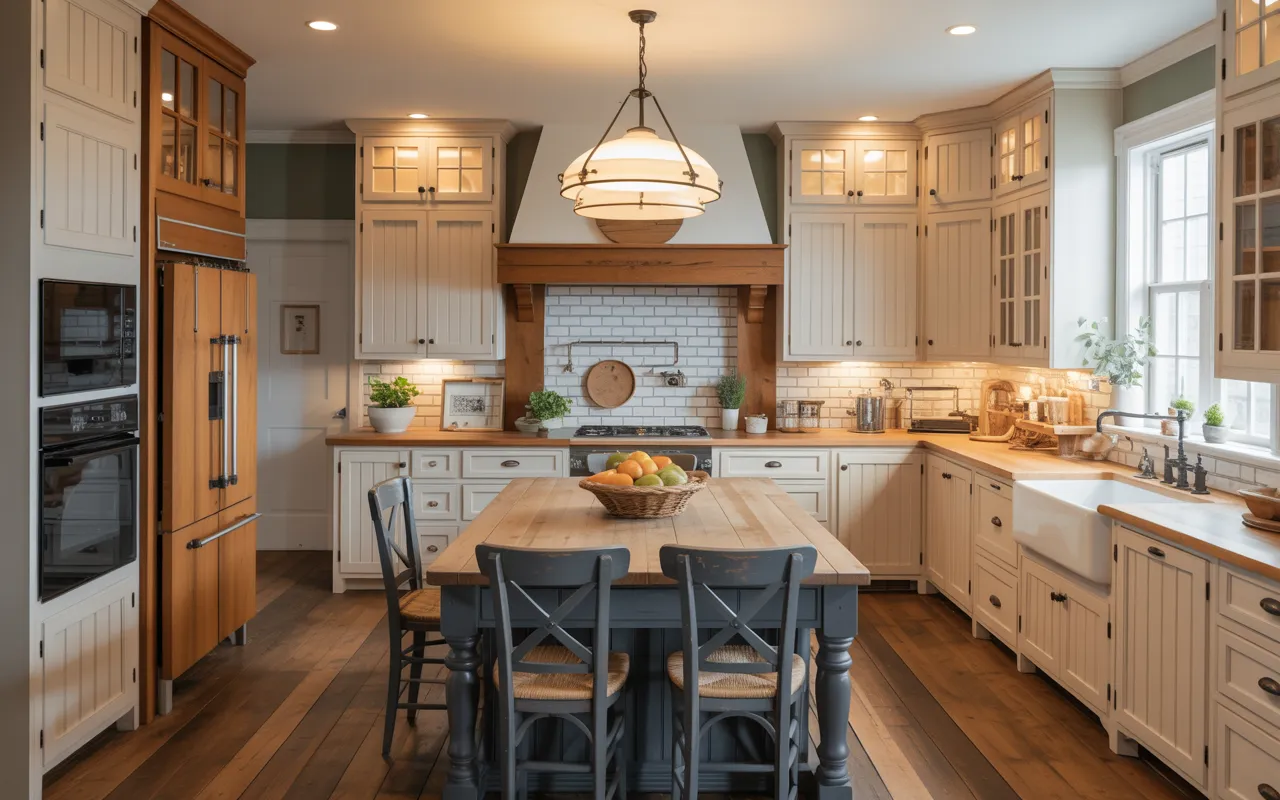
18 Farmhouse Kitchen Cabinets Ideas for Rustic Style
Farmhouse kitchen cabinets set the mood of the whole kitchen. They are the reason a room feels warm instead of sterile, lived-in instead of showroom. This guide covers 18 farmhouse kitchen cabinet ideas, from classic shaker doors to glass fronts, beadboard, and reclaimed wood, with practical notes on cost, finishes, and what actually holds up.
Cost is the big variable. A simple paint-and-hardware refresh of existing cabinets runs roughly 200 to 600 dollars in materials. Stock farmhouse-style cabinets usually land around 2,000 to 5,000 dollars for an average kitchen, while custom woodwork climbs to 7,500 dollars and beyond. Prices vary by region, wood species, and how much of the work you do yourself, so get local numbers before you plan.
The farmhouse look is forgiving, which is its best quality. Slight wear, mixed wood tones, and vintage hardware all work with it instead of against it. If you want to carry the style into the next room, our farmhouse living room ideas post picks up where the kitchen leaves off.
This post contains affiliate links. If you buy through them, I may earn a small commission at no extra cost to you.
1. Shaker-Style Wood Cabinets
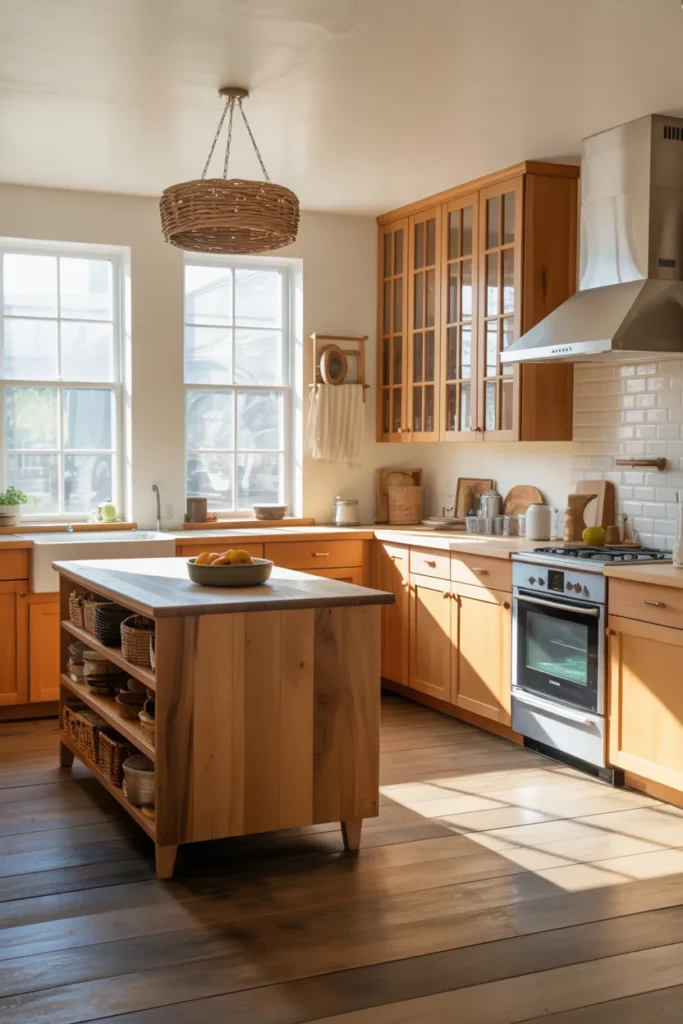
Shaker cabinets are the backbone of the farmhouse kitchen: a simple recessed panel inside a clean frame, no fuss. They work in natural wood, painted white, or soft gray, and they pair with almost any hardware. If you can only pick one door style and want it to still look right in fifteen years, this is it.
Check the construction: solid wood or plywood boxes with soft-close hinges last far longer than particle board, especially near the sink and dishwasher. Stock shaker cabinets cost roughly 100 to 300 dollars per linear foot, and prices vary by wood species and finish. A refresh with new cup pulls and knobs alone can make old shakers feel new for under 100 dollars.
Mind the grain direction: on stained wood shakers, make sure the grain runs consistently across doors and drawers, or the kitchen looks patchwork. Honest warning: cheap shaker-style doors with paper-thin veneer chip at the edges and cannot be sanded or touched up. Spend the extra for real wood faces.
- Timeless door style that suits farmhouse, modern, and transitional kitchens.
- Simple frame cleans easily, no dust-trapping crevices.
- Wide availability in stock, semi-custom, and custom lines.
Shop This Look
| PULLS | KNOBS | HINGES |
|---|---|---|
| Black farmhouse cup pulls | Round wood cabinet knobs | Soft-close cabinet hinges |
| Shop → | Shop → | Shop → |
2. Distressed Painted Cabinets
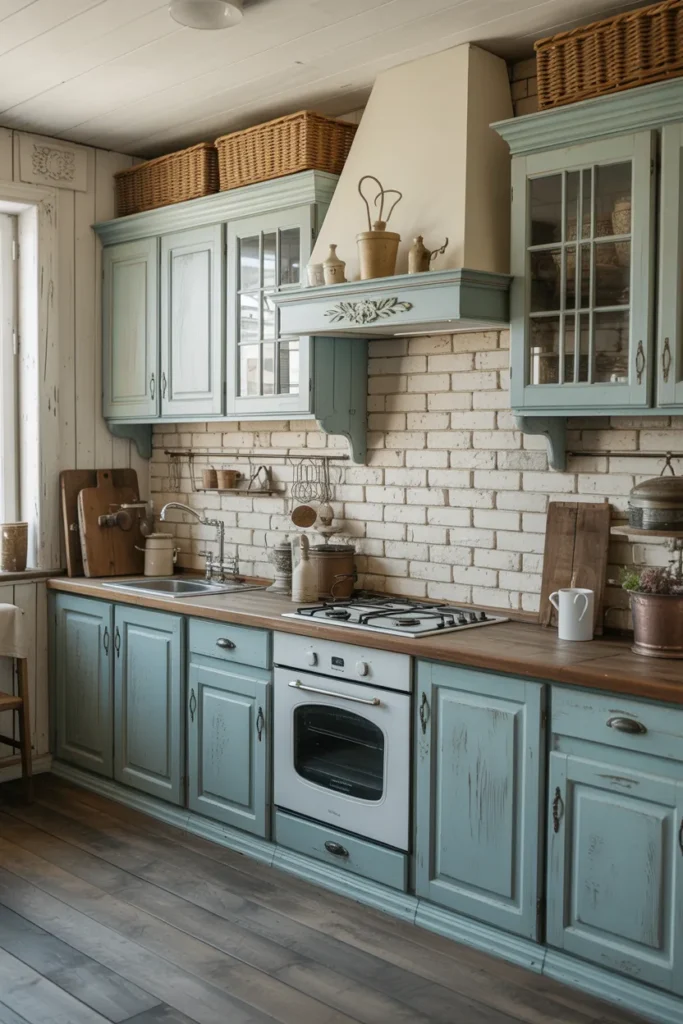
Distressed cabinets give you the aged, timeworn farmhouse look without waiting forty years. Painted in cream, sage, or soft gray, then sanded lightly at edges and corners, they look like they came from an old country house. It is a finish with real charm when done with restraint.
Distress lightly: the difference between charming and shabby is about ten minutes of sanding. Hit high-touch edges only, then seal with a matte topcoat. A DIY distressed paint job costs roughly 50 to 150 dollars in paint and supplies, and prices vary by cabinet count and paint brand. Professionally distressed custom cabinets run far higher, often 500 dollars or more per linear foot.
Seal your work: unsealed distressed paint absorbs grease and fingerprints fast, especially near the stove. Practical tip: use a water-based polycrylic topcoat in matte. It protects without the yellowing that oil-based finishes cause on light paint.
- Instant vintage character without sourcing actual antiques.
- Very forgiving finish, new dings blend right in.
- Achievable as a DIY project over a long weekend.
Shop This Look
| PAINT | SANDERS | SEALERS |
|---|---|---|
| Chalk-style cabinet paint | Detail sander kit | Matte water-based topcoat |
| Shop → | Shop → | Shop → |
3. Open Shelving with Wood Accents
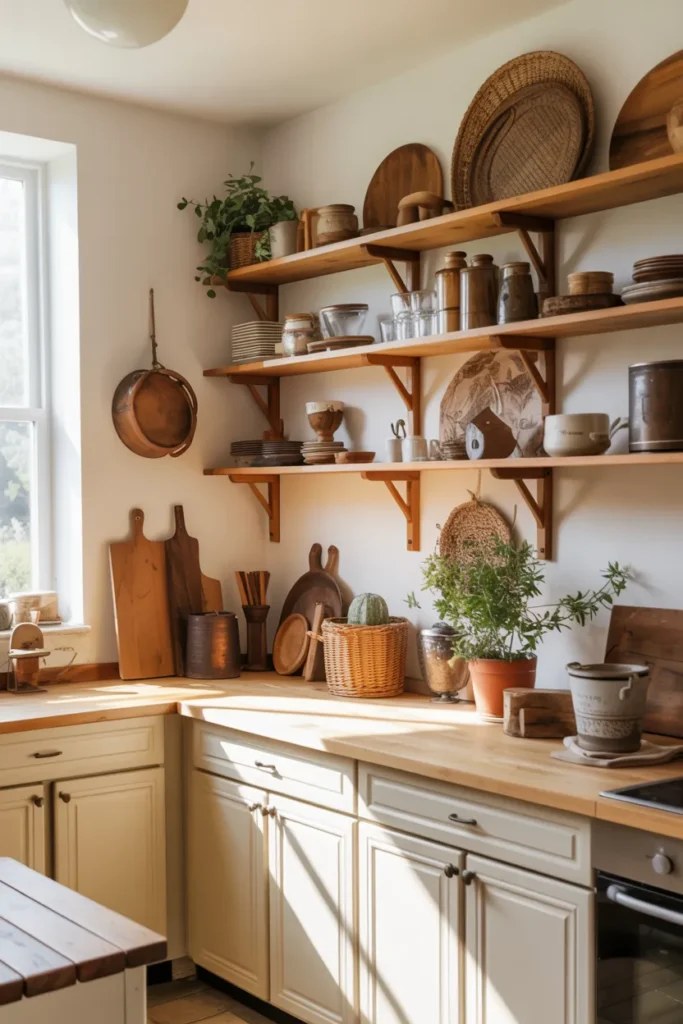
Swapping some upper cabinets for open wood shelves is the fastest way to make a kitchen feel like a farmhouse. Thick reclaimed boards on iron brackets, styled with everyday dishes and a few plants, give you warmth and display space at once. It is also one of the cheapest changes on this list.
Keep it functional: open shelves work best for things you use daily. Dust settles on anything that sits still, so display the dishes you reach for, not the wedding china. Floating wood shelves cost roughly 20 to 80 dollars each installed, and prices vary by wood type and bracket style. A full wall of shelving usually lands well under 300 dollars.
Anchor them properly: shelves loaded with plates and bowls are heavy. Screw brackets into studs, never just drywall, or the whole display comes down one day. Honest warning: open shelving looks effortless in photos and demands editing in real life. If you hate tidying, keep it to one small section.
- Cheapest way to add farmhouse character to existing cabinets.
- Everyday dishes stay within easy reach.
- Reclaimed wood adds texture no cabinet can match.
Shop This Look
| BRACKETS | SHELVES | BASKETS |
|---|---|---|
| Iron shelf brackets | Reclaimed wood floating shelves | Wire storage baskets |
| Shop → | Shop → | Shop → |
4. Two-Tone Cabinets
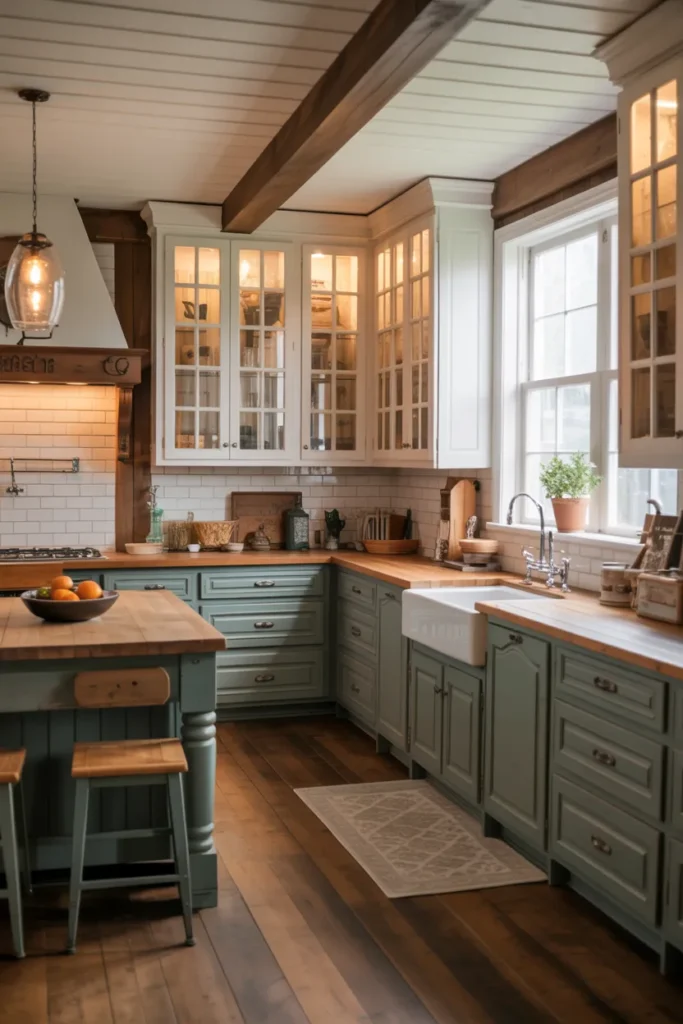
Two-tone cabinets, usually white or cream uppers with a darker island or lower cabinets in navy, sage, or black, are the modern farmhouse signature. The contrast adds depth without adding clutter, and it lets you use a bold color without committing the whole kitchen to it. The island becomes the furniture piece.
Test the dark color: navy and deep green look very different under your kitchen lighting than on a swatch. Paint a large board and live with it for a few days. A two-tone paint refresh costs roughly 100 to 300 dollars in materials, and prices vary by paint quality and cabinet count. New two-tone cabinetry follows standard pricing, roughly 2,000 to 5,000 dollars for stock sets.
Unify with hardware: one hardware finish across both tones keeps the look intentional instead of mismatched. Practical tip: keep the uppers light in small kitchens. Dark uppers close in a room fast, while a dark island grounds it.
- Bold color with a built-in safety net, only on part of the kitchen.
- Island becomes a natural focal point and gathering spot.
- Easy to achieve with paint if your cabinet boxes are sound.
Shop This Look
| PAINT | PULLS | SAMPLES |
|---|---|---|
| Cabinet enamel paint navy | Brass bar cabinet pulls | Peel and stick paint samples |
| Shop → | Shop → | Shop → |
5. Reclaimed Wood Cabinets
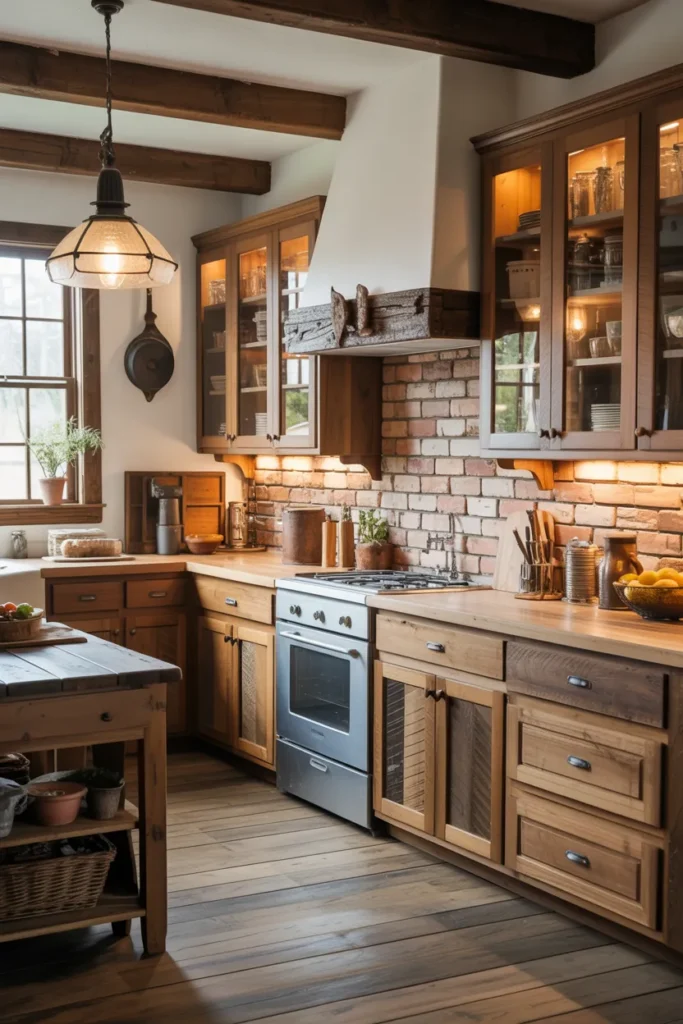
Reclaimed wood cabinets carry history in every board: old barns, factory floors, farmhouses that outlived their first life. The nail holes, saw marks, and varied tones give a kitchen a depth that new lumber cannot fake. For the true rustic farmhouse, nothing else comes close.
Verify the source: reclaimed lumber can hide old paint with lead, pests, or rot. Buy from a reputable dealer who kiln-dries and tests their stock. Reclaimed wood cabinets cost roughly 500 to 1,200 dollars per linear foot custom-built, and prices vary with wood species and how much milling the boards need. It is a premium choice, not a budget one.
Seal against moisture: old wood moves with humidity, so a good finish and stable indoor climate matter. Honest warning: reclaimed boards are inconsistent by nature. If you need every door to match perfectly, this material will fight you. Embrace the variation or choose something else.
- Unmatched character and patina from real aged wood.
- Eco-friendly, reuses lumber with decades of history.
- Each kitchen is genuinely one of a kind.
Shop This Look
| OILS | HARDWARE | CLEANERS |
|---|---|---|
| Tung oil wood finish | Hand-forged iron pulls | Wood cabinet cleaner |
| Shop → | Shop → | Shop → |
6. Glass-Front Cabinets
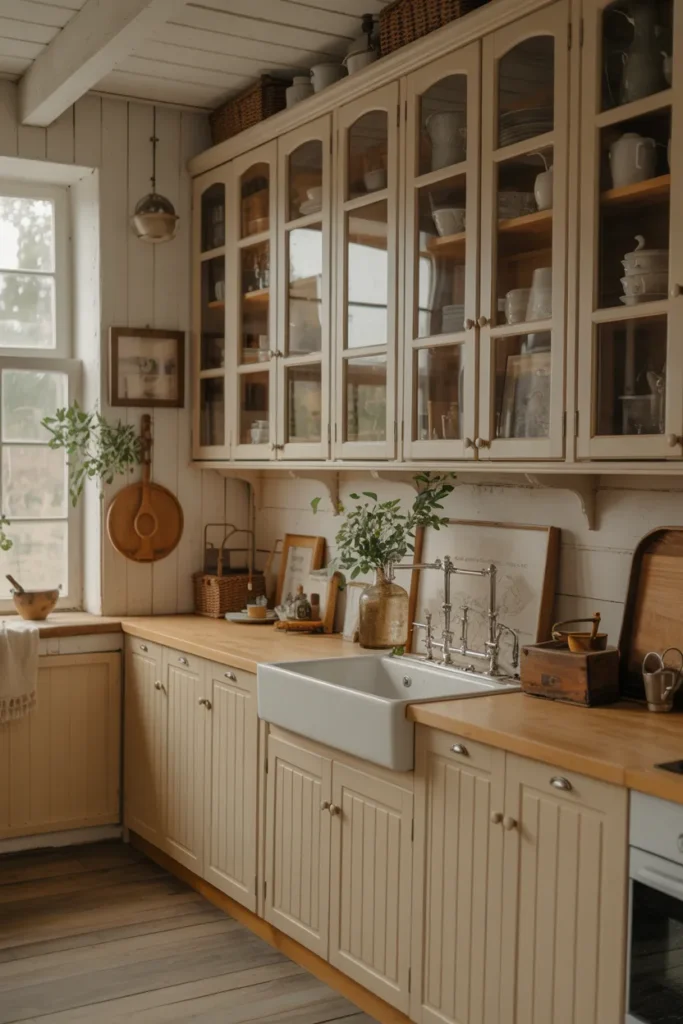
Glass-front uppers break up a wall of solid doors and give a farmhouse kitchen its airy, collected feel. They work beautifully flanking a range hood or at the ends of a cabinet run. Clear glass shows off pretty dishware, while seeded or frosted glass hides the everyday mess behind a soft blur.
Pick the right glass: clear glass demands tidy shelves, seeded glass forgives a lot. Decide honestly which household you are. Converting existing doors to glass fronts costs roughly 50 to 150 dollars per door, and prices vary by glass type and whether you DIY the swap. New glass-front uppers add a modest premium over solid doors.
Light the inside: a small LED strip inside a glass cabinet turns dishes into decor at night. Practical tip: line the shelves with simple liners so the view through the glass stays clean and the shelves wipe easily.
- Opens up the kitchen visually, less wall of wood.
- Shows off collected dishware and vintage pieces.
- Seeded or frosted glass adds texture and hides clutter.
Shop This Look
| LIGHTS | LINERS | CLEANERS |
|---|---|---|
| LED puck lights cabinet | Non-adhesive shelf liner | Glass cleaner spray |
| Shop → | Shop → | Shop → |
7. Beadboard Cabinets
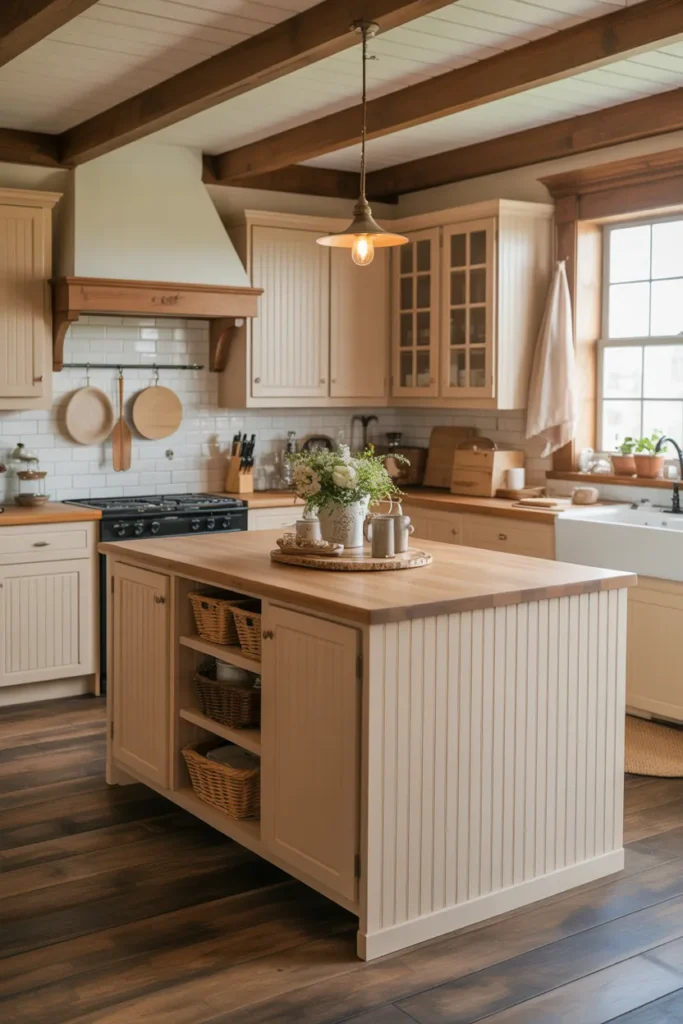
Beadboard, those narrow vertical grooves, is cottage style in its purest form. On cabinet doors, a kitchen island, or just the backs of an open hutch, it adds texture that paint alone cannot. It reads as farmhouse instantly, even in a newer home.
Use it in doses: beadboard everywhere can feel busy. An island front, a pantry door, or one cabinet run is usually enough. Beadboard panels cost roughly 15 to 40 dollars per sheet, and prices vary by material, MDF is cheapest, real wood costs more. Adding beadboard fronts to an island is a classic weekend project under 150 dollars.
Fill and sand the grooves before painting: paint settles into the beads and drips if you rush. Two thin coats beat one thick one every time. Honest warning: the grooves collect dust and grease near the stove. A quick wipe during your normal cleaning routine keeps them from building up.
- Instant cottage texture from an affordable material.
- Great for islands, hutches, and pantry doors.
- DIY-friendly, cuts and installs with basic tools.
Shop This Look
8. Corner Cabinets with Lazy Susan
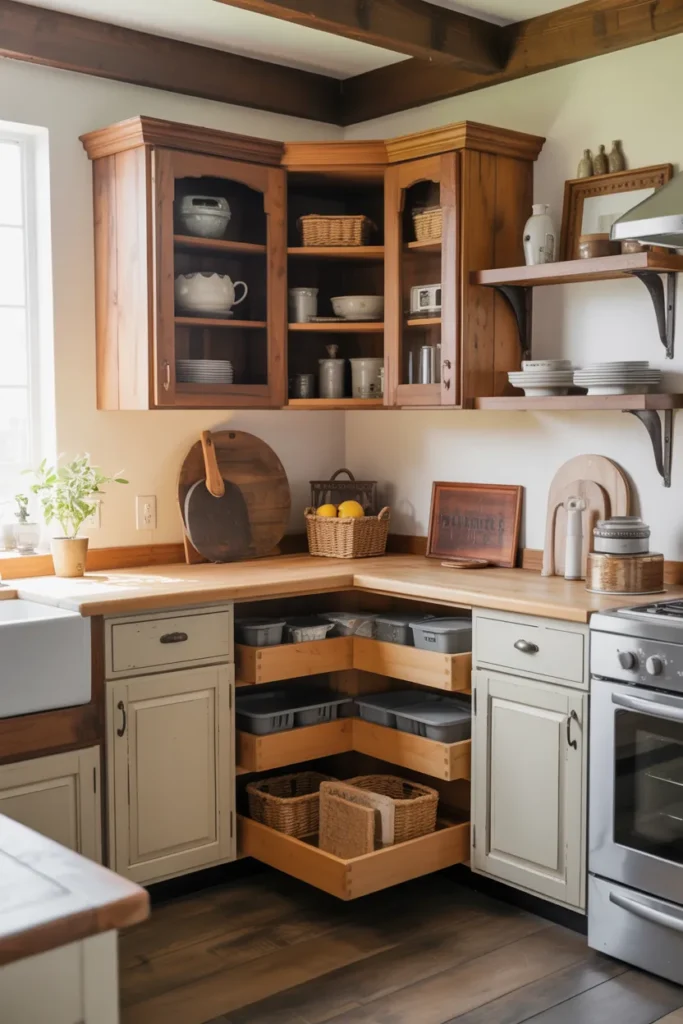
Corner cabinets are where kitchen storage goes to die, unless you put a lazy susan inside. A good two-tier turntable pulls dead corner space back into daily use for pots, oils, and bulky appliances. It is the least glamorous idea on this list and one of the most useful.
Measure the opening: lazy susans come in standard diameters, and your corner opening decides the size. Measure twice before ordering hardware. A quality two-tier lazy susan costs roughly 40 to 120 dollars, and prices vary by material and bearing quality. Installation is a straightforward DIY job with basic tools.
Choose wood over wire: wire turntables let small items tip through, while solid wood or polymer trays keep everything upright. Practical tip: leave a little clearance around the edges. An overfilled lazy susan that scrapes the door frame gets abandoned fast.
- Reclaims the deepest, darkest corner of the kitchen.
- Keeps heavy pots reachable without crawling inside.
- Affordable hardware upgrade with big daily payoff.
Shop This Look
| TURNTABLES | ORGANIZERS | TOOLS |
|---|---|---|
| Two-tier lazy susan turntable | Cabinet door organizers | Cabinet installation tool kit |
| Shop → | Shop → | Shop → |
9. Floating Cabinets
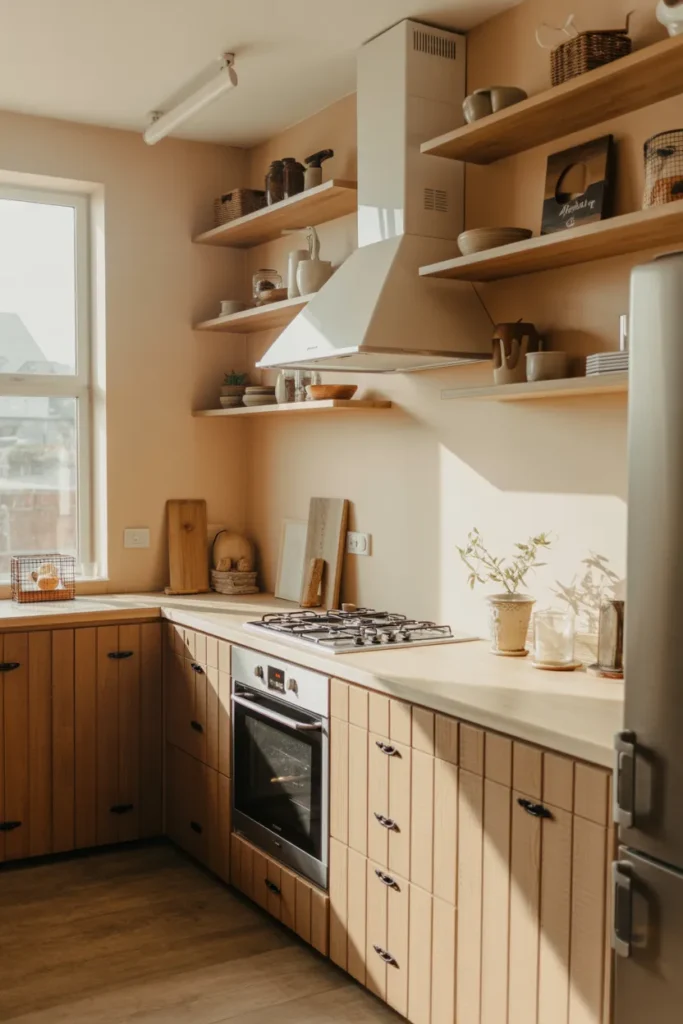
Floating cabinets, mounted off the floor with open space beneath, bring a modern edge to the farmhouse look. The visible floor underneath makes a small kitchen feel larger, and cleaning under them is suddenly easy. They work especially well as a sideboard-style base under open shelving.
Check the wall: floating cabinets hang entirely on wall structure, so studs or solid blocking are non-negotiable. A floating vanity-style base costs roughly 200 to 600 dollars, and prices vary by size and wood. Do not hang one on drywall anchors alone, no matter what the box says.
Mind the plumbing: if the floating cabinet hides pipes, leave an access panel. Future you will be grateful. Honest warning: heavy countertops like stone add serious weight to a floating unit. Confirm the load rating of your mounting system before the stone goes on.
- Makes small kitchens feel bigger and airier.
- Easy to sweep and mop underneath.
- Modern-farmhouse mix that feels fresh, not trendy.
Shop This Look
| BRACKETS | LEVELS | LIGHTS |
|---|---|---|
| Heavy-duty floating brackets | Magnetic torpedo level | Motion sensor cabinet lights |
| Shop → | Shop → | Shop → |
10. Rustic Farmhouse Cabinets with Built-In Seating
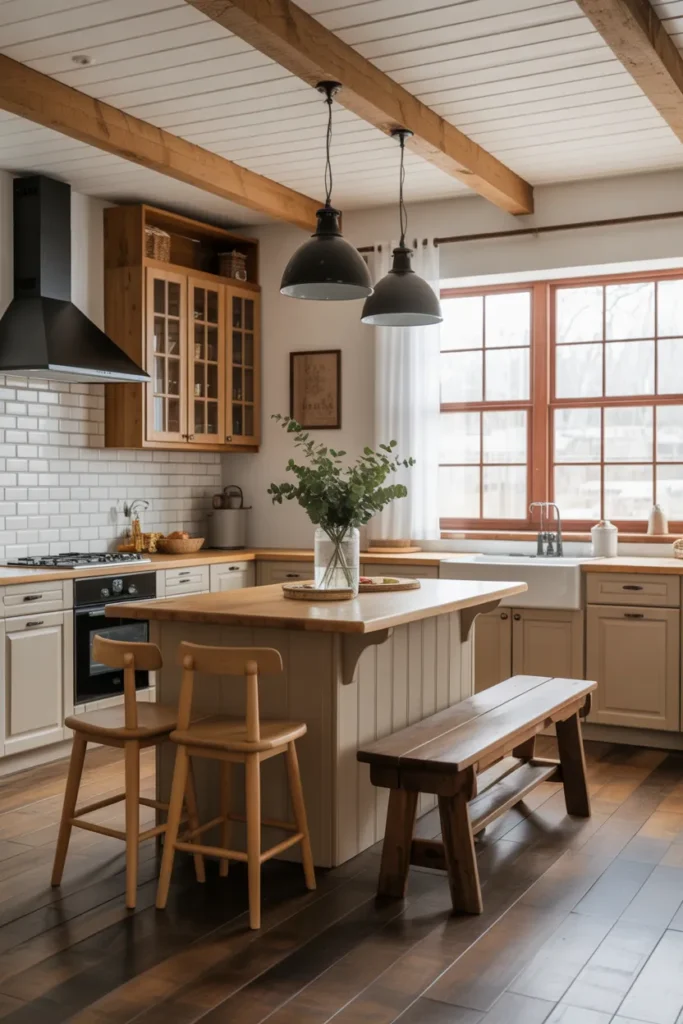
A banquette or built-in bench tucked against cabinetry turns a kitchen corner into the most-used seat in the house. Morning coffee, homework, long dinners, the built-in nook collects all of it. Paired with rustic cabinets, it makes the kitchen feel like the heart of an old farmhouse even in new construction.
Build storage into the bench: hinged seats over deep boxes swallow table linens, seasonal dishes, and all the clutter that has no home. A custom built-in banquette costs roughly 800 to 2,500 dollars, and prices vary with size, wood, and cushion work. Simpler freestanding benches with storage run 150 to 400 dollars.
Plan the table clearance: leave about 18 inches between bench edge and table edge for comfortable knees. Practical tip: choose washable cushion covers. A breakfast nook takes daily spills, and removable covers are the difference between charming and grimy.
- Creates a cozy gathering spot without extra floor space.
- Bench storage hides bulky items beautifully.
- Works in corners that would otherwise go unused.
Shop This Look
| CUSHIONS | BENCHES | PILLOWS |
|---|---|---|
| Bench seat cushions washable | Wooden storage bench | Farmhouse throw pillows |
| Shop → | Shop → | Shop → |
11. Cabinet Pantry with Sliding Doors
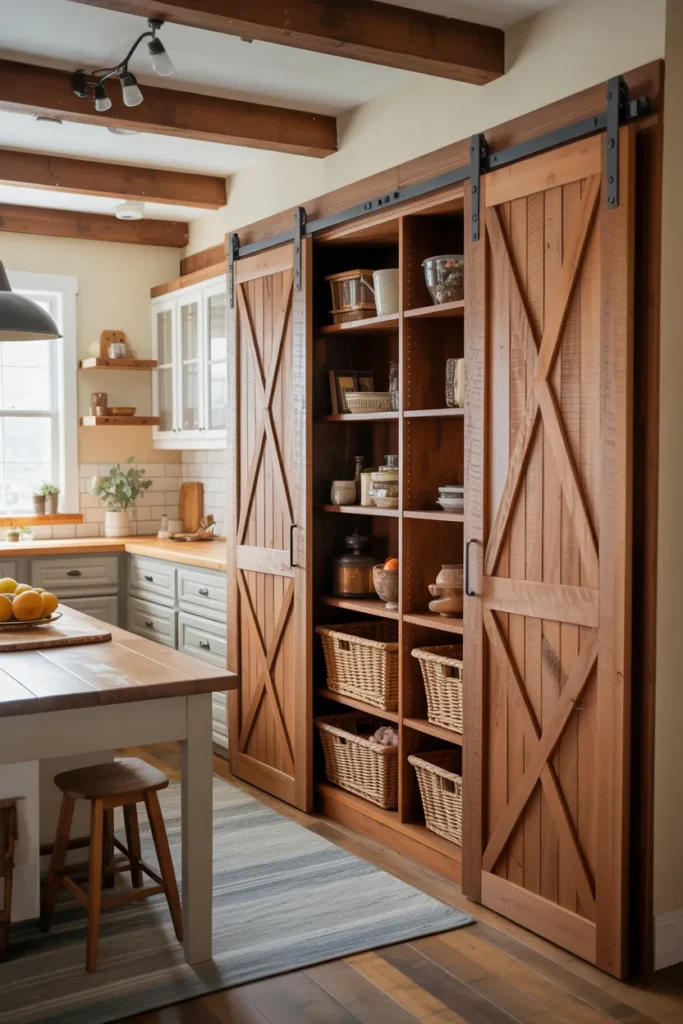
A tall cabinet pantry with sliding barn-style doors gives you walk-in storage looks without the walk-in. The doors slide instead of swinging, which saves clearance in tight kitchens and adds that unmistakable farmhouse detail. Inside, deep shelves hold everything a small pantry closet would.
Check door clearance: sliding doors need wall or cabinet space beside the opening to park. Measure the slide path before you commit. Barn door hardware kits cost roughly 30 to 100 dollars, and prices vary by track length and weight rating. A full pantry cabinet build runs 300 to 900 dollars in materials.
Use soft-close hardware: cheap barn tracks slam and jump. A soft-close track costs a little more and feels ten times better daily. Honest warning: sliding doors only ever show half the pantry at once. Organize so daily items live on the accessible side.
- Pantry storage without remodeling for a closet.
- Sliding doors save swing space in tight kitchens.
- Barn hardware is a strong farmhouse signature detail.
Shop This Look
| HARDWARE | BASKETS | LABELS |
|---|---|---|
| Barn door sliding hardware kit | Stackable pantry baskets | Chalkboard pantry labels |
| Shop → | Shop → | Shop → |
12. Cabinet Islands with Rustic Accents
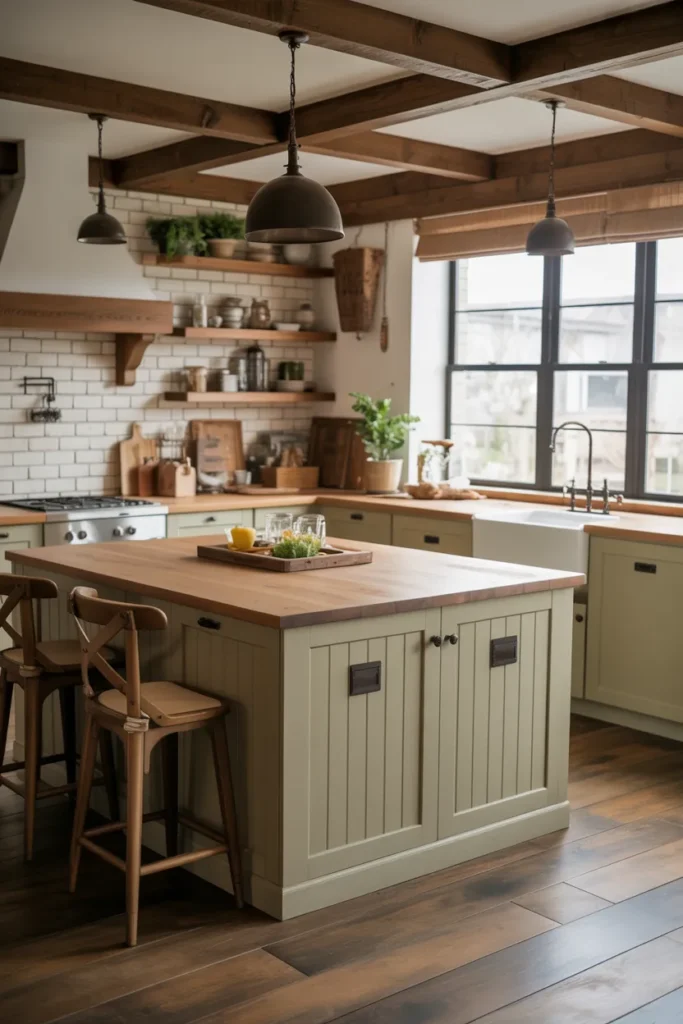
The island is where rustic accents belong. Corbels, turned legs, a weathered wood top, or X-brace ends turn a plain base cabinet into furniture. Because the island stands alone, you can go bolder here than on the perimeter cabinets without overwhelming the room.
Anchor it well: islands get leaned on, bumped, and climbed by kids. Bolt the base to the floor so it never shifts. A stock island base costs roughly 300 to 1,000 dollars, and prices vary by size and features. Rustic add-ons like corbels and legs run 20 to 80 dollars each, a small spend for a big look change.
Plan seating overhang: counter stools need about 12 inches of knee space. Mark it with tape before the countertop is cut. Practical tip: put the microwave or trash pullout in the island. It frees the perimeter for prep space where you need it.
- Island becomes the furniture centerpiece of the kitchen.
- Rustic details read strongest on a standalone piece.
- Extra storage and seating in one footprint.
Shop This Look
13. Cabinets with Open-Top Shelves
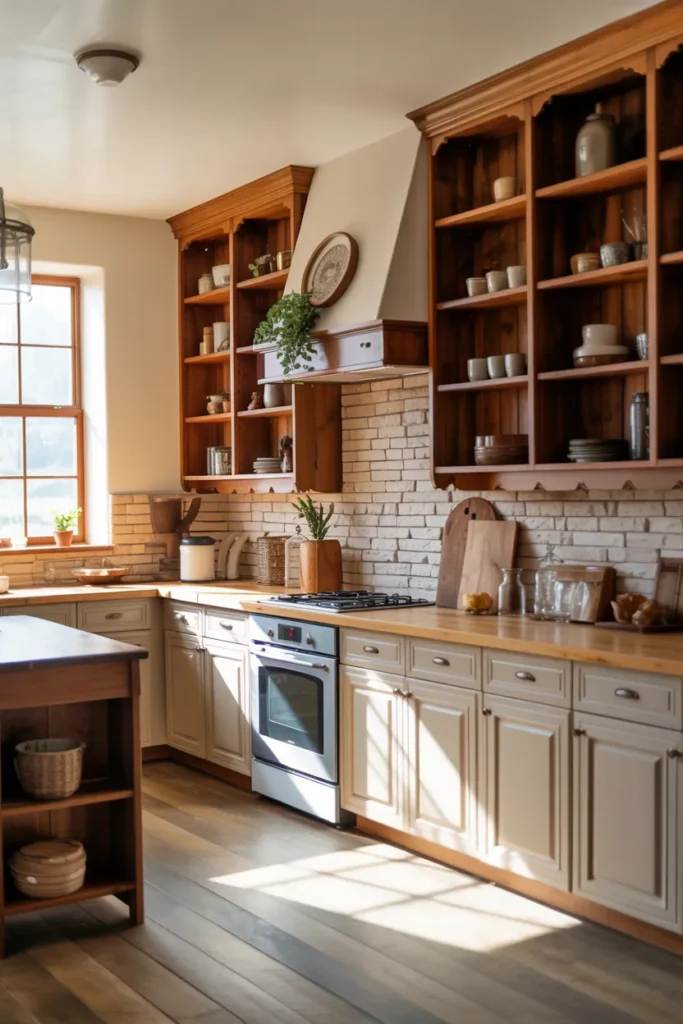
Open-top shelves, a short run of display shelving mounted above the upper cabinets or as a cabinet topper, give you display space without giving up closed storage. It is the compromise between full open shelving and a wall of doors. Baskets, crocks, and a trailing plant up there soften the whole kitchen.
Watch the grease: anything stored high near the stove collects a sticky film over time. Keep open tops away from the range or plan to wash items seasonally. A cabinet topper shelf costs roughly 30 to 120 dollars in materials, and prices vary by length and wood. Baskets to fill it run 10 to 25 dollars each.
Style in odd numbers: groups of three look intentional, rows of identical items look like a store shelf. Honest warning: the top of cabinets is a dust magnet. If you will not wipe it down a few times a year, leave it empty rather than filling it with things you have to wash.
- Display space without losing closed storage below.
- Softens the line where cabinets meet the ceiling.
- Cheap to add, easy to change with the seasons.
Shop This Look
| BASKETS | CROCKS | PLANTS |
|---|---|---|
| Seagrass storage baskets | Stoneware kitchen crocks | Trailing artificial plants |
| Shop → | Shop → | Shop → |
14. Cabinets with Built-In Wine Rack
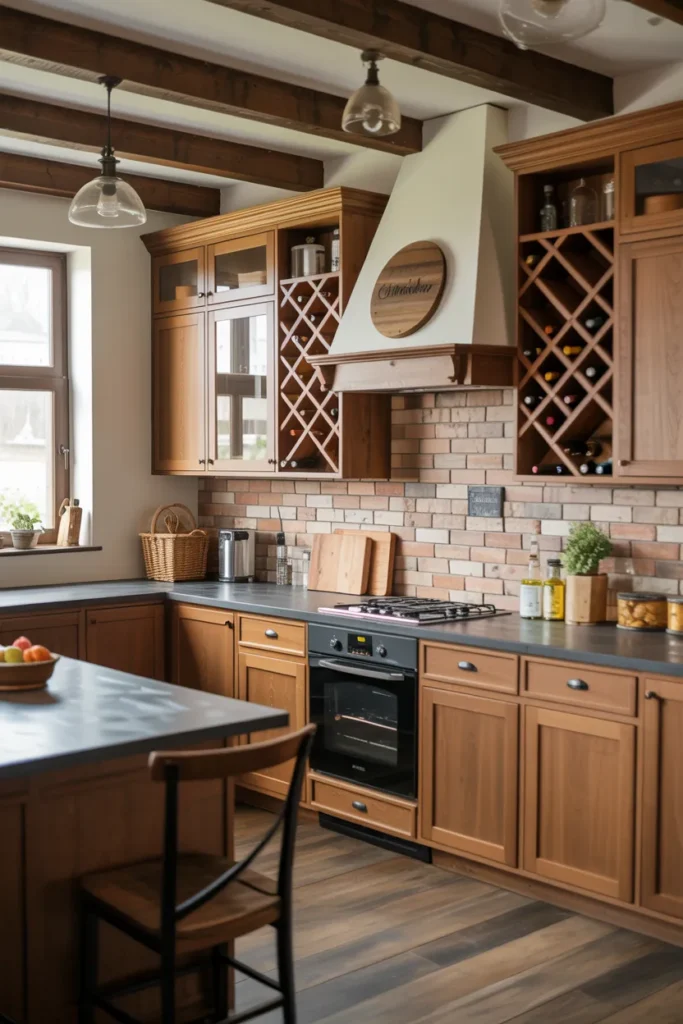
A built-in wine rack, slotted into a cabinet end or above the fridge, keeps bottles organized and adds a classic farmhouse touch. The X- or diamond-style dividers look great in natural wood against painted cabinets. Even if you only keep a few bottles, it reads as intentional design.
Keep it away from heat: wine hates warmth, so skip the rack above the oven or next to the dishwasher vent. A cool pantry wall is ideal. Wine rack inserts cost roughly 25 to 100 dollars, and prices vary by bottle count and wood. Custom built-ins run higher but fit odd spaces exactly.
Size for real bottles: standard slots fit Bordeaux shapes, but wider bottles like Champagne need bigger cubbies. Practical tip: mix a few horizontal cubbies with vertical dividers so the rack works for whatever you actually buy.
- Keeps bottles organized and off the counter.
- Classic wood detailing suits farmhouse style.
- Works in narrow spaces other storage cannot use.
Shop This Look
| RACKS | GLASSES | OPENERS |
|---|---|---|
| Wooden wine rack insert | Stemless wine glasses set | Waiters corkscrew |
| Shop → | Shop → | Shop → |
15. Cabinets with Beveled Panels
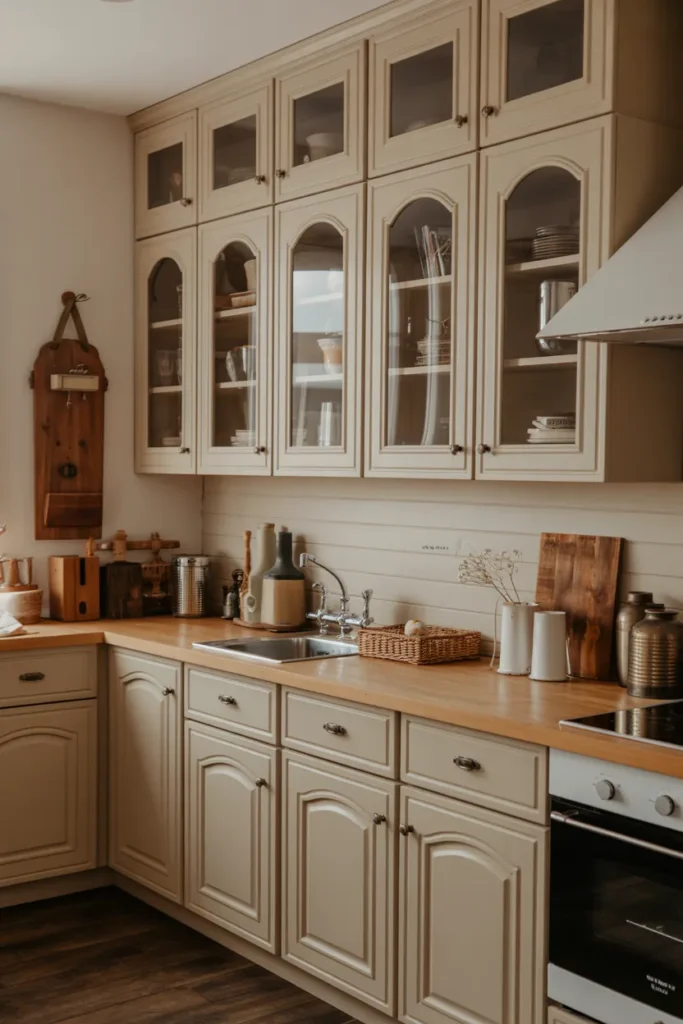
Beveled panels, where the door edges are cut at an angle instead of square, add quiet craftsmanship to farmhouse cabinets. The bevel catches light along the edges, giving flat doors subtle dimension without ornament. It is a detail people notice without knowing why the kitchen looks expensive.
Compare door samples side by side: bevel widths vary, and a wide bevel reads traditional while a narrow one reads modern. Hold samples against your cabinet color in your light. Beveled-panel doors cost roughly 20 to 60 dollars more per door than flat shaker doors, and prices vary by wood and manufacturer. On a full kitchen that adds up, so get the per-door price in writing.
Keep profiles consistent: mixing beveled doors with square drawers looks like a mistake. Match the bevel across every door and drawer front. Honest warning: deep bevels collect crumbs along the lower cabinets. A quick pass with a soft brush during cleaning handles it.
- Subtle dimension that elevates simple cabinetry.
- Light play along edges adds richness without carving.
- Works with painted and stained finishes alike.
Shop This Look
| KNOBS | PULLS | CLEANERS |
|---|---|---|
| Antique bronze knobs | Matte black cabinet pulls | Wood cabinet polish |
| Shop → | Shop → | Shop → |
16. Cabinets with Wire Mesh Doors
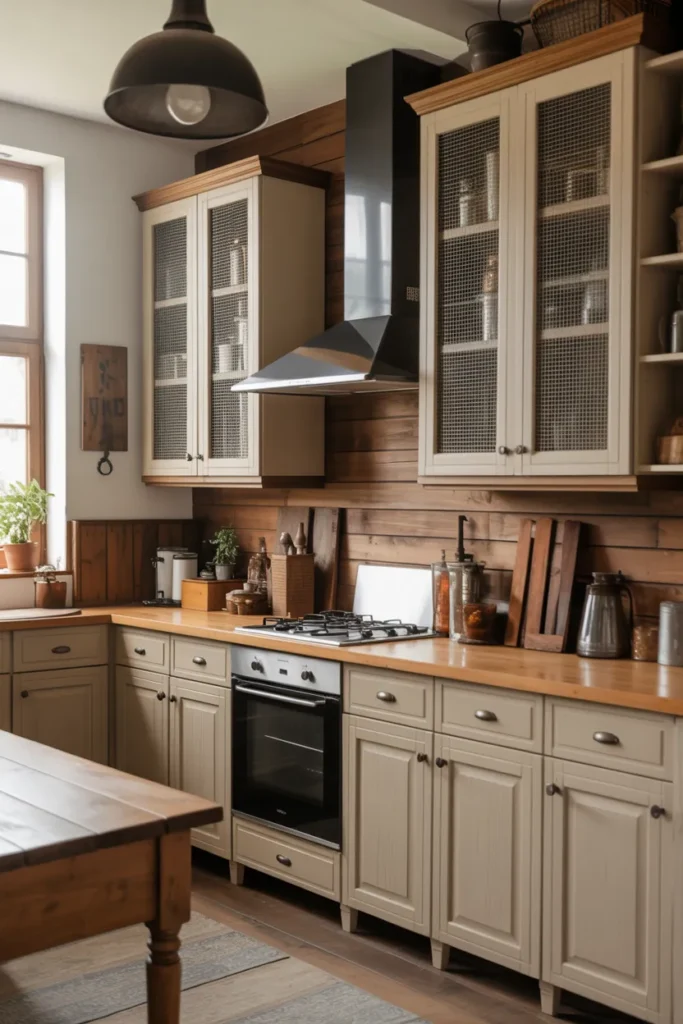
Wire mesh door fronts, chicken wire or fine metal grid set into a wood frame, are pure vintage farmhouse. They ventilate the cabinet, which is handy for produce storage, and they turn ordinary uppers into a design feature. The look is straight out of a country pantry, and it photographs beautifully.
Back it with fabric or leave it open: bare mesh shows everything inside, while a linen backing softens the view and hides clutter. Decide before you build. Wire mesh inserts cost roughly 10 to 30 dollars per door, and prices vary by mesh type and size. It is one of the cheapest door upgrades here.
Secure the mesh well: stapled mesh pulls loose over time. Sandwich it between the frame and an inner trim piece so it stays taut. Practical tip: chicken wire suits rustic kitchens, while fine black grid reads more modern farmhouse. Pick the one that matches your hardware.
- Distinctive vintage look for very little money.
- Ventilation makes it practical for produce cabinets.
- Easy DIY swap for existing door panels.
Shop This Look
17. Cabinets with Integrated Lighting
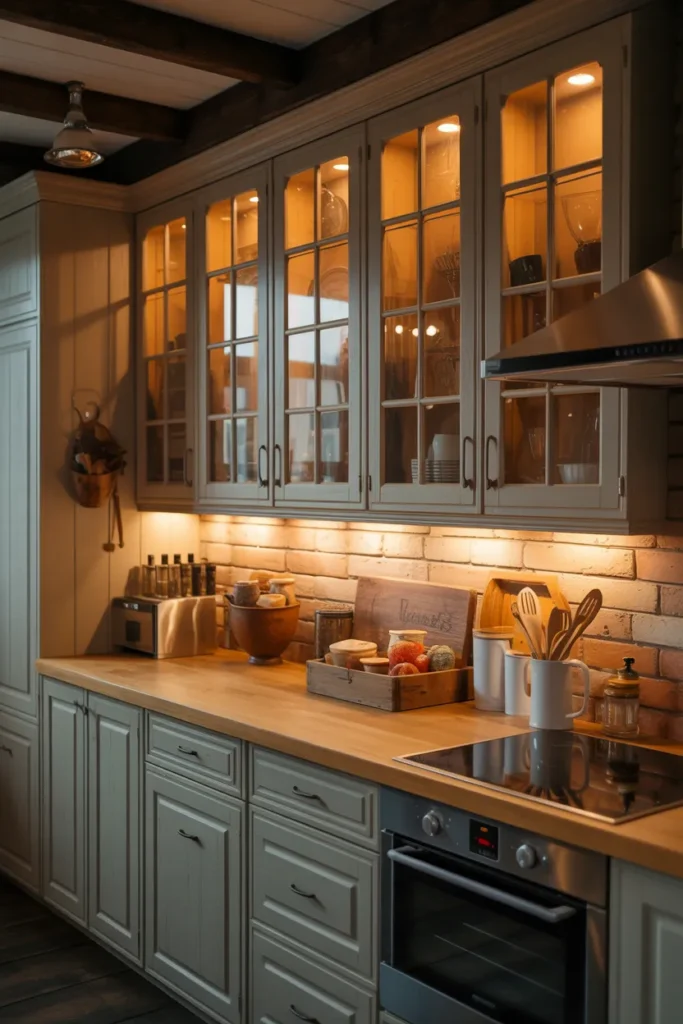
Integrated lighting, LED strips tucked under uppers or inside glass cabinets, changes how a farmhouse kitchen feels after dark. Task lighting on the counters makes prep safer and easier, and a soft glow inside display cabinets turns the kitchen into the warmest room at night. It is the upgrade people notice most and cost least.
Go warm white: 2700K to 3000K light flatters wood and food. Cool white makes a farmhouse kitchen feel like an office. LED strip kits cost roughly 15 to 50 dollars per run, and prices vary by length and brightness. Battery puck lights are even simpler for inside cabinets, no wiring at all.
Hide the source: mount strips toward the front of the cabinet bottom so the light washes the counter, not your eyes. Honest warning: visible LED dots look cheap. Use a diffuser channel or place strips where the diodes stay out of sight.
- Better task lighting for safer, easier cooking.
- Warm glow makes the kitchen inviting at night.
- Cheap and simple, most options need no electrician.
Shop This Look
| STRIPS | PUCKS | SENSORS |
|---|---|---|
| Warm white LED strip lights | Battery puck lights remote | Under cabinet motion sensor |
| Shop → | Shop → | Shop → |
18. Corner Cabinets with Glass Inserts
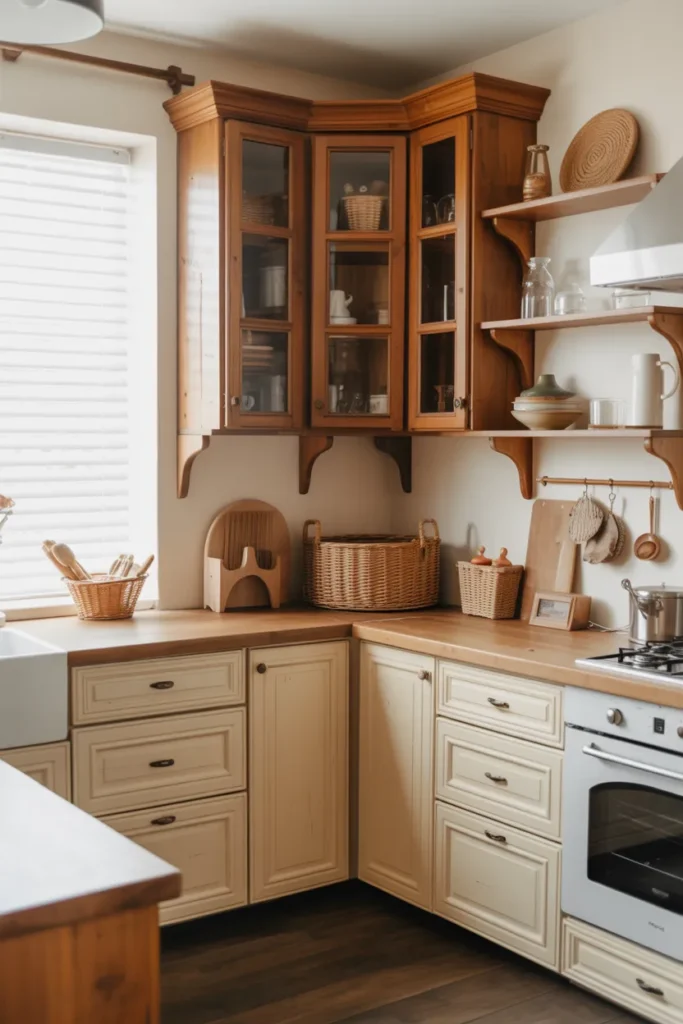
Corner cabinets with glass inserts solve two problems at once: the dead corner gets usable storage, and the glass keeps a big corner unit from feeling like a wall of wood. It is a smart pick for the corner between two cabinet runs, where solid doors would feel heavy and dark.
Use angled or diagonal corners: a diagonal corner cabinet with a glass door reads lighter than a blind corner with two doors. Plan the interior with a turntable or pull-out so the space actually gets used. Glass insert panels cost roughly 30 to 80 dollars per door, and prices vary by glass style and size.
Keep the contents pretty: glass means the inside is always on display. Reserve these corners for attractive items, and put the plastic containers somewhere with solid doors. Practical tip: add a small light inside. A lit glass corner at night is one of the prettiest things in a farmhouse kitchen.
- Makes bulky corner units feel lighter and brighter.
- Combines display space with real corner storage.
- Works well as the transition between two cabinet runs.
Shop This Look
| GLASS | LIGHTS | LINERS |
|---|---|---|
| Seeded glass cabinet panels | Mini LED cabinet lights | Clear non-slip shelf liner |
| Shop → | Shop → | Shop → |
How to Start
Start with what you already have. Walk your kitchen and sort the cabinets into three groups: solid and worth keeping, ugly but structurally fine, and genuinely failing. Most farmhouse looks can be achieved with paint, hardware, and a few add-ons on the first two groups. Only the third group needs replacing, and that is where the real money goes.
Pick one finish direction before you buy anything: painted, stained wood, or a mix. Then order door samples or paint swatches and test them against your floor and counters in daylight. Cabinets cover a huge visual area, and small swatches lie. A large sample board tells the truth.
Your first shopping trip should stay under 60 dollars and it will move the project forward fast. Buy a quart of cabinet paint, a pair of sample cup pulls in different finishes, and a small LED puck light. The total stays well under 60 dollars, and by the weekend you will know your color, your hardware, and whether under-cabinet light is worth adding everywhere.
- Pick up a quart of cabinet enamel paint, around 20 dollars, and paint one door as a test.
- Buy two sample cup pulls, black and brass, about 15 dollars total, and live with both.
- Add a 4-pack of battery puck lights for about 20 dollars and try them under one cabinet.
Shop This Look
| PAINT | PULLS | LIGHTS |
|---|---|---|
| Quart cabinet enamel paint | Farmhouse cup pulls sample | Battery puck lights 4-pack |
| Shop → | Shop → | Shop → |
Common Mistakes
- Skipping measurements: cabinet hardware, inserts, and organizers all come in standard sizes. Measure every opening before ordering, or returns will eat your weekends.
- Painting without prep: grease and old gloss kill paint adhesion. Degrease, sand, and prime, or the paint peels within a year, usually right by the stove.
- Mixing too many finishes: black pulls, brass knobs, and nickel hinges in one kitchen looks accidental. Pick one main metal and let it run.
- Ignoring the inside: pretty doors over sagging shelves and broken hinges disappoint fast. Fix the boxes and hardware before you spend on the faces.
- Overfilling open shelves: open shelving needs negative space to look good. If every inch is packed, it reads as clutter, not farmhouse.
- Forgetting lighting: new cabinets under old lighting look half-finished. Budget for under-cabinet LEDs from the start, it is the cheapest rework in the room.
- Choosing style over function: a beautiful corner cabinet you cannot reach into is just expensive wall art. Every cabinet should open, close, and store something easily.
Frequently Asked Questions
How much do farmhouse kitchen cabinets cost?
A paint-and-hardware refresh costs roughly 200 to 600 dollars in materials. Stock farmhouse-style cabinets run roughly 2,000 to 5,000 dollars for an average kitchen, and custom woodwork starts around 7,500 dollars and climbs. Prices vary by region and materials, so get local quotes.
Can I get the farmhouse look without replacing my cabinets?
Yes, and most people do. New cup pulls or knobs, a fresh coat of paint in cream or sage, beadboard on the island, and open shelving in place of one upper run will rework a kitchen for a few hundred dollars. Replace only the cabinets that are structurally failing.
What is the most popular farmhouse cabinet color?
White and off-white shaker cabinets are still the safest and most common choice. Soft gray, sage green, and navy islands are the popular ways to add color without overwhelming the room. Natural wood is coming back strong for islands and open shelving.
Are open shelves practical in a real kitchen?
They are practical for everyday dishes you use and wash constantly. They are not practical for rarely used items, which collect dust and grease. Keep open shelving to one or two sections near the dishwasher and keep the rest of your storage behind doors.
What hardware goes with farmhouse cabinets?
Matte black and oil-rubbed bronze cup pulls are the classics, with brass and aged nickel as strong alternatives. Match the hardware finish to your faucet for a pulled-together look, and keep one finish dominant through the whole kitchen.
The Finishing Touch
The best farmhouse kitchens look collected over time, not installed in a day. That is your permission to phase the work. Paint now, swap hardware next month, add the open shelving when you find the right wood. A kitchen that grows in layers ends up with more character than one bought all at once.
Let the cabinets be the quiet background and give one or two details the spotlight. Maybe it is the brass pulls against sage doors, or the reclaimed shelves styled with pieces you actually use. Restraint is what separates farmhouse from cluttered. When in doubt, take one thing off the shelf.
Finish with light and textiles, the two things people forget. Warm under-cabinet lighting makes wood glow at night, and a washable runner softens the floor between work zones. These small layers are what make someone walk in and say the kitchen feels like home.
For more design pairings, colors, and hardware combinations, browse the farmhouse cabinet design guide at Lily Ann Cabinets before you finalize your plan.