
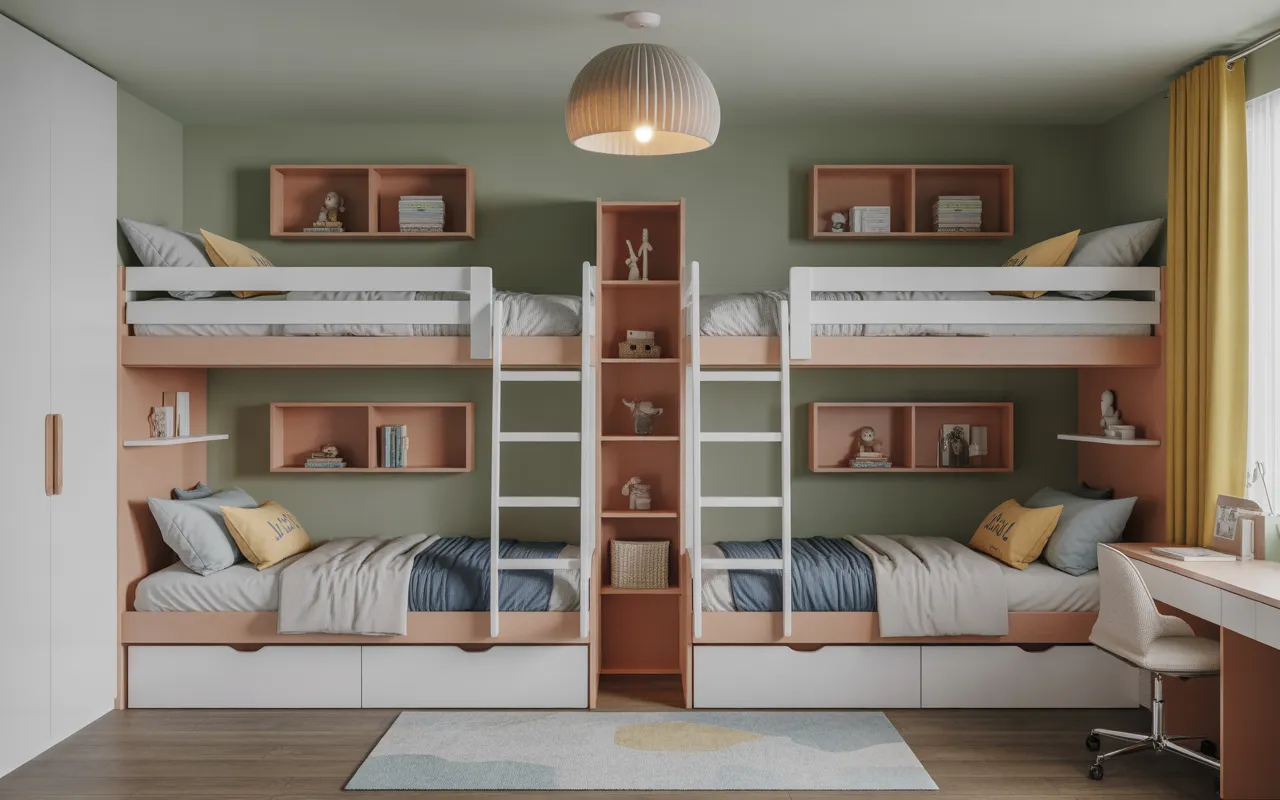
22 Tiny Bedroom Ideas for Children in Small Spaces
A small bedroom for a child has to hold a bed, clothes, toys, books, and somewhere to play or do homework, often in a room smaller than the parents bedroom. The space does not grow, but the child and the amount of stuff both do.
The ideas below rely on beds that stack, fold, or hide storage inside, plus walls and the space under the bed doing the heavy lifting. Each one keeps floor space open, because floor space is where children actually play. Most work for toddlers through to early teens with small adjustments.
Set up the room in layers: sleeping first, then storage for clothes and toys, then a desk or play spot if the floor allows. A room a child can tidy themselves, with storage they can reach, stays tidier than one organised only for adults.
This post contains affiliate links. If you buy through them, I may earn a small commission at no extra cost to you.
1. Loft Bed with Play Area Below
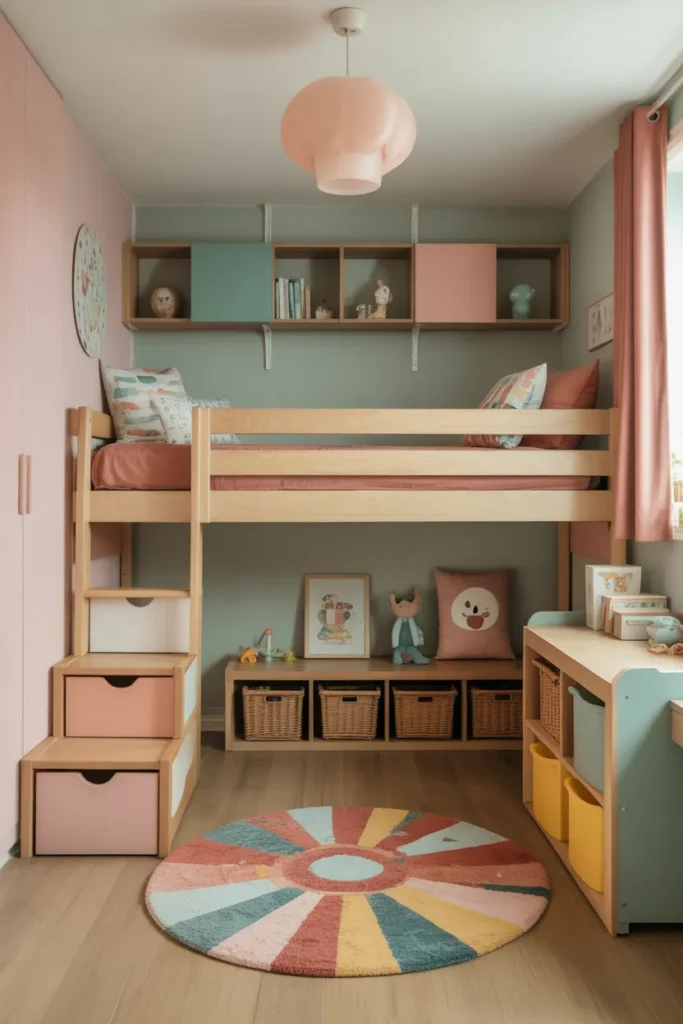
A loft bed raises the sleeping area and turns the space underneath into a play area, which is where most of the floor in a small child room gets used anyway. A curtain, a mat, and cushions under the loft make a den children actually use. The bed footprint stays the same, but the room gains a whole play zone.
Check age and ceiling height: Loft beds suit children who can climb and sleep up high safely, usually from around six years old, following the maker guidance. You need headroom above the mattress for the child to sit up. A solid guard rail and a fixed ladder are basic requirements, not extras.
Keep the play area simple: A soft mat, a few cushions, and a small box of toys is enough under the loft. Too much stored under there turns it into a cupboard instead of a play space. A battery light on the underside of the bed makes it usable in the evening.
- Follow the age and weight guidance for the bed you buy.
- Keep the ladder side clear of toys at bedtime.
- Store only soft items in the play area so bumps do not hurt.
Shop This Look
2. Bunk Beds with Built-In Storage
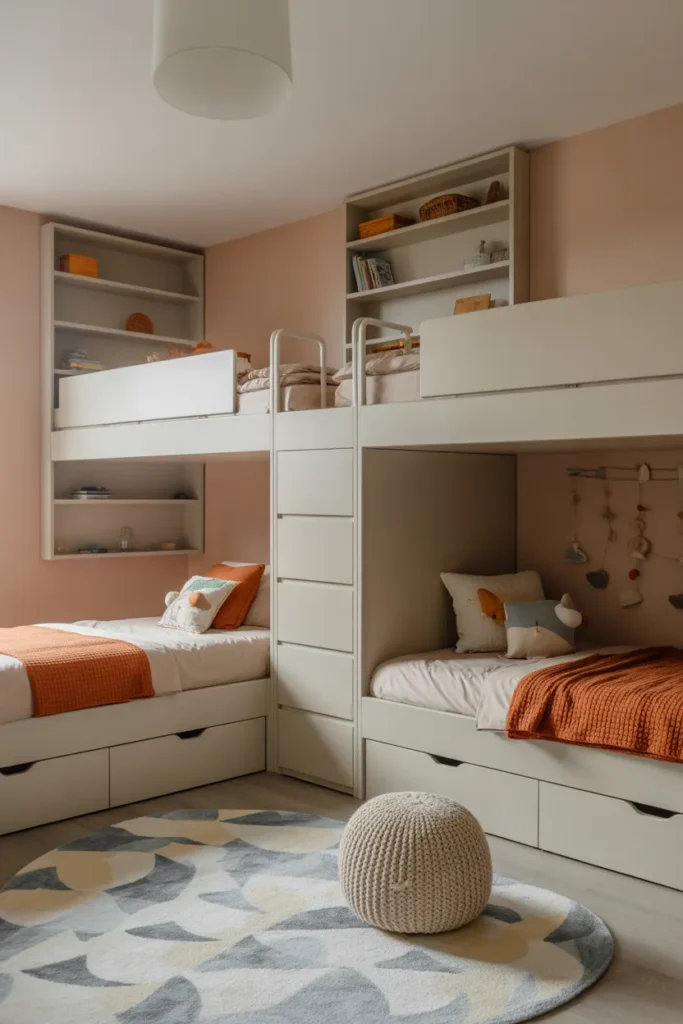
Bunk beds with built-in storage sleep two children in the footprint of one bed, with drawers or shelves built into the frame for clothes and toys. In a shared small room, this is often the only layout that leaves any floor to play on. Stair drawers, where each step is also a drawer, use space a ladder wastes.
Put safety first: The top bunk needs guard rails on all sides and a mattress thin enough that the rail still stands well above it. Young children belong in the bottom bunk. Check the frame for wobble once a month, as bunk fixings loosen with use.
Give each child a drawer: Shared rooms work better when each child has storage that is clearly theirs. One drawer each for personal items reduces arguments and tidies faster. Shared items like books can live on a shared shelf at the end of the bed.
- Teach climbing on the ladder or stairs only, never the frame.
- Keep a small night light near the bottom bunk.
- Rotate which toys live in the drawers so both children get a turn with favourites.
Shop This Look
3. Under-Bed Storage Drawers
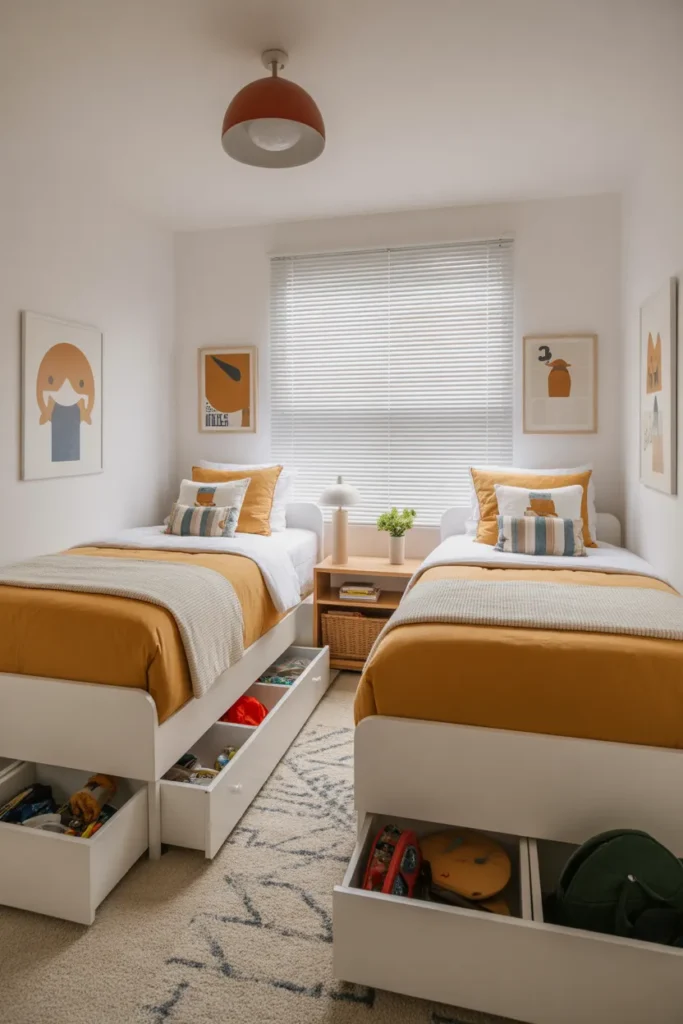
Under-bed storage drawers give a child a place for clothes, bedding, or toys that slides out of sight in seconds. Children can open them themselves, which makes tidying realistic. In a small room, drawers under the bed often hold more than the wardrobe does.
Match drawers to the child: Low drawers with simple handles suit young children. Divide the space so clothes do not become one mixed pile. One drawer for clothes and one for toys is a workable split most children can keep up.
Keep the runners smooth: Drawers that stick do not get used, and toys end up back on the floor. Wheeled drawers run well on hard floors, while sliders suit carpet. Clear the floor in front before opening, and teach the child to close drawers fully so nobody trips at night.
- Label drawers with words or pictures for young children.
- Store spare bedding in the drawer that is hardest to reach.
- Check for small items rolling under the bed every week or so.
Shop This Look
4. Wall-Mounted Shelves for Books and Toys
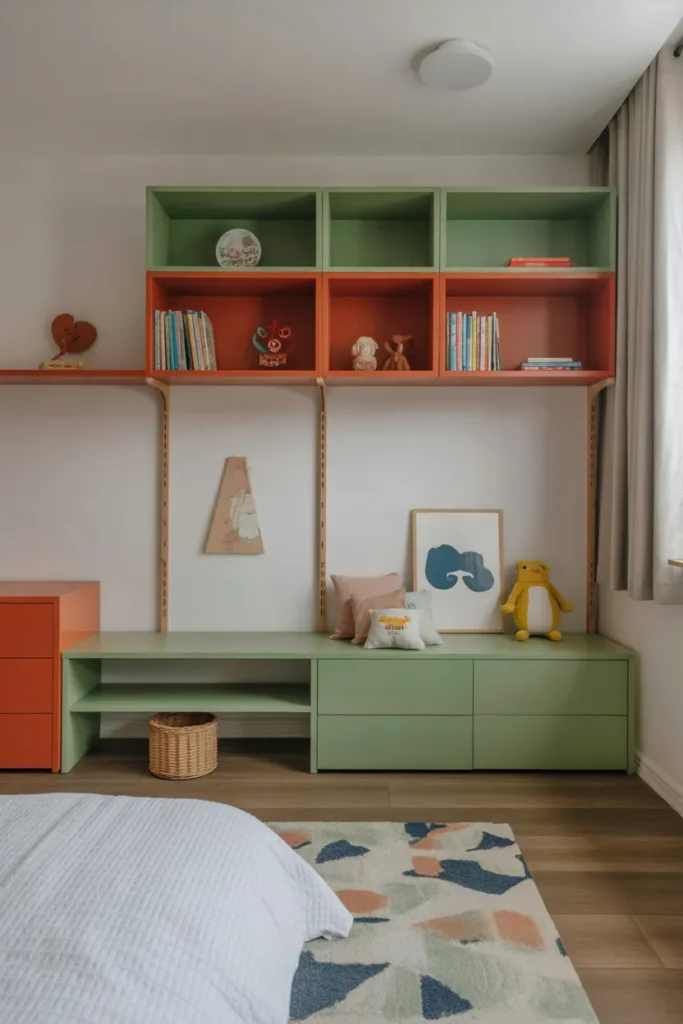
Wall-mounted shelves hold books and favourite toys up off the floor while keeping them visible and reachable. Forward-facing book shelves suit young children, who choose books by the cover. A couple of shelves above a dresser or beside the bed use wall space that otherwise holds nothing.
Fix them at child height: Shelves a child cannot reach become display shelves for adults, and the child still has nowhere to put books. Place the main shelves where the child can reach standing on the floor. Higher shelves, if any, are for spare or fragile items only.
Limit what lives on them: A shelf packed tight is hard for a child to use and tidy. Leave space so books slide in and out easily. Rotate the books and toys on the shelves with a stored set, which keeps the room feeling fresh without buying more.
- Fix shelves into studs or use proper anchors, children pull on them.
- Keep heavy items off shelves above the bed.
- Use bookends so books do not slide off the ends.
Shop This Look
5. Foldable Desk for Homework
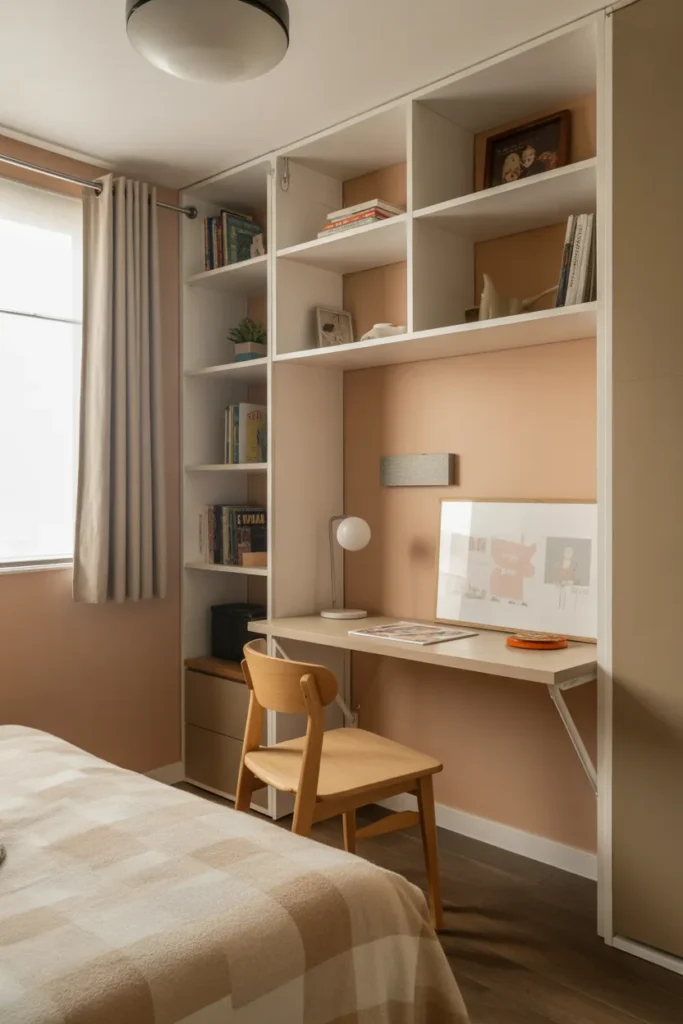
A foldable desk gives a child a proper homework surface that folds away when the floor is needed for play. Wall-mounted drop-down desks and small folding tables both work. The key point is the same: homework gets a real spot, and the room gets its floor back afterwards.
Set it up for homework only: Keep pencils, paper, and the school bag near the desk so setup takes a minute. When homework ends, everything goes back and the desk folds. If the desk becomes a storage surface, it stops getting folded and the room loses the space.
Check the size as they grow: A desk that suits a six year old will be small for a twelve year old. Adjustable or larger folding desks last longer. Test that knees fit under it with the chair the child actually uses, not a chair you plan to buy later.
- Fix wall desks into solid wall or studs, they take leaning weight.
- Add a small lamp that clips on rather than taking desk space.
- Keep a homework caddy that moves on and off the desk.
Shop This Look
6. Storage Bins Under the Bed
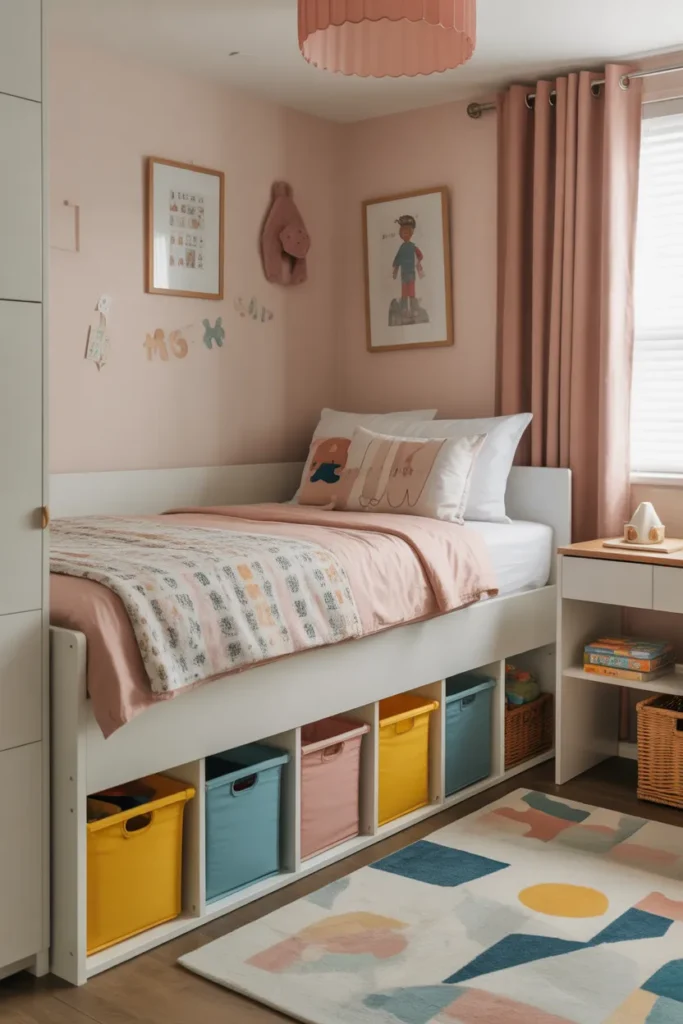
Storage bins under the bed are a cheaper, simpler version of drawers, and young children find them easy to use. Open or lidded bins slide under most bed frames and hold toys, out-of-season clothes, or spare bedding. For a fast tidy-up, a child can sweep toys into a bin and push it out of sight.
Choose bins the child can move: A bin a child cannot pull out alone will not be used for tidying. Handles and a size matched to the child matter more than maximum capacity. Clear bins help young children find toys without emptying everything onto the floor.
Sort by type, not by tidy rules: One bin for building toys, one for soft toys, one for clothes overflow. Three clear groups are enough. When a bin overflows, some toys leave the room or go to a donation box, because under-bed space is fixed and the collection always grows.
- Measure the gap under the bed before buying bins.
- Use lids for items stored for months, open tops for daily toys.
- Keep one bin empty for quick tidy-ups before visitors or bedtime.
Shop This Look
7. Loft Bed with Slide for Fun and Function
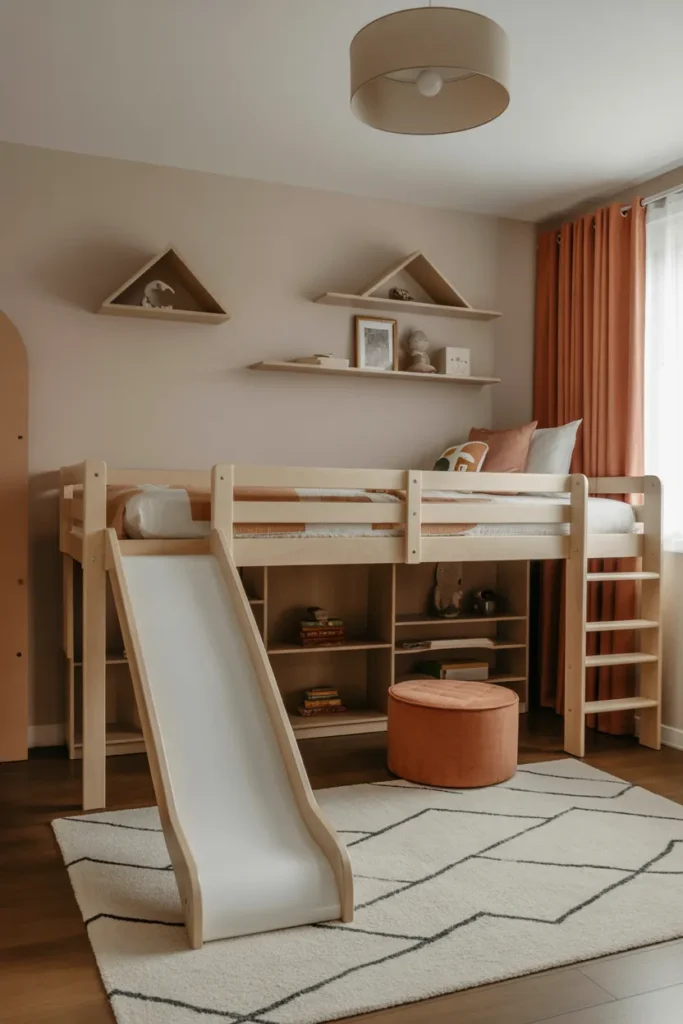
A loft bed with a slide trades a ladder for a faster, more fun way down, and younger children love it. The slide takes more floor length than a ladder, so it only suits small rooms with one longer wall. Under the bed, the space still works as a play or storage area.
Measure the slide run: The slide needs clear floor at its end, with nothing hard to land against. Check the total length of bed plus slide against your longest wall before ordering. A mat at the bottom softens landings and protects the floor.
Set clear slide rules: One child on the slide at a time, feet first, no toys on the slide. Slides on beds are play equipment, and they need the same supervision as any other. Check the slide fixings regularly, as they take repeated impact.
- Confirm the child age range suits a slide bed before buying.
- Keep the area under the bed free of hard storage boxes.
- Tighten slide and frame bolts every few months.
Shop This Look
8. Wall Hooks for Backpacks and Accessories
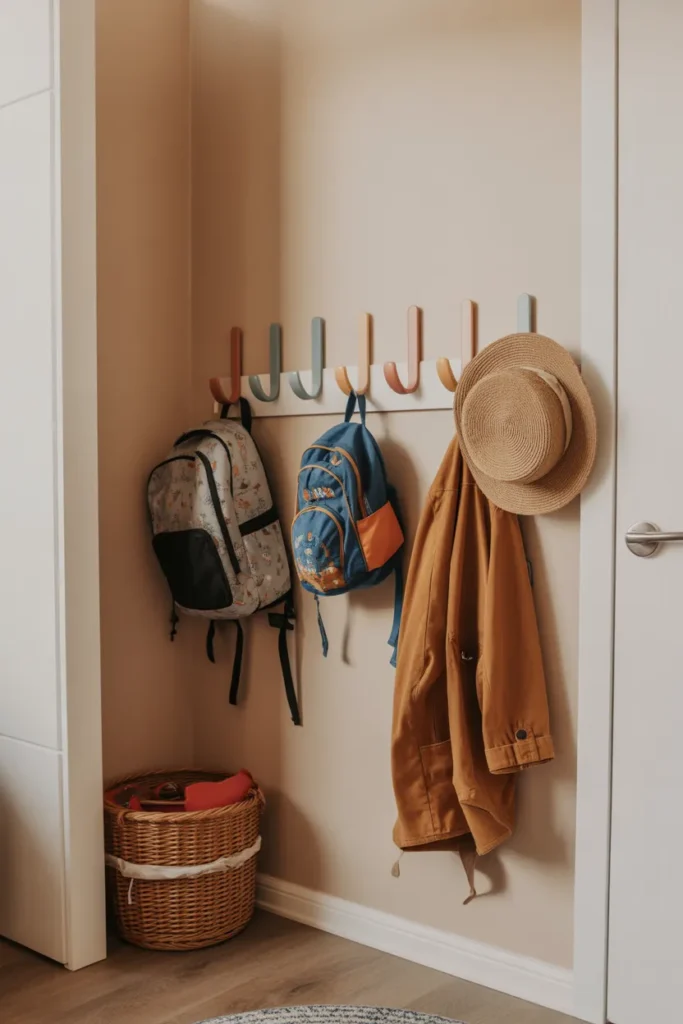
Wall hooks by the door hold the school backpack, coat, and PE bag off the floor and in one place. In a small room, bags on the floor take a large share of the walking space. A short row of hooks at child height fixes the morning scramble for bags as well.
Fit them where bags are dropped: Hooks only work where the child naturally puts things down, which is usually just inside the door. Fit them at a height the child can reach without stretching. Strong fixings matter, as a loaded school bag is heavy.
One hook per job: Backpack, coat, and bag each get a hook. When hooks double up, bags fall and the floor system returns. Keep one spare hook for a friend bag or a wet coat so the system survives real life.
- Use wide hooks so straps stay on.
- Add a small basket under the hooks for shoes or gloves.
- Move hook height up as the child grows.
Shop This Look
9. Foldable Play Mat for Floor Space
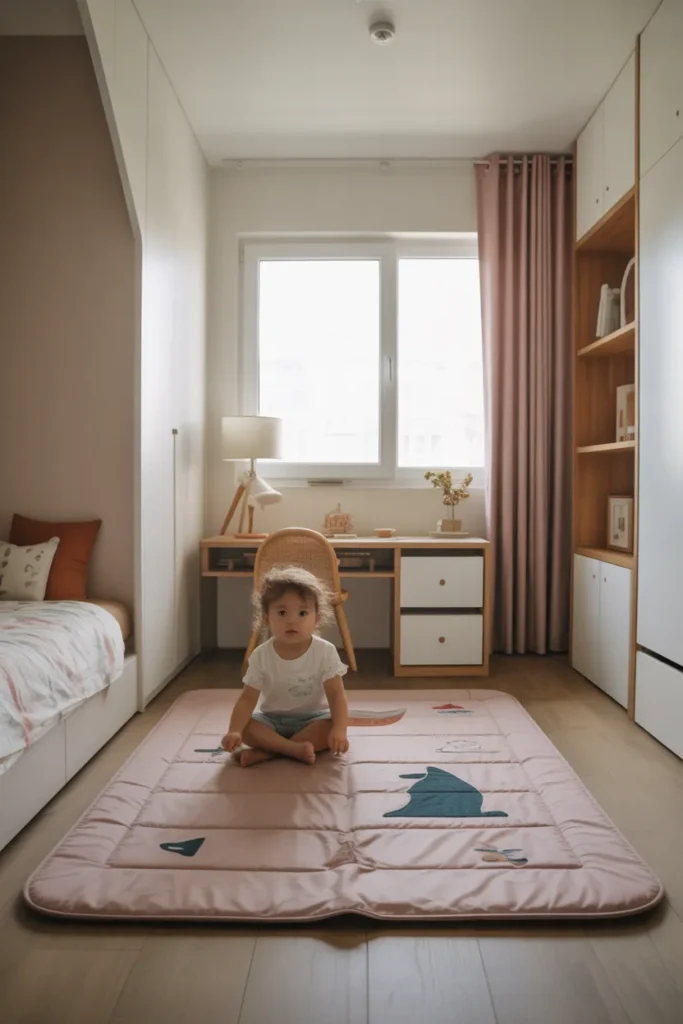
A foldable play mat defines a play area on the floor without a rug that stays down all the time. Thick folding mats cushion falls, soften noise for the rooms below, and fold into a corner or under the bed when play ends. For toddlers in small rooms, this is often the play solution that actually fits.
Choose thickness over size: A thicker mat in a modest size protects better than a thin mat covering the whole floor. Check the folded size and where it will live before buying. If folding it away is a faff, it will stay out and the space saving is lost.
Keep it clean and simple: Wipe-clean surfaces suit mats that see snacks, paint, and crawling babies. Plain or lightly patterned mats look calmer in a small room than busy cartoon prints. Store a few play items in a box that sits on the mat during play and leaves with it after.
- Fold and store the mat daily so the habit sticks.
- Check the surface for tears where small fingers can pick at foam.
- Use the mat under messy play to protect the floor or carpet.
Shop This Look
10. Corner Shelves for Toys and Books
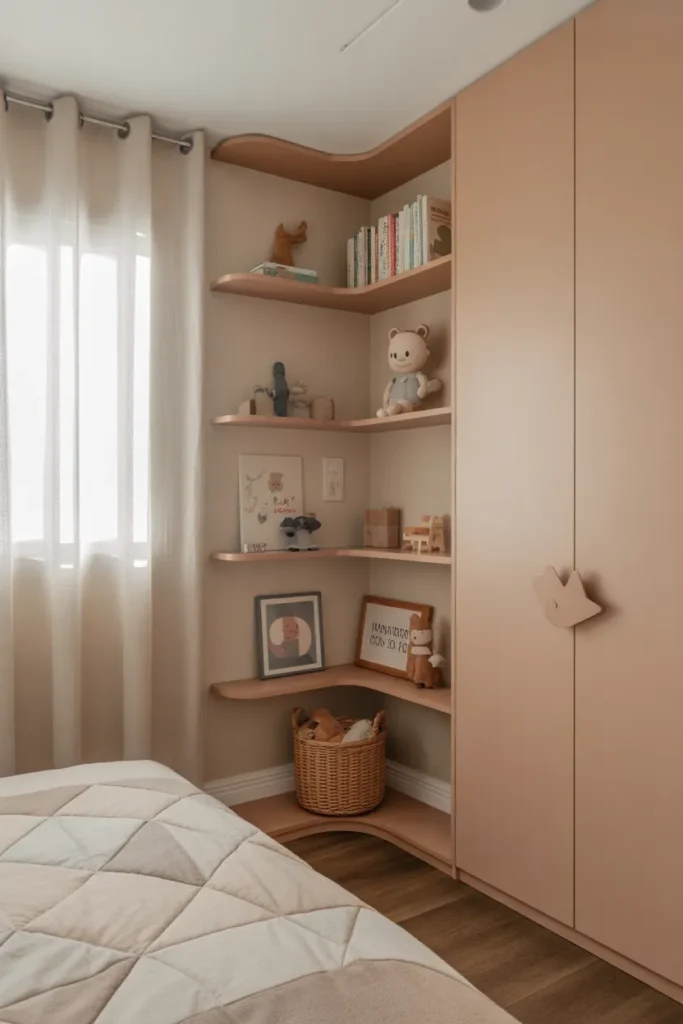
Corner shelves use the part of a child room that fits nothing else, stacking books and toys up a corner instead of across a wall. They suit the corner by the bed for bedtime books, or the corner by the door for daily items. A small corner unit can also hold a night light at a good height.
Keep the bottom shelves for the child: The lowest shelves hold what the child uses daily and can put back alone. Upper shelves take spare books, keepsakes, or items you would rather a young child asks for. This split keeps the unit useful instead of decorative.
Fix tall units to the wall: Any tall corner shelf in a child room needs an anti-tip fixing. Children climb, pull, and lean on furniture. A strap into the wall takes minutes to fit and removes a real risk.
- Measure corner space including skirting boards.
- Rotate toys on the shelves with stored ones monthly.
- Keep one shelf for library books so they do not mix with owned ones.
Shop This Look
11. Built-In Wall Desk with Shelves
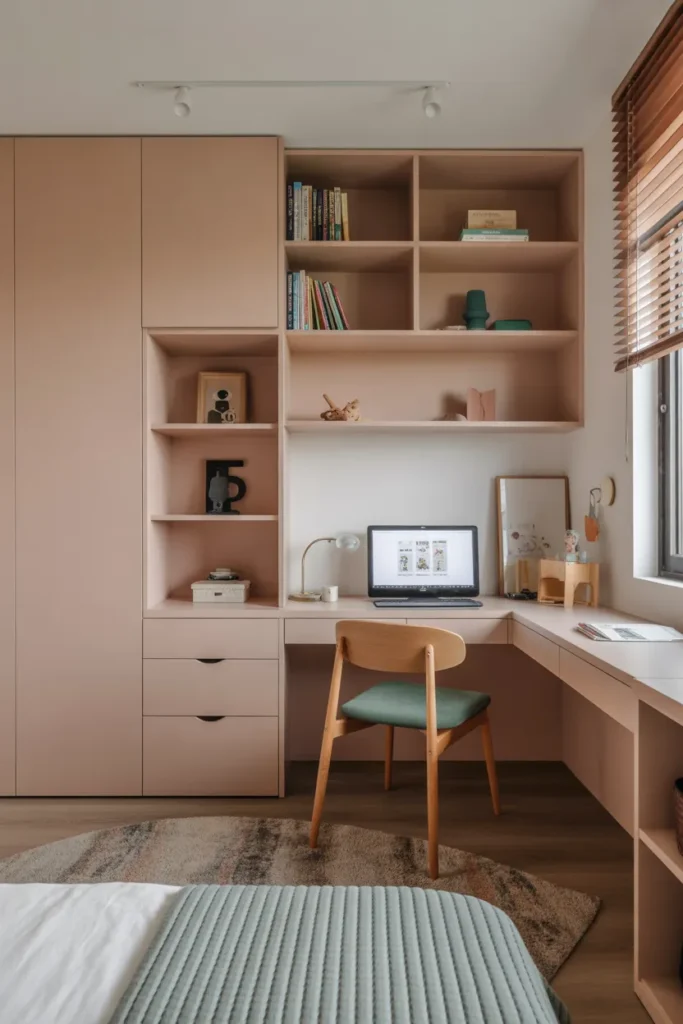
A built-in wall desk with shelves above it gives an older child a fixed study spot that takes no extra floor beyond its depth. The shelves hold school books, files, and supplies, so the desk surface stays clear for work. In a small room, building the desk into an alcove or along one short wall uses space standard furniture does not fit.
Size it for school years: Leave enough depth for books and a laptop at the same time, and enough width for papers beside them. A desk built too small gets abandoned for the kitchen table. Add a power point at desk height if you can, so cables do not trail across the room.
Light it properly: Homework under poor light strains eyes and puts children off working there. A fixed wall light or a good desk lamp pointed at the page makes a clear difference. Keep the brightest light off the screen if a laptop is used, to cut glare.
- Fit shelves within arm reach of the chair.
- Use boxes and files on shelves so small items stay sorted.
- Choose a chair that tucks fully under the desk.
Shop This Look
12. Bunk Beds with Pull-Out Trundle
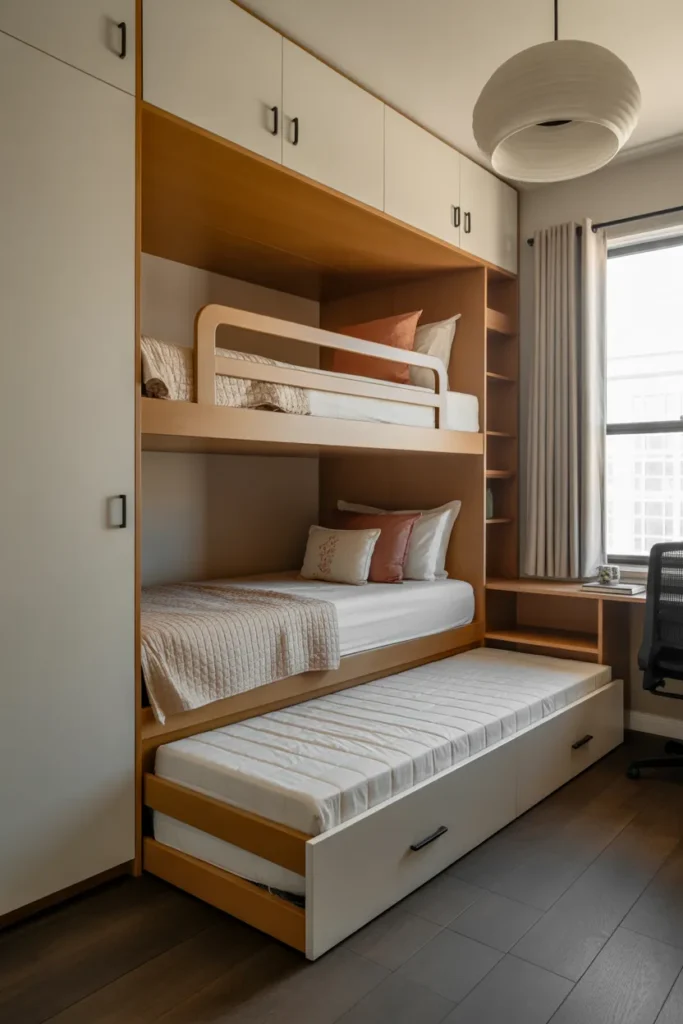
Bunk beds with a pull-out trundle sleep a third child or a sleepover guest without a third bed in the room. The trundle slides under the bottom bunk during the day, so the floor stays clear. For siblings who have friends to stay, this solves the guest bed problem in rooms with no spare space at all.
Check the floor space to open it: A trundle needs the full length of the bed plus its own width in clear floor when pulled out. Measure the room with that in mind, including where the door swings. On carpet, wheeled trundles move more easily than sliding ones.
Keep bedding with the trundle: Store the trundle sheet and a light blanket in a bag beside it or in a drawer nearby. If setting up the guest bed means hunting through cupboards, sleepovers become a chore. A quick setup also helps when a child is ill and a parent sleeps in the room.
- Check the trundle mattress thickness fits the space under the bunk.
- Teach children to push the trundle fully in each morning.
- Keep the pull-out path clear of toys at bedtime.
Shop This Look
13. Hanging Organizers on Closet Doors
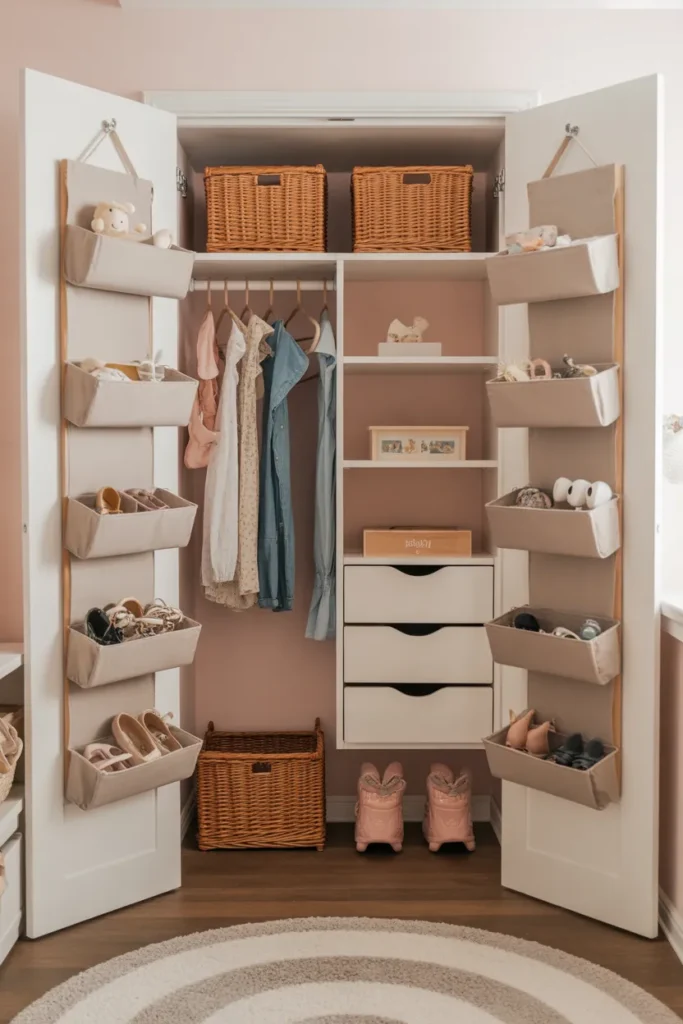
Hanging organisers on the back of the closet door use space that is otherwise completely wasted. Clear pockets hold small toys, hair items, socks, art supplies, or action figures, all visible at a glance. For small items that vanish into drawers and toy boxes, pockets work better.
Sort pockets by category: One row for hair items, one for small toys, one for art bits. Children keep a system they can see. If pockets hold mixed items, the organiser becomes another place to rummage. Empty and resort it every few months as interests change.
Protect the door and the items: Use hooks that fit the door thickness so the door still closes properly. Heavy items stretch pockets and strain the hooks, so keep the organiser for light things. Check that nothing hangs where it can swing into a sleeping child if the door is near the bed.
- Choose clear pockets for young children so contents are visible.
- Label pockets with pictures for children who are not reading yet.
- Keep one low pocket for the morning essentials the child grabs daily.
Shop This Look
14. Storage Cubes for Toys
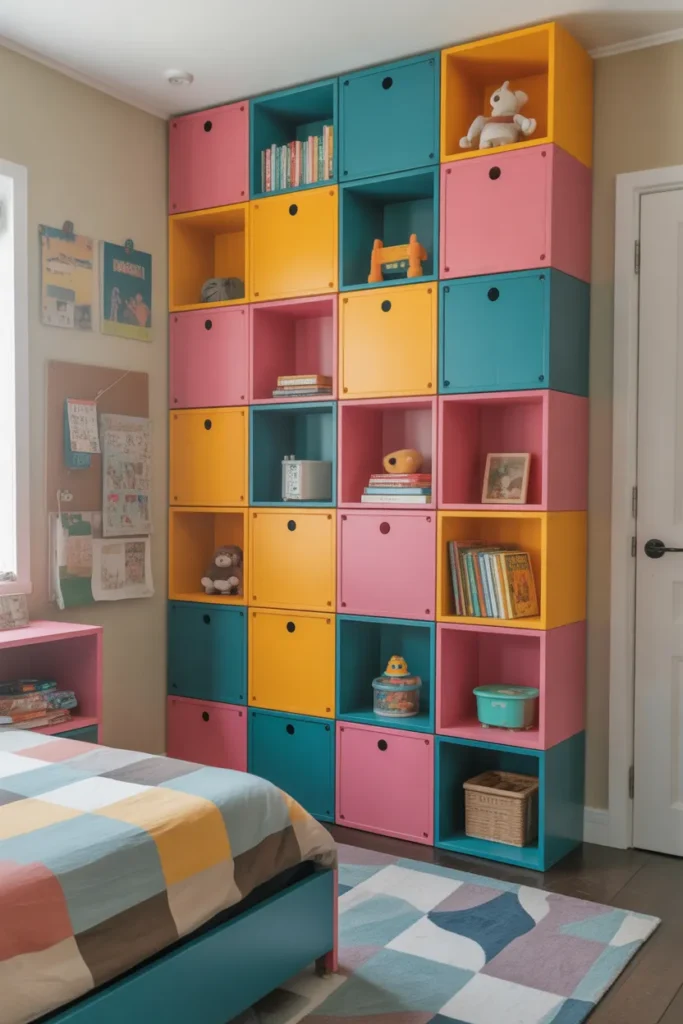
Storage cubes are a flexible way to hold toys in a small room. A low cube unit gives a child open compartments they can reach and tidy themselves, and fabric boxes inside keep each type of toy apart. As the child grows, the same unit holds books, games, and school things.
Keep it low and fixed: Low units suit children and look less bulky in a small room. Fix any unit a child might climb to the wall. Open cubes at child height get used. Cubes stacked high become adult storage the child ignores.
One box per toy type: Cars in one box, dolls in another, craft in a third. When a box overflows, sort it with the child and pass some on. Pictures on the front of boxes help young children put things back in the right place without help.
- Choose boxes that wipe clean, toy boxes get grubby fast.
- Leave one cube empty as a rotating spot for current favourite toys.
- Place the unit where the child plays, not across the room from it.
Shop This Look
15. Foldable Wall-Mounted Table
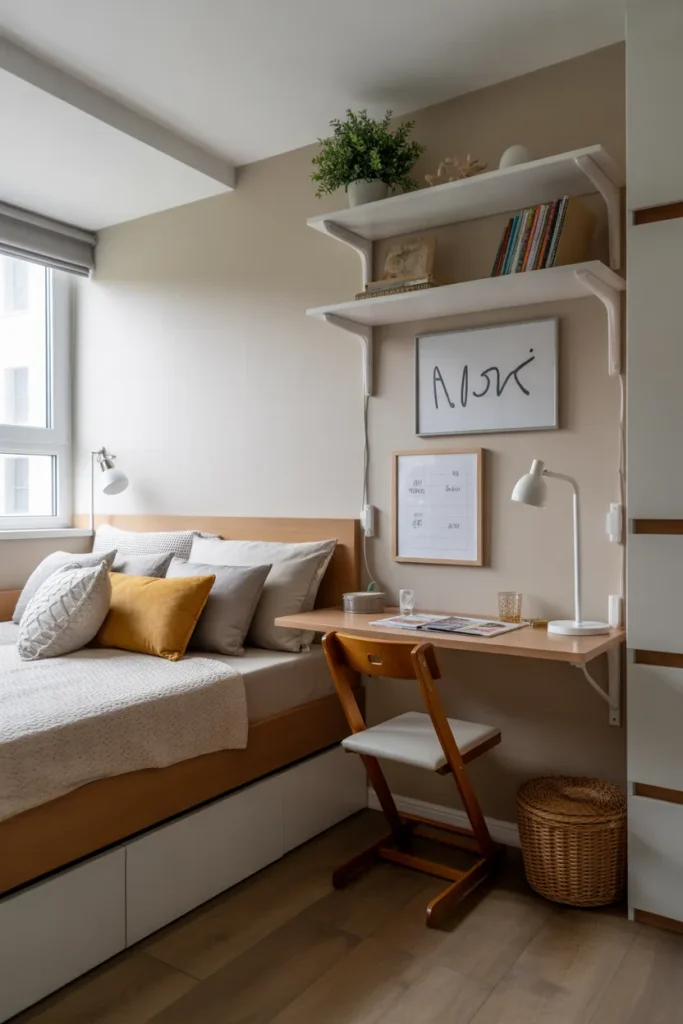
A foldable wall-mounted table works as a craft table, a snack table, or extra homework space, then folds flat to the wall. In a small child room, a permanent table is often the piece that does not fit. A folding one gives the surface only when it is needed.
Fix it at child height: Table height should match the chairs or stools the child uses. Too high and it will not be used for drawing or homework. The fixings need solid wall or studs, as children lean on table edges. Test the lock that holds it open before letting a child use it.
Keep supplies mobile: A table that folds away cannot store things on it, so keep craft or homework supplies in a caddy that moves on and off. This also makes clearing the table a one-minute job. If clearing takes ten minutes, the table will stay down and block the room.
- Choose a size that fits one child working or two sharing.
- Round or soften sharp corners on tables for young children.
- Fold it up as part of the bedtime tidy routine.
Shop This Look
16. Loft Bed with Study Nook
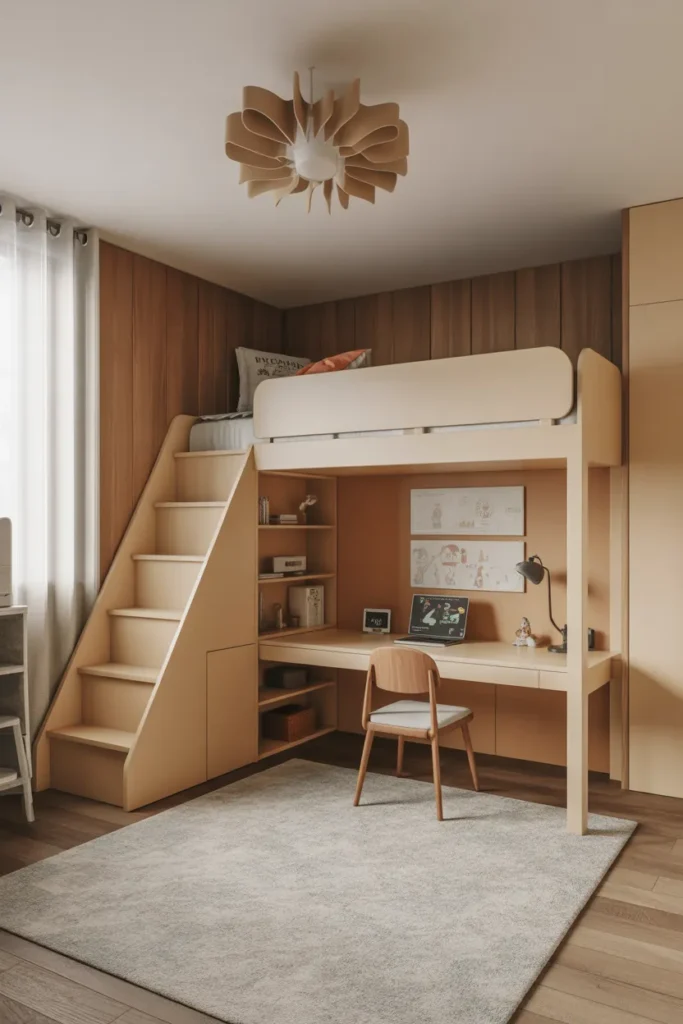
A loft bed with a study nook underneath suits an older child in a small room. The desk below gives homework a fixed home, and a shelf and lamp turn it into a proper work spot. It is a good step up when a child outgrows a play area under the loft but still has only one small room.
Make the nook a real workspace: A desk surface big enough for books and a laptop, a chair that fits under the bed frame, and a fixed light are the basics. Add one shelf for school books so the desk stays clear. If the nook is dark or cramped, homework will drift back to the bed.
Keep sleep and study apart: The split level helps a child treat the desk as work space and the bed as rest space, even in one room. Keep chargers and school bags at the desk, not up in the bed. A small pinboard on the wall of the nook holds timetables and reminders where they are seen.
- Check the desk height fits the child chair before buying the bed.
- Run cables neatly down the frame, away from the climbing side.
- Review the setup each school year as books and kit grow.
Shop This Look
17. Wall-Mounted Hooks for Accessories

Wall-mounted hooks for accessories hold hats, headphones, dress-up items, medals, and bags where a child can see and reach them. A row of hooks near the mirror or door keeps these items off the bed and floor. Hooks also suit the awkward narrow wall sections that fit no furniture.
Group by getting-ready order: Hooks near where the child dresses work best. School items by the door, dress-up near the play area. When hooks are spread randomly, items end up on the floor between them. A small mirror beside the hooks makes the spot more useful.
Use hooks children can manage: Large, smooth hooks are easier for small hands than small knobs. Bags and hats should lift off without a struggle. Fix hooks firmly, as children yank items down in a hurry, and keep anything heavy off hooks above the bed.
- Set hook height so the child reaches without standing on furniture.
- Limit the row to the items used weekly.
- Add name labels above hooks in shared rooms.
Shop This Look
18. Corner Desk with Shelving
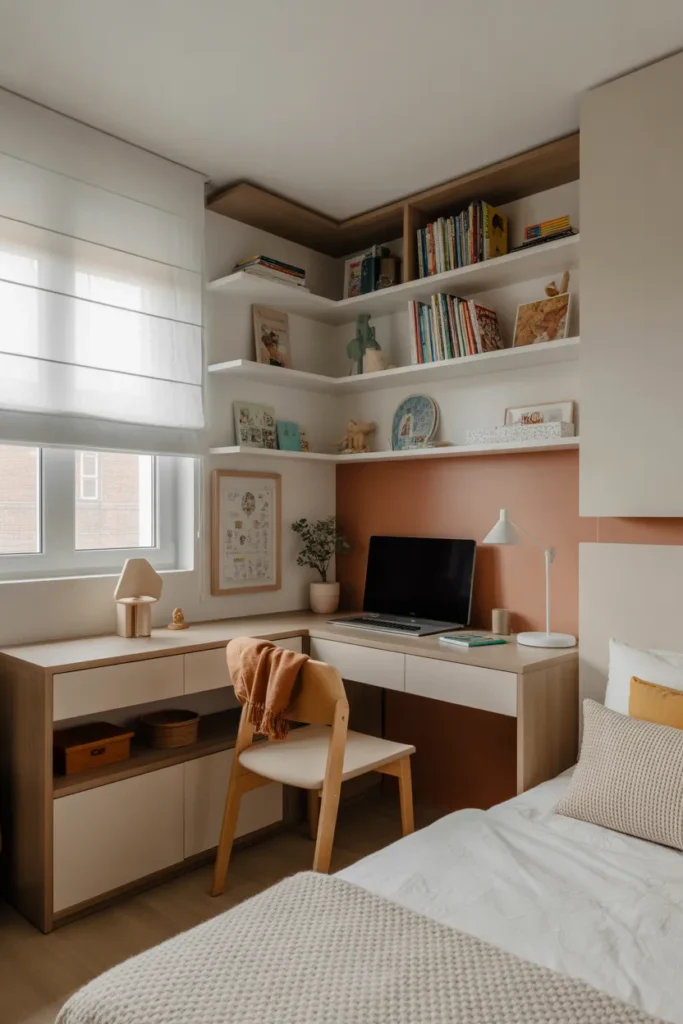
A corner desk uses the one spot in a small room that is often left empty, and its shelves hold school supplies up the corner. Corner desks give a surprising amount of surface for their footprint. For a child who needs a homework spot but has no free wall length, this is often the layout that fits.
Use both sides of the corner: One side for working, one side for books, supplies, or a lamp. Shelves climbing the corner hold files and boxes without taking desk surface. Keep the working side clear at the end of each day so the desk stays inviting.
Fit the chair space: Check the chair pulls out and the child can sit without knees hitting the desk supports. A chair that tucks in fully keeps the walkway clear. If two children share the room, a corner desk for one and a folding desk for the other balances the space.
- Measure the corner including skirting and any radiator.
- Put the lamp on the shelf, not the desk, to save surface.
- Keep a small bin beside the desk for paper scraps.
Shop This Look
19. Under-Bed Pull-Out Drawers

Under-bed pull-out drawers on wheels suit older children with more clothes and kit to store. They roll out fully, so nothing gets lost at the back like it does in a fixed drawer the child cannot reach into. In a small room they often replace a chest of drawers entirely.
Divide for clothes by type: One drawer for school clothes, one for home clothes, one for sports kit or bedding. Rolled clothes fit more and stay visible. A drawer the child can see into fully is a drawer that stays sorted.
Check the wheels for your floor: Hard wheels suit hard floors, softer or larger wheels suit carpet. Drawers that drag will be left open or ignored. Leave a clear pull-out zone in front of the bed and keep it out of the main play area if you can.
- Measure the under-bed gap at its lowest point, including centre supports.
- Add simple labels inside the drawer lids or fronts.
- Sort drawers at each season change with the child helping.
Shop This Look
20. Hanging Fabric Organizers
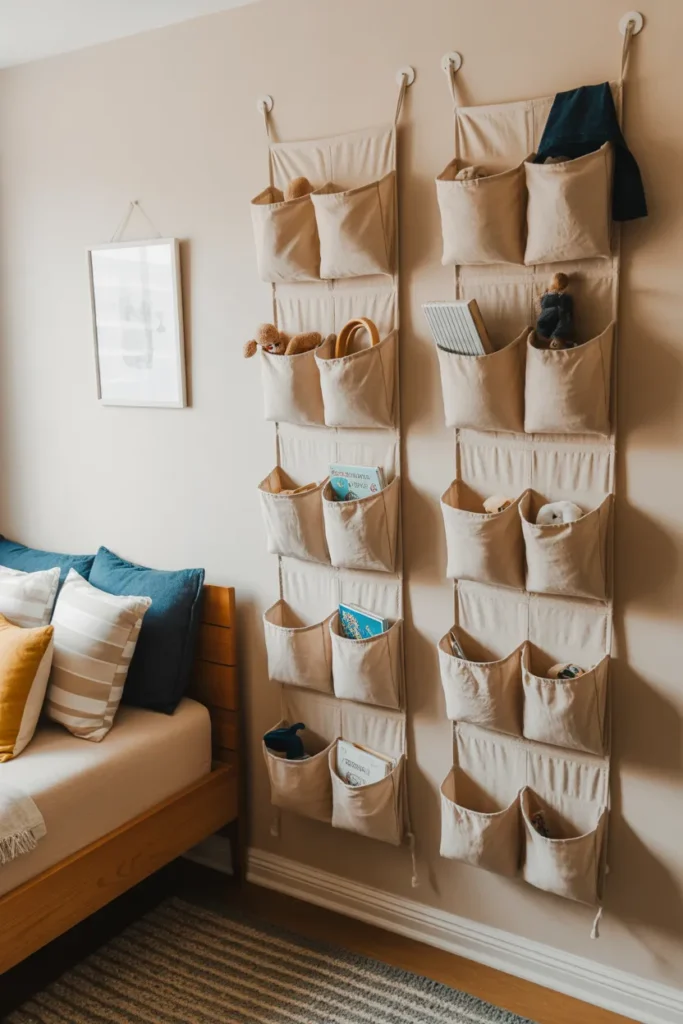
Hanging fabric organisers inside the wardrobe or on a hook hold the soft, light items that fill drawers fast: pyjamas, underwear, socks, and seasonal accessories. They hang in narrow gaps that fit nothing else, such as beside hanging clothes. For a small child room with a small wardrobe, they add a whole column of storage.
Assign each section clearly: One section per item type, at a height the child can reach for daily things. Higher sections hold spares. Fabric organisers sag when overloaded, so keep each section to a sensible amount and fold items rather than stuffing them in.
Use spare hanging space: Children clothes are short, so the space below hanging clothes often fits a short organiser or boxes. Measure the wardrobe before buying, as widths vary. An organiser that swings every time the door opens will annoy everyone, so hang it where it sits still.
- Choose a washable organiser, fabric pockets collect dust.
- Put daily pyjamas and socks at the child easy reach height.
- Review sizes every few months and move outgrown items out.
Shop This Look
21. Multi-Functional Storage Bench
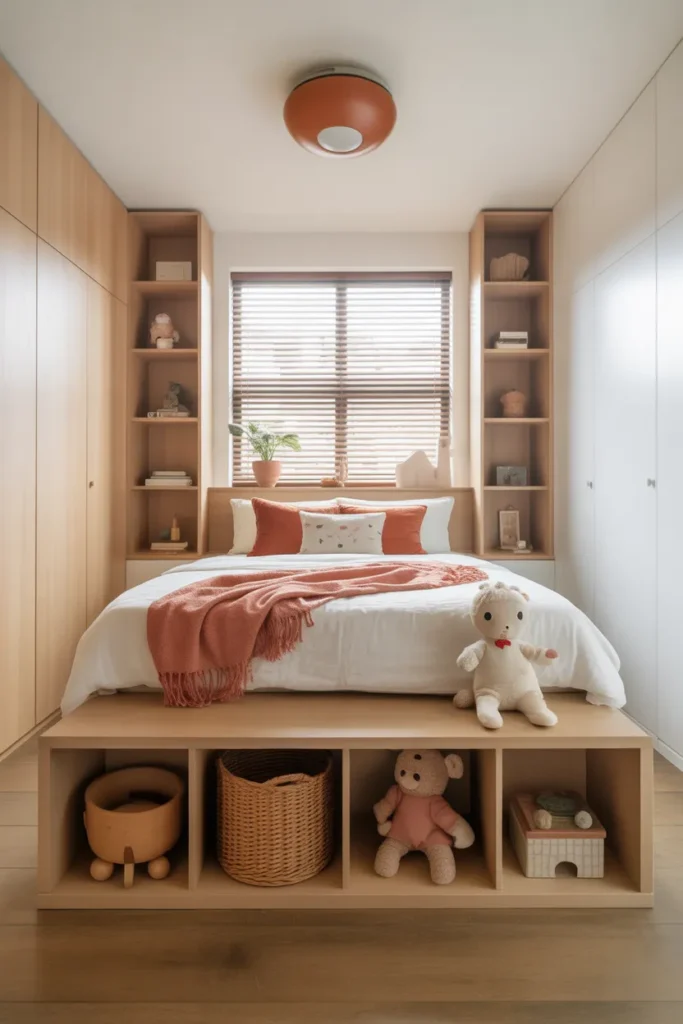
A storage bench gives a child a seat for dressing and reading, with toys, shoes, or books stored inside or below it. Placed under a window or at the foot of the bed, it uses spots that suit nothing taller. A bench with a cushion top also works as a reading seat that encourages the child to sit and look at books.
Store one thing well: A bench stuffed with mixed items becomes a toy pit. Give it one job: shoes by the door side, books by the bed, or dress-up clothes in the play corner. A single category keeps it quick to use and quick to tidy.
Check the lid safety: For younger children, choose a lid with a soft-close hinge or no lid at all, using open compartments or boxes instead. Fingers and heavy lids do not mix. The bench must be stable enough that a child can sit and wriggle without it tipping.
- Place the bench where the child dresses or reads most.
- Add a washable cushion for comfort.
- Keep the top clear of stored items so it stays a seat.
Shop This Look
22. Foldable Wall-Mounted Table
A second foldable wall-mounted table sounds like a repeat, but in practice many small rooms need the folding surface in a different spot and for a different job: one by the bed as a craft and drawing station, this one near the window or door as a flexible spot for games, puzzles, or a second child to work. Folding tables earn their place because they vanish, so two of them still take no floor space when the room is in play mode.
Give each table its own job: Two tables only work if each has a set use. One for art, one for homework or games, for example. Supplies for each job live in a labelled box nearby, not on the table. When jobs mix, both tables end up down all the time and the room is back to square one.
Stagger the folding routine: Fold the table in the play area first when floor space is needed, and keep the work table down during homework time. Building the fold-up step into the bedtime tidy makes it automatic. Check both tables locks and fixings every few months, as folding parts wear.
- Measure each wall spot separately, suitable walls differ.
- Keep chairs or stools that tuck away for both tables.
- If a table stays down for a week unused, its job needs rethinking.
Shop This Look
How to Start
Start with the bed, because it is the largest item and decides what floor is left. Once the bed position is set, mark out the play or study area on the floor and keep it clear while you add storage around the edges. Storage goes on walls, under the bed, and inside furniture, in that order.
Measure with the child in mind: Measure the under-bed gap, the wall space above the dresser, and the reach height of your child. Storage a child cannot reach does not get used for tidying, and storage a toddler can climb needs fixing to the wall. Both points decide what you buy.
Set up tidy systems the child can run: Give each type of toy one home the child can reach and carry: a bin, a cube, a low drawer. Label with pictures if the child is young. Test the system at tidy-up time. If putting things away takes an adult ten minutes of sorting, the system is too complicated.
- Measure under the bed and note your child comfortable reach height.
- Fix any tall storage unit to the wall before it is filled.
- Set up one toy category and test tidy-up before adding more.
Shop This Look
Common Mistakes
- Choosing a bed that fills the room and leaves no floor for play.
- Putting toy storage where the child cannot reach it without climbing.
- Skipping anti-tip fixings on tall shelves and cube units in a child room.
- Storing toys in one large box, so every play session empties the whole box.
- Fitting a desk that is too small for school work within a year or two.
- Hanging shelves or hooks above the bed where items can fall on a sleeping child.
- Buying themed furniture a child will outgrow before it wears out.
Frequently Asked Questions
What bed saves the most space in a small child bedroom?
For one child, a loft bed frees the most floor because the area underneath becomes play or study space. For two children, bunk beds with storage drawers give the most per square metre. For a single low bed, drawers or bins underneath still recover a large amount of storage.
How can a child keep a small room tidy?
Keep storage at their height, keep categories simple, and keep the total amount of toys in the room small enough to fit the storage. Rotate toys with a stored box every few weeks. If tidy-up needs an adult to sort and stack, the system, not the child, is the problem.
Is a loft bed safe for a young child?
Follow the maker age guidance, which is commonly around six years and up for a raised bed, and check guard rail height against the mattress you use. Younger children are safer in a low bed with under-bed storage. Whichever bed you choose, fix tall furniture to the wall and check frame bolts regularly.
Where should homework happen in a tiny bedroom?
A small fixed desk, a corner desk, or a foldable wall table all work if the surface fits books and a laptop or workbook at the same time. Good light matters as much as size. A desk that folds away suits younger children, while older children usually do better with a fixed study spot.
Where can I find more ideas for decorating a small child room?
Once the layout and storage are sorted, colour and bedding make the biggest visual difference for the least money. For more ways to pull a small bedroom together, see these bedroom decor inspirations and adapt the ideas to the storage setup you already have.
The Finishing Touch
A small child room works when the floor stays mostly clear and everything in it can be put away by the child who uses it. The bed does the heavy work, the walls hold the rest, and the toys in the room at any one time fit the storage that exists. That balance matters more than the size of the room.
If you want to see how other families arrange tight rooms, browse small bedroom ideas on Houzz and look at where the storage sits in the photos. In the rooms that work, it is under beds, up walls, and inside furniture, rarely in extra pieces standing on the floor.
Change one thing at a time and watch how your child uses the room for a week. Children show you quickly whether storage is in the right place. Move it to where they actually play and tidy, and the room will mostly look after itself.



One Comment