21 Stylish Sofa Ideas for Living Room Comfort
The sofa is the one piece of furniture that decides how your whole living room feels. You can change the curtains, swap the rug, and restyle the shelves, but if the sofa is wrong, the room never quite works. Too big and the space feels cramped. Too small and everything looks lost. The wrong fabric shows every spill, and the wrong color fights with the walls. This article walks through 21 stylish sofa ideas for living rooms of every size and budget, from plush velvet and classic chesterfields to sectionals, sleepers, and compact loveseats.
Each idea below covers a specific sofa style, who it suits best, and how to style it so it looks intentional instead of random. You will find notes on fabric choice, scale, color, and placement, plus practical tips for measuring, maintenance, and pairing each sofa with the rest of your decor. Whether you are furnishing your first apartment or refreshing a family room you have lived with for years, there is a look here that fits. The goal is simple: help you pick a sofa you will still love five years from now.
This guide is for anyone who wants a living room that feels pulled together without hiring a designer. Renters working with small footprints, families who need comfort that survives daily life, and style lovers chasing a specific aesthetic will all find something useful. Read straight through for the full tour, or jump to the numbers that match your space and budget. By the end you should know exactly which sofa style fits your room, which fabric makes sense for your household, and which small styling moves make the biggest difference.
This post contains affiliate links. If you buy through them, I may earn a small commission at no extra cost to you.
1. Plush Velvet Sofa with Neutral Accents

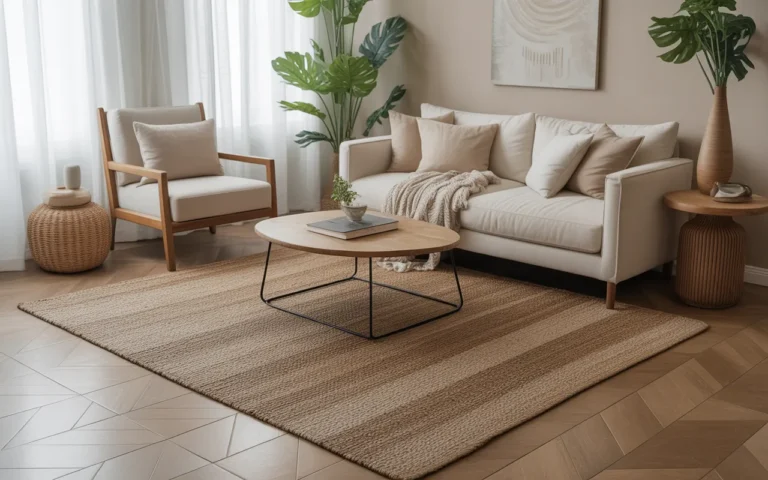
Velvet has a way of making a living room feel finished even when everything else is simple. A plush velvet sofa in a neutral shade, think warm beige, soft gray, or muted taupe, gives you the richness of the fabric without locking you into a color scheme you might regret later. The pile catches light differently through the day, so the sofa looks slightly different in the morning than it does in the evening, which keeps the room feeling alive. Neutral velvet also plays well with almost any accent color, so you can change throw pillows with the seasons and the sofa still works. If you worry velvet is too fancy for real life, modern performance velvets are far tougher than the delicate versions from decades past.
Pick the right neutral: Undertones matter more than the color name on the swatch. A beige with warm yellow undertones can look muddy next to cool gray walls, while a gray with blue undertones can feel cold in a north-facing room. Bring home large swatches and look at them in your actual light at different times of day before you commit. Warm neutrals like camel, oatmeal, and greige tend to flatter most living rooms because they bridge warm wood tones and cooler wall colors. If your room already has a lot of warm elements, lean slightly cool to balance it, and vice versa.
Keep velvet looking new: Velvet needs a little routine care, but nothing dramatic. Vacuum with an upholstery attachment every couple of weeks to keep dust out of the pile, and brush it lightly in one direction to keep the nap even. Blot spills immediately with a dry cloth instead of rubbing, which pushes liquid deeper. Most velvet sofas come with removable cushion covers or cleaning codes on the tag, so check before you buy anything for spot treatment. Rotate seat cushions every month so wear stays even, and your sofa will look good for years.
- Measure your doorway, hallway, and stairwell before ordering, since velvet sofas often come in one solid piece.
- Pair neutral velvet with textured pillows, like linen or knit, to avoid a flat, one-note look.
- Use a velvet-safe fabric protector spray on day one for easier cleanup later.
Shop This Look
2. Modern Sectional Sofa with Low Profile
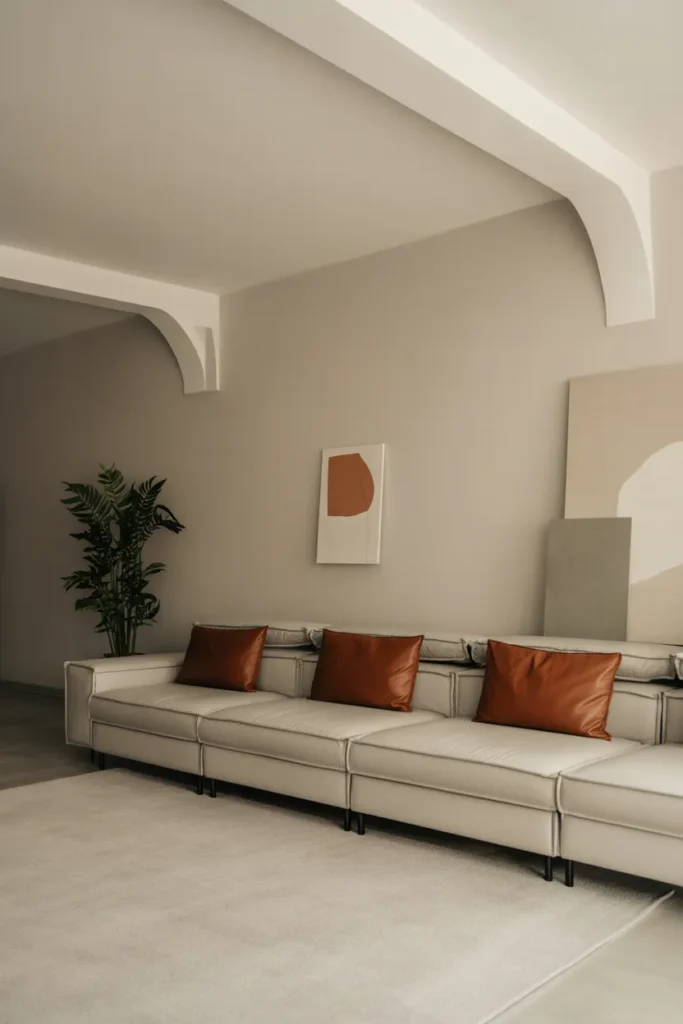
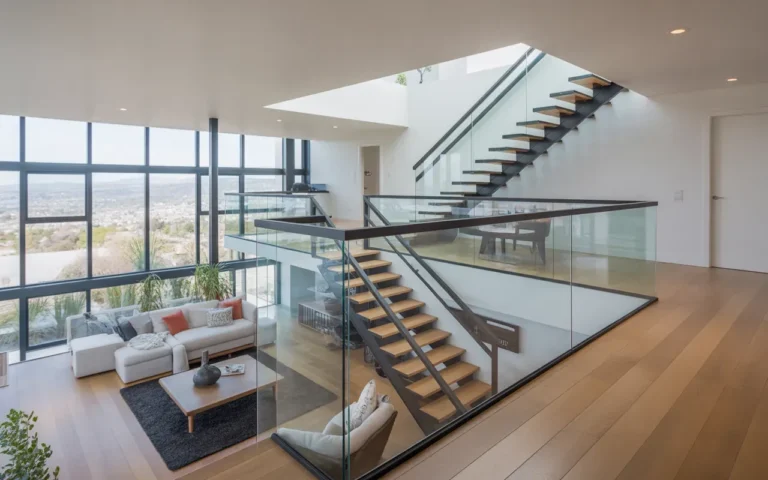
A low-profile sectional changes the whole feel of a living room. By sitting closer to the ground, it opens up sightlines across the room, which makes even a modest space feel larger and calmer. The clean horizontal lines suit modern and minimalist decor, and the generous seating means everyone actually has a comfortable spot when friends come over. Low sectionals work especially well in rooms with large windows or a nice view, because they do not block the light or the scenery. The trade-off is that getting up takes a bit more effort, so it is worth testing the seat height in person if anyone in the household has knee or back issues.
Get the configuration right: Sectionals come as left-facing, right-facing, or reversible, and picking the wrong orientation is one of the most common regrets. Stand in your room and picture the chaise or extended seat on each side before you order. Think about traffic flow: you want at least 30 inches of walkway around the sectional so people are not squeezing past. In open-plan spaces, the back of the sectional can act as a room divider between the living area and dining area, which is a neat trick. Tape the footprint on the floor with painter’s tape to confirm it fits.
Style it without clutter: Low sectionals look best with restraint. Two or three throw pillows in varied textures beat a mountain of cushions that just end up on the floor. A single lightweight throw draped over one corner adds softness without hiding the clean lines. Keep the coffee table proportional, roughly two-thirds the length of the sofa section it faces, and leave a few inches of breathing room between them. Because the profile is low, a tall floor lamp or large art piece above the sofa helps balance the vertical space.
- Check whether the chaise section is reversible so you can flip the layout if you move.
- Choose stain-resistant fabric if the sectional will see daily family use.
- Leave 18 inches between the sectional and coffee table for comfortable legroom.
Shop This Look
3. Chesterfield Sofa with Classic Elegance

Few sofas have the staying power of a chesterfield. The deep button tufting, rolled arms, and low back have been around for centuries, and they still look right in both traditional libraries and modern lofts. A chesterfield brings instant character to a room, which is useful if your space feels a bit plain or newly built. Leather is the classic choice and ages beautifully, developing a patina that makes the sofa look better over time. Fabric versions in velvet or linen soften the formality and work well in rooms where leather would feel too heavy. Either way, this is a statement piece, so let it be the star and keep everything else quieter.
Balance the formality: A chesterfield can feel stiff if everything around it is equally formal, so mix in some relaxed elements. A soft wool rug underfoot, a couple of casual linen pillows, and a simple wooden coffee table keep the look from turning into a museum. If the rolled arms make the sofa feel bulky in your space, choose a version with slightly slimmer arms, since proportions vary a lot between makers. The low back means the sofa sits nicely under windows, and it pairs well with taller bookcases or art behind it for contrast.
Care for the tufting: Button tufting collects dust in the crevices, so plan on vacuuming with a crevice tool or soft brush attachment every few weeks. For leather chesterfields, condition the leather twice a year to prevent cracking, especially in dry climates or rooms with strong sun. Keep the sofa out of direct sunlight when possible, since UV fades both leather and fabric unevenly. If a button ever loosens, most upholstery shops can reattach it cheaply, so do not panic, but do fix it promptly before the surrounding tufting pulls.
- Sit in a chesterfield before buying, the low back and firm seat are not for everyone.
- Choose nailhead trim in a finish that matches your other hardware for a cohesive look.
- In small rooms, a two-seat chesterfield gives the look without overwhelming the space.
Shop This Look
4. Contemporary Sofa with Minimalist Design
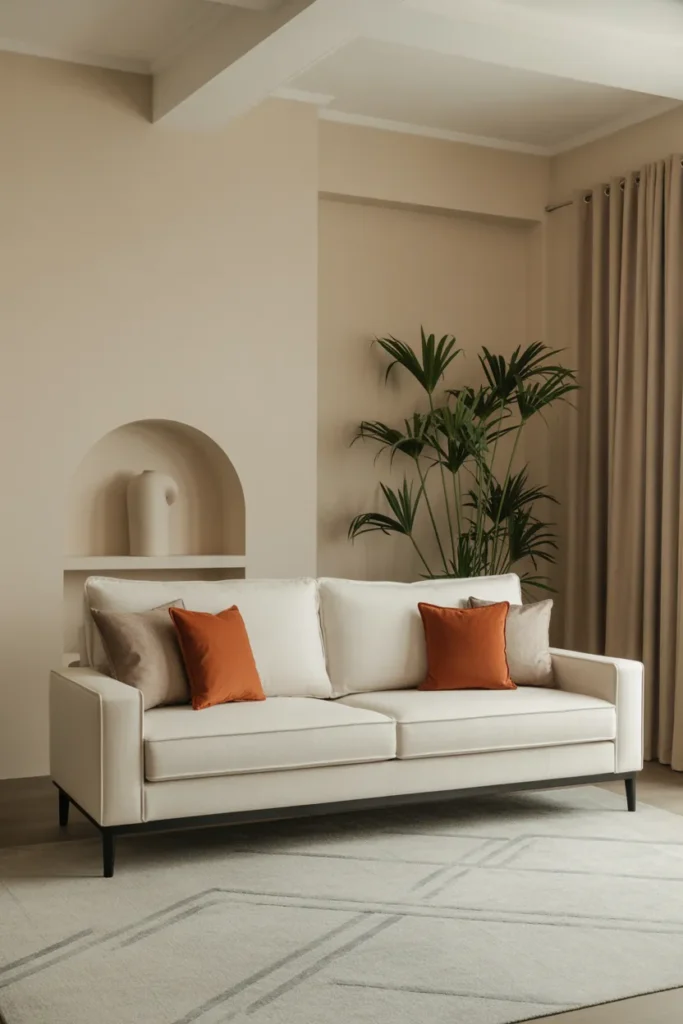
A contemporary minimalist sofa is the quiet backbone of a calm living room. Clean lines, simple silhouettes, and a lack of fussy details mean it never competes with your art, your view, or your rug. This style works best when the rest of the room follows the same philosophy: a few well-chosen pieces rather than a lot of decoration. Neutral colors like white, light gray, and warm beige are the usual picks, but a minimalist sofa in a deep, saturated color can also work if the shape stays simple. The real test of a minimalist sofa is comfort, since there is no ornament to hide behind, so the seat depth and cushion quality matter more than usual.
Nail the proportions: Minimalist rooms live or die on proportion. A sofa that is too large makes the room feel crowded no matter how simple the design, while one that is too small looks lost. Aim for the sofa to take up about two-thirds of the longest wall it sits against. Seat depth around 21 to 23 inches suits most people for everyday sitting; deeper seats are better for lounging but awkward for shorter legs. Keep arm height low or go armless if the room is small, since bulky arms eat visual space.
Add warmth without clutter: Minimalist does not have to mean cold. One textured throw, a single sculptural pillow, and a warm wood side table are enough to make the space feel human. Natural materials help a lot: wool, linen, and light oak soften the clean lines without adding visual noise. Lighting matters too, so use warm bulbs and a simple floor lamp rather than harsh overhead light. Resist the urge to fill every surface. Empty space is part of the design.
- Stick to a palette of two to three colors total to keep the minimalist feel.
- Choose cushions with removable, washable covers to keep light fabrics looking fresh.
- Float the sofa slightly off the wall if the room allows, it makes the space feel larger.
Shop This Look
5. L-Shaped Fabric Sofa with Cozy Seating
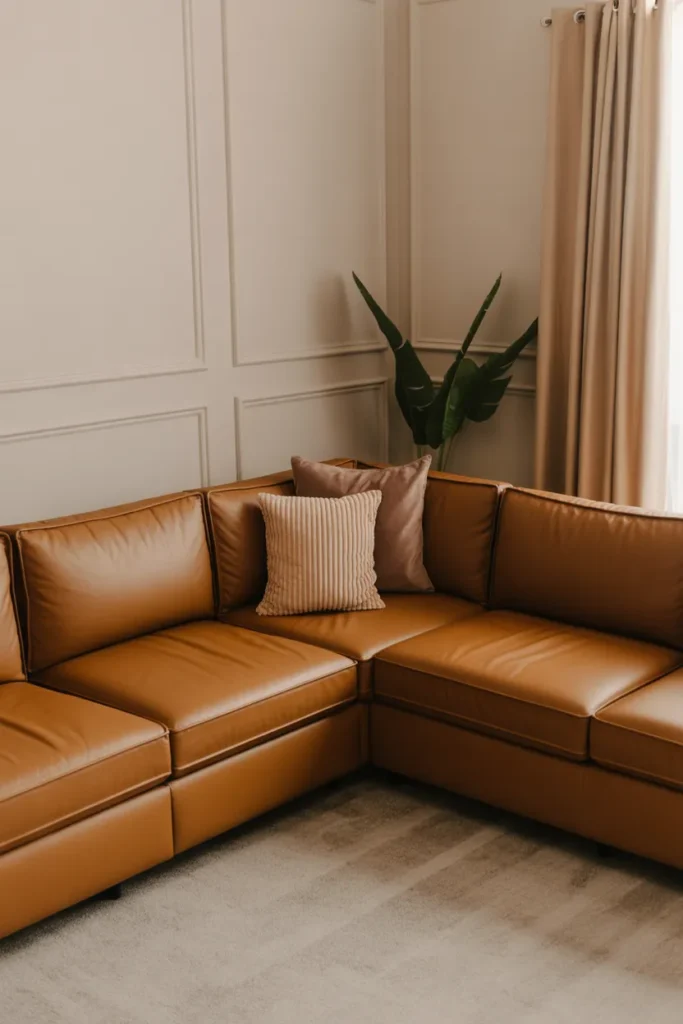
The L-shaped fabric sofa is the workhorse of comfortable living rooms. The corner section creates a natural lounging spot, and the wraparound shape pulls people together in a way that a straight sofa never quite manages. Fabric upholstery keeps the look soft and inviting, and it comes in far more textures and colors than leather, so you can match almost any decor. This shape is ideal for family movie nights, long conversations, and anyone who likes to stretch out with a book. Because it seats more people in the same footprint as a regular sofa plus a chair, it is also one of the most space-efficient choices you can make.
Choose fabric for your life: Not all fabrics survive the same way. If you have kids or pets, look for tightly woven fabrics with high rub counts, or performance fabrics designed to resist stains. Removable, machine-washable covers are worth their weight in gold in a busy household. Darker colors and subtle patterns hide wear better than light solids, but a light sofa with washable covers can still work. Order swatches and abuse them a little: spill coffee on one, scratch another, and wash a third before you decide.
Make the corner useful: The corner seat of an L-shape is often the least comfortable spot if the sofa is poorly designed, since it can feel like sitting in a pit. Look for models with a well-supported corner and firm back cushions there. Style-wise, the corner is a great place for your softest throw and your favorite pillow, which signals that it is the prime seat. A floor lamp arched over the corner turns it into a reading nook, and a small side table within reach makes it practical too.
- Confirm the L orientation (left or right) matches your room layout before ordering.
- Vacuum fabric upholstery weekly to prevent dust settling into the weave.
- Add a slim console table behind the sofa if it floats in an open-plan room.
Shop This Look
6. Modular Sofa with Customizable Layout
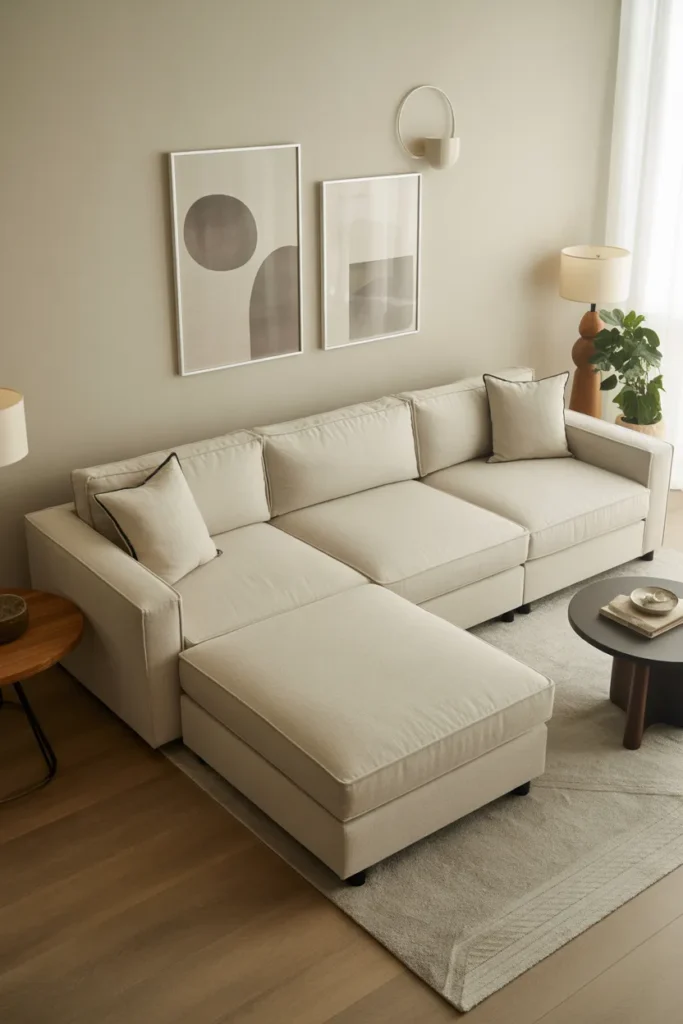
A modular sofa is made of individual sections that you can rearrange, which makes it one of the most practical choices for real life. Hosting a party? Push the pieces into a big conversation pit. Need a guest bed? Line them up into a flat sleeping surface. Moving to a new place? The modules fit through tight doors and adapt to a totally different floor plan. This flexibility is the whole point, so look for solid connectors that keep the pieces from drifting apart during everyday use. Good modulars also let you buy extra sections later, which means the sofa can grow with your household instead of being replaced.
Plan for how you actually live: It is tempting to buy the biggest configuration, but start with the layout you will use daily. An ottoman module that doubles as a coffee table or extra seat earns its place fast. Corner modules are great for lounging but limit rearrangement options, so think about whether you rearrange often. Measure each module, not just the total footprint, so you know every piece fits through your doorways. If you have kids, rounded or armless modules are safer and easier to climb on.
Keep it looking intentional: The risk with modular sofas is that they can look like a pile of blocks if you are not careful. Unify the pieces with a consistent throw draped across the seam between two modules, and choose pillows that repeat one or two colors across the whole arrangement. When you rearrange for an event, take five minutes afterward to put it back into its daily layout so the room does not stay in party mode. Store any unused modules against a wall as a daybed-style bench rather than stacking them in a corner.
- Test the connectors in the store, they should lock firmly without tools.
- Buy one spare module cover if available, so a stained section can be swapped out.
- Choose a timeless fabric, since a modular sofa is built to last many years.
Shop This Look
7. Tufted Linen Sofa with Elegant Charm

Linen and tufting together hit a sweet spot between casual and refined. The tufting adds tailored detail that elevates the sofa, while linen keeps it relaxed and breathable, never stuffy. This combination suits French-inspired, coastal, and transitional rooms especially well. Linen wrinkles, and that is part of its charm, but if you want a crisper look, choose a linen blend with a bit of synthetic fiber for wrinkle resistance. Light colors like ivory, oatmeal, and pale gray show off the tufting shadows best, though deeper tones can look dramatic in the right room.
Live happily with linen: Pure linen softens with every wash and gets better with age, but it does need realistic expectations. The fabric will develop a lived-in texture, which looks intentional in a relaxed room and messy in a formal one. Removable covers are a huge plus, since you can wash them and the wrinkles actually look right. For everyday durability, a linen-polyester blend resists abrasion better than 100 percent linen while keeping the natural look. Keep a fabric shaver handy for the occasional pilling.
Style around the texture: Tufted linen has enough texture on its own, so pair it with smooth, simple companions. A sleek metal or glass coffee table contrasts nicely with the soft upholstery, and solid-color pillows in complementary tones let the tufting be the pattern. Avoid pairing it with heavily patterned rugs, since two strong textures compete. A single piece of large-scale art above the sofa gives the eye somewhere to rest and keeps the arrangement feeling calm.
- Choose a linen blend over pure linen if the sofa gets heavy daily use.
- Fluff and rotate tufted back cushions regularly to keep the shape even.
- Keep linen sofas away from strong direct sun to prevent uneven fading.
Shop This Look
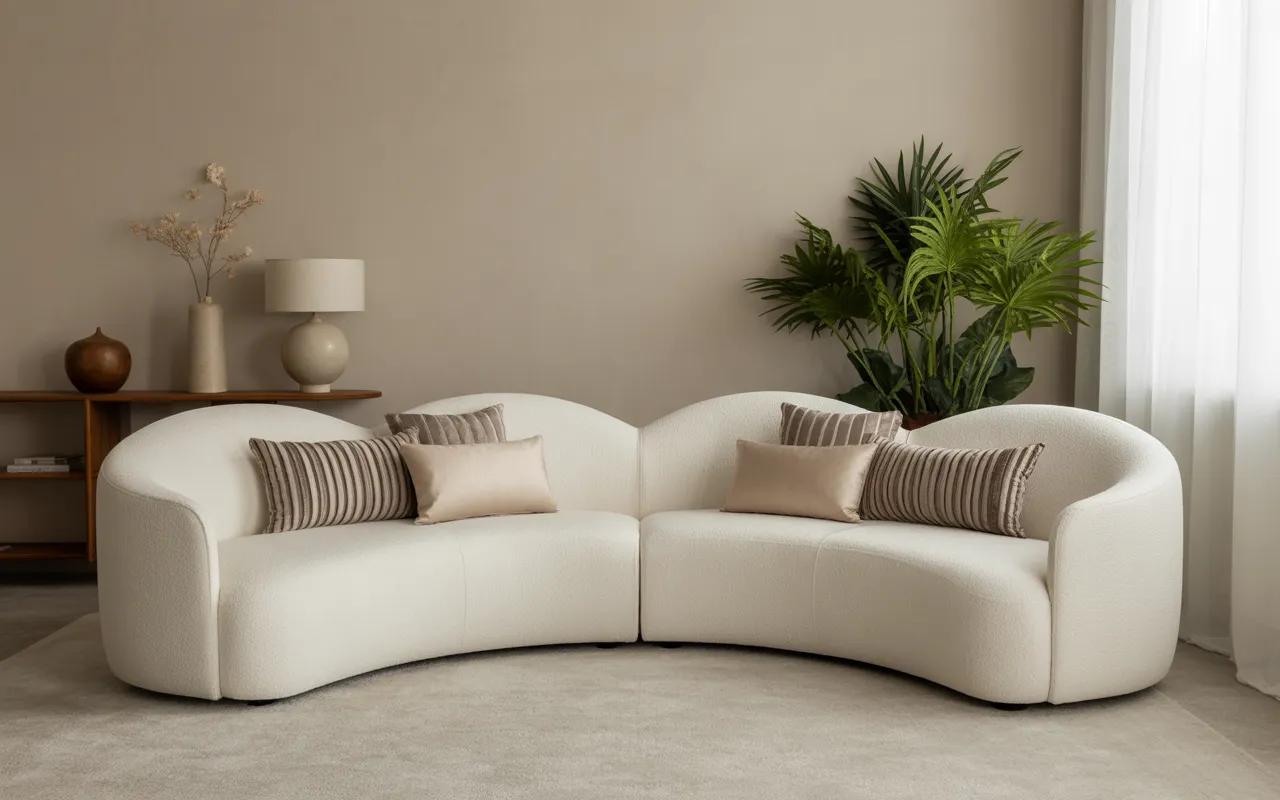
8. Curved Sofa for Intimate Living Spaces
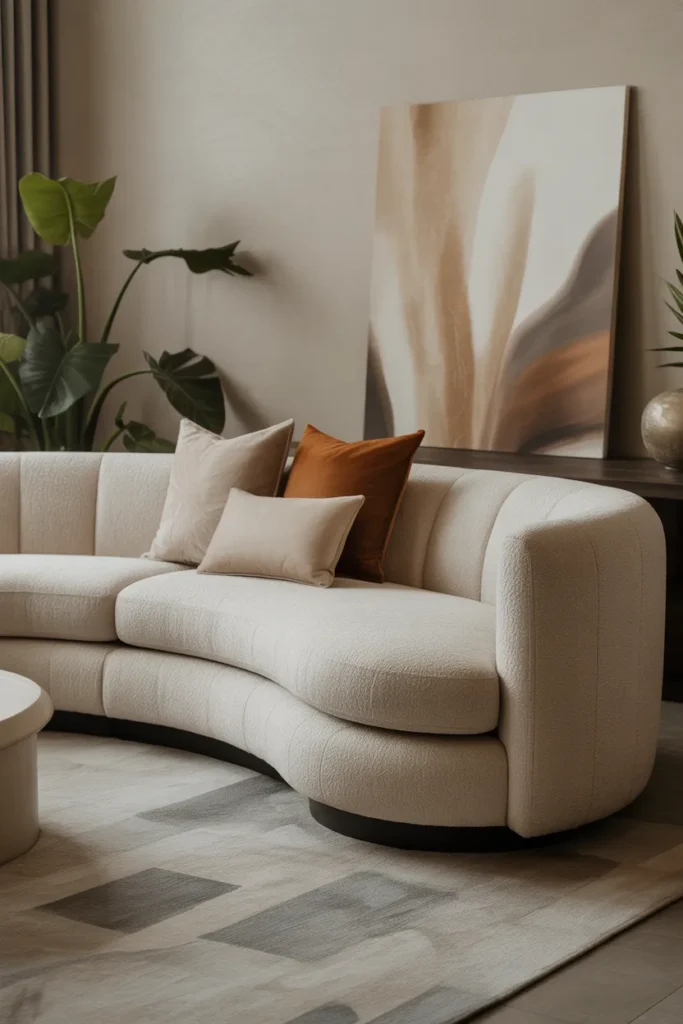
A curved sofa breaks up the boxiness of a typical living room in the best way. The gentle arc softens all the straight lines around it, from the walls to the coffee table to the rug, and it naturally draws people into conversation. Curved sofas photograph beautifully and give a room a designer feel with very little effort. They work well in both small and large spaces: in a small room, the curve tucks neatly into a corner or bay window, while in a large room it can anchor a distinct seating zone. The shape does make placement trickier, so measure carefully and think about what sits in front of it.
Place it with purpose: A curved sofa needs a round or oval coffee table in front of it, since a rectangular table fights the geometry and leaves awkward gaps. Leave enough room behind the curve for the shape to read, pushing it flat against a wall wastes its best feature. In an open-plan space, use the curve to define the living zone, with the convex back facing the dining or kitchen area. If the sofa is compact, a pair of small round side tables at the ends completes the arrangement without crowding it.
Choose fabric and color boldly: The sculptural shape of a curved sofa rewards confident fabric choices. A rich bouclé, a deep jewel tone, or even a subtle pattern looks intentional on a curve, while a plain beige can make the shape disappear. That said, if the rest of your room is already busy, a solid neutral lets the silhouette do the talking. Because curved sofas are harder to find secondhand in the right size, treat this as a longer-term piece and pick something you will love for a while.
- Pair curved sofas with round coffee tables and round rugs to echo the shape.
- Check the full width at the widest point of the curve when measuring doorways.
- A curved sofa facing the fireplace creates a naturally cozy conversation spot.
Shop This Look
9. Sleeper Sofa for Function and Comfort
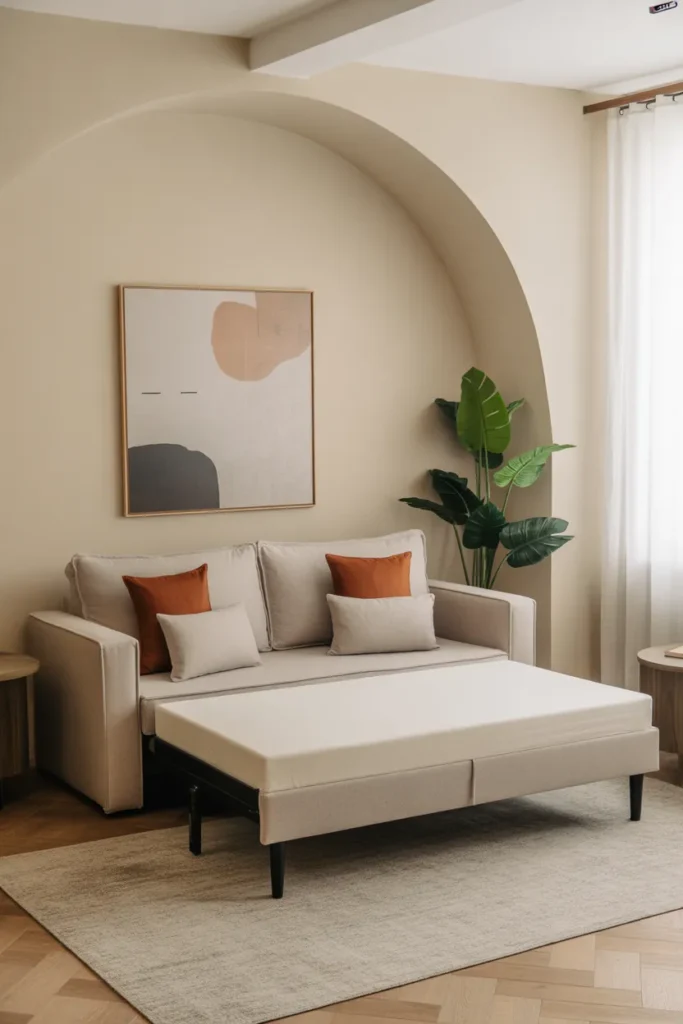
A good sleeper sofa solves the guest problem without dedicating a whole room to visitors. The best modern sleepers look exactly like regular sofas, with no telltale bulk or awkward proportions, and the mattress quality has improved enormously in recent years. Memory foam and hybrid mattresses now come standard on better models, which means your guests actually sleep well instead of politely suffering. For apartments and small homes, a sleeper in the living room is often the difference between hosting comfortably and not hosting at all. Use it daily as your main sofa and it earns its keep twice over.
Test the bed, not just the sofa: Most people sit on a sleeper in the store and never unfold it, which is a mistake. Open the mechanism fully and lie on the mattress for a few minutes. Check for the dreaded support bar pressing through, and look at how flat the sleeping surface really is. Mechanisms vary: pull-out designs offer full mattresses but add weight, while click-clack and futon styles are lighter but usually less comfortable for nightly use. If guests stay often, prioritize the mattress over the sofa aesthetics.
Keep bedding close at hand: A sleeper sofa is only convenient if the bedding is too. Store sheets, a blanket, and pillows in an ottoman or a lidded basket right next to the sofa so setup takes two minutes. A mattress topper rolled up nearby can rescue a thinner mattress for picky sleepers. When the bed is folded away, dress the sofa like any other, with pillows and a throw, so the room never feels like a makeshift bedroom. Vacuum the mechanism area occasionally, since dust collects in the folds.
- Measure the fully opened bed footprint to make sure your room can handle it.
- Choose a model with a lockable mechanism so it cannot fold unexpectedly.
- Add a mattress protector to guard against spills and extend mattress life.
Shop This Look
10. Leather Sofa with Modern Farmhouse Appeal

Leather and modern farmhouse are a natural pair. The leather brings warmth and patina, while the farmhouse style keeps everything relaxed and unpretentious. A cognac or caramel leather sofa against white shiplap or soft gray walls is the classic version of this look, and it works because the contrast is strong but not loud. Leather is also one of the most practical upholstery choices for a busy household: it wipes clean, resists odors, and actually improves with age as it develops character. For the modern farmhouse feel, choose simple, clean-lined leather pieces rather than ornate traditional ones.
Get the leather right: Not all leather is equal, and the label matters. Full-grain and top-grain leather are the durable, long-lasting options that develop a beautiful patina. Bonded leather and faux leather cost less upfront but peel and crack within a few years, which makes them a poor value. If the budget is tight, a good faux leather can still work for a guest room or lightly used space, but for the main family sofa, real top-grain leather pays off. Feel the leather in person when you can: it should feel supple, not plasticky.
Style the farmhouse mix: The trick to modern farmhouse is balance. Pair the leather sofa with rustic wood, like a reclaimed coffee table or exposed beams, plus soft textiles to keep it cozy: a chunky knit throw, linen pillows, a jute rug. Black metal accents in lighting or shelving add the modern edge. Keep the palette warm and neutral, with the leather as the richest tone in the room. A little greenery, real or faux, finishes the look without trying too hard.
- Condition real leather every 6 to 12 months to prevent drying and cracking.
- Keep leather sofas at least two feet from radiators and heating vents.
- Blot leather spills immediately, most wipe up cleanly if caught fast.
Shop This Look
11. Compact Two-Seater Sofa for Small Spaces
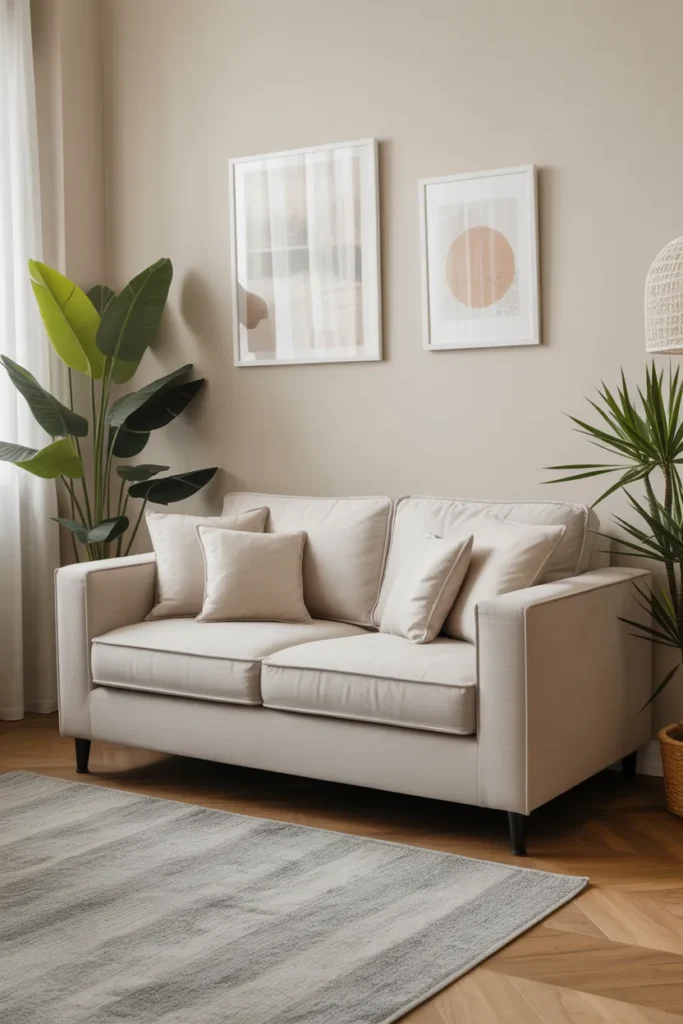
A compact two-seater, often called a loveseat, is the smart answer to a small living room. It gives you real sofa comfort without swallowing the floor plan, and it leaves room for the other pieces that make a space livable. The key is choosing one with good proportions: look for slim arms, a raised leg base that shows floor underneath, and a back height that does not dominate the wall. These visual tricks make even a small sofa feel airy. A two-seater also works beautifully as a secondary piece in a larger room, paired with a full sofa or facing a pair of chairs.
Maximize a small footprint: In a tight room, every inch matters, so measure twice and use painter’s tape to mark the sofa footprint on the floor. Leave at least 30 inches for main walkways, and make sure doors and drawers near the sofa can still open. A loveseat with a chaise extension on one side can add lounging space without much extra width. Wall-mounted shelves instead of a bulky bookcase, and a round coffee table instead of a rectangular one, free up visual and physical space around the sofa.
Make it feel generous: Small sofas can still feel luxurious with the right styling. Deep seat cushions in a soft fabric invite sinking in, and two good-quality throw pillows beat four flat ones. A well-sized rug, large enough that the front legs of the sofa sit on it, grounds the arrangement and makes the room feel bigger, not smaller. Good lighting helps too: a floor lamp beside the loveseat creates a cozy reading corner that feels intentional rather than cramped.
- Choose raised legs over a skirted base to show more floor and add airiness.
- A loveseat around 48 to 60 inches wide suits most small living rooms.
- Use the wall above for art or shelves to draw the eye up.
Shop This Look
12. Chaise Sofa for Ultimate Relaxation
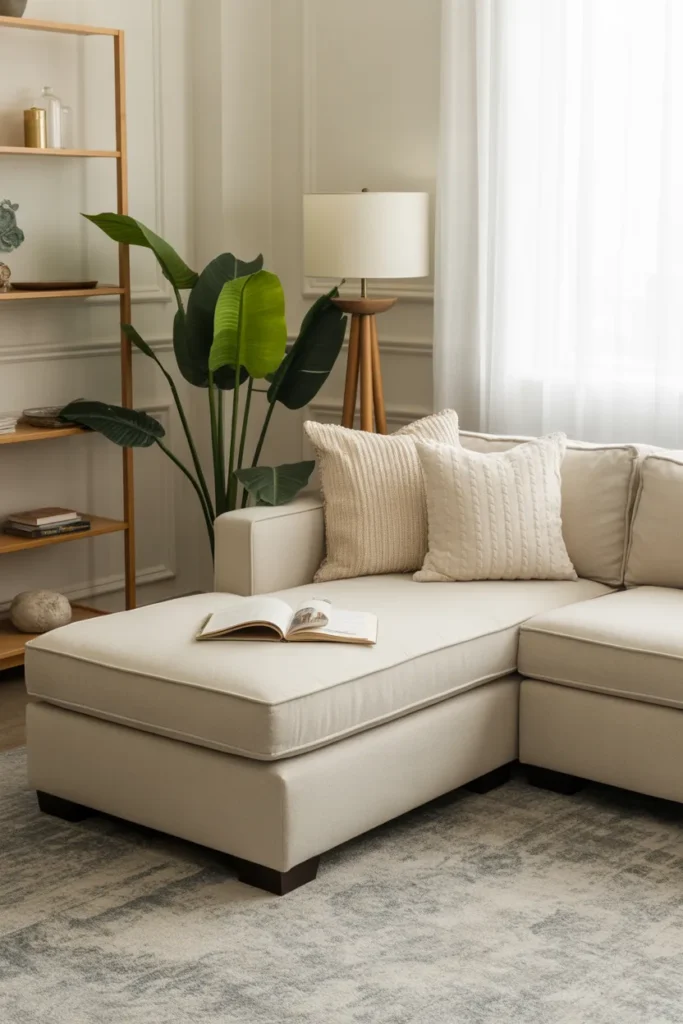
Some sofas are for sitting, and some are for truly unwinding. A chaise sofa, with its extended seat for stretching out your legs, belongs firmly in the second category. It is the piece you gravitate toward with a book, a blanket, and no plans to move for an hour. The extended section works like a built-in ottoman, which means you get full lounge comfort without a separate footstool cluttering the room. Chaise sofas come in every style from sleek modern to plush traditional, so you are choosing a feature, not a whole aesthetic.
Left or right, decide once: Chaise sofas are directional, and this is the detail to get right before you buy. Sit in your room and imagine the flow: the chaise should extend into open space, not block a doorway or walkway. Some models offer a reversible chaise that can switch sides, which is worth the small premium if you move often or like to rearrange. Also check the chaise length against your height. If you are tall, look for an extended chaise around 60 inches or more so your legs are actually supported.
Style the long line: The extended seat gives you a wonderful canvas for layering. Drape a throw along the chaise section and anchor it with one lumbar pillow, which looks inviting and keeps the throw in place. Because the chaise draws the eye along its length, keep the coffee table parallel and proportional, not too short. A floor lamp positioned over the chaise end creates the perfect reading spot. Resist overloading the chaise with pillows, since its whole point is open lounging space.
- Test the chaise length in person if possible, comfort depends on your height.
- Place the chaise away from high-traffic paths so it stays a calm zone.
- A washable throw on the chaise section protects the most-used spot.
Shop This Look
13. Mid-Century Modern Sofa with Wooden Legs
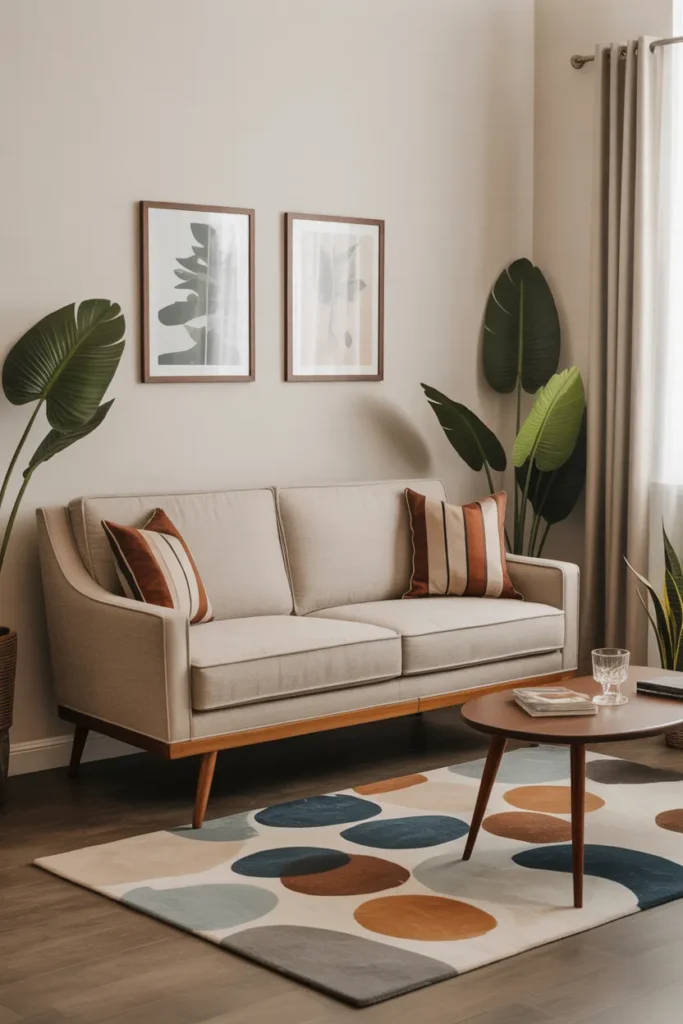
Mid-century modern sofas have that rare quality of looking current in almost any decade. The tapered wooden legs, clean lines, and compact proportions were designed for post-war apartments, which is exactly why they suit today’s smaller living spaces so well. The raised base shows floor underneath, making the room feel larger, and the wood legs add warmth that keeps the minimal shape from feeling cold. Walnut-toned legs are the classic choice, but lighter oak works beautifully in Scandinavian-leaning rooms. This style pairs with almost everything, from vintage finds to brand-new minimalism.
Spot quality construction: The mid-century look is widely copied, and quality varies enormously. Check that the wooden legs are solid wood, not plastic made to look like wood, and that they attach with sturdy hardware rather than just screws into particle board. A kiln-dried hardwood frame lasts decades, while a softwood or engineered frame may wobble within a few years. Seat cushions should be high-density foam wrapped in down or fiber for comfort that holds its shape. If the price seems too good to be true, the frame is usually where corners were cut.
Mix eras with confidence: A mid-century sofa does not require a mid-century room. It looks great alongside contemporary art, a traditional rug, or industrial lighting, because its simple geometry plays well with others. The wooden legs give you a natural bridge to other wood tones in the room, so echo them in a side table or picture frames. Keep the palette grounded with one or two accent colors drawn from your rug or art. A common mistake is going overboard with the retro theme, so let the sofa be the nod to the era and keep everything else current.
- Match leg wood tone loosely to other wood in the room, exact matching is unnecessary.
- Look for removable legs to make moving and delivery much easier.
- Add felt pads to wooden legs to protect hard floors from scratches.
Shop This Look
14. Reclining Sofa for Family Comfort
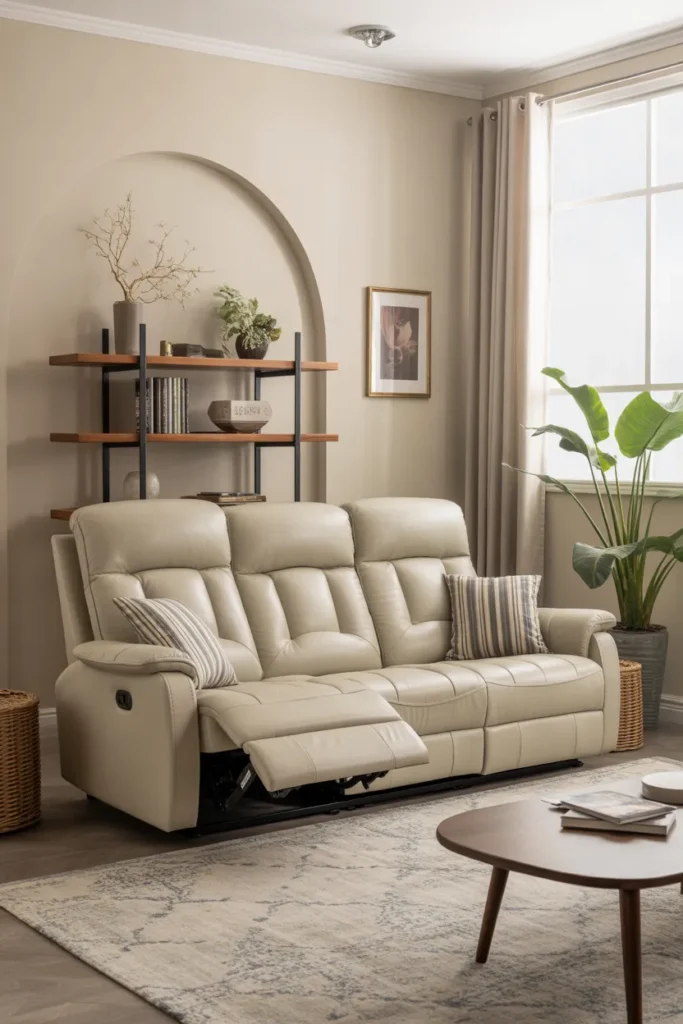
A reclining sofa is unapologetically about comfort, and there is nothing wrong with that. After a long day, being able to kick back with your feet up and the back tilted is one of life’s simple pleasures. Modern reclining sofas have come a long way from the bulky versions of the past: many now have sleek profiles where the reclining mechanism is nearly invisible when closed. Power recline with USB ports is a popular upgrade that families genuinely use. If your living room is where everyone actually lives, prioritizing comfort over formality is simply the honest choice.
Plan the space it needs: Reclining sofas need clearance behind them to tilt back, usually 4 to 8 inches for wall-hugger models and up to 2 feet for standard ones. Measure this before you buy, since a sofa that cannot fully recline is just a heavy regular sofa. Wall-hugger or zero-wall designs are worth seeking out for smaller rooms because they slide forward as they recline instead of tipping back. Also think about power: if you choose power recline, you need an outlet nearby, and a cord cover keeps things tidy.
Keep it looking sharp: Reclining sofas can look bulky, so choose performance fabrics or leather in solid, mid-tone colors that hide wear. Avoid busy patterns, which emphasize the segmented look of the reclining sections. A large rug underneath grounds the visual weight, and keeping the area around it uncluttered prevents the room from feeling crowded. Wipe down the mechanism area and vacuum under the seats regularly, since crumbs and dust collect in the moving parts.
- Choose wall-hugger recliners if the sofa must sit close to the wall.
- Test the recline motion in store, it should move smoothly without sticking.
- Keep kids’ fingers clear of the mechanism when opening and closing.
Shop This Look
15. Bold-Colored Sofa for a Statement Look
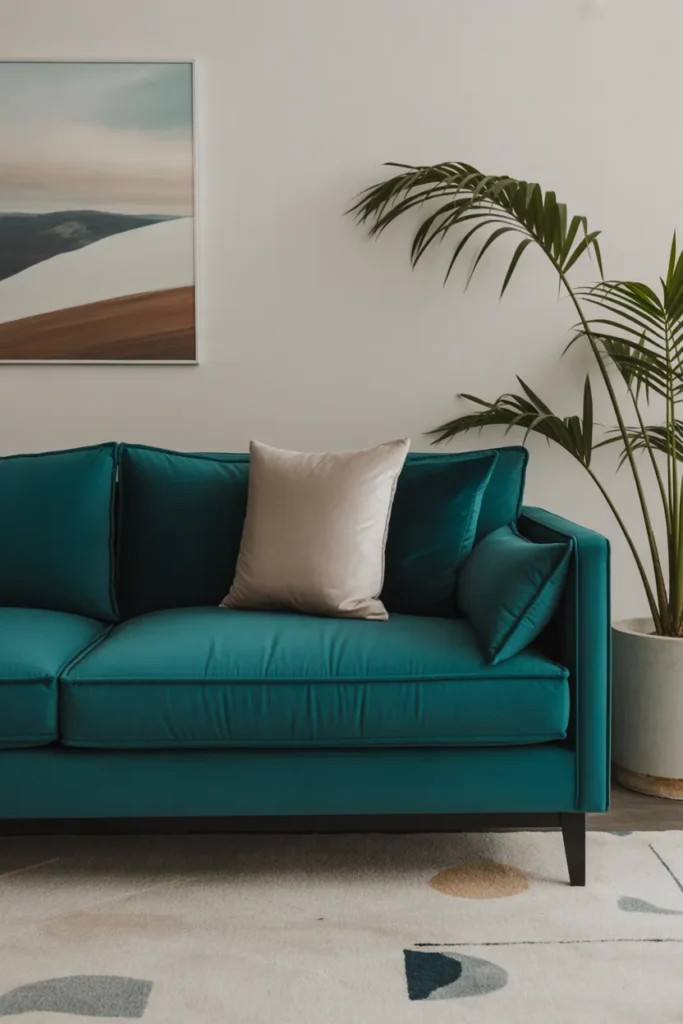
A bold-colored sofa is the fastest way to give a living room personality. Emerald green, deep navy, burnt orange, or rich mustard can turn an ordinary room into one people remember. The key to pulling it off is commitment: a bold sofa works when the rest of the room supports it rather than competing with it. That means calmer walls, a rug that picks up the sofa color in small doses, and accessories in complementary neutrals. If you love color but fear regret, remember that a sofa is reupholsterable and slipcoverable, so the decision is not as permanent as it feels.
Build the room around it: Start with the sofa color and pull two or three supporting tones from it for the rest of the room. A color wheel helps: complementary colors (opposite on the wheel) create energy, while analogous colors (neighbors on the wheel) feel calmer. White or light gray walls give a bold sofa room to breathe, and natural textures like wood, jute, and linen keep the look grounded. Repeat the sofa color in small touches, a vase, a book spine, one pillow, so it feels woven through the room instead of isolated.
Choose a shade you can live with: Bold does not have to mean bright. Deep, saturated colors like forest green, ink navy, and oxblood red feel bold but are surprisingly easy to live with because they read almost as neutrals. Test large swatches in your light over several days, since strong colors shift dramatically between morning and evening. Consider your existing art and rug: if they already contain strong colors, make sure the sofa does not clash. When in doubt, pick the slightly muted version of the color you love.
- Order the largest swatch available and live with it for a week before ordering.
- Keep walls neutral so the bold sofa remains the clear focal point.
- A slipcover in a neutral tone gives you an exit strategy for color fatigue.
Shop This Look
16. Sectional Sofa with Storage and Hidden Compartments
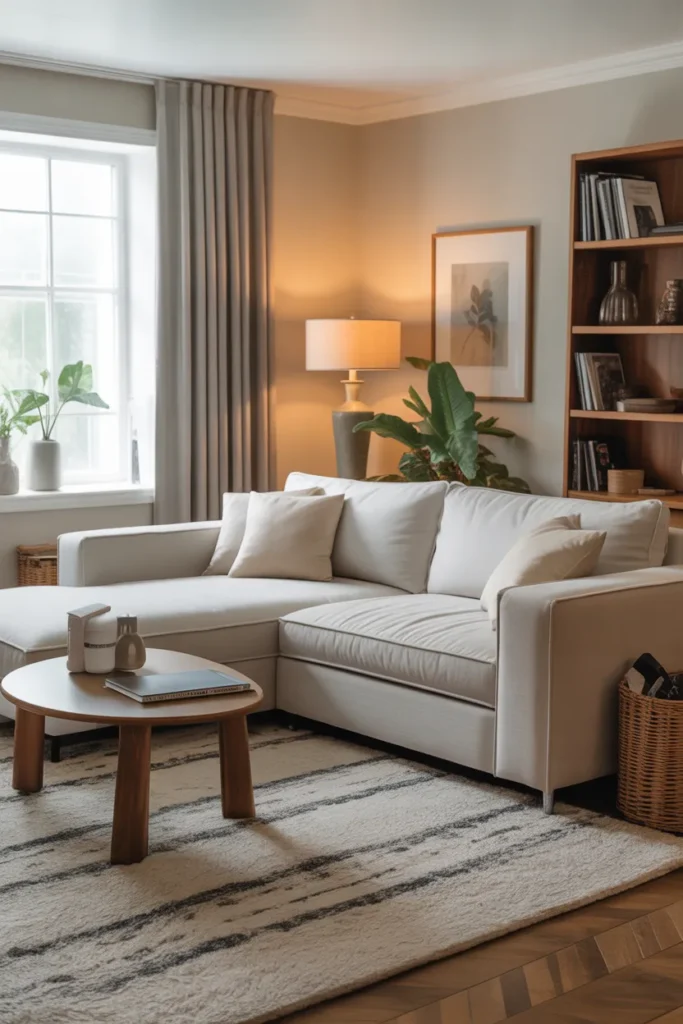
Storage sectionals are the secret weapon of tidy living rooms. The chaise lifts to reveal space for blankets, the ottoman hides the board games, and armrest compartments swallow remotes and chargers. In homes without much closet space, this hidden storage genuinely changes how the room functions, because everything has a place to disappear to. The best designs hide the storage so well that guests never guess it is there, with smooth-opening lids and hinges that do not slam. You get all the seating of a full sectional plus the equivalent of a small closet, with zero extra footprint.
Check the storage mechanics: Not all storage sectionals are built equally. Lift the lids and test the hinges in person if you can: they should open smoothly, stay open on their own, and close softly. Check the interior depth, since some compartments are frustratingly shallow. Look at how the storage affects comfort, because in cheaper models the seat above a storage bin can feel hard or uneven. Ventilation matters for storing blankets and pillows, so a small gap or breathable lining prevents mustiness.
Organize what goes inside: Hidden storage only helps if you use it well. Assign each compartment a job: one for throws and blankets, one for games and media accessories, one for the things that usually clutter the coffee table. Use small bins or fabric boxes inside large compartments so items do not become a jumbled pile. Do a quick reset every few weeks, since hidden storage has a way of quietly filling with things you forgot about. Keep the heaviest items in the lowest compartments for easier lifting.
- Test every lid and hinge before buying, smooth operation matters daily.
- Store remotes and chargers in the armrest compartment to clear the coffee table.
- Avoid overloading lids, which strains hinges over time.
Shop This Look
17. Curved Sectional Sofa for Spacious Rooms
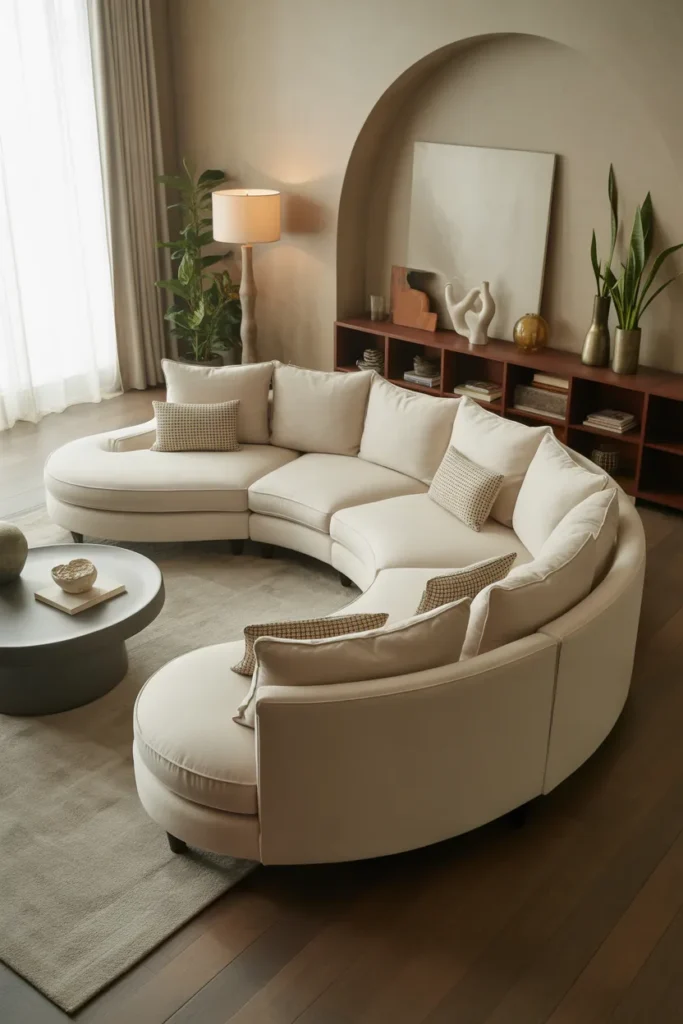
In a large living room, a curved sectional does something a straight one cannot: it creates intimacy at scale. The arc pulls seating into a conversational embrace, so a big room feels welcoming instead of echoey. This is the piece for great rooms, open-plan spaces, and anyone who hosts often. The curve also softens the architecture, which is especially welcome in rooms with lots of hard angles, high ceilings, or floor-to-ceiling windows. Because it is a substantial piece, a curved sectional anchors the room the way a rug or fireplace does, giving everything else a center to orbit around.
Zone a large space: Big rooms need defined zones or they feel cavernous. Place the curved sectional to carve out the living zone, with its back marking the boundary to the dining or play area. A large round rug under the front half of the sectional reinforces the zone and softens the acoustics. Float a console table behind the curve with lamps and decor to finish the back view, since in open rooms the back of the sofa is fully visible. Leave generous walkways around the outside of the curve, at least 36 inches, so traffic flows easily.
Scale everything else up: A curved sectional can make standard-size companions look dinky, so scale up accordingly. Choose an oversized round coffee table or a pair of large ottomans for the center, substantial floor lamps, and big art on the walls. Pillows can be larger than usual, and you will need more of them to fill the long curve without looking sparse. One dramatic element, like a sculptural pendant light above the coffee table, gives the seating area a focal point worthy of its size.
- Use a round rug at least 9 feet across to ground a large curved sectional.
- Style the back of the sofa since it will be visible in open-plan rooms.
- Confirm delivery access, curved pieces are harder to maneuver than straight ones.
Shop This Look
18. Compact Loveseat for Cozy Corners
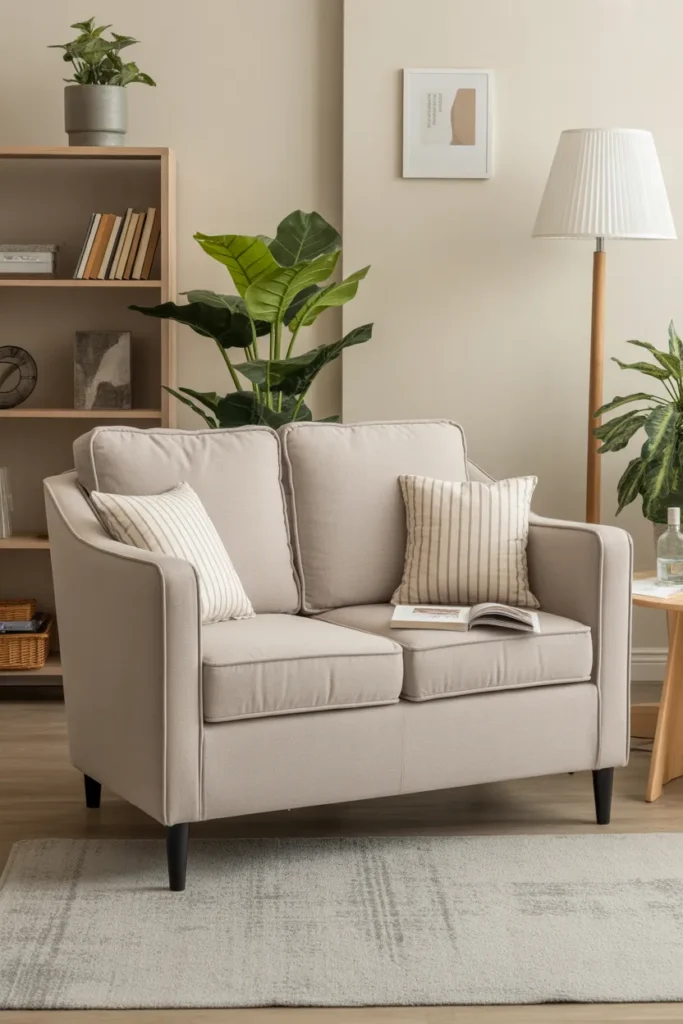
Every home has that awkward corner that is too small for a full sofa but too big to leave empty. A compact loveseat turns it into the coziest spot in the house. Tucked into a corner with a floor lamp and a small side table, it becomes a reading nook, a morning coffee spot, or a quiet retreat from the main living area. The compact size is the whole advantage: it fits where nothing else will, from bay windows to bedroom corners to home office alcoves. Choose one with real comfort, not just good looks, since this will become somebody’s favorite seat.
Build the nook around it: A loveseat in a corner needs a few companions to feel like a destination. A small round side table within arm’s reach holds coffee and books, and a floor lamp with warm light makes it inviting after dark. A soft throw and one or two pillows in colors that tie to the rest of the room keep it coordinated. If the corner is near a window, sheer curtains soften the light and add privacy. A small rug under the front legs defines the nook as its own little zone.
Pick comfort-first details: Because a corner loveseat invites curling up, prioritize softness: plush cushions, a forgiving back angle, and arms at a good height for leaning. Performance fabric or a washable cover makes sense since this seat will get daily use. If the nook doubles as a guest spot, a loveseat with a slightly deeper seat works better for sitting upright in conversation. Keep the scale modest, since an oversized loveseat defeats the purpose of fitting into a cozy corner.
- Angle the loveseat slightly rather than pushing it flat into the corner.
- A 24-inch round side table is the perfect companion size.
- Layer a soft throw for instant coziness that also protects the fabric.
Shop This Look
19. Reclining Sectional with Modern Design
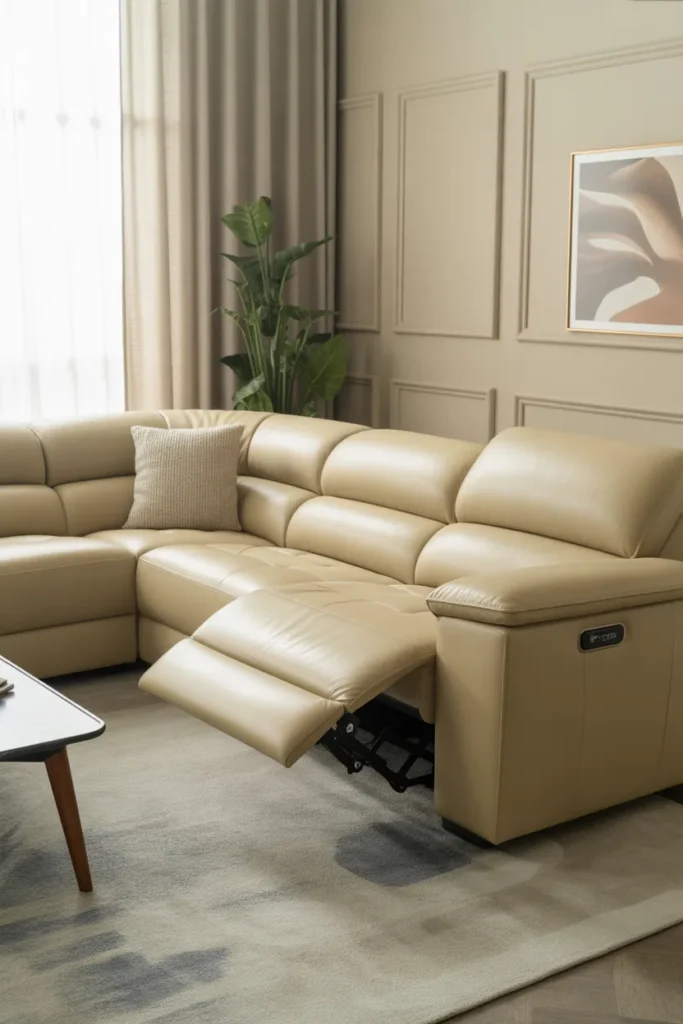
A reclining sectional with modern design gives you the best of both worlds: sprawling family seating and genuine lounge-everywhere comfort, without the bulky look of old-school recliners. The clean lines and tailored upholstery keep it looking current, while hidden reclining seats let everyone find their perfect angle. This is the ultimate movie-night piece, with room for the whole household to stretch out. Modern versions use wall-hugger mechanisms and slim profiles, so they fit in more rooms than you would expect. If your family lives in the living room, this is arguably the most honest choice on this list.
Choose your reclining seats wisely: Most reclining sectionals let you pick which seats recline, and more is not always better. Recliners on the ends are the most used, while a middle recliner often goes untouched and adds cost and weight. Power recline is smoother and easier for kids and older adults than manual latches, and models with adjustable headrests are worth the upgrade for TV watching. Check the weight capacity per seat if anyone in the household is on the larger side, since mechanisms have limits.
Keep the modern look intact: The challenge with reclining sectionals is preventing them from looking like a row of armchairs. Choose a model with continuous, tailored upholstery that hides the seat divisions when closed. Solid colors and subtle textures work better than patterns here. Style it like a regular sectional: a cohesive pillow palette, one throw, and a proportional coffee table or ottoman. Keep the power cords managed with a cord cover or by placing the sectional near a wall outlet with a floor outlet if possible.
- Prioritize recliners on the end seats, which get the most use.
- Power recline with adjustable headrests is worth the upgrade for comfort.
- Leave recommended clearance behind each reclining seat for full motion.
Shop This Look
20. Chesterfield-Inspired Modern Sofa
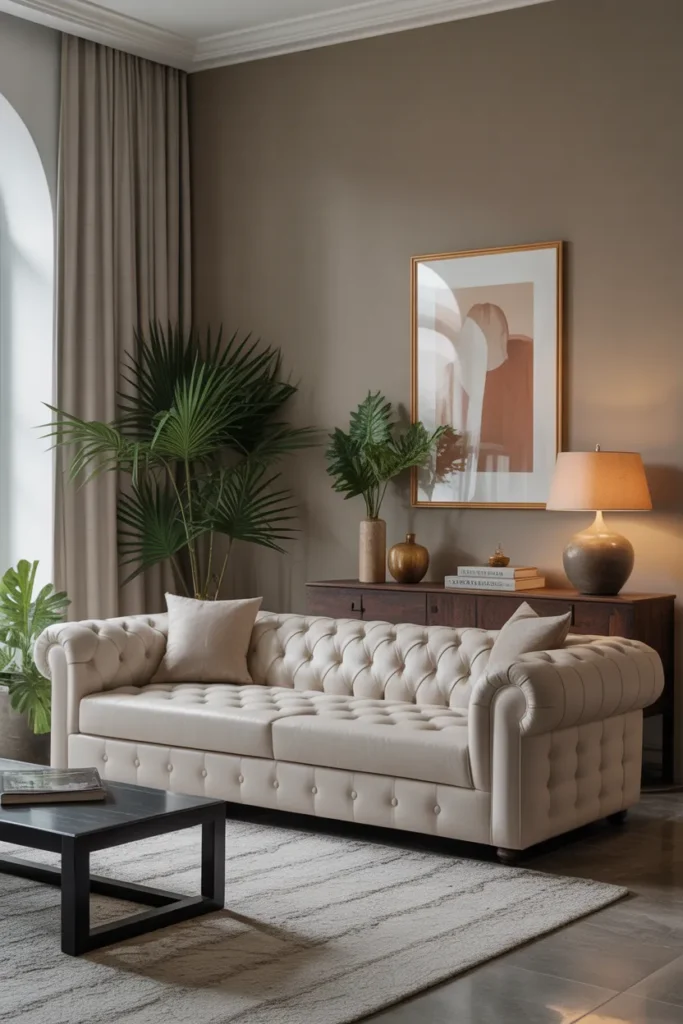
A chesterfield-inspired modern sofa takes the classic DNA, the tufting, the rolled arms, the tailored silhouette, and streamlines it for contemporary rooms. The result keeps the character of the original without the formality, so it works in lofts, modern farmhouses, and eclectic spaces where a full traditional chesterfield would feel stiff. Modern versions often skip the nailhead trim, slim down the arms, and use cleaner fabrics, which makes the piece feel fresh rather than costume-like. It is a great choice if you love classic design but live a casual life.
Know what makes it modern: The differences from a traditional chesterfield are in the details. Look for slightly higher backs for better comfort, slimmer or simplified arms, and legs instead of a skirted base. Fabric choices lean contemporary: performance weaves, subtle patterns, and colors beyond the classic browns and oxbloods. The tufting may be shallower and less buttoned, giving texture without the deep crevices that collect dust. These tweaks add up to a sofa that nods to tradition while living comfortably in a modern room.
Style it for today: Treat it as a bridge piece between classic and contemporary. Pair it with a modern rug, like a simple geometric or a solid textured weave, rather than an ornate Persian, to keep the look current. Contemporary art above the sofa and streamlined lighting complete the mix. One or two classic accessories, like a brass lamp or a leather-bound book stack, honor the traditional roots without tipping into theme territory. The goal is a room that feels collected over time, not decorated in one era.
- Shallower tufting is easier to clean and suits casual rooms better.
- Pair with modern rugs and art to keep the look contemporary.
- A performance fabric makes the tailored style practical for families.
Shop This Look
21. Convertible Sofa for Small Spaces
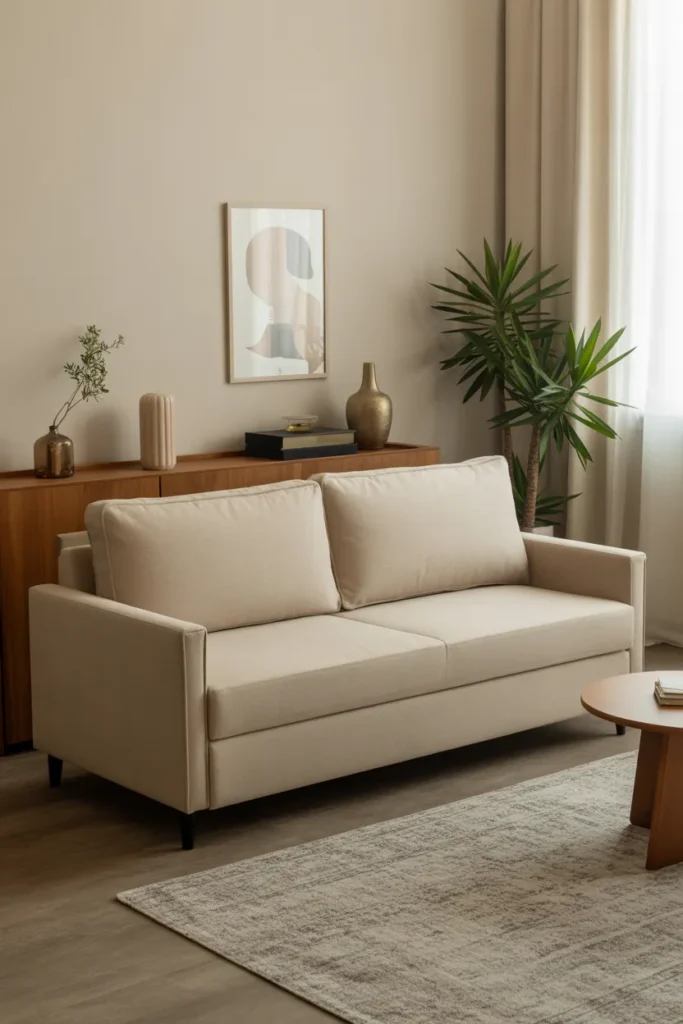
A convertible sofa is the hardest-working piece in a small home. By day it is a comfortable place to sit, and by night it becomes a bed, a lounger, or extra floor seating, depending on the design. Unlike traditional sleeper sofas with heavy pull-out mechanisms, convertibles use simpler transformations: click-clack backs, fold-flat seats, or futon-style hinges. This makes them lighter, more affordable, and easier to move, which matters in apartments and studios. For a first apartment, a guest room that doubles as an office, or a studio where every piece must multitask, a convertible sofa is often the smartest buy.
Match the mechanism to your routine: How often you convert the sofa should drive your choice. For nightly use as a bed, look for a flat, even sleeping surface and a sturdy frame, and test it yourself before committing. For occasional guests, a simpler click-clack model is fine and costs less. Check how easy the conversion is: if it takes two people and ten minutes, you will dread using it. One-person, one-minute conversion is the standard to aim for. Also confirm the folded dimensions fit your space with room to walk around.
Make it look like a real sofa: The old knock on convertibles was that they looked like dorm furniture, but modern designs have fixed that. Choose tailored upholstery in a solid, sophisticated color, and dress it with proper throw pillows rather than the thin cushions some models include. A good rug and side tables make it read as intentional living room furniture. Keep bedding stored nearby in a lidded ottoman so the day-to-night switch is painless. With the right styling, guests will never guess your sofa moonlights as a bed.
- Test the conversion mechanism yourself before buying, ease matters.
- For nightly sleeping, prioritize a flat surface over sofa aesthetics.
- Store bedding in a nearby ottoman for quick day-to-night changes.
Shop This Look
How to Start
Start with measurements, not shopping. Measure your room, then mark the sofa footprint on the floor with painter’s tape and live with it for a day or two. Walk around it, open nearby doors, and picture your daily routines. This one step prevents the most common regret in sofa buying, which is choosing a beautiful piece in the wrong size. While the tape is down, note where the light falls and which wall the sofa will face, since these details shape every choice that follows.
Next, get honest about how you live. A household with toddlers and a dog needs different fabric than a quiet couple who hosts book club. List your non-negotiables: washable covers, a sleeper function, pet-friendly fabric, a specific seat height. Then set a realistic budget that includes delivery and any accessories like a rug or pillows. It helps to decide your top three priorities in order, because no sofa is perfect at everything, and knowing what matters most makes the final choice much easier.
Finally, test before you commit whenever possible. Sit on floor models, check cushion firmness, and operate every mechanism. Order fabric swatches and abuse them at home before ordering. Read return policies carefully, since sofas are expensive to ship back. When the sofa arrives, give it a week before judging comfort, since cushions need a little break-in time. Then style it simply: a rug, a throw, a few pillows, and good lighting do most of the work.
- Tape the footprint on your floor and live with it for 48 hours before ordering.
- Order fabric swatches and test them with real spills, scratches, and washing.
- Confirm delivery details: doorway fit, stairwell turns, and old sofa removal.
Shop This Look
Common Mistakes
- Buying a sofa that is too large for the room, which makes everything feel cramped no matter how nice the piece is.
- Skipping the tape-on-the-floor test and discovering too late that walkways are blocked or doors cannot open.
- Choosing a delicate fabric for a high-traffic household, then watching it stain and wear within the first year.
- Picking the wrong sectional orientation, so the chaise blocks the natural path through the room.
- Forgetting to measure doorways, hallways, and stairwells, which turns delivery day into a crisis.
- Judging comfort in the first five minutes, before cushions have had any break-in time.
- Overloading a beautiful sofa with too many pillows and throws until the design disappears under clutter.
Frequently Asked Questions
What size sofa should I buy for my living room?
Measure your room first, then choose a sofa that takes up about two-thirds of the wall it sits against. Leave at least 30 inches of walkway around it and 18 inches between the sofa and coffee table. Tape the footprint on the floor before ordering to confirm the fit in real life.
Which sofa fabric is best for pets and kids?
Tightly woven performance fabrics, microfiber, and top-grain leather handle pets and kids best. Look for removable, washable covers and darker colors or subtle patterns that hide wear. Avoid delicate fabrics like silk or light-colored linen in high-traffic households.
How do I make my living room feel cozier around the sofa?
Layer in texture with throws and pillows, add warm lighting with a floor lamp, and anchor the seating area with a rug that the sofa’s front legs sit on. For more ideas on building a warm, inviting space, see these cozy living room ideas that pair beautifully with any sofa style.
How often should I replace my sofa?
A well-made sofa lasts 7 to 15 years depending on quality and use. Replace it when the frame wobbles, cushions no longer hold their shape after fluffing, or the fabric is worn beyond what covers or reupholstery can fix. Good frames can be reupholstered to extend life significantly.
Can I mix sofa styles in one living room?
Yes, mixing works well when the pieces share something in common, like a color palette, similar scale, or matching leg finishes. Keep one dominant sofa style and let the secondary piece be simpler. Repeating one or two colors across both pieces ties the mix together.
The Finishing Touch
Choosing a sofa is one of those decisions that shapes your daily life more than you expect. It is where you drink your morning coffee, where guests gather, where kids build forts, and where you collapse at the end of a long day. Take the time to get it right: measure carefully, test honestly, and pick the fabric that fits your real life instead of an imagined one. A sofa chosen with care pays you back every single day in comfort.
Remember that the sofa is the foundation, not the whole room. Once it is in place, the smaller choices, a rug that grounds it, lighting that flatters it, pillows that add personality, are what turn furniture into a home. You do not need to do everything at once. Live with the sofa for a while, notice what the room still needs, and add pieces slowly. If you want a deeper dive into choosing the right one, this sofa buying guide from Houzz covers style, size, and comfort testing in helpful detail.
Whichever of these 21 ideas spoke to you, trust your instincts and your measurements in equal measure. The most stylish living room is the one that works for the people who live in it. Pick the sofa that fits your space, suits your household, and makes you happy every time you walk into the room. That is the whole secret, and now you know it.