
22 Tiny Bedroom Ideas for Couples & Baby Setup
Sharing one small bedroom with a baby is workable, but only if every piece of furniture earns its place. There is no spare corner for a full nursery set, and most of what a baby needs in the first year is smaller than people expect.
The ideas below focus on furniture that does two jobs, storage that uses walls and the space under the bed, and layouts that keep a clear path for night feeds. Nothing here needs a large room. Most of it fits in a bedroom that already holds a double bed and one dresser.
Start with the sleeping setup, then add storage where you can reach it from the bed. A shared room changes fast in the first year, so pieces that fold, slide, or convert tend to work better than fixed nursery furniture.
This post contains affiliate links. If you buy through them, I may earn a small commission at no extra cost to you.
1. Convertible Crib Next to the Bed

A convertible crib placed right beside the parents bed keeps the baby within reach through the night and removes the need for a separate nursery. Most models turn into a toddler bed later, so the same frame stays useful for several years instead of a few months.
Night feeds stay simple: You can lift the baby out without walking across a dark room or opening doors. Keep the crib mattress at a height that lines up close to your own bed height, and leave a small gap you can step into rather than pushing the frames tight together.
Check the fit first: Measure the wall length before ordering, including skirting boards, and check that the crib rail lowers without hitting your bed frame. A firm mattress that fits the frame with no gaps at the edges matters more than extra features.
- Measure the space beside the bed before you order any crib.
- Keep spare sheets and a change of clothes in a basket you can reach from the bed.
- Leave the floor between the bed and crib completely clear for night waking.
Shop This Look
2. Wall-Mounted Shelving for Baby Essentials

Wall shelves above the dresser or changing spot hold the things you use many times a day: diapers, wipes, creams, and spare clothes. Using the wall keeps the floor and dresser top clear, which matters when the whole room is only a few steps wide.
Put daily items low: Keep diapers and wipes on the lowest shelf, at the height you can reach while one hand stays on the baby. Heavier or rarely used items go higher up. Shallow shelves work better than deep ones because nothing gets lost at the back.
Fix them properly: Screw shelves into studs or use the right wall anchors for your wall type, and never place a shelf where a standing child could later pull items down onto the crib. Test each shelf with weight before you load it with supplies.
- Group items by task, such as changing, feeding, and bath time.
- Use small baskets on the shelves so loose items do not roll off.
- Leave one shelf for your own things so the room still feels shared, not taken over.
Shop This Look
3. Foldable Changing Table in the Corner

A foldable changing table fits into a corner that is otherwise wasted, then folds flat against the wall or slides behind a door when changing is done. For a small room, that folding step is the whole point. The surface only exists when you need it.
Set it at a safe height: Choose a table that brings the baby close to waist height so you are not bending over the bed for every change. Check the lock or strap that holds it open, and set it up on a level patch of floor, not on a rug edge.
Keep supplies on it: A small caddy that lives on the table means you are not carrying diapers and wipes across the room each time. When the baby outgrows it, the same corner can take a small chair or storage unit, so no part of the room is built around one short stage.
- Open and fold it a few times before the baby arrives so the motion is familiar.
- Never leave the baby on the table while you reach for supplies.
- Store the folded table where you can get it out with one hand.
Shop This Look
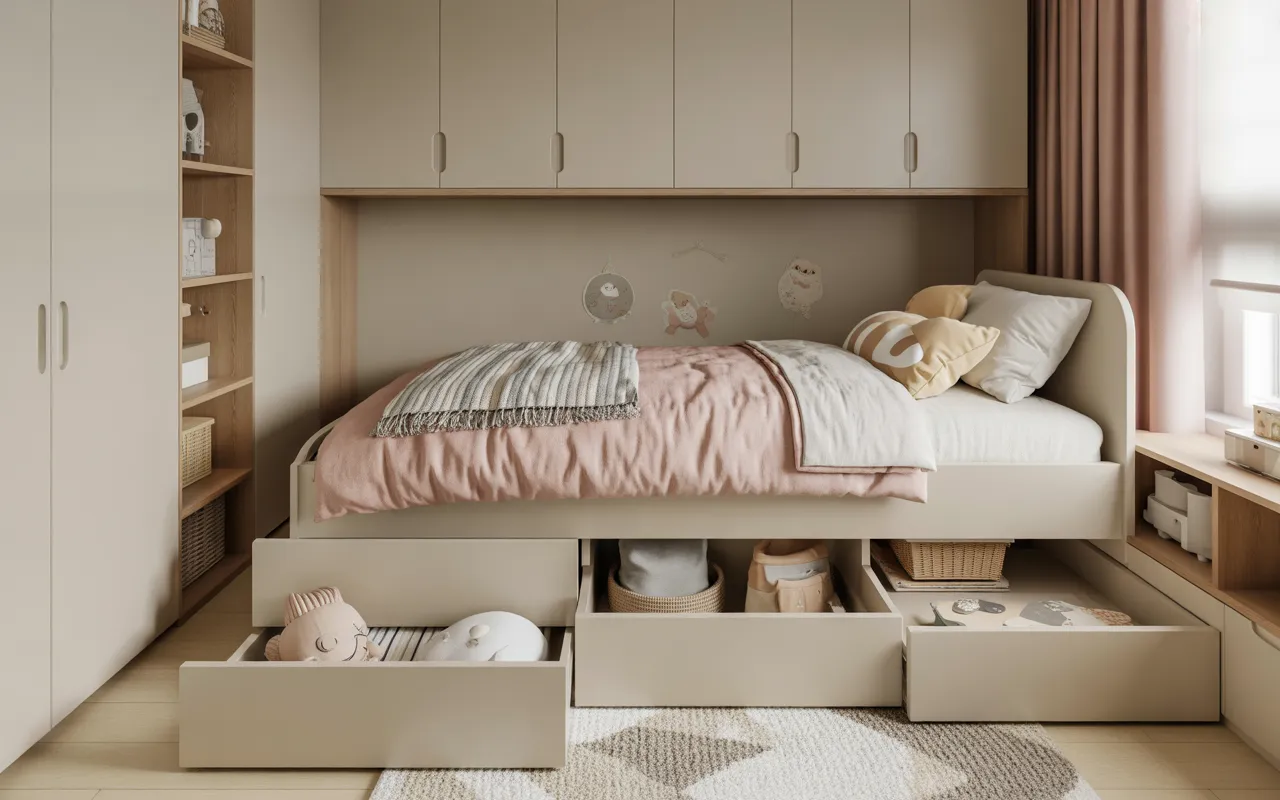
4. Under-Bed Storage for Shared Family Needs

The space under a double bed usually holds several large bins, which is a lot of storage in a room that has none to spare. Use it for the bulky, less frequent things: spare bedding, outgrown baby clothes, and the next size of clothes waiting to be worn.
Sort by how often you need it: Put everyday overflow, like extra blankets, in bins at the side you can reach easily. Seasonal items can go in the middle, where they are harder to reach. Low bins with lids keep dust off and slide better than soft bags on carpet.
Label everything: A label on the end of each bin saves you pulling out three bins at 2 a.m. looking for one item. Keep one bin partly empty on purpose. Baby items arrive faster than you expect, and a little spare room stops the system falling apart.
- Measure the clearance under your bed frame before buying bins.
- Keep one small bin for items to pass on or donate, and empty it monthly.
- Avoid storing anything heavy under the side where the crib stands.
Shop This Look
5. Compact Nursing Chair in the Corner

A compact nursing chair tucked into a corner gives you a proper seat for feeds instead of the edge of the bed. Look for a narrow armchair or small glider rather than a full nursery rocker. The footprint difference is large, and you still get back support.
Test the arms and back: Your elbows need support while holding the baby, so low, padded arms help more than a wide seat. A small cushion behind your lower back makes long evening feeds easier. If the chair rocks or glides, check it does not drift into the wall behind it.
Add a small surface nearby: A narrow side table or wall shelf next to the chair holds water, your phone, and a burp cloth. A dim lamp you can switch on without standing up also helps. Keep the chair corner free of storage boxes so it stays a calm spot, not a dumping ground.
- Choose a washable fabric or add a washable throw over the seat.
- Keep a feeding cushion stored on the chair so it is always in place.
- Place the chair where you can see the crib without turning around.
Shop This Look
6. Crib with Built-In Drawers for Extra Storage

A crib with drawers underneath puts baby clothes and bedding inside a footprint you are already using. In a shared room this can remove the need for a separate small dresser. Two or three drawers is usually enough for the first year of clothes, which are small and fold flat.
Divide the drawers: Use one drawer for current-size clothes, one for sleep items and blankets, and one for the next size up. Small dividers or rolled clothes keep tiny items from mixing into one pile. Keep the drawer you open most on the side away from your bed so both can open fully.
Think past the crib stage: Many of these cribs convert to a toddler bed and keep the drawers, which extends their use. Check how the drawers run before buying. Smooth runners matter when you are opening them one-handed while holding a baby.
- Line drawers so small clothes slide in and out easily.
- Keep medicines and small items out of these drawers once the baby can pull up.
- Rotate clothes by size at the front of the drawer to avoid missed outfits.
Shop This Look
7. Floating Nightstands for Couples and Baby Gear

Floating nightstands free the floor on both sides of the bed and still give each parent a drawer and a surface. In a room shared with a baby, that floor space is useful for the crib, a laundry basket, or simply walking around at night without tripping.
Mount at mattress height: Fix the top of the nightstand roughly level with the top of your mattress so a glass of water and a phone sit within easy reach. Leave enough wall space above each one for a small lamp or a wall light, which keeps the surface free.
Share the storage fairly: One drawer each sounds minor, but it stops chargers, books, and baby items mixing together on one side. A small tray on top keeps loose items in one place. If the drawer is shallow, store flat items there and move bulky things to under-bed bins.
- Use wall lights instead of table lamps to keep the surface clear.
- Add a small basket under each nightstand only if the floor still looks open.
- Check the weight limit before placing anything heavy on top.
Shop This Look
8. Multi-Functional Dresser as Changing Station

A wide dresser you already own can double as the changing station with a changing tray or pad fixed on top. This avoids buying a separate changing table that the baby outgrows in about a year. The drawers below hold clothes exactly where you dress the baby.
Secure the changing top: Use a tray with raised edges or a pad with a non-slip base, and follow the straps or fixings it comes with. Keep the dresser against the wall so it cannot tip, and use anti-tip straps if your dresser is tall or light.
Organize for one-handed use: You will often have one hand on the baby, so diapers, wipes, and cream need to be reachable with the other. The top drawer works well for changing supplies. Clothes go in the drawers below, sorted by size so dressing takes seconds.
- Keep the dresser top clear apart from the changing tray.
- Store spare changing covers in the top drawer for quick swaps.
- Once changing ends, the tray comes off and the dresser is just a dresser again.
Shop This Look
9. Corner Crib to Maximize Floor Space

A corner crib uses the one part of the room that rarely fits anything else and opens up the middle of the floor. Some are shaped to sit into a corner, others are standard cribs simply placed diagonally or flat into the corner. Either way, the walking space in the room improves.
Leave access on one side: You need to lower a sleeping baby in without stretching, so keep one long side of the crib fully reachable. Do not wedge it so tightly into the corner that you cannot change the sheet. Pull it a few centimetres off the wall for airflow and cleaning.
Use the freed floor well: The space you gain is best kept open for dressing, playing on a mat, and moving around at night. Resist filling it with extra furniture straight away. If the corner sits near a window, check for drafts and keep the crib away from blind cords.
- Measure both walls of the corner, not just one.
- Keep cords, curtains, and shelves well out of reach of the crib.
- A small rug in the open centre softens the room without adding furniture.
Shop This Look
10. Neutral Color Palette for Calm Shared Space

A neutral palette of white, warm grey, and soft beige keeps a shared room calm for adults while still suiting a baby. It also means adult bedding and baby items do not clash in a space where everything is visible at once. Colour can come from a few small items that are easy to change.
Build it in layers: Start with plain bedding and curtains, then add texture through a knit throw, a woven basket, or a cushion. This keeps the room from looking flat without adding visual clutter. Matching storage boxes in one colour also makes the room look tidier than mixed colours do.
Keep baby colour small: A coloured blanket, a few toys, and one print are enough in a small shared room. When everything is large and bright, the room feels smaller and busier. Swap the small items as the baby grows instead of redoing the whole room.
- Choose washable fabrics for anything within reach of the baby.
- Repeat the same two or three colours across bedding, storage, and curtains.
- Add one plant or framed picture so the room still feels like an adult bedroom too.
Shop This Look
11. Folding Bassinet for Flexible Sleeping Arrangements

A folding bassinet gives the baby a sleeping spot that can move between beside the bed at night and a corner during the day. Many fold flat enough to slide under the bed or behind a wardrobe. For the first months, that flexibility is worth more than a fixed piece of furniture.
Check the fold and weight: You will fold and carry it often, so test how it opens and whether it locks firmly in place. A light frame with a handle helps if you move it between rooms. The mattress should sit flat with no tilting when the bassinet is open.
Plan where it lives folded: Decide the storage spot before you buy, whether that is under the bed, behind the door, or in the wardrobe. If folding it away is awkward, it will end up left open and taking the space you were trying to save. Keep its sheet and a spare in the same spot.
- Use the bassinet only on the floor, never raised on furniture.
- Stop using it once the baby pushes up or reaches the weight limit.
- Keep a fitted sheet that matches the exact mattress size.
Shop This Look
12. Over-the-Crib Mobile for Visual Stimulation

A crib mobile gives a baby something to look at during awake time in the crib and takes up no floor or shelf space at all. In a small room, that matters. Choose one with slow movement and soft shapes rather than loud colours and noise.
Mount it out of reach: The mobile is for looking, not grabbing, so it must sit well above the mattress and be fixed firmly to the crib rail or ceiling. Check the fitting weekly as the baby grows. Remove it once the baby can push up on hands and knees.
Keep the look consistent: Felt or wooden mobiles in soft colours suit a shared adult room better than bright plastic ones. A wind-up or battery music box is optional. Many parents find a quiet, slow-turning mobile settles into the room better at night.
- Position it over the baby chest area, not directly over the face.
- Test that no parts hang loose before first use.
- Pair it with plain bedding so the crib area does not look busy.
Shop This Look
13. Slim Wardrobe with Baby Section

One slim wardrobe can hold clothes for both parents and the baby if you divide it by section rather than buying separate storage. Give the baby one hanging rail section and one shelf. Baby clothes are short, so the space under them fits boxes or a small set of drawers.
Divide by person and size: Hang adult clothes on one side and keep the baby section at the height you can reach without stretching. Store the next clothing sizes in a labelled box at the top. As sizes change, swap the box contents instead of reorganising the whole wardrobe.
Use the door and the gaps: Hooks or a slim organiser inside the door hold bibs, hats, and small items. A narrow gap beside the wardrobe often fits a laundry basket or the folded bassinet. Measure depth before ordering, as slim wardrobes vary a lot and hangers need a set minimum depth.
- Use matching slim hangers to fit more in a narrow rail.
- Keep one shelf for shared items like towels and spare bedding.
- Put daily baby clothes at the front so dressing does not disturb sleeping adults.
Shop This Look
14. Soft Area Rug to Define Spaces

A soft rug placed under or beside the crib marks out the baby area in a shared room without any physical divider. It also gives you a padded spot for tummy time and floor play during the day. Choose a low pile rug that is easy to clean, because it will be cleaned often.
Size it to the zone: The rug should cover the crib side and the space where you stand to lift the baby out. Too small looks lost, too large slides under the bed and bunches. A non-slip pad underneath keeps it flat on hard floors and makes standing on it at night safer.
Pick a practical fabric: Machine washable rugs save a lot of effort in the first year. A mid-tone colour hides small marks between washes better than white. Keep the adult side of the room in a matching tone so the rug reads as part of the room, not a separate nursery dropped into it.
- Wash or vacuum the rug weekly, as babies spend a lot of time on it.
- Avoid long pile, which traps crumbs and is hard to clean.
- Let the rug edge sit flat with no curling corners near the walking path.
Shop This Look
15. Wall Hooks for Diaper Bags and Essentials

A row of sturdy wall hooks near the door holds the diaper bag, a carrier, and a change of clothes so they are ready to grab on the way out. These are the items that otherwise end up on the bed or the floor. Hooks cost little and need no floor space.
Fix them at the right height: Hooks at shoulder height keep bags off the floor but still easy to lift down. Use screws into studs or proper anchors, because a loaded diaper bag is heavier than it looks. Keep hooks away from the crib side of the room so nothing hangs over the baby.
Limit what hangs there: Two or three hooks with one job each stay tidy. When every hook holds three things, the wall looks messy and items fall. Rotate what hangs by season, and move outgrown items out of the room rather than onto another hook.
- Use wide hooks so bag straps do not slip off.
- Hang the carrier where it can air out after use.
- Keep one hook free for visitors bags or a parent coat.
Shop This Look
16. Sliding Door Closet to Save Space

Sliding closet doors remove the swing space that hinged doors need, which in a small bedroom can be the difference between fitting the crib beside the wardrobe or not. The floor in front of the closet stays usable at all times. You can place a basket or the folded bassinet there without blocking access.
Know your options: Full sliding door tracks suit owned homes, but renters can often swap to a curtain or lightweight sliding panels with less fixing. Even replacing one hinged door with a curtain frees the same swing area. Check that the doors run smoothly and cannot be pushed off the track by a toddler later.
Organize behind the doors: Sliding doors only show half the closet at a time, so put daily items on the side you open most. Boxes and seasonal things go on the other side. Good internal order matters more with sliding doors because you cannot see everything at once.
- Keep the track clear of rug edges and stored items.
- Store baby daily clothes on the most opened side.
- Add a small light inside if the closet is deep and dark.
Shop This Look
17. Hanging Baskets for Lightweight Storage

Hanging baskets on a wall rail or the side of a wardrobe hold light, soft items like muslins, bibs, socks, and small toys. They keep these small things visible and off surfaces. Because the items are light, the baskets can hang in places that would not take a shelf of heavy goods.
Group by type: One basket for feeding cloths, one for socks and small clothes, one for small toys. When a basket overflows, that is the signal to move some items out of the room. Clear or open-weave baskets let you see contents at a glance, which speeds up dressing.
Hang them within reach: Place the baskets you use daily between waist and shoulder height. Higher baskets suit spare items only. Fix rails firmly, and avoid hanging baskets where a standing baby in the crib could reach and pull them down later.
- Choose baskets that come off the rail for washing.
- Keep heavy items out of hanging baskets entirely.
- Use the wardrobe side or the back of the door if wall space is gone.
Shop This Look
18. Corner Shelf for Baby Monitors and Accessories

Corners above dresser height are usually empty, and a small corner shelf there is a good spot for the baby monitor camera, which needs height and a wide view of the crib. The same shelf holds a small clock, a night light, or the monitor parent unit while charging.
Aim the monitor first: Set the shelf height and angle so the camera sees the whole crib mattress without you standing on furniture to adjust it. Run the cable down the corner and clip it to the wall so it stays out of reach. Test the view at night, not just in daylight.
Keep the shelf small: A corner shelf is not general storage. One or two items only, or it starts to look cluttered and dust builds up. Wipe it weekly, since items at that height get forgotten in normal cleaning.
- Secure cables with clips all the way down the wall.
- Check the monitor view again after moving the crib or bed.
- Leave room on the shelf for nothing else once the monitor is set.
Shop This Look
19. Daybed with Storage Drawers for Multi-Use Space

A daybed with storage drawers gives a shared room a second place to sit, rest, or sleep a visiting grandparent, while the drawers below hold bedding and baby overflow. During the day it works as a seat for feeding or reading. It suits rooms where the main bed plus crib leaves one long wall free.
Use the drawers with intent: Keep spare bedding in one drawer so the daybed converts to a bed in minutes. The other drawer suits baby items that are bulky but light, like blankets and play mats. Avoid making it the place where everything without a home ends up.
Dress it simply: A plain cover and two cushions keep it looking like part of a bedroom rather than a spare bed. Choose bedding that washes easily. If a parent sometimes sleeps there during night feeds rotation, keep a pillow and blanket stored in the drawer so setup takes a minute.
- Measure the wall length plus walking space at the end before ordering.
- Keep the top clear during the day so it stays usable as a seat.
- Choose drawers over a pull-out trundle if storage matters more than a second bed.
Shop This Look
20. Neutral Curtains to Separate Baby Space

A plain curtain on a ceiling track or tension rod can divide the baby corner from the rest of the room so adults can read or watch something after the baby is asleep. It blocks light and some sound without a wall, a screen, or any floor space. Neutral fabric keeps it from dominating the room.
Choose the fabric for the job: A heavier, lined curtain blocks more light than a thin one, which helps if one parent reads late. Make sure the curtain hangs clear of the crib and cannot be pulled into it. Leave a gap at the top or bottom for air to move through the room.
Fix it safely: Ceiling tracks need proper fixings, and tension rods need a firm fit between walls. Test the rod with a firm pull before hanging the curtain. Keep the curtain fully out of the baby reach as the baby starts standing in the crib.
- Pick a washable fabric in the same tone as the bedding.
- Open the curtain fully during the day so the room feels its full size.
- Use tiebacks so the curtain sits neatly when open.
Shop This Look
21. Foldable Baby Playpen for Versatile Space

A foldable playpen gives the baby a safe, defined place to play on the floor of the shared room while you get dressed or tidy up. When play time ends, it folds away behind the wardrobe or under the bed. That fold-away step is what makes it realistic in a small bedroom.
Check the folded size: Measure where it will live folded before buying, not after. A playpen that is awkward to store will stay up and eat the floor space it was meant to free. Look for a simple fold you can do one-handed and a carry handle or bag.
Keep the inside simple: A soft mat and a few toys are enough. Too many toys crowd the space and end up scattered across the room. Wash the mat cover regularly, and check the frame locks each time you set it up.
- Set it up on a flat floor away from cords and heaters.
- Supervise play even in the playpen, it is not a substitute for watching.
- Rotate a few toys weekly instead of filling it once and leaving it.
Shop This Look
22. Multi-Functional Bedside Organizer

A bedside organiser that hangs over the bed frame or sits in a slim caddy keeps night items in reach for both parents: water, phone, tissues, burp cloths, and a spare pacifier. In a shared room, night items scattered across surfaces quickly make the room feel chaotic. One caddy per side solves most of it.
Pick pockets by item: Deep pockets hold a water bottle and book, shallow ones suit a phone and lip balm. Keep baby night items on the side nearest the crib so one parent handles feeds without crossing the room. Empty and shake out the caddy weekly, as crumbs and dust collect fast.
Keep it light: A hanging organiser is not a shelf. Too much weight pulls it out of shape and can mark a bed frame. Heavy items belong in the nightstand drawer or under-bed bins. The caddy is for the handful of things you reach for without getting up.
- Choose a washable fabric, as spills happen at night.
- Keep cords for chargers threaded neatly, away from the crib.
- Review the contents monthly and remove what you no longer use at night.
Shop This Look
How to Start
Start by clearing the room back to the bed, one dresser, and the floor space you actually walk through. Decide where the baby will sleep first, because the crib or bassinet position shapes everything else. Leave the night path from bed to door clear before you add a single storage item.
Measure before you buy: Write down the wall lengths, the space beside the bed, and the clearance under the bed frame. Most mistakes in a shared room come from ordering nursery furniture that was sized for a separate nursery. A tape measure and ten minutes will save you a return and a room that does not work.
Add storage in reach order: Set up the storage you use at night first: a bedside caddy, a shelf for changing supplies, hooks for the diaper bag. Then add the weekly storage, like under-bed bins. When the daily system works, the room feels manageable even before it looks finished.
- Measure the crib space, under-bed clearance, and one wall for shelves.
- Set up night feeding supplies within reach of the bed.
- Keep one empty bin or shelf ready for the items that arrive later.
Shop This Look
Common Mistakes
- Buying a full nursery furniture set for a room that only has space for two pieces.
- Placing the crib where blind cords, curtains, or shelves are within reach.
- Blocking the path between the bed and the door with storage boxes or a playpen.
- Using deep shelves or drawers for tiny baby clothes, so everything ends up in one mixed pile.
- Storing night feed supplies across the room instead of within reach of the bed.
- Filling every wall with storage and leaving no clear surface or open floor at all.
- Choosing furniture that cannot be folded, converted, or moved as the baby grows.
Frequently Asked Questions
How long can a baby share a room with parents in a small space?
Many families share for the first year or longer, and a small room can work for that whole period if the sleeping setup is safe and storage stays under control. The usual pressure points are clothes storage as sizes change and floor space once the baby crawls. Rotating outgrown items out of the room every few months keeps it workable.
What size crib suits a tiny shared bedroom?
A mini crib or a compact convertible crib suits most small shared rooms. Measure the space beside your bed first, including room to lower the rail and change the sheet. A standard crib can still fit in some rooms, but only if it does not block drawers, doors, or the path to the exit.
Where do you change a baby in a small shared bedroom?
The common options are a changing tray on top of a dresser, a foldable changing table in a corner, or a changing mat on the bed for short periods. A dresser top works best for most families because the supplies store in the drawers below and the setup packs away to a normal dresser once changing ends.
How do you keep a shared room calm at night?
Keep light low and local: a dim night light near the crib and one near the changing spot, instead of the main light. Keep night supplies in one caddy so feeds and changes happen in one place without searching. A curtain or a rug-defined baby zone also helps adults keep a small area of the room feeling separate.
Where can I find more ideas for a nursery corner?
Start with the sleeping area, then add one storage piece at a time and live with it for a week before adding more. For more layouts and colour ideas for the baby side of the room, see these baby nursery inspiration ideas and pick the parts that fit your measurements.
The Finishing Touch
A shared room works when each side of it has a clear job and nothing in it is single-purpose for long. The crib converts, the dresser changes the baby, the space under the bed stores the next size up. That is how three people fit in a room built for two without it feeling crowded every day.
If you want to compare layouts before you move furniture around, browse small bedroom ideas on Houzz and note which arrangements keep a clear path beside the bed. Photos of real small rooms are a useful check on whether a layout that works on paper works in practice.
Make one change at a time and live with it for a few nights. Sleep matters more than a finished look in the first year. A room that lets everyone rest, with supplies where your hand expects them at 3 a.m., is a room that is working.





2 Comments