15 Handcrafted Decor Ideas for a Warm, Stylish Home
Handcrafted decor refers to home accessories and furnishings made by hand — through weaving, throwing, carving, stitching, or forging — rather than mass-produced by machine. This article gives you 15 handcrafted decor ideas across color, materials, lighting, furniture, accessories, layout, and small-space styling so you can bring genuine warmth and artisan character into every room.
There’s a particular quality to a handmade object that no factory finish replicates. The slight irregularity of a thrown ceramic bowl, the uneven texture of hand-knotted wool underfoot, the warm grain of a hand-carved wooden shelf — these are the details that make a house feel inhabited rather than staged. Handcrafted decor doesn’t ask for a big budget or a complete renovation. It asks for intention. Here are 15 ideas worth saving — and stealing.
Why Handcrafted Decor Works So Well
Handcrafted decor draws from centuries of artisan tradition — from Japanese mingei (folk craft) philosophy, which celebrates the beauty of everyday objects made with care, to the British Arts and Crafts movement of the late 19th century, which pushed back against industrial uniformity by championing the human hand in every object. What unites these traditions is a shared belief: that the maker’s touch is visible in the finished piece, and that visibility creates warmth no machine can replicate.
The material palette of handcrafted interiors is tactile and specific. Think unglazed stoneware in warm clay and ash glaze tones, hand-loomed wool in undyed natural fleece or dusty indigo, beeswax-finished walnut and cherry wood, hammered copper and blackened wrought iron, and raw linen in oat, warm greige, and aged white. Colors tend to stay within the organic spectrum — terracotta blush, warm ochre, sage, dusty rose, and deep forest green — because these are the tones that natural dyes and unprocessed materials naturally produce.
The cultural moment could not be more aligned. The global shift toward slow living, sustainability, and conscious consumption has made handcrafted goods one of the fastest-growing home decor categories. Searches for “handmade home decor,” “artisan pottery,” and “hand-knotted rugs” have surged consistently, driven by a generation of homeowners deliberately moving away from disposable, trend-driven interiors toward objects with provenance and permanence.
Small spaces benefit enormously from handcrafted decor — in fact, a single well-chosen handmade piece does more for a small room than a dozen mass-produced accessories. The key in compact spaces is restraint: choose one dominant handcrafted texture per surface (one ceramic, one woven textile, one carved wood element) and let each breathe rather than clustering everything together.
Style at a Glance
| Element | Detail |
|---|---|
| Philosophy | Beauty lives in imperfection; the maker’s hand is the decoration |
| Key Materials | Stoneware, hand-loomed wool, beeswax-finished walnut, hammered copper, raw linen |
| Key Colors | Terracotta blush, warm ochre, dusty sage, aged white, deep forest green |
1. Hand-Thrown Ceramic Vase Cluster on a Wooden Shelf
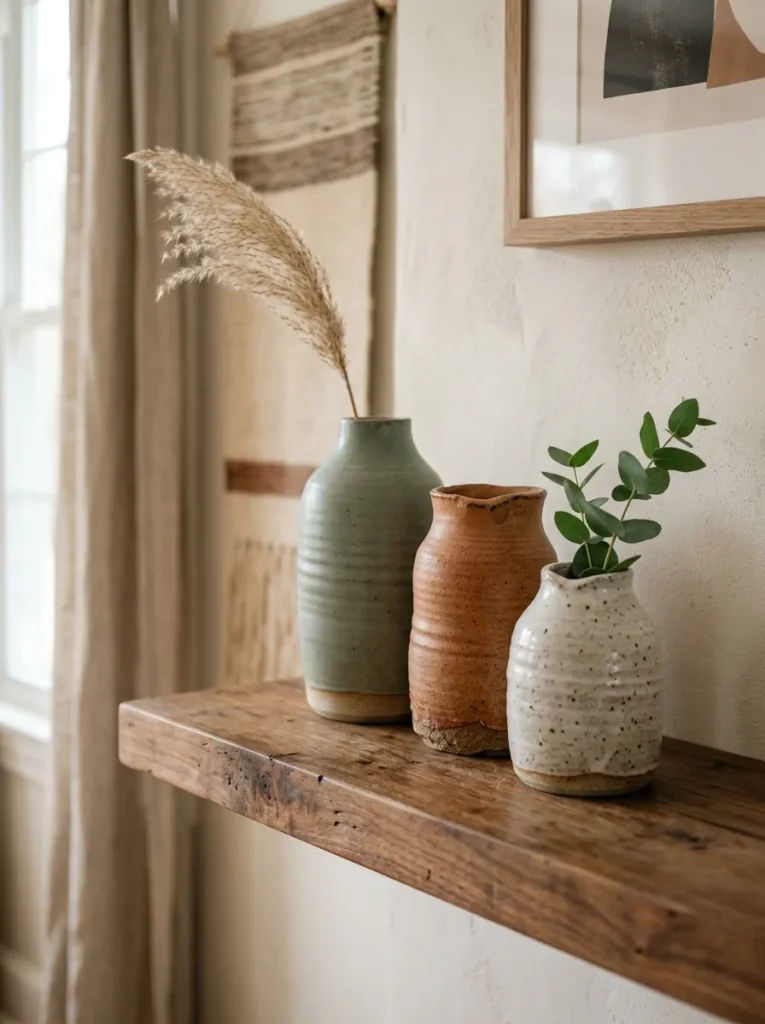
Vibe: The shelf is grounded — three imperfect ceramic forms together create a still-life composition that no matching store-bought set achieves.
Why it works: Clustering vases in odd numbers (three or five) exploits the design principle of asymmetric balance — the eye moves between them rather than settling on a symmetrical pair, creating the sensation of a curated collection rather than a purchase. Varying height ratios (tall, medium, squat) within the same color family creates vertical rhythm without color chaos. The visible throwing lines on hand-thrown ceramics catch light differently across the day, making the shelf a dynamic display rather than a static one.
How to get it: Source hand-thrown ceramics from local pottery studios, Etsy ceramicists, or weekend craft markets — avoid anything labeled “handcrafted” but with perfectly uniform walls, which signals slip-casting rather than throwing. Look specifically for pieces with unglazed feet (the raw clay base left unfinished) as a sign of genuine hand-throwing.
Quick Win: A single hand-thrown matte terracotta bud vase (widely available on Etsy for $18–$35) placed on an otherwise bare shelf does more visual work than a full set of matching machine-made vessels.
Shop The Look
- Hand-thrown ceramic vase set matte terracotta
- Floating walnut wood shelf wall mount
- Dried pampas grass stems natural cream
- Ash glaze ceramic bud vase minimal
- Sage green ceramic vessel handmade style
Also view: 14 Hotel Style Bedding Ideas for Cozy Bedrooms
2. Hand-Knotted Wool Rug in Natural Undyed Fleece
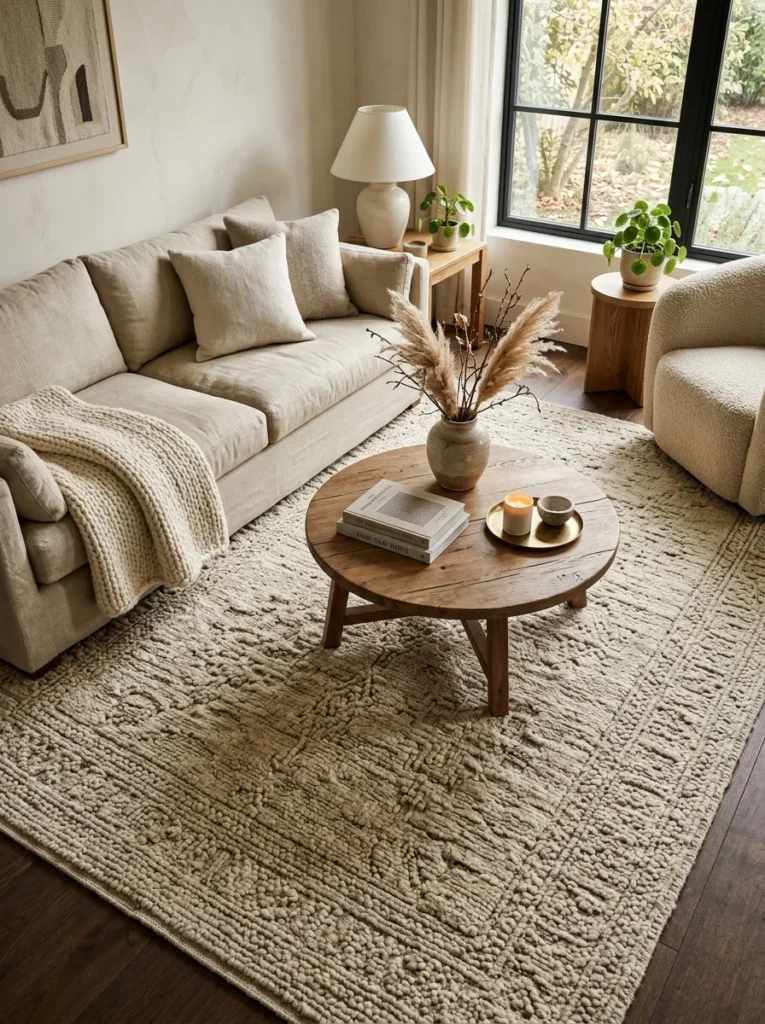
Vibe: The room is warm — a hand-knotted wool rug underfoot transforms a hard floor into something you want to cross barefoot every morning.
Why it works: Hand-knotted rugs have a pile density measured in knots per square inch (KPSI) that machine-made rugs cannot replicate — a quality hand-knotted rug runs 100–300 KPSI, creating a depth of texture that changes appearance from different angles as the wool pile reflects light directionally. Natural undyed fleece in ivory, warm grey, and oat is the most versatile colorway because it coordinates with every warm neutral interior palette without competing for attention. It also ages gracefully — natural wool develops a soft patina rather than fading unevenly.
How to get it: Specify “hand-knotted” (not “hand-tufted” — tufted rugs use a gun and backing adhesive that deteriorates over time) and look for wool content of at least 80%. If budget is a constraint, a 5×8 hand-knotted rug used as a layering piece over sisal is more effective than a cheap 8×10 machine-made alternative.
Shop The Look
- Hand knotted wool area rug natural ivory 8×10
- Low profile linen sofa natural modern
- Ceramic decorative object coffee table neutral
- Wool throw blanket natural undyed oat
- Rug pad non-slip thick felt
3. Macramé Wall Hanging as a Textile Focal Point
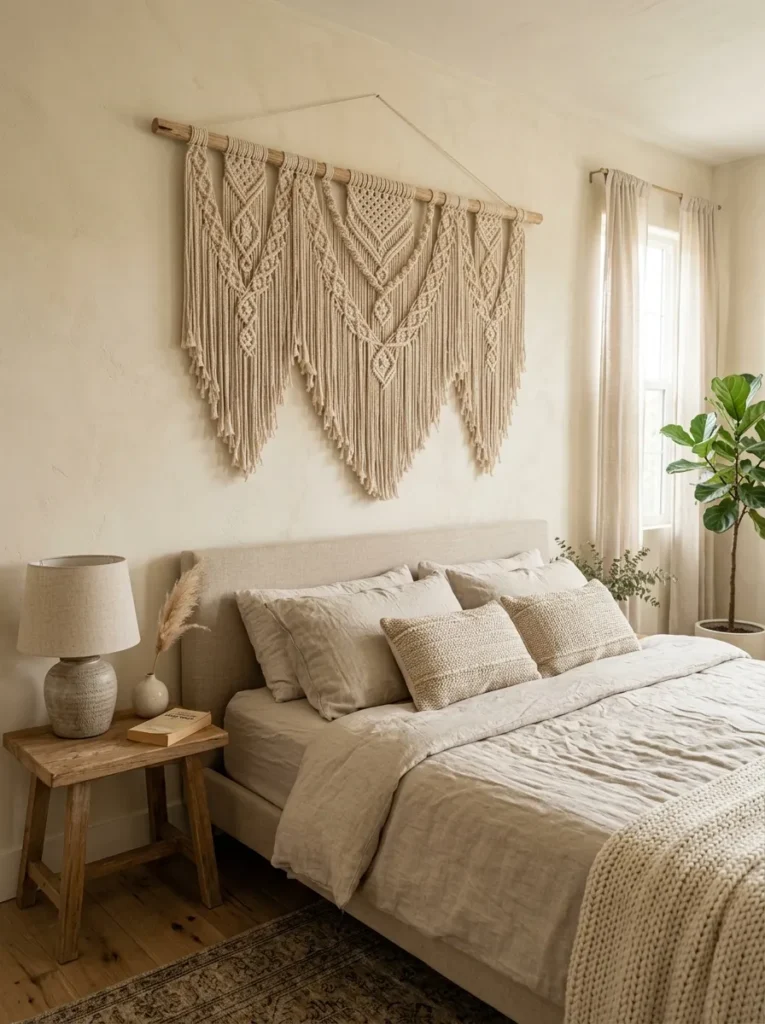
Vibe: The wall is layered — a large macramé piece introduces textile depth above the bed that no framed print replicates.
Why it works: Macramé operates on the principle of texture contrast: the knotted cotton rope creates visual complexity against a flat painted wall without adding color, which means it works above virtually any bedding palette. Large-scale macramé (minimum 24 inches wide) functions as wall art — it fills the visual void above a headboard the way a painting does, but with dimensional depth that a flat canvas cannot provide. The fringe ends introduce gentle movement in air currents, adding a subtle kinetic quality.
How to get it: For the most convincing handcrafted look, source from independent makers on Etsy rather than mass-market versions — genuine handmade macramé has slightly irregular knot spacing that machine-assisted versions lack. Hang on a raw oak or driftwood dowel (never a metal curtain rod) to keep the artisan aesthetic consistent.
Quick Win: A 24×36 inch macramé wall hanging from an Etsy maker runs $45–$90 and ships flat — it covers the wall space above a queen headboard perfectly without requiring any picture-hanging hardware beyond two small nails.
Shop The Look
- Large macramé wall hanging natural cotton boho
- Raw oak wooden dowel rod craft hanging
- Oat linen duvet cover set queen
- Ceramic bedside table lamp matte warm
- Dried stem botanical bud vase set
4. Hand-Carved Wooden Serving Board as Wall Decor
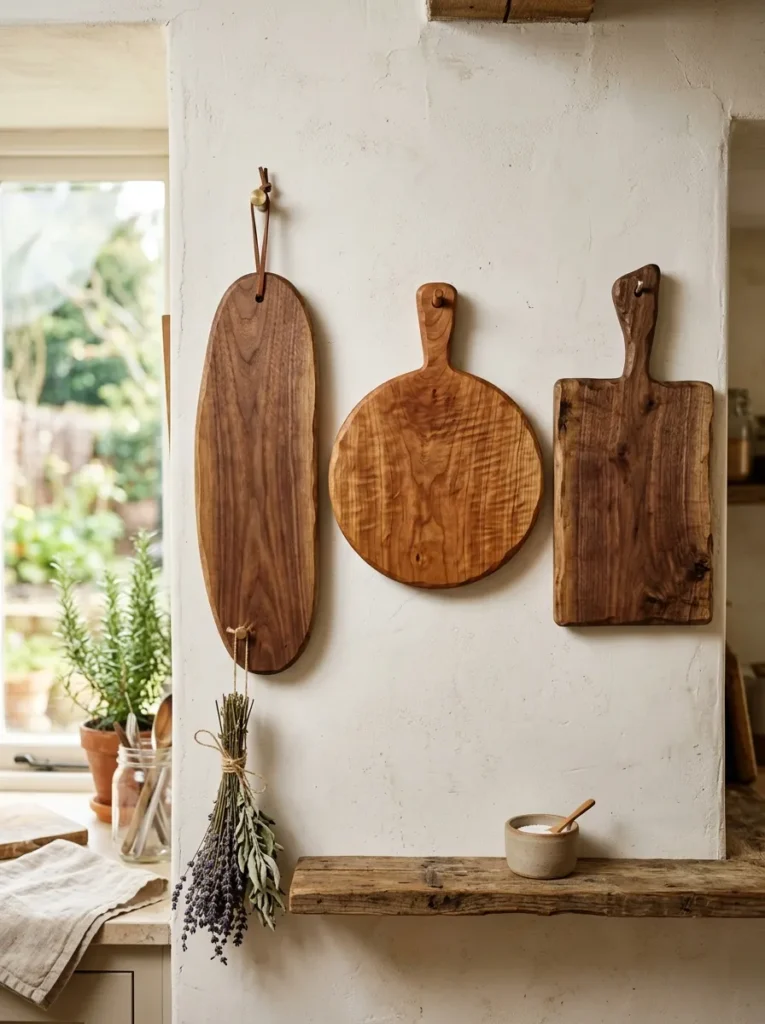
Vibe: The wall is artisan — wooden boards hung as decoration blur the line between the functional and the beautiful in a way that feels genuinely lived-in.
Why it works: Mounting wooden boards on a wall exploits the same principle as gallery-hanging — varied shapes and sizes at different heights create a composition that reads as intentional rather than decorative clutter. The natural wood grain provides organic pattern that wallpaper or art prints cannot, and beeswax-finished wood has a subtle warmth and depth that painted surfaces entirely lack. This also follows the handcrafted principle of dual purpose: every piece on the wall can come down and be used.
How to get it: Mount boards using a single screw through a small hole drilled at the narrow end of the handle, or use picture rail hooks for boards with hanging holes already carved. Group at least three for the gallery effect — a single board reads as forgotten rather than decorative.
Shop The Look
- Hand carved walnut charcuterie board set
- Beeswax wood conditioner furniture finish
- Ceramic salt cellar pinch pot handmade
- Dried herb bundle kitchen decor natural
- Picture rail hook set brushed brass
5. Beeswax Taper Candles in Handmade Ceramic Holders
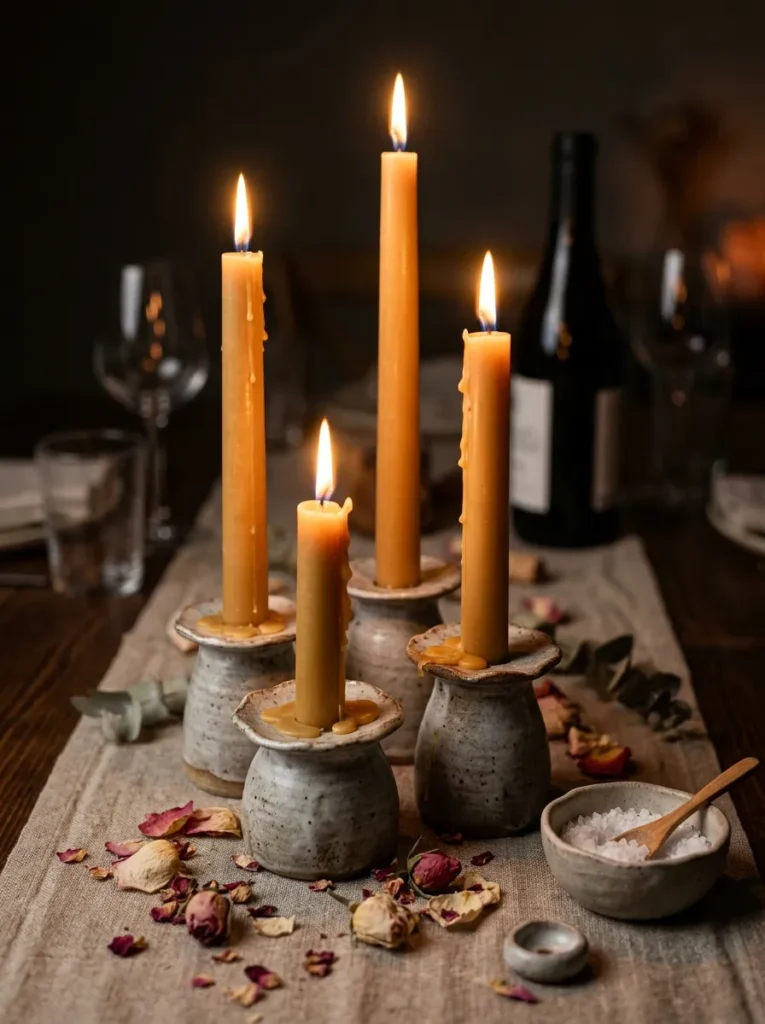
Vibe: The table is romantic — beeswax tapers in hand-pinched ceramic holders cast the warmest light of any candle type, turning a dinner table into something cinematic.
Why it works: Beeswax burns at a lower temperature than paraffin, producing a softer, more golden flame with a natural honey scent rather than chemical fragrance. The visual pairing of honey-toned taper candles with matte clay candleholders creates tonal harmony — both materials exist in the same warm ochre-to-cream color range, so they read as a curated pair without being a matched set. Hand-pinched ceramic holders have visible fingerprint impressions in the clay that catch candlelight in a way smooth machine-cast holders cannot.
How to get it: Source hand-pinched ceramic taper holders from ceramicists on Etsy or local craft fairs — look for unglazed or partially glazed interiors and organic, non-circular rims as markers of genuine hand-pinching. Pair with 100% pure beeswax tapers (not beeswax blend, which contains paraffin) for the authentic honey scent and slow clean burn.
Quick Win: A pack of six natural beeswax taper candles costs $12–$20 and burns 8–10 hours each — placed in even inexpensive ceramic holders, they transform a dining table for an entire season.
Shop The Look
- Pure beeswax taper candles set natural honey
- Hand pinched ceramic taper candle holder set
- Natural linen table runner oat
- Ceramic small bowl handmade salt cellar
- Dried botanical rose petals decor natural
6. Indigo Hand-Dyed Linen Curtains
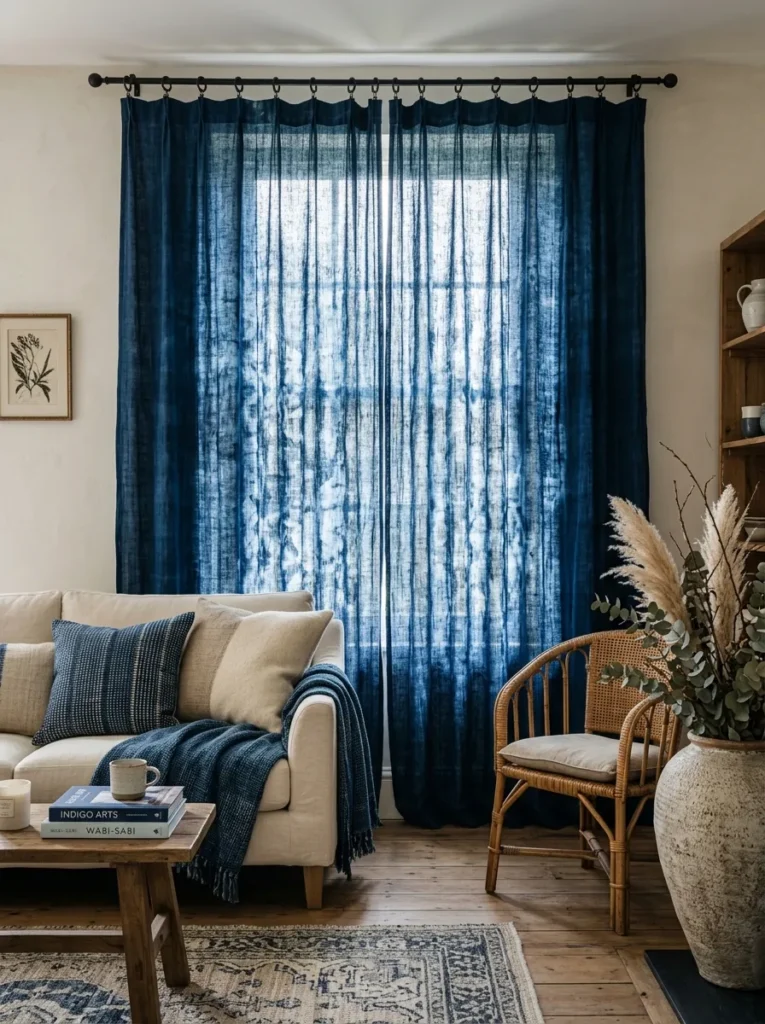
Vibe: The room is serene — indigo curtains filter natural light into a blue-toned warmth that changes the character of the room across the entire day.
Why it works: Hand-dyed linen has a dye variation that machine-printed fabric cannot replicate — the indigo tone shifts from deep navy at the top to softer dusty blue midway down, creating a gradient that functions as a color wash across the room’s largest vertical surfaces. Linen’s natural slub texture (the slightly irregular weave inherent to the fiber) catches this variation and deepens it. Indigo against cream or warm white interiors creates one of the most historically validated color pairings in textile tradition — it appears in Japanese, Indian, and West African weaving cultures for the same reason: the combination is inherently balanced.
How to get it: Look for curtains sold as “hand-dyed” or “natural-dyed indigo linen” from independent textile makers, or purchase natural linen panels and dye them yourself using an indigo shibori kit (Dharma Trading Co. kits run $25–$40 and treat up to 20 yards of fabric).
Shop The Look
- Indigo hand dyed linen curtain panel set floor length
- Black iron curtain rod with rings simple
- Cream linen throw pillow cover set
- Rattan accent chair natural indoor
- Ceramic floor vase large neutral matte
7. Wabi-Sabi Dried Botanical Arrangement in Stoneware
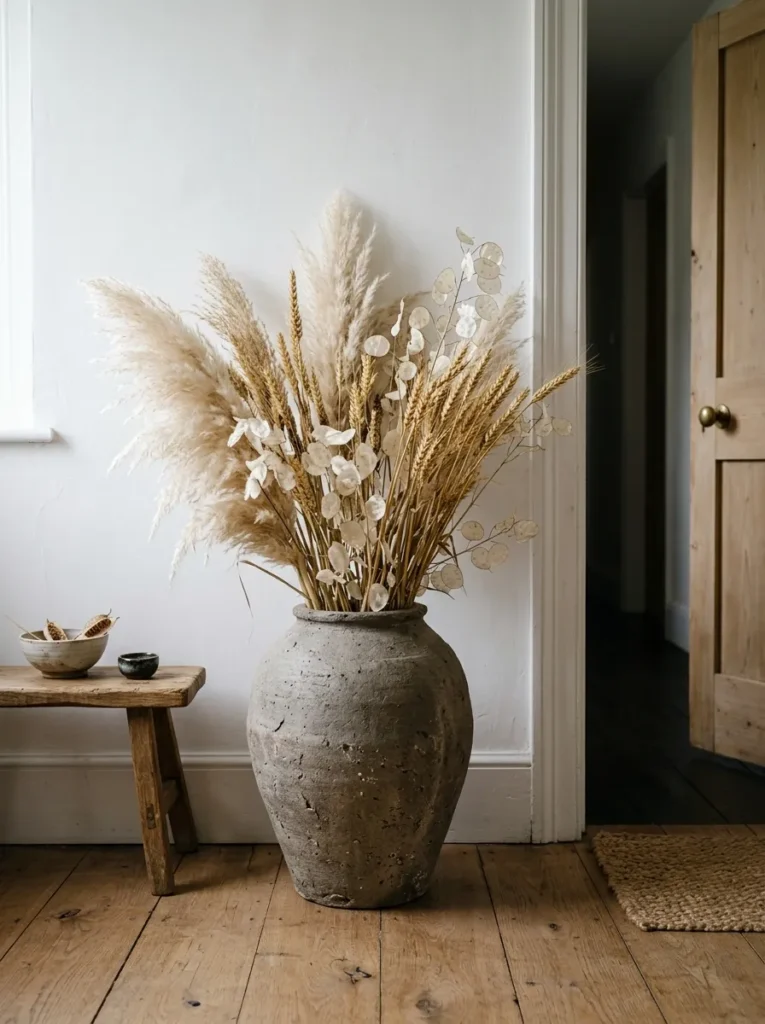
Vibe: The arrangement is hushed — a floor-level dried botanical composition in rough stoneware has the quiet authority of something that belongs exactly where it stands.
Why it works: Dried botanicals in stoneware vessels embody the Japanese wabi-sabi principle of finding beauty in impermanence and natural aging — the botanicals are already at their “finished” state, requiring no water, no maintenance, and no replacement. Placing a large-scale arrangement at floor level exploits vertical space in a way that tabletop arrangements cannot, and the rough stoneware vessel grounds the composition physically and visually. The color palette — bleached creams, warm golds, raw grey-brown clay — requires no other color in the arrangement to read as complete.
How to get it: Build the arrangement in three layers: tall (pampas grass or dried cortaderia, 36–48 inches), medium (lunaria or dried allium, 20–28 inches), and short (dried wheat or lavender bundles, 12–16 inches). Weigh the stoneware base with a handful of sand or smooth pebbles before inserting stems so the tall arrangement doesn’t tip.
Quick Win: A single bundle of dried pampas grass (5–7 stems) from a craft store or farmers market, placed in any vessel you already own, costs under $15 and lasts 2–3 years without any maintenance.
Shop The Look
- Large stoneware floor vase rough texture neutral
- Dried pampas grass bunch natural cream large
- Dried lunaria silver dollar plant stems
- Dried wheat bundle natural gold decor
- Smooth river pebble filler vase set
8. Handwoven Rattan Pendant Light Over a Dining Table
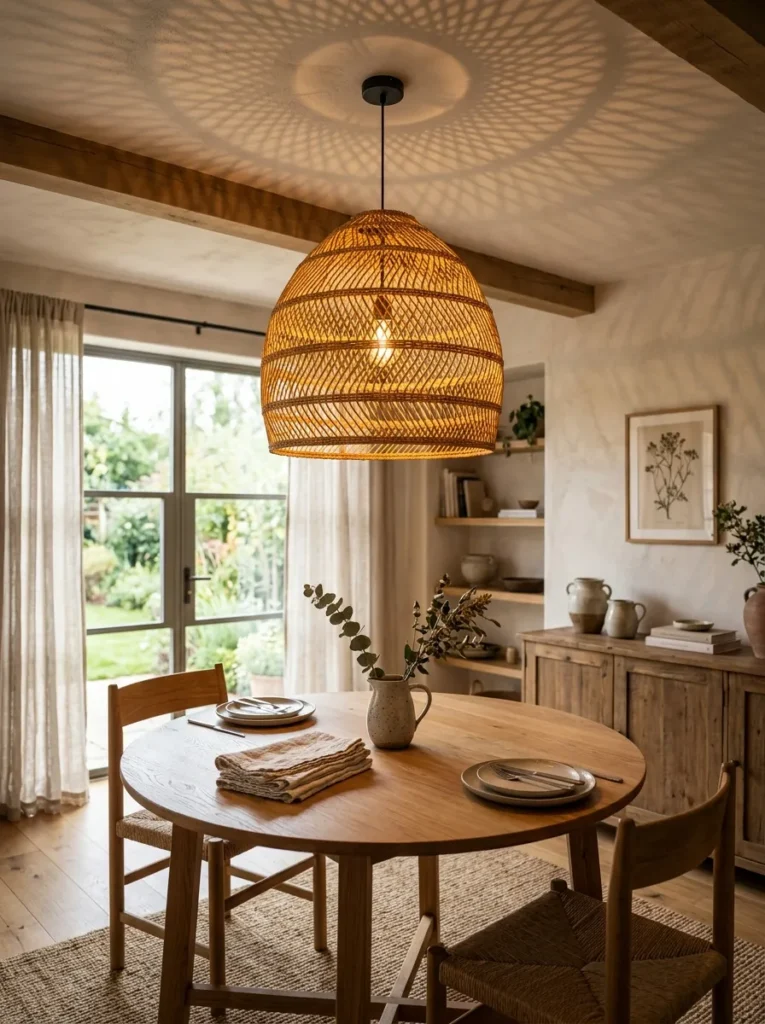
Vibe: The dining room is warm — a rattan pendant casts patterned amber light across the ceiling that no solid shade replicates, turning every meal into something ambient.
Why it works: Open-weave rattan pendant lights function as both a light source and a decorative object simultaneously — during the day, they read as sculptural form; at night, the gaps in the weave project patterned light onto surrounding surfaces, creating a dappled shadow effect that changes with the bulb position. Hanging a pendant low over a dining table (bottom of shade at 30–34 inches above the tabletop) concentrates light on the surface where it’s needed while keeping the fixture within visual engagement range during a seated meal.
How to get it: Choose open-weave over tight-weave rattan for the shadow projection effect — a tight weave acts like a solid shade and loses the pattern. Pair with a warm 2200K Edison-style LED bulb for the amber tone that complements the rattan’s honey color; a cool daylight bulb turns the rattan yellow-grey.
Shop The Look
- Handwoven rattan pendant light large dining room
- Round solid oak dining table natural
- Linen napkin set natural oat
- Ceramic small pitcher handmade style
- Warm Edison LED bulb 2200K E26
9. Hand-Stitched Quilted Throw for a Living Room Sofa
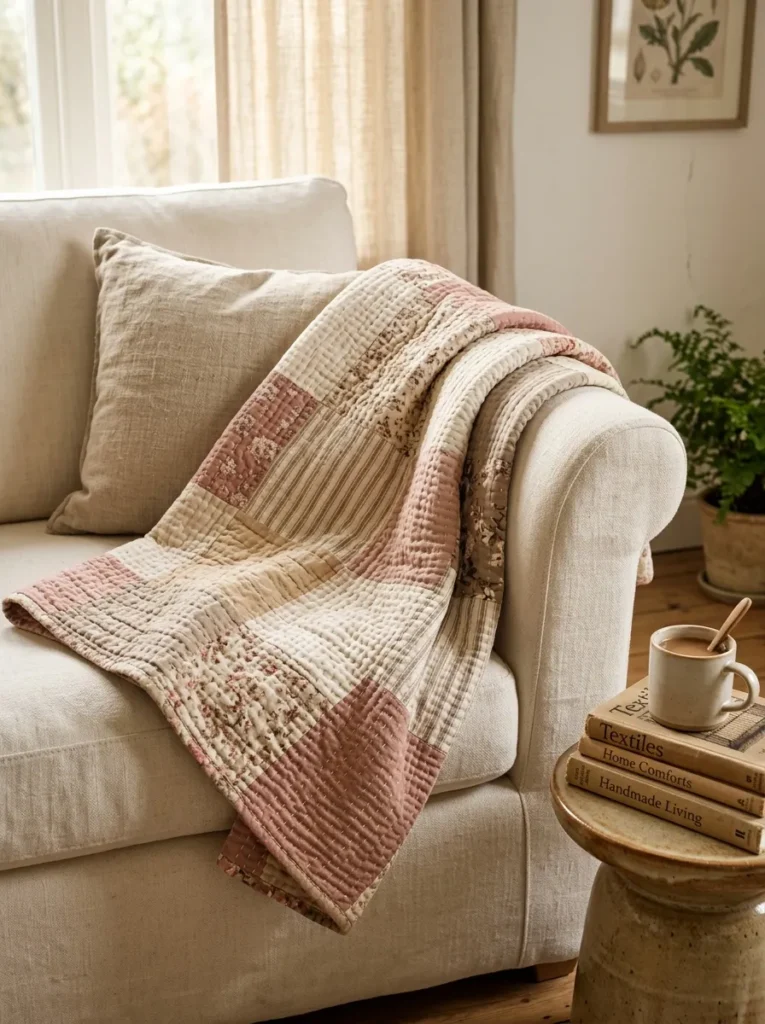
Vibe: The sofa is lived-in — a hand-quilted throw draped with casual intention is the fastest single object that transitions a sofa from showroom to home.
Why it works: Hand-stitched quilts have visible imperfection in the stitch line — a slight wobble, a knot on the surface, a variation in stitch spacing — that communicates human labor in a way that machine quilting’s perfectly uniform stitching cannot. This imperfection is not a flaw; it’s the signal that someone made this. Draped rather than folded, a quilted throw introduces layered textile depth to a sofa: the combination of the sofa upholstery beneath and the quilt’s patchwork surface creates a tonal layering effect across two textures simultaneously.
How to get it: Source hand-quilted throws from Etsy makers or antique markets — genuine vintage American or Japanese boro quilts are among the most beautiful handcrafted textiles available and can be found for $40–$120. For new pieces, specify “hand-quilted” (not “hand-stitched facing machine-quilted” — read the listing carefully) from independent makers.
Quick Win: Drape the throw diagonally across one sofa arm and seat rather than folding it over the back — the asymmetric placement reads as artful rather than a throw left behind.
Shop The Look
- Hand quilted cotton throw blanket patchwork
- Cream linen sofa slipcover modern
- Oat linen square throw pillow cover set
- Ceramic side table small round
- Hardback art and design books set
10. Forged Iron Coat Hooks in an Entryway
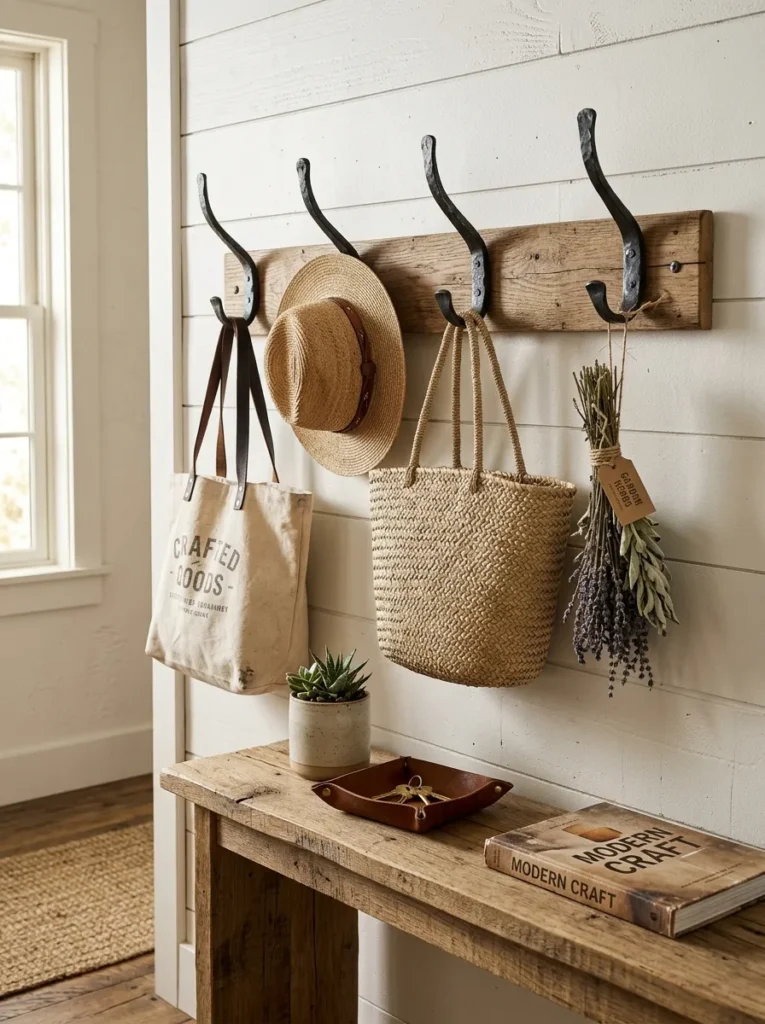
Vibe: The entryway is artisan — hand-forged iron hooks turn the most functional wall in the house into a material statement.
Why it works: Hardware is the jewelry of a room — and nowhere is this truer than in an entryway, where hooks are among the most-touched objects in daily use. Hand-forged iron hooks have a hammer-textured surface that catches light differently from every angle, with a depth that cast iron or zinc die-cast alternatives entirely lack. Mounting them on a raw oak plank (rather than screwing them directly into drywall) creates a visual base that unifies the hooks as a composition and allows for easy relocation without patching multiple holes.
How to get it: Look for blacksmiths on Etsy who make hooks to order — a set of four hand-forged iron hooks typically runs $60–$120, significantly less than equivalent decorative hardware from retail home stores. Specify “raw oil finish” or “beeswax finish” rather than lacquer-coated black, which chips and looks synthetic.
Shop The Look
- Hand forged iron wall hook set blackened
- Raw oak wall mounting board plank
- Linen canvas tote bag natural
- Woven straw wide brim hat wall decor
- Dried herb bundle twine tied decor
11. Handmade Soy Wax Candles in Vintage Glass Vessels

Vibe: The shelf is intimate — handmade candles in mismatched vintage glass have a personal, made-with-care quality that store-bought vessels never carry.
Why it works: Soy wax has a naturally matte, slightly rough surface after cooling (unlike the smooth glossy finish of paraffin), and this textural difference is visible — it confirms the candle was hand-poured rather than machine-filled. Mismatched vintage glass vessels (collected rather than purchased as a set) create an evolving, layered display because each piece has its own history in the glass itself: small bubbles, slight color variations, embossed lettering. The display grows more interesting as each candle burns down at its own pace.
How to get it: Pour your own in 15 minutes using a soy wax kit ($25–$35 for 2 lbs of wax, fragrance, and wicks from CandleScience) poured into thrift-store glass vessels. Or source from independent candle makers on Etsy who pour into vintage glass — look for cotton or wooden wicks and fragrance-free or essential-oil-scented options.
Quick Win: Any jam jar becomes an artisan candle vessel — melt a soy wax tea light into the bottom of a clean jam jar, press in a cotton wick tab, and you have a handmade candle in under 10 minutes.
Shop The Look
- Soy wax candle making kit beginner
- Vintage glass tumbler set mismatched
- Cotton candle wick tabs pack
- Ceramic plate tray for candle display
- Essential oil candle fragrance set natural
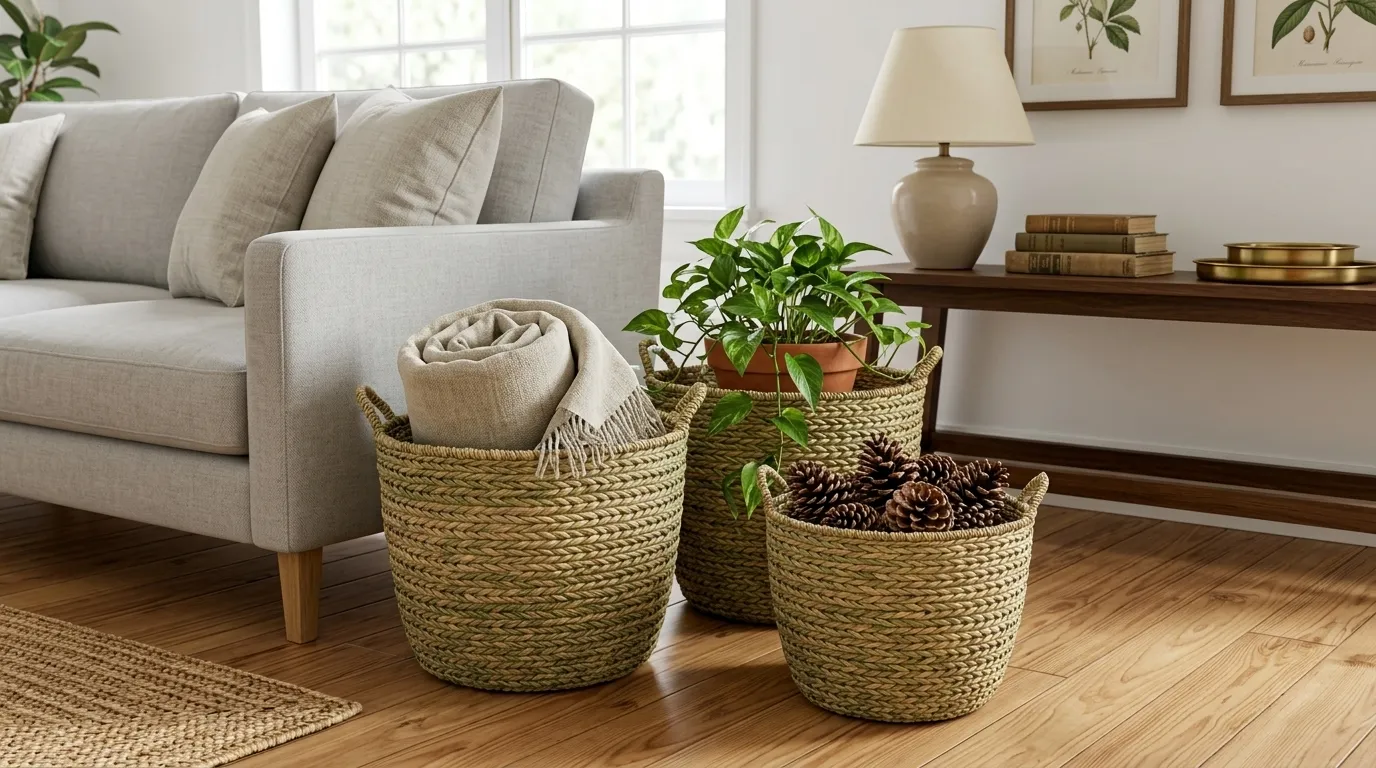
12. Woven Seagrass Baskets as Open Storage and Display
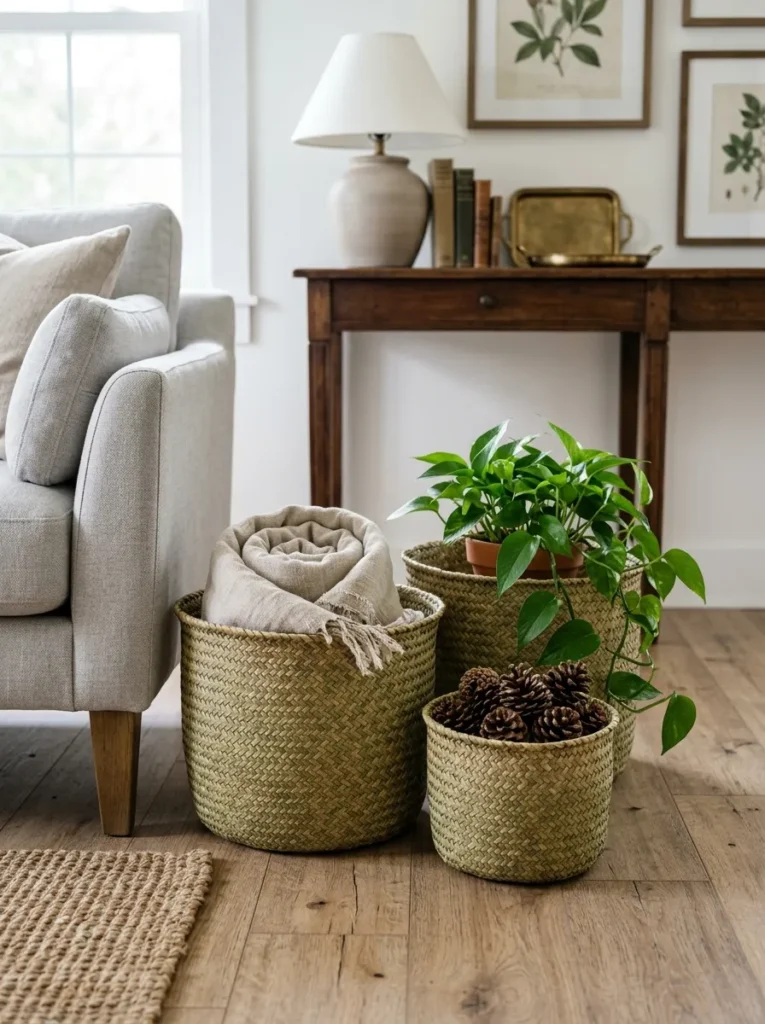
Vibe: The corner is organized — woven baskets make storage look like decoration, turning the contents of the room into part of the visual composition.
Why it works: Woven seagrass baskets work on the principle of visible organization — storage that can be seen and identified without being opened. The natural fiber’s color variation (seagrass ranges from warm green when fresh to honey-tan as it dries) adds organic warmth that painted wood or plastic bins cannot provide. Grouping baskets in three sizes at floor level creates a composition that anchors a corner or sofa end, adding visual weight to a zone that might otherwise feel empty.
How to get it: Size proportion matters: the largest basket should be at least 14 inches in diameter at the opening to hold a full throw blanket without compressing it into a bundle — compression makes handmade textiles look sloppy. The medium basket (10–12 inches) works for books or remotes; the small (6–8 inches) for small plants, candles, or objects.
Shop The Look
- Hand woven seagrass basket set 3 sizes natural
- Rolled linen throw blanket oat storage
- Small trailing pothos plant artificial realistic
- Natural pinecone decorative bowl filler
- Seagrass lidded storage basket medium
13. Hand-Painted Ceramic Tile Tray as a Kitchen Display
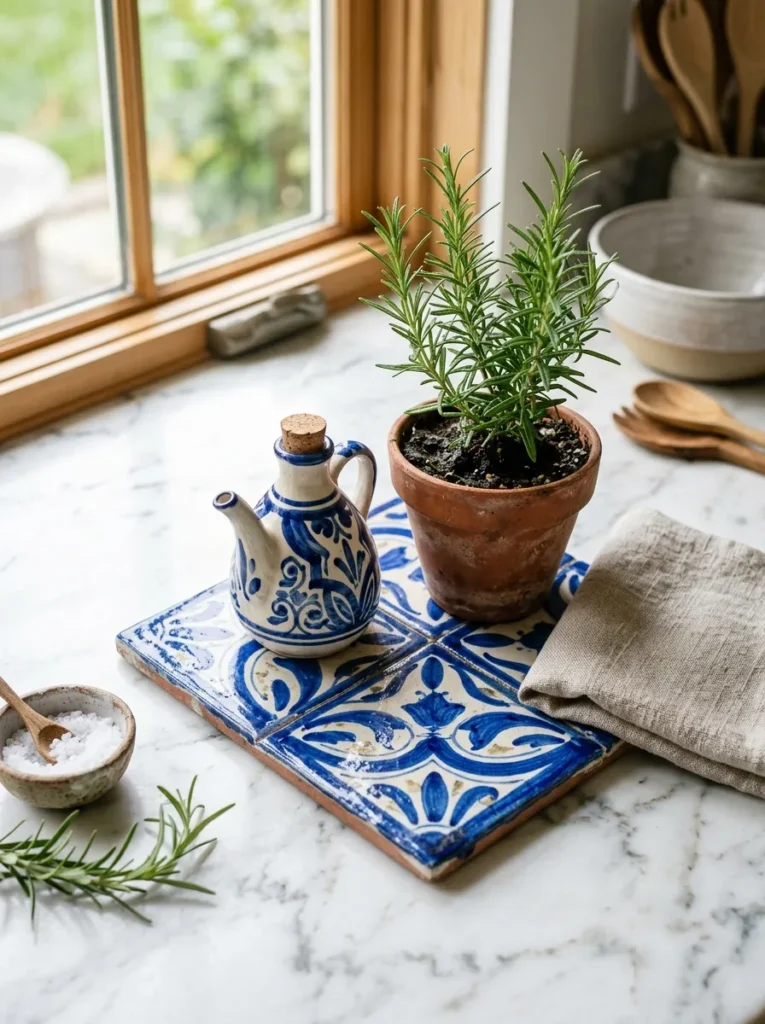
Vibe: The counter is bright — a single hand-painted ceramic tile transforms a kitchen surface arrangement from practical to purposeful.
Why it works: A decorative tile used as a tray exploits its glazed surface’s heat and moisture resistance while functioning as a composition frame — every object placed on it becomes part of a curated display rather than counter clutter. Hand-painted ceramics from Mediterranean, Portuguese azulejo, or Talavera traditions carry centuries of artisan pattern language in their brushwork, giving a kitchen counter the visual depth of collected objects rather than purchased accessories. The cobalt blue and aged white palette is perennially functional in kitchens because it reads as clean without being clinical.
How to get it: Source hand-painted tiles from Portuguese or Spanish ceramic importers, or from Etsy makers working in Mediterranean traditions — a single 8×8 or 6×6 tile runs $15–$40 and becomes a permanent display tray. Add small rubber feet to the underside to prevent scratching the countertop.
Quick Win: Stick four clear rubber bumper pads (under $5 for a pack) to the underside of any decorative ceramic tile you already own and it instantly becomes a heat-safe, stable kitchen tray.
Shop The Look
- Hand painted blue white ceramic tile decorative
- Ceramic olive oil pourer bottle kitchen
- Small terracotta herb pot with drainage
- Linen kitchen cloth set natural
- Ceramic salt pinch bowl handmade
14. Linen and Leather Bookbinding as Shelf Decor
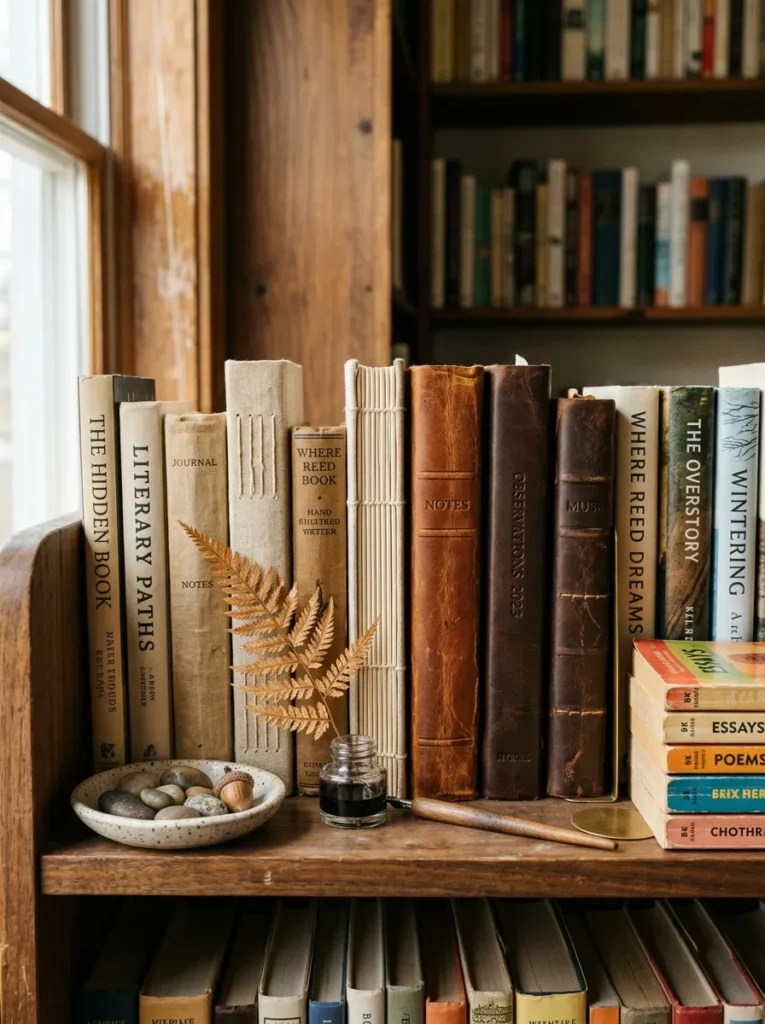
Vibe: The shelf is literary — hand-bound journals displayed spine-out among books give a bookshelf the warmth of a personal archive rather than a furniture display.
Why it works: Hand-bound books and journals have exposed spine stitching — the Coptic or long-stitch binding thread visible on the spine edge — that mass-produced books cover with printed paper. This exposed craft detail reads as intentional and artisan against the uniform printed spines of regular books, creating contrast that draws the eye. Displayed spine-out in varying heights, they function as both bookends and sculptural objects simultaneously, which is the most efficient use of shelf space available.
How to get it: Source hand-bound journals from bookbinding artists on Etsy or bind your own using a basic Coptic stitch kit ($20–$30 includes linen thread, awl, bookboard, and instructions). Arrange in groups of two or three between regular books rather than clustering them all together — distributed across the shelf, they elevate the entire display.
Shop The Look
- Hand bound linen journal hardcover blank
- Cognac leather journal hand stitched
- Ceramic small dish pebble display
- Dried preserved fern botanical decor
- Bookbinding kit beginner Coptic stitch
15. Hand-Thrown Stoneware Dinnerware as Everyday Display
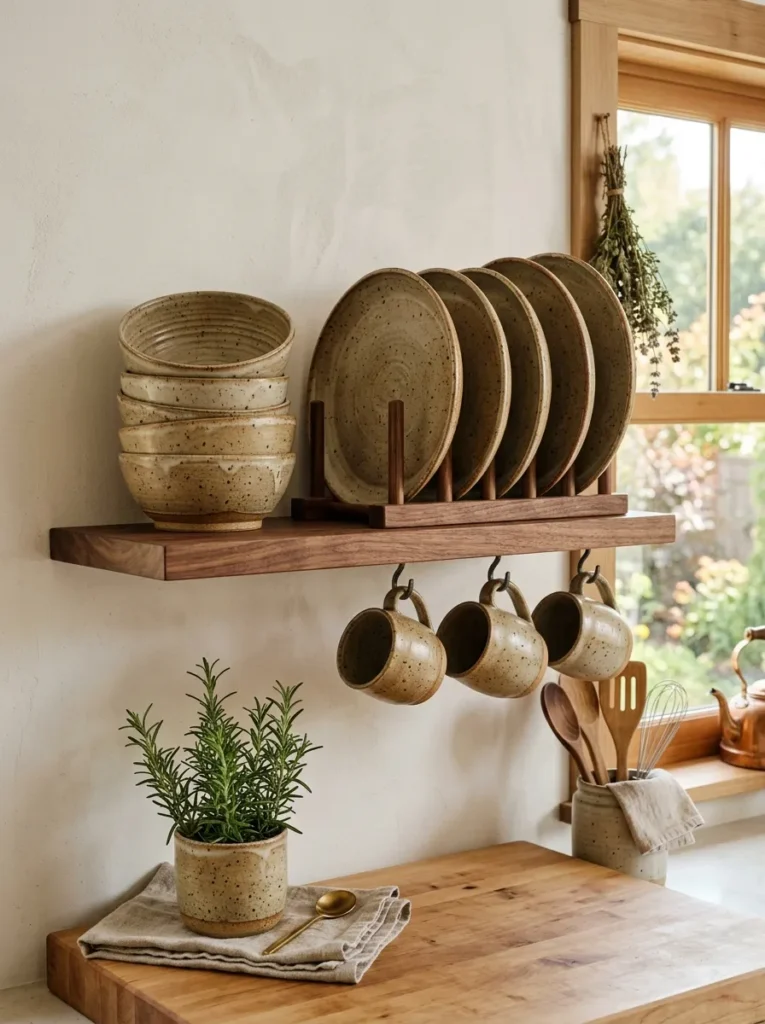
Vibe: The kitchen is artisan — hand-thrown stoneware displayed on open shelves turns the most functional room in the house into its most beautiful.
Why it works: Open-shelf display of handmade dinnerware exploits the beauty of the objects themselves as the decoration — no styling required beyond arrangement. Hand-thrown stoneware’s speckled glaze and visible throwing rings turn a stack of bowls into a visual object; the slight size variation between pieces confirms their handmade origin and gives the display an organic quality that uniform machine-made sets lack. Displayed on walnut shelving (warm wood paired with warm clay tones), the arrangement creates tonal harmony across the kitchen’s vertical plane.
How to get it: Begin with a cohesive glaze family rather than a matching set — choose two or three glaze colors from the same maker (ash white, warm grey, and matte clay, for example) that are designed to work together but aren’t identical. This creates the collected-over-time feeling of genuine handmade display without mismatched chaos.
Quick Win: Display your mugs handle-out in a row rather than stacked — it reveals the thrown form of each mug individually and makes the collection look intentional at zero cost.
Shop The Look
- Hand thrown stoneware mug set speckled glaze
- Stoneware bowl set ash glaze handmade
- Walnut floating wall shelf kitchen display
- Linen dish cloth set natural
- Ceramic utensil holder kitchen handmade
How to Start Your Handcrafted Decor Transformation
The single most powerful first move is to add one hand-thrown ceramic piece to your most-used surface — a kitchen counter, a coffee table, a bathroom shelf. Not a set. One piece. A single matte stoneware bowl or bud vase in a warm clay tone anchors the entire surface with a quality that immediately distinguishes it from the surrounding mass-produced objects. Start there, and everything else you add will calibrate toward that standard.
The most common beginner mistake with handcrafted decor is grouping too many pieces together too quickly. The impulse to fill a shelf with every beautiful handmade object at once actually diminishes each piece — they compete rather than breathe. The fix is the rule of three: no more than three handcrafted objects on any given surface, with deliberate negative space between them. If a fourth piece arrives, something comes off.
Three items under $50 that make an immediate handcrafted impact: a single dried pampas grass bundle in a vessel you already own ($12–$18 at a farmers market or craft store); a set of beeswax taper candles in pure unscented beeswax ($14–$20 for six); and a hand-loomed linen napkin set in natural oat or aged white ($22–$35 for four) that makes every meal feel considered.
Handcrafted decor transformation doesn’t require a renovation timeline. A single afternoon spent rearranging what you own — grouping in threes, clearing negative space, adding one ceramic piece — is a realistic weekend project. A full room transformation toward a genuinely handcrafted interior takes three to six months of intentional collecting, with a realistic starting budget of $150–$400 for the first meaningful layer of artisan objects.
Frequently Asked Questions About Handcrafted Home Decor
What is the difference between handcrafted and handmade decor?
Handcrafted refers to objects made using a specific skill-based craft technique — throwing, weaving, forging, carving — that requires training and produces a distinct material result. Handmade is a broader term that includes any object assembled by hand, including those using pre-made components or kits. In practical terms, a hand-thrown ceramic vase is handcrafted; a vase decorated with stickers at home is handmade. For home decor, the distinction matters because handcrafted objects carry the specific material qualities — throwing lines, weave variation, hammer texture — that create the warmth and visual interest that purely assembled handmade objects may not.
What colors work best with handcrafted decor?
Warm organic tones are universally the right foundation for handcrafted interiors. Specifically: warm white (Benjamin Moore Chantilly Lace OC-17 or Sherwin-Williams Alabaster SW 7012) on walls, warm wood tones (walnut, cherry, white oak) for furniture and shelving, and earth-accent colors — terracotta, dusty sage, warm ochre, or deep indigo — introduced through ceramics and textiles. Cool greys and stark whites create contrast that can make handmade objects look rough or unfinished rather than intentionally artisan. If you have a cool-toned existing interior, introduce warmth first through a single textile — a natural linen throw or a jute rug — before adding ceramics or wood pieces.
How much should I spend on handcrafted decor pieces?
Quality handcrafted pieces range widely: a hand-thrown ceramic mug from an independent maker runs $28–$65; a hand-knotted wool rug in 5×8 runs $200–$600; hand-forged iron hooks run $15–$30 each. The most cost-effective entry points are farmers markets and local craft fairs, where maker prices are typically 30–40% lower than the same maker’s Etsy shop due to no platform fees. A realistic first-layer handcrafted decor budget is $150–$300 — enough for one quality ceramic piece, a dried botanical arrangement, beeswax candles, and a linen textile that collectively transform a room’s character.
Can handcrafted decor work in a modern or minimalist interior?
Absolutely — in fact, a single handcrafted piece in a minimal interior carries more visual power than in a maximalist one precisely because nothing competes with it. The key is selecting handcrafted pieces with clean forms: a matte stoneware bowl with a simple silhouette, a hand-forged hook without ornate detail, a macramé piece in natural undyed cotton rather than multicolor yarn. Japanese mingei tradition is the direct precedent — the most refined minimalist interiors in the world are built around handcrafted folk objects. The craft detail and the minimal form are not in conflict; they enhance each other.
What is the best way to display handcrafted decor without it looking cluttered?
The most effective display principle is the rule of odd numbers with deliberate negative space: group handcrafted objects in threes (or fives for larger surfaces), leave at least 30% of any surface clear, and vary height within each grouping. Place the tallest object at the back or side, the medium piece at center, and the smallest at the front or opposite side. Every grouping should have one rough texture (ceramic, woven basket), one smooth texture (glass, polished wood), and one organic element (dried botanical, stone, fresh plant). This three-part composition formula works on any surface — shelf, coffee table, mantel, or counter — and prevents the visual competition that makes a handcrafted collection look like clutter.
Ready to Bring Handcrafted Warmth Into Your Home?
These 15 ideas span the full range of what handcrafted decor can offer — from the texture of a hand-knotted rug underfoot and the shadow pattern of a woven rattan pendant overhead, to the visible stitching on a quilted throw and the throwing lines on a stoneware bowl catching morning light. You don’t need to introduce all of this at once; the most intentional handcrafted interiors are built piece by piece, each object chosen with the same care that went into making it. Start today by choosing one surface in your home and placing a single handcrafted object on it — one ceramic, one dried stem, one beeswax candle — and notice how the standard of the entire space shifts upward around it. A home filled with handcrafted objects doesn’t just look warmer; it feels different to live in, because every object in it carries the trace of a human being who made it with care. Pin the ideas that stopped your scroll — in handcrafted decor, the ones that catch you are always the ones worth coming back to.