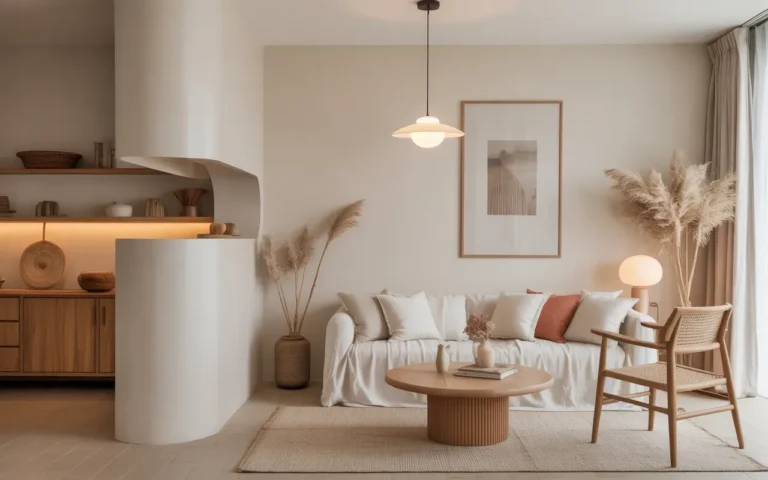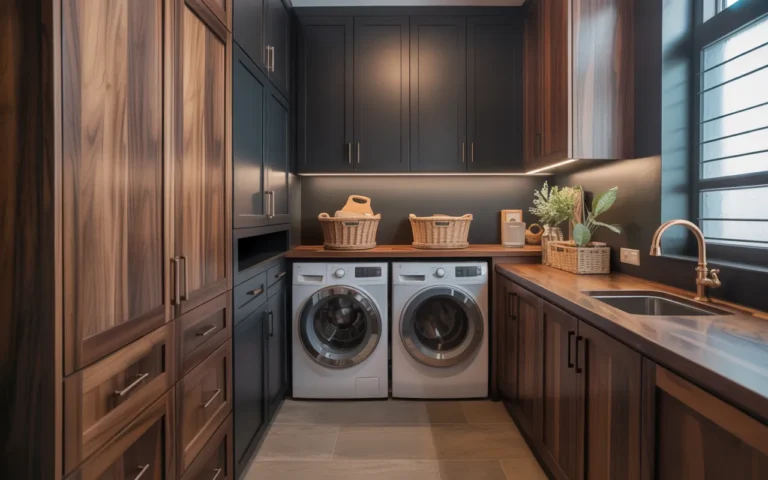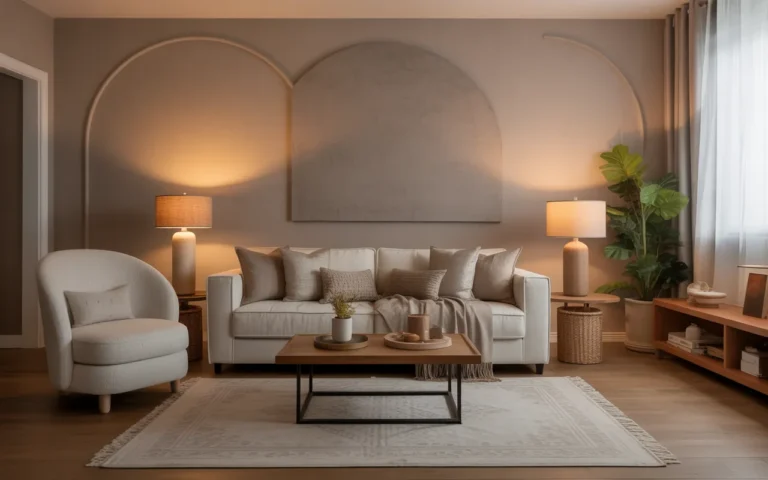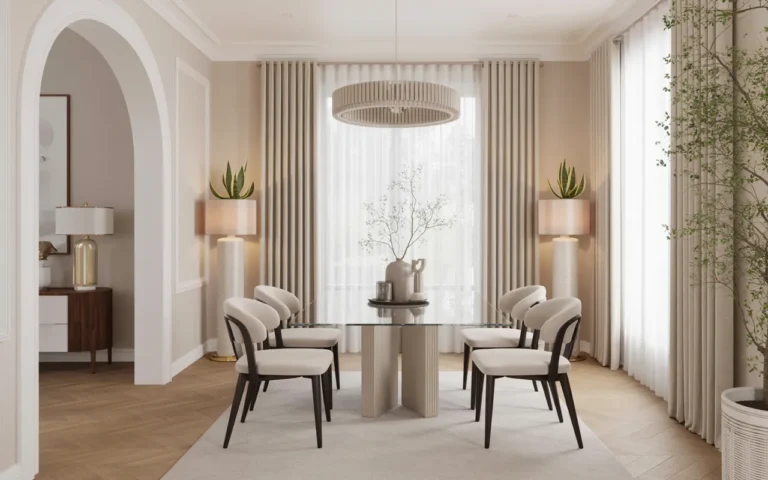
13 Media Wall Ideas That Look Modern and Luxe
Media wall ideas that look modern and luxe use the television’s largest wall as an architectural opportunity — built-in joinery, layered lighting, natural stone, decorative panels, and curated styling that transforms what is typically the most neglected surface in a living room into its most considered feature. This article gives you exactly 13 ideas spanning material choices, lighting systems, shelving configurations, color palettes, and small-space solutions so every room size and budget finds a media wall approach that reads as genuinely designed.
A media wall done right makes the television disappear into something larger — a composition of materials, light, and objects that holds the room’s attention whether the screen is on or off. The television becomes one element in a considered architectural moment rather than a black rectangle on a white wall. That transformation — from utility to feature — is what separates a media wall from a TV setup, and it is achievable at every scale from a rented apartment to a full renovation. Here are 13 ideas worth saving — and building.
Why Media Wall Ideas That Look Modern and Luxe Work So Well
The media wall as a distinct interior design category emerged from two converging shifts in residential design: the dramatic reduction in television depth that flatscreen technology enabled from the mid-2000s onward (which made wall-mounting architecturally viable for the first time) and the parallel design movement toward open-plan living that made the television’s primary wall simultaneously the most visible surface in the combined living-dining space and the most important one to address with intentional design. Where previous generations placed the television in a corner or entertainment center that acknowledged its functional status, the flatscreen era invited a different approach — treating the television wall as the room’s architectural statement.
The materials that define the modern luxe media wall draw from high-end hospitality and residential design: book-matched marble or large-format porcelain slabs for textural and material drama, fluted oak or walnut panels for warmth and tactile richness, painted MDF joinery in deep tones (warm charcoal, forest green, midnight navy) for architectural definition, and LED strip lighting integrated behind panels and beneath shelves for the ambient luminosity that makes the composition readable in low light. Color palette centers on the warm-dark end of the design spectrum — warm charcoal, deep navy, forest green, and warm black for the architectural surround, contrasted with natural wood accents, brass or aged gold hardware, and the warm glow of integrated lighting. Neutral-light media walls (white or cream joinery) read as designed but lose the depth and drama that make a media wall genuinely luxe rather than merely tidy.
Pinterest searches for “media wall ideas,” “built-in TV wall,” and “luxury living room TV wall” have grown substantially year over year since 2020, driven by the working-from-home and nesting periods that prompted significant investment in living room quality during extended periods of home occupation. The design media’s coverage of the media wall as a renovation category has similarly expanded — publications including Architectural Digest, House Beautiful, and Livingetc have devoted increasing editorial space to media wall design since 2021, reflecting and amplifying mainstream consumer interest in the category. The emotional driver is simple: the television wall is unavoidable, and making it something you’re proud of rather than something you manage produces a meaningful improvement in the daily quality of the spaces most people inhabit most frequently.
Small living rooms — the majority of urban apartments and terraced houses — benefit particularly from a well-designed media wall because the feature creates the illusion of greater depth and architectural character than the room’s actual dimensions suggest. A floor-to-ceiling joinery unit with integrated lighting and a floating hearth shelf reads as deliberately designed spatial enclosure regardless of the room’s size. The honest constraint: floating media joinery in rooms under 3 meters wide can feel overwhelming if built to full floor-to-ceiling depth — in narrow rooms, a more shallow floating shelving configuration with a focused central panel delivers the design impact without the claustrophobic weight of full-depth built-ins on both flanks.
Style at a Glance
| Element | Architectural Function | Luxe Design Edge |
|---|---|---|
| Philosophy | The TV wall becomes the room’s feature | Material and light do the work |
| Materials | MDF joinery, porcelain, LED strip | Fluted oak, book-matched marble, aged brass |
| Color Palette | Warm charcoal, deep navy, forest green | Warm black, forest green, slate |
1. Full-Height Fluted Oak Panel Media Wall with Integrated LED Niches
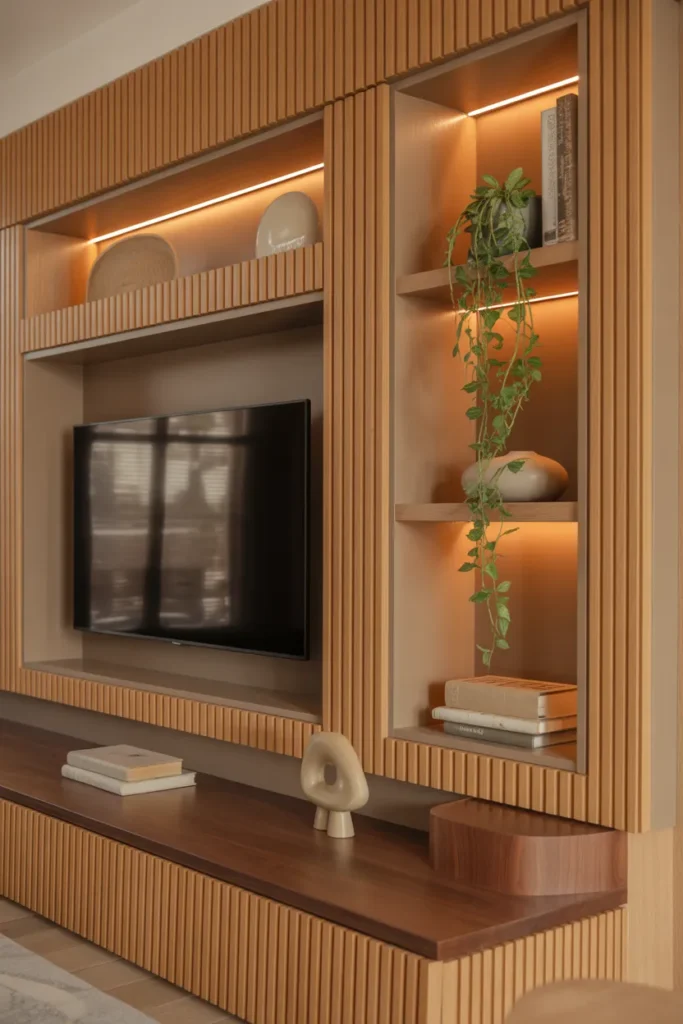
Vibe: The wall feels architectural and warm simultaneously — a surface that makes the rest of the room lean toward it.
Why it works: Fluted oak panel cladding applied floor-to-ceiling applies the architectural design principle of textural continuity — a single material applied consistently across the full wall plane creates an uninterrupted field of surface interest that reads as intentional building rather than applied decoration. The vertical flute profile catches light at a grazing angle, creating subtle shadow lines that shift throughout the day as the light source changes — the wall is never visually static. Recessed niches with integrated LED strip lighting behind the TV and on flanking shelves apply the hospitality lighting principle of reverse illumination — lighting that shines out from recessed openings rather than down from the ceiling creates a fundamentally different (warmer, more atmospheric) quality of light in the room.
How to get it: Source fluted oak MDF panels (available as pre-made cladding sheets from specialist joinery suppliers and timber merchants) and install over a framed MDF substrate that accommodates the recess depth of the TV niche (minimum 120mm for a standard slim TV with wall mount). Build flanking niches to 300mm depth, install LED strip lighting to the top inner edge of each niche (directed downward), and wire through the panel substrate for a clean, visible-cable-free result. The floating walnut shelf mounts on concealed steel brackets set into the substrate behind the panels.
Quick Win: Fluted MDF panel sheets ($45–85 per sheet from timber merchants) installed directly over an existing smooth wall and painted in a warm tone — without any recess work — create the full fluted panel aesthetic for a fraction of built-in cost and can be completed in a single weekend.
Shop The Look
| Product |
|---|
| Fluted oak MDF panel sheet cladding wall |
| LED strip light warm white 2700K adhesive |
| Floating shelf bracket concealed steel wall |
| Walnut floating shelf board natural |
| LED strip aluminium channel profile recessed |
Also view: 15 Handcrafted Decor Ideas for a Warm, Stylish Home
2. Large-Format Porcelain Stone Slab Media Wall
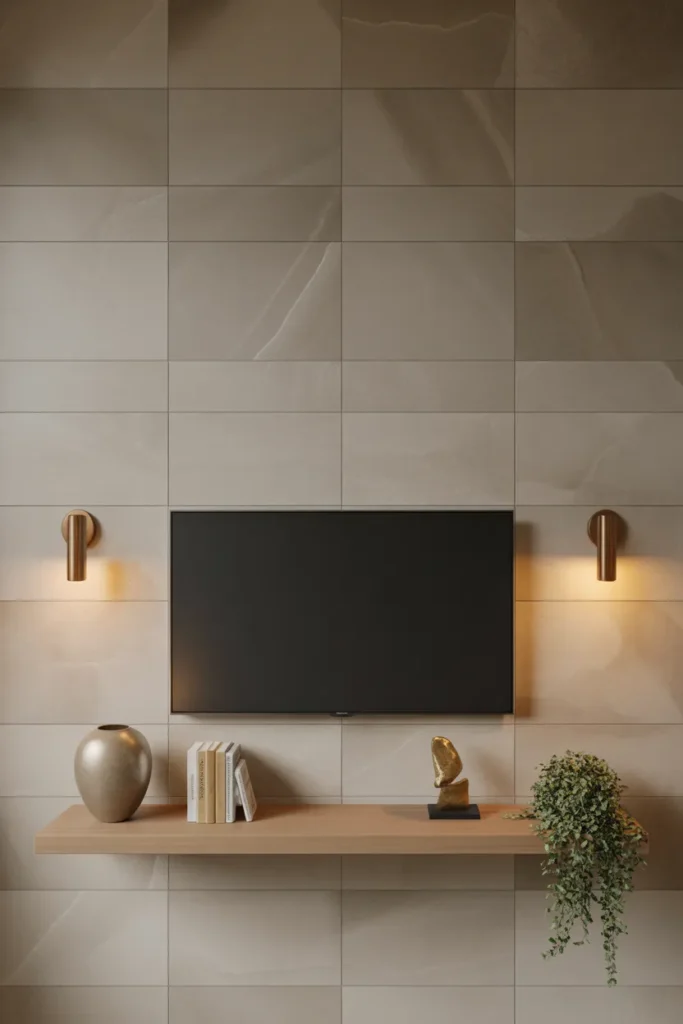
Vibe: The wall feels mineral and refined — the kind of surface that looks more expensive than it cost because stone reads as inherently architectural.
Why it works: Large-format porcelain slabs (1200×2400mm or larger) applied as a media wall surface apply the architectural principle of material continuity at monumental scale — the near-absence of grout lines across the full wall field creates the impression of a single continuous stone surface that reads as genuinely luxurious regardless of whether the material is natural stone or porcelain. Contemporary porcelain tile printing technology has reached a fidelity of natural stone replication that makes visual distinction from natural marble or travertine essentially impossible at room scale, delivering the visual impact of natural stone at 20–30% of the cost and with zero maintenance requirements (porcelain requires no sealing, tolerates household cleaning products, and does not stain). Brass sconce lighting at shelf height provides the warm-toned light that makes stone surfaces glow rather than appear flat.
How to get it: Specify large-format porcelain tile in a warm gray with natural veining (Calacatta Oro, Statuario, or Atlas Plan equivalents from Italian porcelain manufacturers) in the largest format your wall height accommodates. Install with a specialist large-format tile adhesive (standard tile adhesive lacks the coverage rate for slabs over 600×1200mm). Request book-matched installation (adjacent tiles rotated to create a mirrored vein pattern) from your tile installer for maximum luxury visual impact. Mount the TV on a slim-profile wall mount that keeps the screen within 25mm of the tile surface.
Shop The Look
| Product |
|---|
| Large format porcelain tile 1200x2400mm stone effect |
| Large format tile adhesive specialist coverage |
| Aged brass wall sconce set living room |
| White oak floating shelf 120cm natural |
| Large ceramic vessel floor standing natural |
3. Painted Dark Joinery Media Wall with Brass Hardware Accents
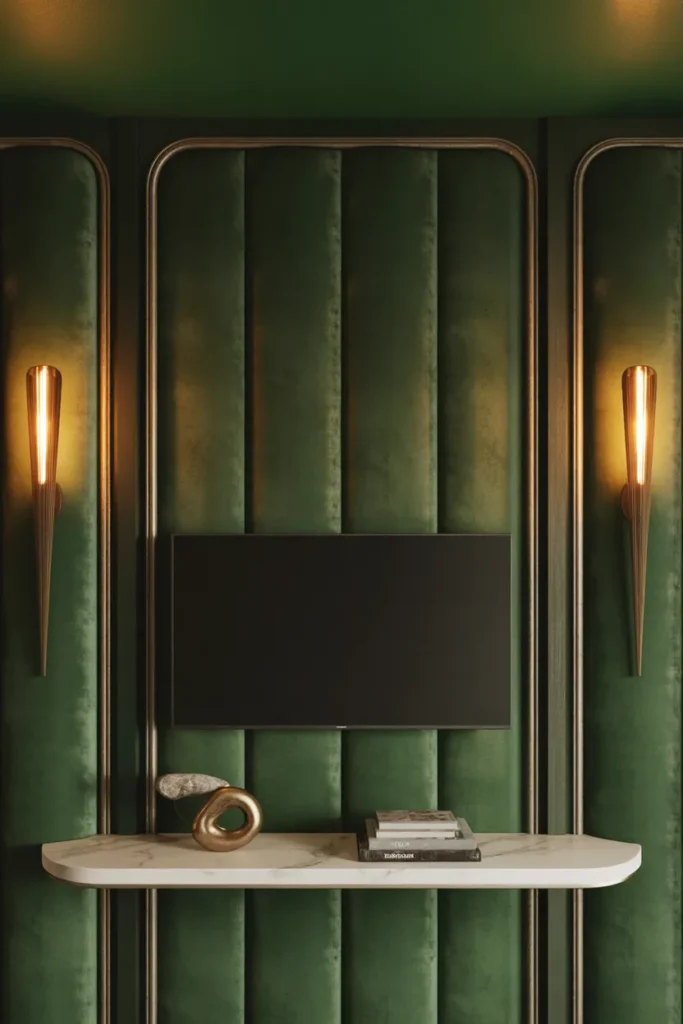
Vibe: The joinery feels deeply designed — a room that has been thought about at every level, from the floor to the cornice.
Why it works: Painted joinery in a deep warm charcoal applies the interior design principle of tonal depth through architectural volume — the dark paint tone recedes the joinery’s surface plane, making the open shelving niches and reeded glass doors appear to float within a deeper, darker field. This depth effect is the primary visual mechanism that makes dark painted joinery feel luxurious rather than heavy — the joinery’s surface appears to have more spatial dimension than equivalent light-toned joinery because the eye perceives the dark tone as further away. Reeded glass cabinet doors on the lower section introduce a secondary texture (the vertical reed profile of the glass) that catches and scatters light across the door surface, preventing flat, matte-painted doors from reading as uniform and uninteresting.
How to get it: Build or commission the joinery from MDF with a furniture-grade primer undercoat and two coats of a high-opacity eggshell paint — Farrow & Ball Railings No. 31, Little Greene Loft or Urbane Grey, or Dulux Heritage Charcoal — applied by brush and roller for the most professional finish. Specify reeded glass (ribbed pattern, not frosted) from a glazing supplier for the lower cabinet inserts. Install aged brass bar pulls rather than cup handles — the elongated bar form reads as more contemporary and architecturally resolved than a round knob in this context.
Shop The Look
| Product |
|---|
| Warm charcoal furniture paint eggshell litre |
| Reeded glass panel insert cabinet door |
| Aged brass bar pull handle set 160mm |
| Adjustable shelf bracket set furniture grade |
| LED under-shelf strip light warm white |
4. Forest Green Velvet Panel Media Wall with Gold Trim Detail
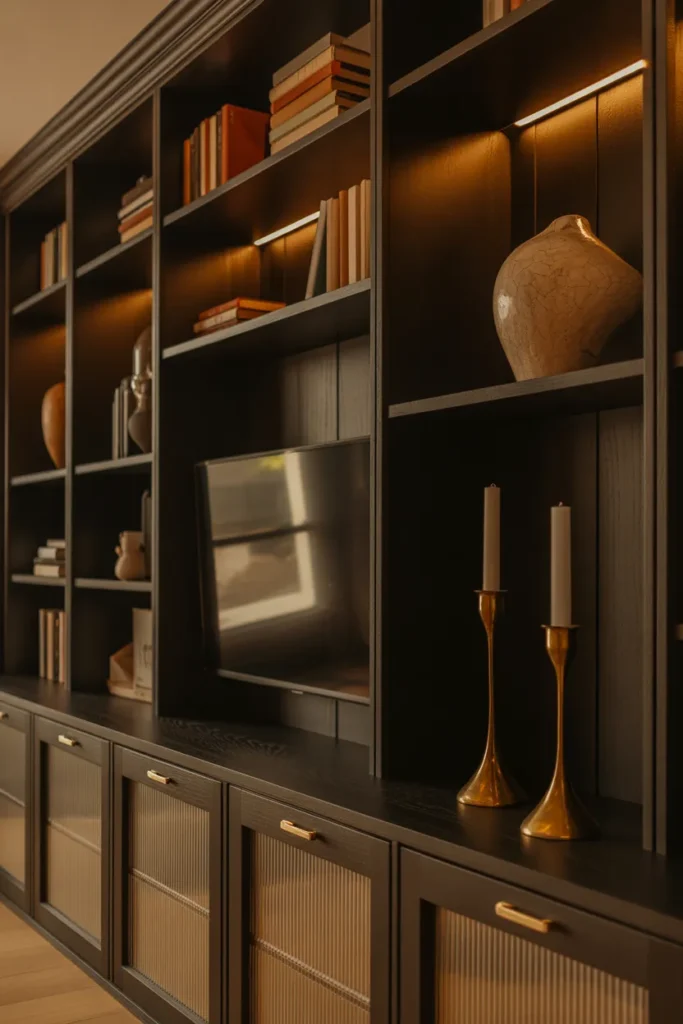
Vibe: The wall feels genuinely glamorous — the kind of interior that references the best hotel lobbies without copying them.
Why it works: Upholstered velvet panel walls with gold trim apply the interior design principle of hospitality register transfer — the specific combination of deep jewel-tone velvet, slim gold trim framing, and warm wall sconce lighting is the defining visual language of high-end hotel lobby and bar design, and bringing it into a residential media wall context creates an immediate atmosphere of considered luxury. The velvet surface’s pile absorbs and reflects light simultaneously — the surface appears to shift between deep and luminous as the viewing angle changes, creating a living quality that flat paint, wallpaper, and even most cladding materials cannot replicate. Extending the wall color to the ceiling (painting the ceiling the same forest green as the velvet panels) prevents the color from reading as a single feature element and creates an enveloping quality of total chromatic immersion.
How to get it: Construct the velvet panel system from 18mm MDF backing panels cut to the desired dimensions, upholstered with commercial-weight upholstery velvet (minimum 140,000 Martindale rub count for a wall panel that will be occasionally touched) stapled to the back and stretched taut to the face. Apply slim gold trim molding (available from architectural molding suppliers in a range of profiles — a 15mm flat gold trim is the cleanest contemporary interpretation) around each panel perimeter using panel adhesive and pin nailing. Mount panels to the wall using a French cleat system for removability.
Shop The Look
| Product |
|---|
| Forest green upholstery velvet fabric metre |
| Slim gold trim molding strip architectural |
| Antique gold wall sconce set of 2 |
| French cleat panel mounting system |
| Marble effect floating shelf console media |
5. Floating Media Unit with Negative Space and Ambient Backlighting
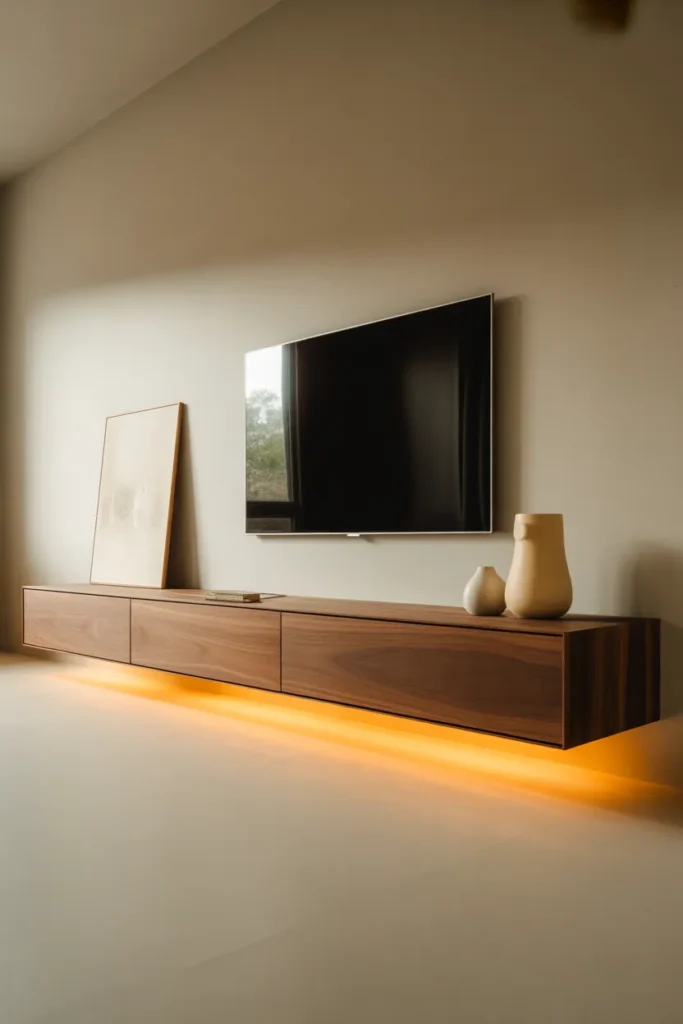
Vibe: The wall feels calm and resolved — the unit’s full-width proportion making the wall feel settled in a way that no standard TV unit achieves.
Why it works: A full-width floating media unit at consistent floor-to-unit height applies the architectural design principle of datum line — a continuous horizontal element at a consistent height that runs the full width of a space creates a visual baseline that organizes everything above it (the TV, any art, the wall space) into a unified composition. This is the same principle that makes picture rails, dado rails, and continuous window sill heights feel architecturally resolved. The LED underside lighting that casts a glow on the floor below the unit applies the lighting design technique of reveal lighting — light that emphasizes the gap between a floating element and the floor makes the element appear to hover and simultaneously illuminates the floor plane without any overhead light source.
How to get it: Build the floating unit from 18mm furniture-grade MDF faced with real walnut veneer (0.6mm thickness) on all visible surfaces, finished with a matte waterborne lacquer. Mount on concealed wall brackets (steel floating shelf hardware rated for minimum 100kg distributed load) at 400mm from the floor. Run a warm-white LED strip along the full-length underside of the unit in an aluminum channel with a frosted diffuser lens to prevent hot spots in the floor glow.
Shop The Look
| Product |
|---|
| Walnut veneer sheet furniture grade 0.6mm |
| Full width floating shelf bracket set heavy duty |
| LED strip light warm white 2700K with diffuser |
| Aluminium LED channel frosted lens profile |
| Push-to-open cabinet hinge furniture hardware |
6. Micro-Cement Render Media Wall with Recessed TV and Shelf
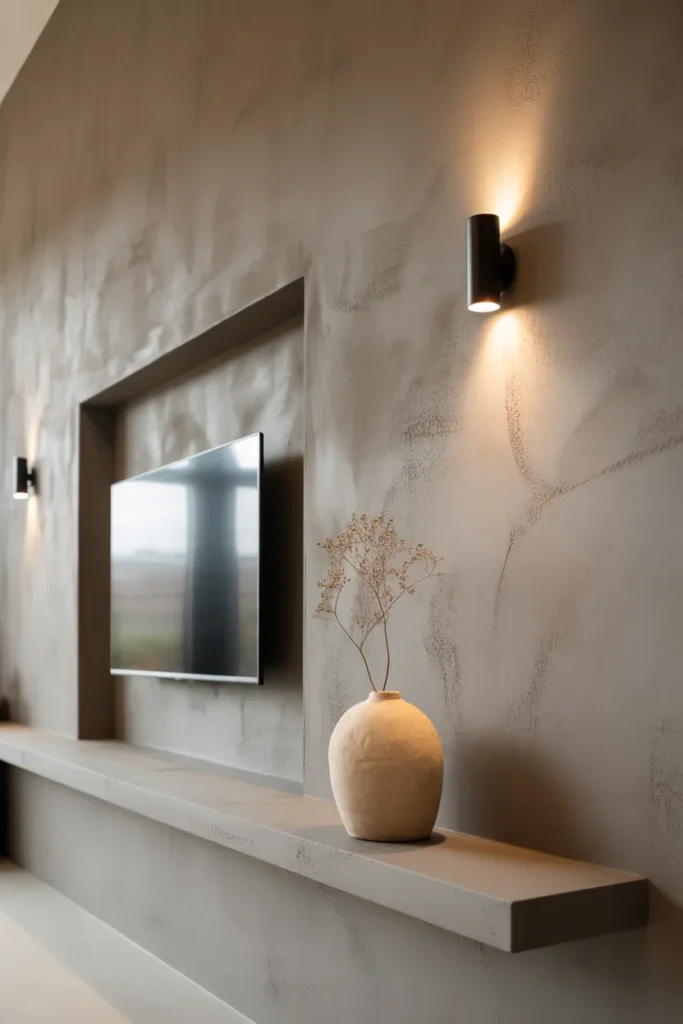
Vibe: The wall feels raw and expensive at the same time — micro-cement achieving the precise material paradox that makes it the most requested finish in contemporary residential design.
Why it works: Micro-cement render applied to a media wall applies the material design principle of continuous surface without joint — unlike tile, wallpaper, or panel cladding systems, micro-cement creates a genuinely seamless surface across the full wall (and can extend to the floor and ceiling without interruption) that reads as a single monolithic material rather than an assembled finish. This monolithic quality is visually associated with high-budget architectural projects (concrete-poured walls, polished plaster) and transfers that association to the finished residential space regardless of cost. Micro-cement’s slight surface variation (the hand-application process leaves a subtle texture that varies across the surface) prevents the finish from reading as flat or uniform — the wall is visually active at close range without being patterned.
How to get it: Apply micro-cement over existing plaster or plasterboard in a minimum three-coat system: a primer coat, a base coat (approximately 2mm thickness), and a fine finish coat (approximately 1mm). Each coat requires 24 hours curing before the next application. The finish coat is sealed with a waterborne polyurethane sealer in matte finish. Application requires specialist skill — micro-cement is unforgiving of inconsistent technique, and the quality difference between an experienced and inexperienced applier is significant and immediately visible. Budget $70–120 per square meter for professional application including materials.
Shop The Look
| Product |
|---|
| Micro-cement kit primer base topcoat set |
| Micro-cement waterborne sealer matte |
| Matte black wall sconce set living room |
| Concrete effect floating shelf slim |
| Micro-cement trowel set application tools |
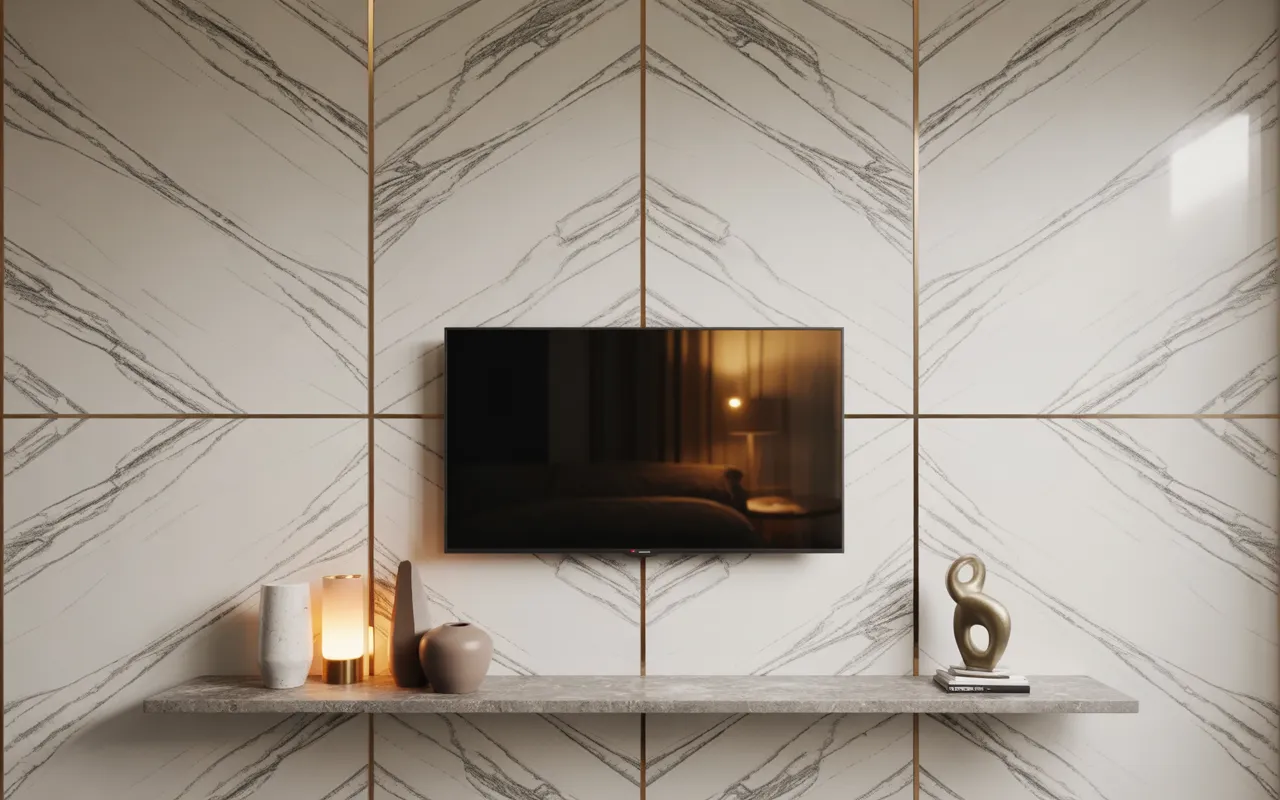
7. Bookmatched Marble Effect Porcelain with Brass Inlay Strip
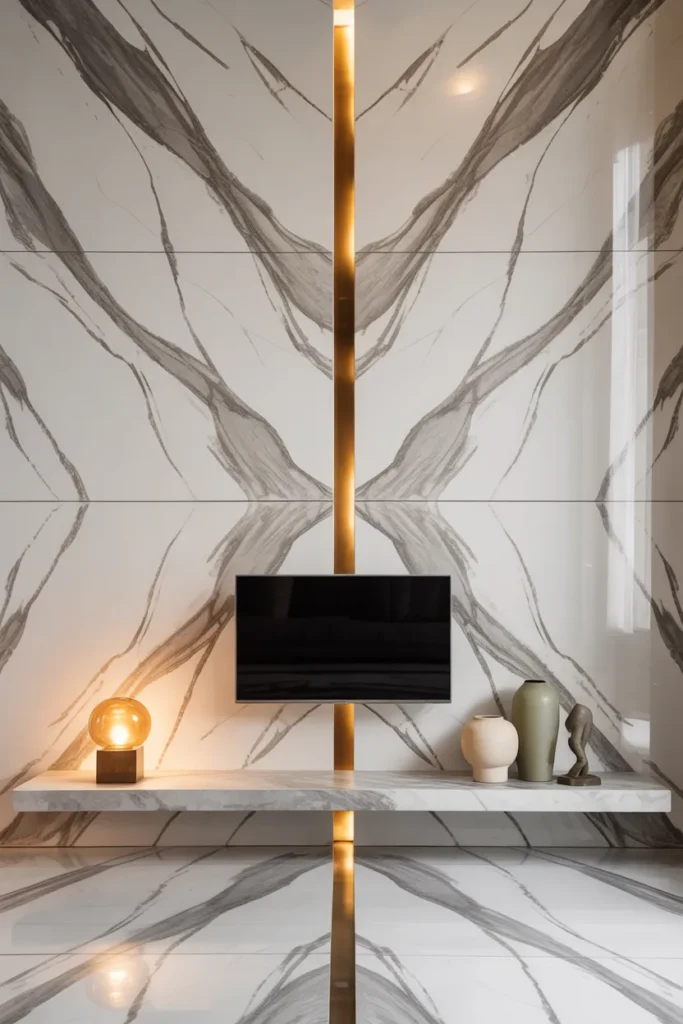
Vibe: The wall feels deliberately composed — the book-matched vein pattern a piece of artwork built into the architecture.
Why it works: Book-matched porcelain panels apply the luxury material principle of sequential installation — adjacent panels installed in a mirrored orientation so that their veining patterns align at the joint, creating a symmetrical, Rorschach-like natural pattern across the full wall width. This technique is borrowed directly from high-end natural stone installation (where actual marble slabs are cut from the same block and opened like a book to reveal the mirrored grain) and applies the same visual logic to the more durable, less expensive porcelain equivalent. The slim brass inlay strip between the panels is the detail that elevates the installation from competent to considered — the brass adds a material accent that references the room’s hardware palette while providing a defined visual joint between the two mirrored panels.
How to get it: Order book-matched porcelain panels (specify “book-matched” to the tile supplier — these are tiles printed to mirror across the joint when installed in sequence) in the largest available format. Source a 10mm flat brass strip from a metal supplier, cut to ceiling height, and set into the panel joint using tile adhesive and fine grout. Polish the brass strip with a clear lacquer coating immediately after installation to prevent tarnishing. Mount the honed marble shelf (or a convincing porcelain equivalent) on concealed brackets at the appropriate height below the TV.
Shop The Look
| Product |
|---|
| Book-matched marble effect porcelain panel large |
| Slim brass inlay strip 10mm flat bar |
| Clear lacquer spray metal protection |
| Honed marble floating shelf 120cm |
| Concealed bracket set heavy shelf mount |
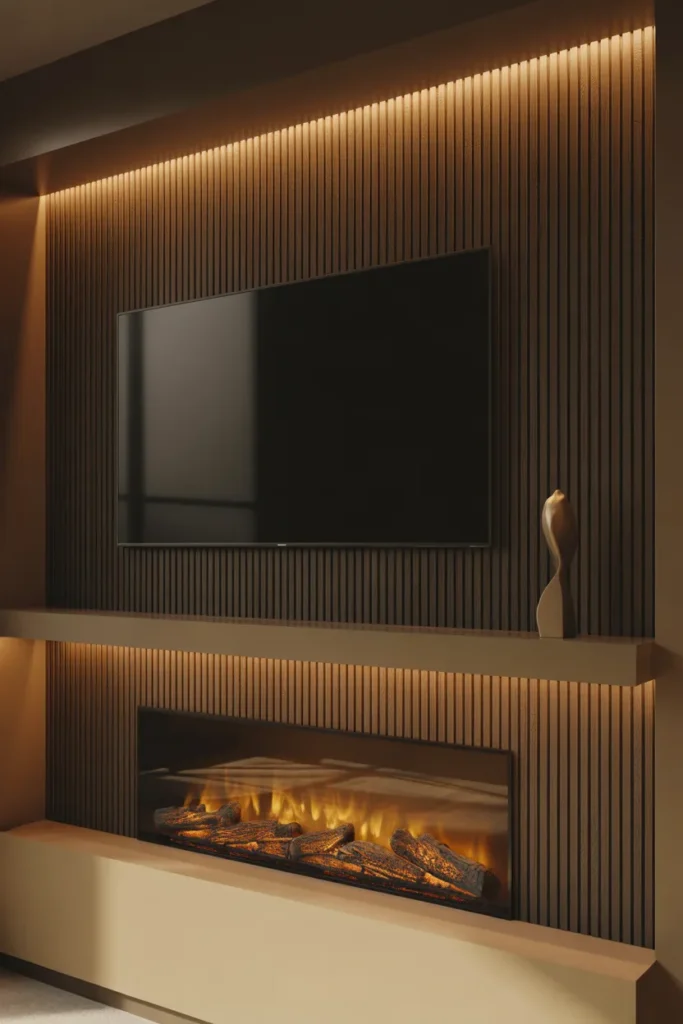
8. Dark Stained Wood Panel Media Wall with Integrated Fireplace
Vibe: The wall feels genuinely warm — fire and screen and timber together creating the kind of atmosphere that makes a room a destination.
Why it works: A combined TV and electric fireplace media wall applies the design principle of focal point consolidation — placing the two primary visual and functional focal points of a living room (the screen and the hearth) on the same wall within a single architectural composition creates a unified, powerful room feature rather than two competing elements on opposite walls. Dark-stained oak slat panels (vertical or horizontal slatted timber with a dark stain — ebony, black walnut, or deep charcoal tones) provide the warm, textural surface that makes the fireplace flame visible and impactful without the fire appearing isolated against a flat background. LED backlighting integrated behind the panel substrate adds ambient glow that the fireplace’s own light cannot provide from a single central position.
How to get it: Source an electric fireplace insert in the appropriate width for the recess (standard inserts range from 900mm to 1500mm width) and build the panel surround from 50×20mm solid oak slats fixed at 10mm intervals to an MDF substrate, stained in a deep tone. Allow a minimum 200mm clearance above the fireplace insert to the floating shelf to comply with fire safety guidelines. Wire the fireplace and LED backlighting through the substrate with dedicated circuits before the panel cladding is installed.
Shop The Look
| Product |
|---|
| Electric fireplace insert slim glass front 1200mm |
| Dark stained oak slat panel cladding sheet |
| Floating shelf slim line TV media wall |
| LED backlighting strip warm behind panel |
| Oak slat stain dark ebony exterior grade |
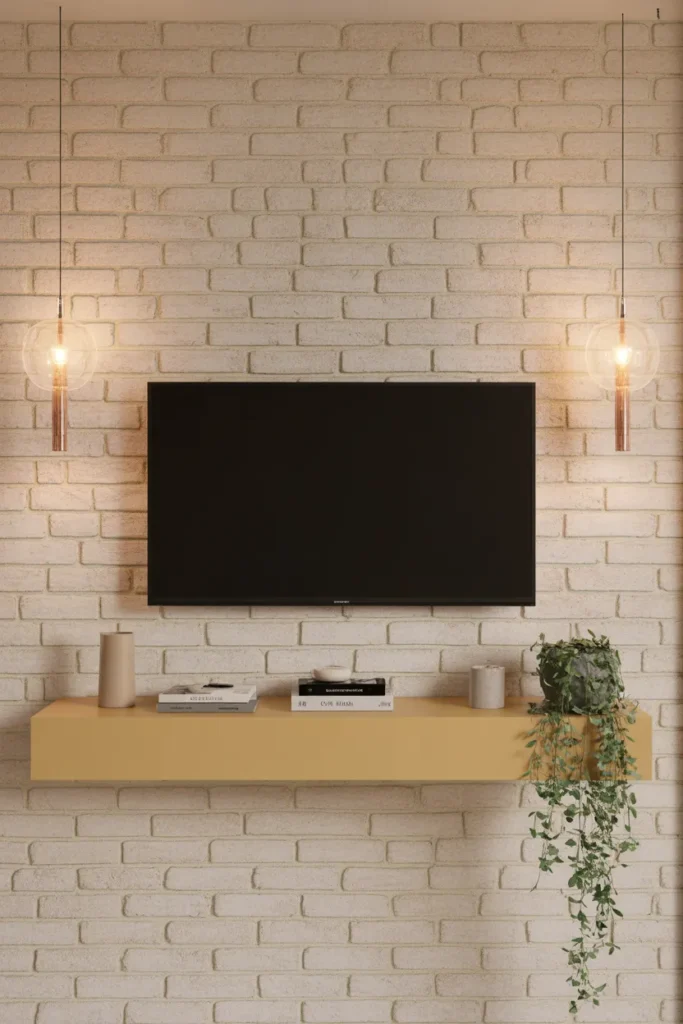
9. White Lime-Washed Brick Media Wall with Minimal Floating Shelf
Vibe: The wall feels honestly material — the lime-washed brick doing what no flat surface can, giving the room a sense of age and substance.
Why it works: Lime-washed brick as a media wall surface applies the design principle of authentic material expression — exposed brick is an inherently architectural material (it was the structure before it was the decoration) and its presence in a living room communicates building substance and material honesty that no applied cladding can replicate. Lime-washing (diluted white or cream limewash paint applied and partially wiped back while wet, leaving the brick and mortar texture visible through the wash) softens exposed brick’s rawness while maintaining its texture — the result is warmer and lighter than untreated brick while being more characterful than a smoothly painted wall. The minimal shelf and pendant light treatment allows the brick to remain the primary design statement rather than competing with additional architectural elements.
How to get it: Apply limewash paint (Bauwerk, Ressource, or a traditional casein-based limewash) to existing exposed or faux-brick in a diluted ratio of 1 part limewash to 1 part water for a partial coverage effect. Apply with a large brush in random directional strokes and wipe back with a damp cloth within 5 minutes while the wash is still wet — this leaves the color in the mortar recesses and partially on the brick face while the highest points of the brick remain closest to the original brick tone. Drill directly into the brick mortar joints for TV mount and shelf bracket fixings — never into the brick face, which is structurally weaker than the mortar.
Shop The Look
| Product |
|---|
| Limewash paint cream warm white litre |
| Slim TV wall mount black ultra flat |
| Pale white oak floating shelf 150cm |
| Warm pendant light plug-in set of 2 |
| Masonry drill bit set brick mortar |
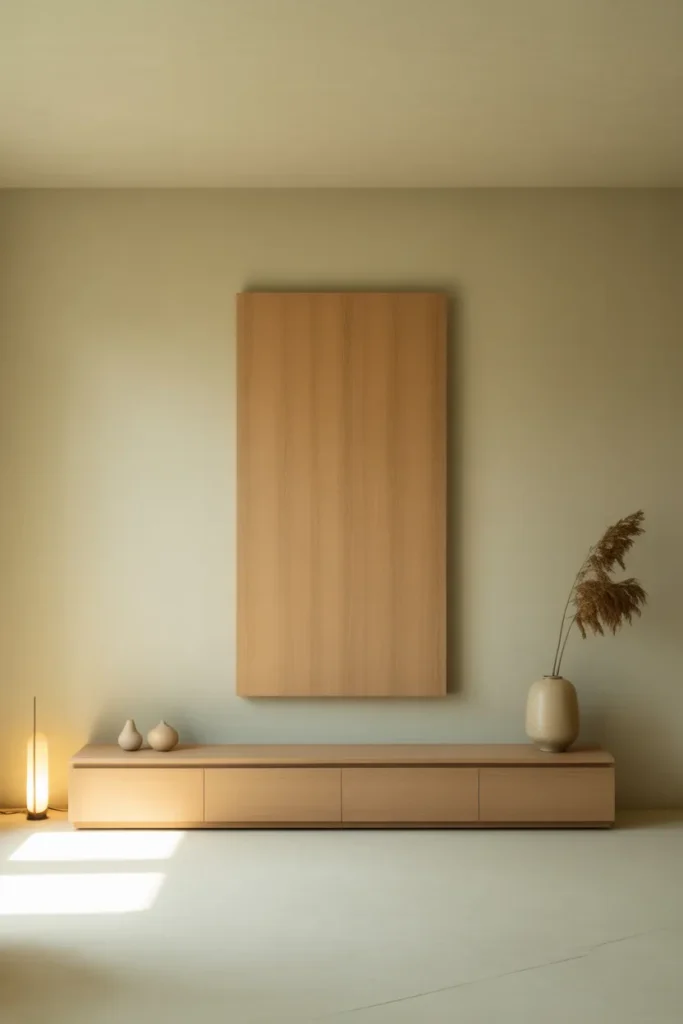
10. Japandi-Influenced Natural Wood and Plaster Media Wall
Vibe: The wall feels still and considered — every element earning its place, silence as a design decision.
Why it works: The Japandi media wall aesthetic applies the design philosophy of ma (Japanese concept of purposeful negative space) to media wall design — reducing the composition to its essential elements (one material contrast, one horizontal datum, one lighting source) and allowing the space between elements to be as designed as the elements themselves. The natural ash wood panel centered behind the TV (without extending to the full wall width) creates a framed, focal quality that a full-wall paneling treatment dilutes. Pale oat plaster — a limewash or mineral plaster in the warm beige-to-cream range — provides a living surface texture that is softer than paint and more responsive to changing light conditions, making the wall read differently at different times of day.
How to get it: Apply a mineral or lime plaster finish (Marmorino, Stucco Veneziano, or a simpler limewash in a warm oat tone) to the full wall. Cut the ash wood panel to the centered dimension and mount on the plaster surface using panel adhesive and concealed fixings. Mount the TV on the ash panel using a slim-profile wall mount, ensuring the mount’s fixing bolts penetrate through the ash panel into the structural wall behind. Build the low floating ash unit to span the full wall width at 400mm from the floor, finished in a natural matte oil.
Shop The Look
| Product |
|---|
| Mineral plaster pale oat warm finish litre |
| Natural ash wood panel sheet furniture grade |
| Low profile floating media unit ash natural |
| Tall ceramic vase floor standing neutral |
| Dried pampas grass stem natural large |
11. Black Fluted Panel Media Wall with Brass and Marble Accents
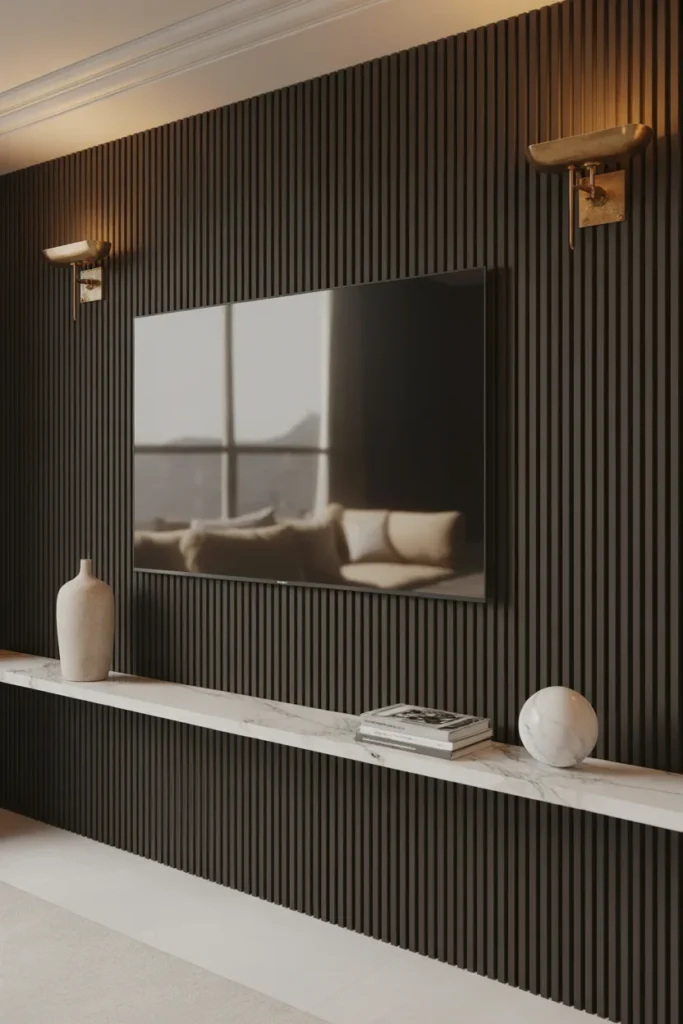
Vibe: The wall feels bold and entirely resolved — the black panel making the room’s warm furnishings glow by contrast.
Why it works: A black fluted panel media wall applies the design principle of maximum contrast — placing the darkest possible architectural surface (matte black) against the warmest possible room furnishings (cream, oat, natural wood) creates the strongest figure-ground contrast achievable in a residential interior, making both the wall and the room’s contents more visually present than either would be against a neutral tone. The TV on a black mount against a black panel essentially disappears when off — the screen becomes invisible in the composition, solving the “black rectangle” problem definitively. White marble and aged brass accents provide the material relief that prevents a full-black feature wall from reading as oppressive.
How to get it: Paint pre-installed fluted MDF panels in Farrow & Ball Railings No. 31, Little Greene Obsidian Green, or Benjamin Moore Black Beauty in a high-opacity eggshell finish — multiple thin coats are required for complete matte black opacity on the deeply grooved flute profile. Mount the white honed marble shelf on concealed brackets at the appropriate height — for a 65-inch TV, the shelf sits approximately 900mm from the floor, with the TV center at 1,350mm. Install aged brass sconces at shelf height, centered between the TV and the panel’s outer edges.
Shop The Look
| Product |
|---|
| Fluted MDF panel sheet cladding black paint |
| Matte black furniture paint eggshell litre |
| White honed marble shelf 100cm |
| Aged brass wall sconce set pair |
| Black slim TV wall mount ultra flat |
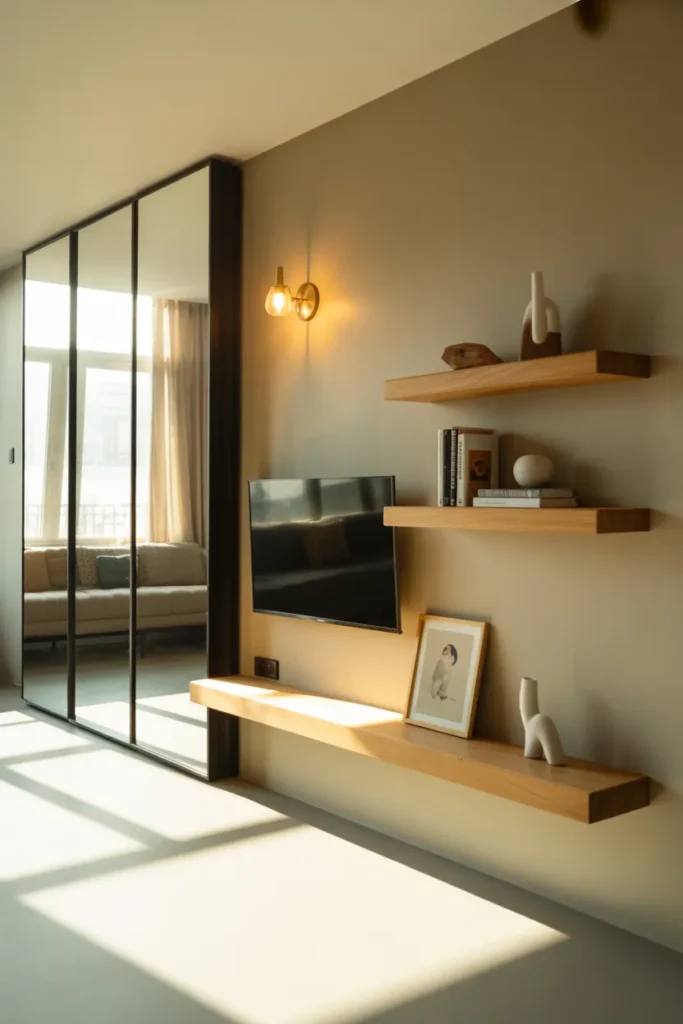
12. Small-Space Media Wall Using Mirror and Shelf Ledge Combination
Vibe: The small room feels twice its actual width — the full-height mirror doing in a tight space what no expansion of walls could.
Why it works: A full-height mirror panel integrated into a small-space media wall applies the spatial design principle of reflective expansion — a mirror that runs from floor to ceiling and wall-to-wall reads as an opening into a second room rather than as a reflective object, effectively doubling the perceived width of the space. This principle is most effective when the mirror is positioned at the end or side of the wall (rather than centered) so that the reflection reveals the room’s depth rather than simply repeating the media wall composition. The picture ledge shelf below the TV — a slim 80–100mm deep shelf that allows art prints and small objects to lean casually rather than being hung precisely — adds the styling opportunity of a gallery wall without requiring drilling and provides easy rotation of displayed objects.
How to get it: Source a full-height mirror panel (90cm × floor-to-ceiling height) from a glazier or mirror supplier in frameless format — the absence of a frame makes the mirror read as an architectural opening rather than a decorative object. Mount with mirror adhesive and mirror clips at top and bottom. Install the picture ledge from a 90mm-wide MDF shelf with a 20mm front lip, painted to match the wall. Mount floating shelves on the opposite side section using concealed brackets.
Quick Win: A single full-height frameless mirror panel ($80–150 from a glazier, cut to floor-to-ceiling height) installed on the left or right third of a small media wall creates the room-doubling effect immediately and requires only adhesive and two mirror clips for installation — the highest spatial impact per pound of any small-space media wall intervention.
Shop The Look
| Product |
|---|
| Frameless mirror panel full height custom cut |
| Mirror adhesive heavy duty wall |
| Mirror safety clip set top bottom |
| Picture ledge shelf slim MDF painted |
| Floating shelf set two wall mounted |
13. Curved Plaster Niche Media Wall with Ambient Strip Lighting
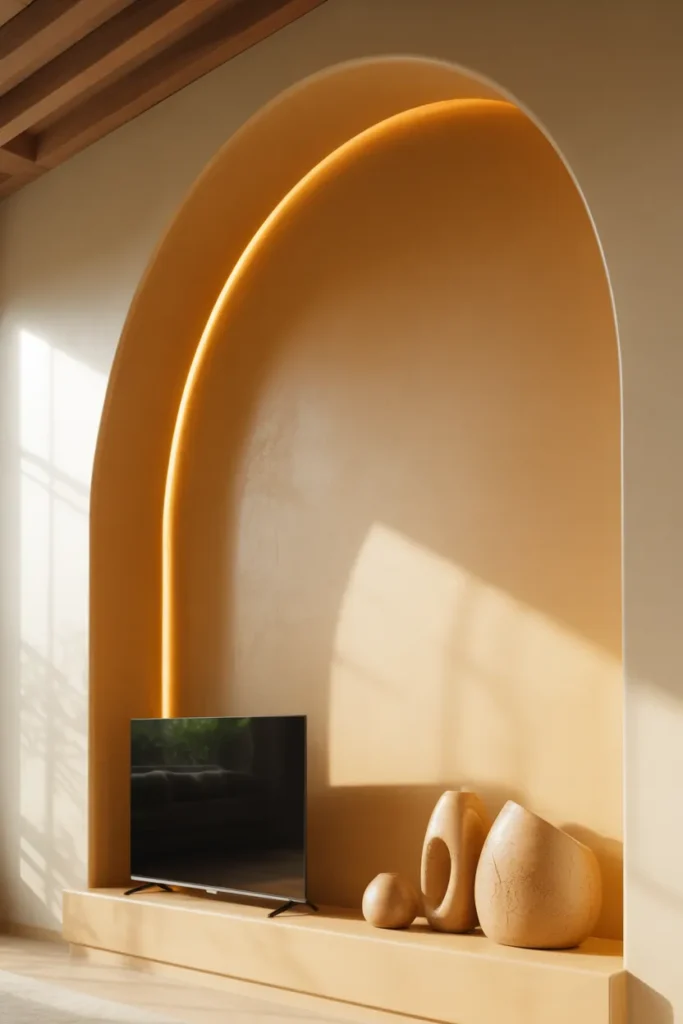
Vibe: The arch feels ancient and contemporary simultaneously — the curved form referencing classical architecture while the LED perimeter lighting makes it unmistakably now.
Why it works: A curved plaster niche as a media wall applies the architectural design principle of spatial enclosure within a larger room — the arch creates a defined pocket of space that frames the television within an architectural moment, giving the screen a context that elevates it from an appliance to a curated feature. Curved plaster arches reference the vernacular architecture of Mediterranean and Middle Eastern buildings — forms that have persisted across design eras because their proportion and material create a timeless quality. The LED strip run around the inner perimeter of the arch applies the halo lighting technique — a continuous light source around the inner edge of a recess that makes the arch appear to glow from within, creating a warmth and depth that no ceiling or wall light can replicate from outside the form.
How to get it: Build the arch from lightweight steel stud framing (curved by cutting slots in the flanges at 25mm intervals to allow the stud to curve) plasterboarded with 6.5mm flexible plasterboard bent over the curved form. Apply two coats of smooth plaster finish to all surfaces. Install LED strip lighting in an aluminium channel recessed into a shallow slot cut into the inner edge of the arch perimeter — the channel conceals the LED strip and directs the light inward across the plaster surface. Seal with a matte mineral plaster topcoat in a warm oat tone. Total construction cost: £800–1,800 for a standard room-width arch, depending on size and finish specification.
Shop The Look
| Product |
|---|
| Flexible plasterboard 6.5mm curved wall |
| Steel stud framing set curved wall |
| LED strip warm 2700K 5m roll |
| Aluminium LED recessed channel arch profile |
| Mineral plaster warm oat finish litre |
How to Start Your Media Wall Transformation
The single best first move is resolving the cable management plan before purchasing any materials, panels, or furniture — every media wall idea in this list depends on the television appearing to be an integral part of the wall rather than a device attached to it, and that integration is impossible when cables run visibly down the wall surface. Install a cable conduit chase (a chased recess in the plaster through which all cables pass invisibly from the TV mount position to the media unit or floor socket below) or a surface-mounted cable trunking painted to match the wall before any panel or cladding work begins. This one preparatory step determines whether the finished media wall looks genuinely designed or merely styled.
The most common mistake in media wall design is positioning the television too high. The instinct — driven by the desire to see the screen from the sofa and the practical challenge of fitting a media unit below — is to mount the television at eye height when standing (approximately 1,500–1,600mm to the screen center) rather than at eye height when seated (approximately 1,050–1,100mm to the screen center). A TV mounted at standing eye height requires viewers to angle their heads upward during extended viewing, causing neck strain and making the media wall’s lower section feel spatially underused. The correct mounting height places the television’s center at approximately 1,050mm from the floor for a standard sofa seating position — significantly lower than most people’s instinct, but consistently more comfortable and architecturally correct.
Three specific items under $50 that immediately improve any media wall before a full project begins: a warm-white LED strip light run behind the television on a 2700K bias lighting kit ($18–28) that prevents eye strain and adds ambient warmth to the immediate wall area; a cable management trunking kit in the wall color ($12–18) that surface-routes all visible cables in a single organized channel; and a single floating shelf in natural wood installed at the correct height below the TV ($25–45 for an IKEA LACK or equivalent) that provides the critical horizontal datum line the media wall needs before any other furniture arrives.
A surface-level media wall transformation — paint, paneling adhesive-mounted to the existing wall, a floating shelf, LED backlighting, and cable management — is achievable over a single weekend for £150–400 in materials. A mid-range media wall with professional joinery, integrated lighting, and quality hardware runs £1,500–4,500 for a standard living room wall. A full bespoke media wall with micro-cement or stone cladding, custom cabinetry, integrated fireplace, and specialist lighting design represents a £6,000–18,000 investment. The LED bias lighting, cable management, and floating shelf can be installed this weekend and will improve the media wall’s quality immediately and visibly at every price point.
Frequently Asked Questions About Media Wall Ideas
What is the difference between a media wall and a TV unit?
A TV unit is a piece of furniture — a standalone or wall-mounted storage unit that supports or houses the television and provides storage for media equipment. A media wall is an architectural intervention — the treatment of an entire wall as a cohesive design composition that integrates the television as one element within a larger architectural, material, and lighting system. A TV unit can be moved; a media wall is built into the room. A TV unit is furniture-scale; a media wall is room-scale. The distinction matters practically because a media wall requires planning, potentially structural work (for recessed elements), and electrical work (for integrated lighting) that a TV unit does not. The design quality difference between the two is significant — a media wall creates a room’s defining character in a way that no freestanding furniture can.
What color works best for a modern luxe media wall?
The most consistently successful colors for a modern luxe media wall are deep warm tones — warm charcoal (Farrow & Ball Railings, Little Greene Urbane Grey), forest green (Little Greene Obsidian Green, Farrow & Ball Studio Green), deep navy (Farrow & Ball Hague Blue, Benjamin Moore Van Deusen Blue), and warm black (Farrow & Ball Off-Black, Dulux Polished Pebble). All of these work because the television’s black screen body becomes less visually conspicuous against a dark wall tone, the depth of the color creates architectural drama and spatial separation from the lighter room beyond, and warm-toned accents (brass, oak, marble, warm LED light) read more richly against dark grounds than against neutral or light ones. Light-toned media walls (white, cream, light gray) read as clean and contemporary but rarely achieve the luxe quality of their dark-toned equivalents.
How much does a built-in media wall cost?
The cost of a built-in media wall varies significantly by specification: a painted MDF joinery media wall with standard hardware and LED lighting runs £1,500–3,500 for a standard 3.5–4 meter wall in the UK (or $2,000–4,500 in the US), including joinery fabrication, installation, and electrical work. A media wall with stone or porcelain cladding adds £800–2,500 to these figures for materials and specialist installation. A media wall with an integrated electric fireplace adds £1,200–3,500 for the fireplace unit and surround. A full bespoke commission with micro-cement, custom lighting design, and architectural detailing runs £8,000–18,000. The highest-value interventions for a given budget are consistently the dark paint color (transformative at under £50 in paint) and the integrated LED lighting (transformative at £80–200 in materials).
Can a media wall work in a rented property?
Yes — with material selection that avoids permanent modification. Adhesive-mounted fluted MDF panels (attached with panel adhesive rated for easy removal, or with double-sided mounting tape on a smooth surface) can be applied to and removed from rental walls without damage. Peel-and-stick tile panels in stone or wood effect create the appearance of tiled or paneled surfaces without permanent adhesive. Freestanding floor-to-ceiling joinery units (using tension systems between the floor and ceiling rather than wall fixings) create the built-in appearance without drilling. Surface-mounted cable trunking in the wall color, removable picture ledge shelves on adhesive strips, and plug-in pendant lights complete the media wall composition without any permanent modification. The result will not match a fully built-in media wall but will deliver significantly more design quality than an unaddressed rental wall.
How do you hide cables on a media wall?
The cleanest cable management solution for a media wall is a chased cable conduit — a recess cut into the plaster wall and covered with a skim of plaster, through which all cables from the TV mount position pass invisibly to a media unit or floor-level socket below. This requires a plasterer and electrician and is only appropriate for owned properties. For rental or non-invasive installations, surface-mounted cable trunking (a plastic or aluminum channel that attaches to the wall surface and conceals cables within it) painted to match the wall color reads as nearly invisible from normal viewing distances. For floating media units, a drill-through cable management hole in the unit top surface allows cables to pass from the TV mount through the unit’s interior to the equipment stored inside. Wireless streaming devices (Apple TV, Chromecast, Fire TV Stick) reduce the number of cables requiring management — the ideal media wall has only one cable visible between the TV and the wall: the power cable, ideally managed through an in-wall power kit.
Ready to Build Your Dream Media Wall?
These 13 ideas move through every dimension of what makes a media wall genuinely modern and luxe — from the material warmth of fluted oak and limewashed brick, to the drama of dark painted joinery and black panels with marble accents, to the architectural ambition of curved plaster niches and book-matched porcelain, to the spatial intelligence of mirror panels in small rooms. Starting with cable management and a warm LED backlighting kit installed this weekend is not a partial beginning — it is the correct foundation, because every material and design layer built above it depends on the cables being invisible and the light being warm for the finished composition to read as designed rather than assembled. Order the LED bias lighting kit and the cable trunking today, resolve both before the weekend ends, and the media wall’s transformation has already begun in the most important dimension. Pin the material and lighting ideas that match the room’s existing palette, and return to the built-in joinery and stone cladding plans when the simpler improvements have proven the wall’s potential. When the fluted panels are up and the LED strip is running and the TV disappears into the dark surface at night, the room will feel different in the way only architecture can make a room feel — like it was always meant to be exactly this.