
21 Brilliant Tiny Bedroom Ideas with Smart Storage
A tiny bedroom usually has enough room for the basics. What it lacks is storage that does not eat the floor. Once clothes, bedding, and daily items have nowhere to go, even a tidy person ends up with piles on every surface.
The ideas below use the space most small rooms waste: under the bed, above doors and headboards, inside furniture, and in corners. Each one adds storage without adding a bulky wardrobe or chest of drawers. Most can be done in a rented room as well.
Work through the room in order, biggest gain first. Under-bed storage and vertical shelving change the feel of a small room more than any small organiser, so start there and add the smaller fixes after.
This post contains affiliate links. If you buy through them, I may earn a small commission at no extra cost to you.
1. Under-Bed Drawers for Maximum Storage

Drawers under the bed turn dead space into the largest storage area in a small room. A set of two to four drawers holds as much as a small dresser, and it uses floor space the bed already occupies. Clothes, spare bedding, and towels all fit well here.
Choose drawers that glide: Wheeled or smooth-running drawers get used daily. Stiff ones get ignored, and the storage might as well not exist. Check the clearance under your frame first, including any centre support legs that block a long drawer.
Assign each drawer a job: One drawer for everyday clothes, one for bedding, one for out-of-season items. When drawers have set jobs, putting things away takes seconds and nothing migrates. Add simple dividers if smaller items slide around.
- Measure under-bed height at the lowest point of the frame.
- Keep daily items in the drawer on your side of the bed.
- Vacuum under the bed before fitting drawers, as access gets harder after.
Shop This Look
2. Floating Shelves Above the Bed

Floating shelves above the bed use the wall space that usually holds only a picture. Two shelves hold books, a small plant, glasses, and the items most people keep on a nightstand. That can remove the need for a nightstand entirely in a very small room.
Keep them out of head range: Fit the lowest shelf high enough that you cannot hit it sitting up in bed. Keep heavy items off these shelves. Books and light objects only, and fix the brackets into studs or with proper anchors.
Style them sparingly: A shelf crammed with objects makes a small room feel busy. Leave gaps between groups of items. If you use the shelves for daily items, a small tray or basket at one end keeps loose things together.
- Use two shelves at most above a bed, more looks crowded.
- Put the items you use nightly at the front edge.
- Dust these shelves weekly, as they sit in full view.
Shop This Look
3. Built-In Wardrobe with Sliding Doors

A built-in wardrobe with sliding doors stores a full set of clothes along one wall without needing any door swing space. Sliding doors let you place the bed or a desk right in front of the wardrobe. Inside, a mix of hanging space, shelves, and drawers suits most wardrobes better than hanging space alone.
Plan the inside first: Count what you own before fixing the layout. Most people need less hanging length and more shelving than they expect. A bank of drawers inside the wardrobe often removes the need for a separate dresser in the room.
Fit doors that run smoothly: Cheap tracks stick and rattle, which puts you off using the far side of the wardrobe. Test the rollers and track before buying. Mirrored doors also help a small room feel larger and remove the need for a separate mirror.
- Store out-of-season clothes on the highest shelves.
- Keep the side you open daily for everyday clothes.
- Add a battery light inside if the wardrobe is deep.
Shop This Look
4. Lofted Bed with Desk Below

A lofted bed lifts the sleeping area up and frees the floor below for a desk, drawers, or a small sofa. It is one of the few changes that can double the usable space in a tiny room. Ceiling height decides whether it works, so measure before anything else.
Check your ceiling height: You need enough room to sit up in bed without ducking, plus a safe gap above your head. As a guide, if sitting in the loft feels cramped during a test, it will annoy you every night. A sturdy guard rail on the open side is not optional.
Use the space below with a plan: A desk below suits students and home workers. Drawers and a wardrobe suit someone who needs storage more than workspace. Decide the main job first, because trying to fit both usually leaves both cramped.
- Fix the frame to the wall if the design allows it.
- Add a small clip light for reading in the loft.
- Keep the ladder clear of stored items at all times.
Shop This Look
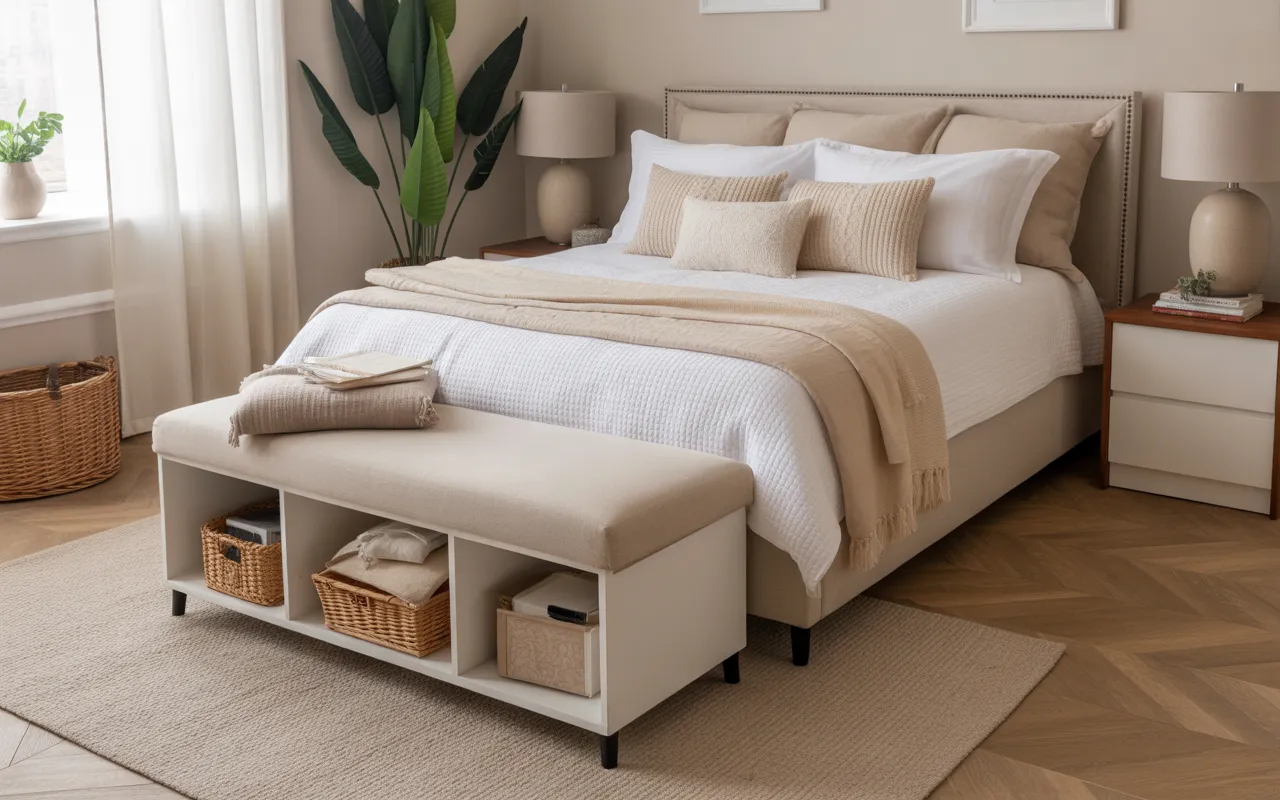
5. Storage Ottoman at the Foot of the Bed

A storage ottoman at the foot of the bed holds spare blankets, cushions, or clothes while giving you a seat for putting on shoes. It also softens the end of the bed, where small rooms often have an awkward gap. Choose a length a bit shorter than the bed width so walkways stay clear.
Pick a firm top: A padded but firm lid works as a seat and a surface for a tray. Very soft tops sag and are less useful. Check the hinges or lift mechanism, as you will open it most days.
Store bulky soft items inside: Blankets, throws, and spare pillows compress well and suit the deep, open space inside an ottoman. Small loose items get lost in it, so keep those in drawers instead. A fabric liner or a large bag inside keeps stored bedding clean.
- Measure the gap at the foot of the bed before ordering.
- Keep the top clear so it stays usable as a seat.
- Use it for items you need weekly, not daily.
Shop This Look
6. Corner Shelves for Extra Storage

Corners collect nothing in most bedrooms, which makes them free storage space. A set of corner shelves or a slim corner unit holds books, toiletries, or folded clothes without blocking walkways. The triangular shape fits where a standard shelf would stick out too far.
Stack storage upward: Three to five shelves climbing the corner hold a surprising amount. Keep heavier items low and light items high. In a rented room, a freestanding corner unit gives the same effect without wall fixings.
Match the job to the corner: The corner by the door suits bags and daily items. The corner by the bed suits books and a night light. Decide what each corner holds and resist mixing, or the shelves turn into general clutter spots.
- Measure the corner angle, as not all corners are square.
- Leave the top shelf for items you rarely need.
- Keep shelf edges clear of the door swing.
Shop This Look
7. Wall-Mounted Nightstands with Drawers

Wall-mounted nightstands with drawers give you bedside storage without legs or floor contact, so the floor underneath stays clear for shoes, a laundry basket, or cleaning. The drawer holds the small items that usually spread across a nightstand top. The top itself stays free for a lamp and a book.
Fit them at the right height: The top should sit close to mattress height so items are easy to reach lying down. Leave wall space above for a wall light if you want the surface fully clear. Fixings must go into solid wall or studs, as a loaded drawer has real weight.
Use the drawer well: One drawer fills fast. Keep only night-use items in it: charger, glasses, medicine, a notebook. Anything else belongs in bigger storage. A small insert tray stops the drawer becoming a jumble.
- Choose a drawer depth that fits your largest night item.
- Run charger cables through a hole or clip at the back.
- Wipe the clear floor space under them weekly, it shows dust fast.
Shop This Look
8. Under-Desk Storage in Small Study Corner

A study corner in a tiny bedroom still needs storage, and the space under the desk is usually wasted or filled with a tangle of bags. A small drawer unit or a set of boxes under the desk holds papers, chargers, and stationery while keeping leg room at the front.
Protect your leg room: Place storage to one side of the desk, not in the middle where your knees go. A narrow unit the depth of the desk works best. If you work there for hours, comfort matters more than squeezing in one more box.
Keep the desktop clear: The point of under-desk storage is a clear work surface. Papers go in a tray or file box below, not in piles on top. Only the items for the current task should sit on the desk itself.
- Use one box for cables and chargers to end the tangle.
- Label file boxes, as unlabelled boxes stop getting opened.
- Leave a clear gap for your feet even with storage fitted.
Shop This Look
9. Bed with Built-In Bookshelves

A bed frame with built-in bookshelves in the headboard or sides replaces a separate bookcase and keeps reading material where you actually read. In a small room, removing one piece of furniture makes a clear difference to floor space. Shelves at the head of the bed also serve as a nightstand surface.
Watch the shelf depth: Deep shelves tempt you to store too much at the head of the bed. Shallow shelves suit books, a clock, and a phone. Keep anything heavy or breakable off shelves above where you sleep.
Balance storage and comfort: A shelved headboard needs a cushion or pillows for sitting up and reading, as the shelves are hard against your back. Check that books cannot slide out onto the bed when you move around in the night.
- Sort books by how often you read them, favourites at arm reach.
- Use bookends on open side shelves.
- Keep one shelf free for water and a night light.
Shop This Look
10. Hanging Rods for Seasonal Clothing

A hanging rod fitted on a wall, inside an alcove, or under a high shelf holds seasonal clothes where they are visible and aired, instead of boxed away and forgotten. This works well for coats, dresses, and the next season work clothes. It costs little and takes no floor space beyond the depth of a hanger.
Give it a set purpose: A rod works when it holds one category, such as coats or next-season clothes. Mixed rods become messy rods. Cover hanging items with a fabric cover if they will stay up for months, as shoulders collect dust.
Fix it for real weight: A full rod of coats is heavy. Fix brackets into studs or solid wall, and space them so the rod does not bow. Keep the rod height reachable without a step for anything you use weekly.
- Use matching hangers so clothes sit evenly and take less width.
- Leave small gaps between items so fabric can air.
- Rotate the rod contents when the season changes.
Shop This Look
11. Floating Desk with Shelves Above

A floating desk fixed to the wall gives a work or dressing surface with no legs and no floor footprint. Shelves above it hold the items that would otherwise cover the desk. The combination works as a study spot, a dressing table, or a laptop station in rooms that cannot fit a standard desk.
Set the height for sitting: Standard desk height suits most chairs, so measure your chair before fixing the desk. Leave enough depth for a laptop and a notebook side by side. A desk that is too shallow ends up used as a shelf instead of a workspace.
Keep shelves within reach: The lowest shelf should be reachable from the chair without standing. Daily items go there. Higher shelves suit storage boxes and books you use less often. Keep the desk surface itself clear at the end of each day.
- Choose a desk depth that fits your laptop with room to spare.
- Add a wall light above rather than a desk lamp on the surface.
- Use boxes on the shelves so small items do not spread.
Shop This Look
12. Storage Ladder for Accessories

A leaning storage ladder uses a narrow strip of wall for blankets, scarves, belts, and bags. It takes minutes to set up, needs no fixing in most cases, and moves easily when you rearrange the room. For renters, it is one of the simplest storage additions there is.
Lean it safely: The ladder must sit firmly with both feet flat and the top resting solidly on the wall. A rubber pad or wall protector where it touches helps. Do not overload the top rungs, as the balance shifts as you add weight low down.
Hang items you use often: A ladder suits things you grab daily, not long-term storage. Blankets on lower rungs, bags and scarves higher up. If an item sits on the ladder untouched for a month, it probably belongs in a drawer or out of the room.
- Limit each rung to two or three items so it stays tidy.
- Match blanket and throw colours to the bedding for a calmer look.
- Stand the ladder where it will not block a door or drawer opening.
Shop This Look
13. Multi-Functional Fold-Out Desk

A fold-out desk gives you a full work surface that folds flat to the wall when you finish. In a tiny bedroom, this is often the only way to fit a desk at all. Many designs include small shelves or a cabinet inside, so work items store inside the folded unit.
Check the folded depth: Folded units still project from the wall by several centimetres, so measure the walkway with it closed. Check the hinge and support legs or chains take the weight of a laptop and books without flexing. A wobbly desk will not get used.
Build a closing routine: The desk only saves space if you actually fold it. Keep its storage simple so closing up takes a minute: laptop and papers inside, chair tucked away. If clearing it is a chore, it will stay open and the room loses the benefit.
- Fix the unit into studs or solid wall, it carries load at an angle.
- Keep only work items inside so closing stays quick.
- Choose a chair that tucks fully under or folds as well.
Shop This Look
14. Ottoman with Hidden Storage

A small ottoman with hidden storage works as a seat, a footrest, and a store for the items that clutter a small room: remotes, chargers, books, or a spare blanket. Placed beside the bed or under a window, it fills awkward spots usefully. The storage is modest, but it is exactly the size for daily clutter.
Use it for daily clutter: Hidden storage earns its keep when it swallows the things that land on the bed every day. Give the ottoman that job and nothing else. When it fills up, sort it rather than finding a second spot for overflow.
Pick a wipe-clean finish: Ottomans get sat on, stood on for reaching shelves, and used as tables. A finish you can wipe suits real life better than a delicate fabric. A firm top also works better as a spare surface for a tray or book.
- Place it where you naturally sit to dress or put on shoes.
- Add a small tray inside the lid items if loose things rattle around.
- Empty and sort it monthly so it does not become forgotten storage.
Shop This Look
15. Pegboard Wall for Organized Accessories

A pegboard wall turns one flat wall into adjustable storage for accessories, hats, bags, jewellery, and daily carry items. Hooks and small shelves move in seconds, so the layout can change as your needs do. It works well by the door or above a desk.
Plan the layout on the floor first: Lay the board down and arrange your items on it before fixing anything. Group by how you use them: leaving-the-house items together, jewellery together. Leave empty holes in the plan, because a pegboard filled edge to edge looks chaotic.
Use the right fittings: Small hooks suit light items, while bags and hats need longer pegs or small shelves. Keep heavy items low on the board. Paint the board the wall colour if you want it to blend in, or a soft contrast if you want it as a feature.
- Keep daily items at eye level and spare items higher.
- Add one small basket fitting for loose items like keys.
- Review the board monthly and remove what you no longer use.
Shop This Look
16. Floating Nightstands with Hidden Storage

Floating nightstands with a concealed drawer or shelf keep bedside items out of sight, which makes a small room look calmer. The visible surface holds only a lamp and a book or glass. Everything else goes inside, out of view.
Concealed storage needs discipline: A hidden drawer fills quietly. Sort it monthly or it becomes a junk drawer by the bed. Keep it to night items only: charger, glasses, hand cream, medicine. If it does not help you at night, it belongs elsewhere.
Mount them level and solid: A pair of floating nightstands looks best exactly level with each other and at mattress height. Fixings go into studs or solid wall. Test with weight before trusting them with a lamp and a full drawer.
- Choose designs with a cable gap for chargers.
- Keep the top surface to two or three items at most.
- Use a small tray inside the drawer for tiny items.
Shop This Look
17. Wall-Mounted Foldable Desk

A wall-mounted foldable desk is the smallest desk option there is. Folded, it is a flat panel or shallow cabinet on the wall. Open, it holds a laptop for work, study, or paying bills. For rooms where even a small fixed desk will not fit, this is the workable option.
Test the open size honestly: Check the open surface fits your laptop and your arms comfortably. Some fold-down desks are only wide enough for a tablet. If you type for hours, a slightly larger panel is worth the extra wall space it takes when folded.
Pair it with flexible seating: A folding chair or a stool that slides under the bed completes the setup. If the chair has nowhere to go, the desk loses its advantage. Some people use the bed as the seat, which works for short tasks if the desk height suits it.
- Fix the desk at a height that matches your chair or bed seat.
- Keep the items stored inside it to the minimum.
- Fold it up every evening for a week to build the habit.
Shop This Look
18. Bed with Side Drawers

A bed with drawers built into the sides gives storage you can reach without getting up, which suits night clothes, books, and spare bedding. Side drawers open along the length of the bed, so check your room width before choosing this design. You need clear floor on at least one side for the drawer to open fully.
Measure the opening space: A side drawer needs roughly its own depth in clear floor space. If your bed sits close to a wall on one side, choose a frame with drawers on the open side only. Drawers that cannot open fully will not be used.
Store soft items inside: Side drawers suit clothes and bedding better than heavy items, which strain the runners over time. Use dividers for smaller clothes. Keep one drawer for spare bedding so making the bed with fresh sheets takes everything from one place.
- Check drawer runners are metal, not plastic, for daily use.
- Leave a rug out of the drawer path so it opens smoothly.
- Keep frequently used items in the drawer nearest the head of the bed.
Shop This Look
19. Pegboard Storage for Accessories

A second pegboard, or a larger one in a different spot, suits people whose accessory collection outgrows one board. Placing it above a dresser or inside a wardrobe door keeps jewellery, watches, belts, and hair items sorted and visible. The point is grouping by area: one board for daily carry, one for accessories.
Divide boards by job: When two boards hold mixed items, finding things slows down. Give each board a clear category. The accessory board works best near where you dress, with a mirror close by if the wall allows it.
Keep small items contained: Tiny items fall off pegs and get lost. Use small cups, baskets, or a shelf fitting for earrings and loose pieces. A shallow tray at the bottom of the board catches anything that drops.
- Hang necklaces separately so they do not tangle.
- Use soft hooks for items that scratch easily.
- Leave space on the board, a full board stops working as a system.
Shop This Look
20. Under-Desk Storage Bins

Under-desk bins are the simplest storage in this list. A few open bins under the desk hold shoes, bags, gym kit, or paperwork, sorted by type. They slide out when you need them and disappear the rest of the time. In a small bedroom where the desk doubles as a dressing table, bins keep the floor around it clear.
Size bins to the space: Measure the height and depth under the desk and buy bins that use most of it without jamming. Open tops suit items you grab daily. Lidded bins suit paperwork and anything dusty. A mix of both usually works best.
Limit the categories: Three or four bins with clear jobs beat six half-empty ones. Shoes, bag, work papers is a workable set for many people. When a new category appears, something else has to leave, or the under-desk area becomes a general dumping zone.
- Choose bins with handles so they slide out easily.
- Keep one bin for items leaving the room, such as donations.
- Vacuum under the desk regularly, as bins hide dust build-up.
Shop This Look
21. Multi-Functional Storage Ottoman

A multi-functional storage ottoman earns its place by doing three jobs: seat, footrest or side surface, and storage. In the smallest rooms, single-purpose furniture is hard to justify, and an ottoman is one of the easiest swaps. Use it at the foot of the bed, beside it as a nightstand stand-in, or under a window.
Choose the spot by the job: At the foot of the bed it holds bedding. Beside the bed it holds night items and works as a surface. In a corner it becomes a dressing seat with shoe storage inside. Decide the main job before buying, as size and shape follow from it.
Keep the inside sorted: One open space fills with mixed items fast. A simple divider, a bag for each category, or storing only one type of item keeps it usable. Sort it whenever you open it and cannot find something quickly. That is the sign it needs attention.
- Pick a height close to your bed or chair seat height.
- Test the lid, you will open it daily and weak hinges fail fast.
- Keep heavy items out so you can move it for cleaning.
Shop This Look
How to Start
Start by emptying one storage problem at a time rather than the whole room. Most tiny bedrooms have the space, it is just in the wrong places: floor-level piles while the walls and the area under the bed sit empty. Pick the biggest pile, usually clothes or bedding, and give it a home first.
Measure the hidden spaces: Measure under the bed, above the headboard wall, and inside any alcove or corner. These three measurements decide which ideas in this list will work in your room. Write them down and keep them on your phone, because most storage buying mistakes are size mistakes.
Work from big to small: Fit the large storage first: under-bed drawers, then shelving, then small organisers like pegboards and ottomans. Small organisers cannot fix a room that lacks a home for bedding and out-of-season clothes. Once the bulky items are stored, the small fixes fall into place quickly.
- Measure under the bed and one full wall before buying anything.
- Store out-of-season clothes and spare bedding first.
- Leave one drawer or shelf empty for new items so the system holds.
Shop This Look
Common Mistakes
- Buying storage furniture before measuring under the bed and the wall space.
- Storing daily items in the hardest places to reach, then not using that storage.
- Adding a wardrobe or dresser when the room needed vertical storage instead.
- Filling open shelves edge to edge, which makes a small room look smaller.
- Keeping out-of-season clothes in prime drawers while everyday clothes pile up.
- Blocking drawer and wardrobe access with other furniture to save a few centimetres.
- Buying organisers for items you should have passed on or thrown out first.
Frequently Asked Questions
What is the biggest storage gain in a tiny bedroom?
Under-bed storage, for most rooms. The area under a double bed holds several large drawers or bins, roughly the same as a small dresser, and it costs no floor space. After that, wall shelving above the bed and in corners gives the next largest gain.
How do I add storage in a rented small bedroom?
Use freestanding and no-fix options: under-bed bins on wheels, a leaning ladder, over-door organisers, and storage ottomans. Where fixings are allowed with permission, floating shelves and pegboards add a lot. Keep the original fittings and fill any holes when you leave.
Where should out-of-season clothes go?
In the least reachable storage you have: the top of the wardrobe, the middle of the under-bed space, or vacuum bags in a suitcase. The rule is that daily clothes get the easy spots. Swap the two groups when the season changes rather than mixing them all year.
Do I need a wardrobe in a very small bedroom?
Not always. A hanging rod, a slim drawer unit, and under-bed storage cover many wardrobes. A wardrobe earns its place if you have long items to hang or a lot of clothes. If it mostly holds items you rarely wear, a smaller setup plus honest sorting usually works better.
Where can I find more small bedroom layout ideas?
Storage works best when the layout is right first, so plan the bed position and walkways before adding units. For more room layouts and furniture arrangements, see these small bedroom ideas and match the storage in this list to the layout closest to your room.
The Finishing Touch
Good storage in a tiny bedroom is mostly invisible. The room looks like a bedroom, not a storeroom, because clothes, bedding, and daily items each have a closed or contained home. If you open a drawer and can see everything in it at a glance, the system is working.
For layout inspiration before you start moving furniture, look through bedroom ideas on Houzz and pay attention to how often the storage sits under the bed or on the walls rather than in extra furniture. That pattern is consistent in small rooms that work.
Add storage one piece at a time and sort as you go. A small room punishes clutter faster than a large one, but it also rewards a good system faster. Two or three well-chosen changes usually transform how the room feels to live in.




One Comment