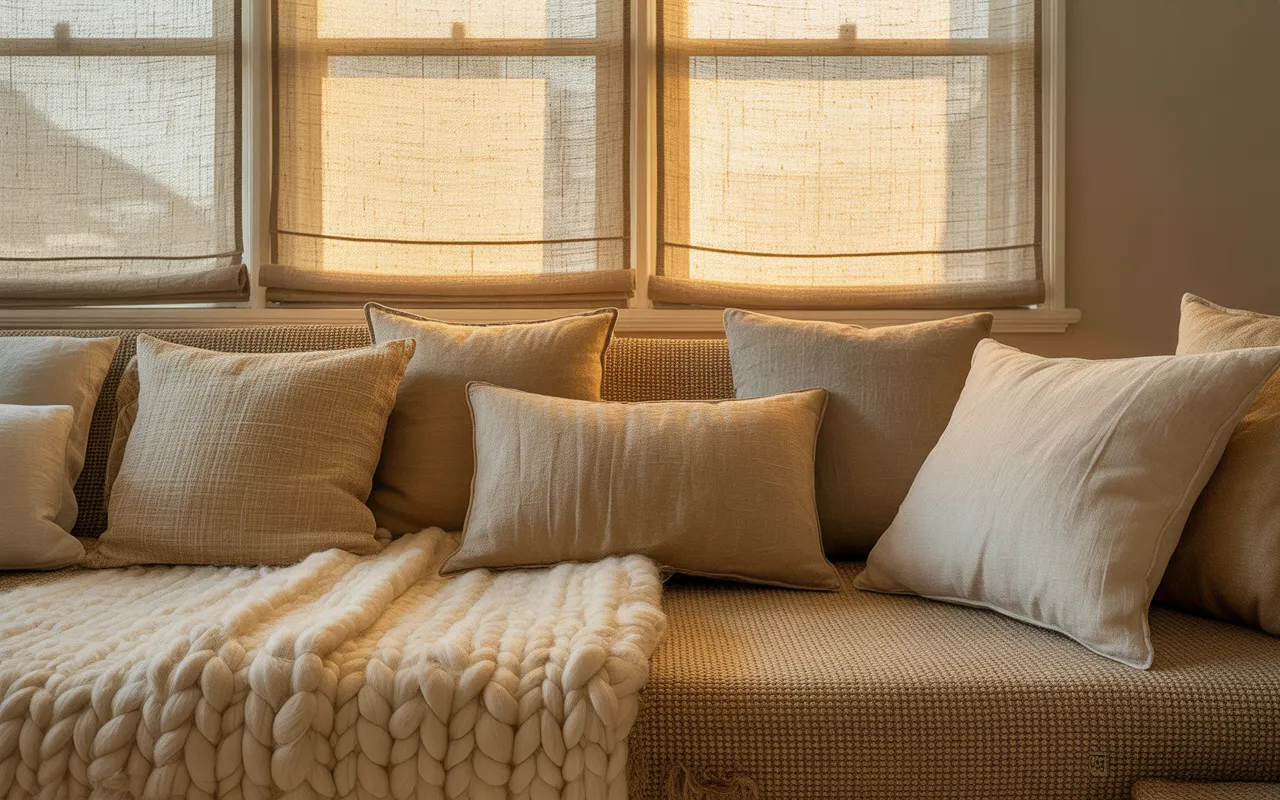
21 Wellness Centered Homes That Feel Peaceful
A wellness-centered home is a living space deliberately designed to support physical health, mental calm, and emotional restoration — through the intentional use of natural materials, light, air quality, sound, and spatial organization rather than trend-driven decoration. This article gives you 21 wellness-centered home ideas across biophilic design, lighting, materials, layout, air and sound quality, color, furniture, and small-space adaptation so every room in your home actively contributes to how well you feel inside it.
There is a particular stillness that certain homes carry — the kind you notice the moment you cross the threshold. The air feels different. The light lands softly. Nothing demands your attention and nothing assaults your senses. That quality is not accidental, and it is not expensive. It is the result of specific, learnable design decisions made in favor of the nervous system rather than against it. Here are 21 ideas worth saving — and stealing.
Why Wellness-Centered Design Works So Well
Wellness-centered home design draws from several converging traditions: the Japanese concepts of ma (negative space as an active presence) and shinrin-yoku (forest bathing, or the restorative effect of natural environments on the nervous system), the Scandinavian philosophy of hygge (the cultivation of comfort, warmth, and psychological safety through the domestic environment), and the evidence base of environmental psychology, which has documented since the 1980s that the physical characteristics of a space — its light quality, acoustic properties, material textures, and spatial organization — measurably affect cortisol levels, sleep quality, cognitive function, and emotional regulation.
The material palette of a wellness-centered home is grounded in natural, low-toxicity, tactilely rich choices. Unfinished white oak and Douglas fir flooring, natural linen and wool textiles, unglazed stoneware and terracotta, beeswax and linseed oil finishes on wood surfaces, and natural clay plaster on walls are the materials that appear consistently across well-designed wellness interiors. These choices share three properties: they are made from natural, low-VOC (volatile organic compound) materials that maintain indoor air quality; they have tactile richness that engages the senses positively; and they age gracefully toward greater warmth rather than deteriorating toward shabbiness.
The cultural urgency has never been stronger. The global mental health crisis, accelerated by pandemic-era isolation and the chronic overstimulation of digital life, has made the home’s role as a restorative environment a genuine public health concern. Architects, interior designers, and environmental health researchers are converging on the same conclusion: the spaces we live in are not neutral containers for our lives — they are active participants in our wellbeing, either depleting or restoring us with every hour spent inside them.
Small spaces are not a barrier to wellness-centered design — in fact, compact homes often achieve the quality of enclosure and intimacy that larger spaces must work to create. The key adaptations for small spaces are vertical organization (keeping floor area clear for movement and breathing room), strict material restraint (one dominant natural material per room rather than several competing ones), and maximizing natural light penetration through mirror placement, light-toned surfaces, and unobstructed window areas.
Style at a Glance
| Element | Detail |
|---|---|
| Philosophy | Design in service of the nervous system — calm, restore, sustain |
| Key Materials | Unfinished white oak, natural linen, clay plaster, stoneware, beeswax-finished wood |
| Key Colors | Warm white, soft sage, dusty greige, terracotta blush, deep forest green |
1. Natural Clay Plaster Walls for Tactile and Air Quality Benefit
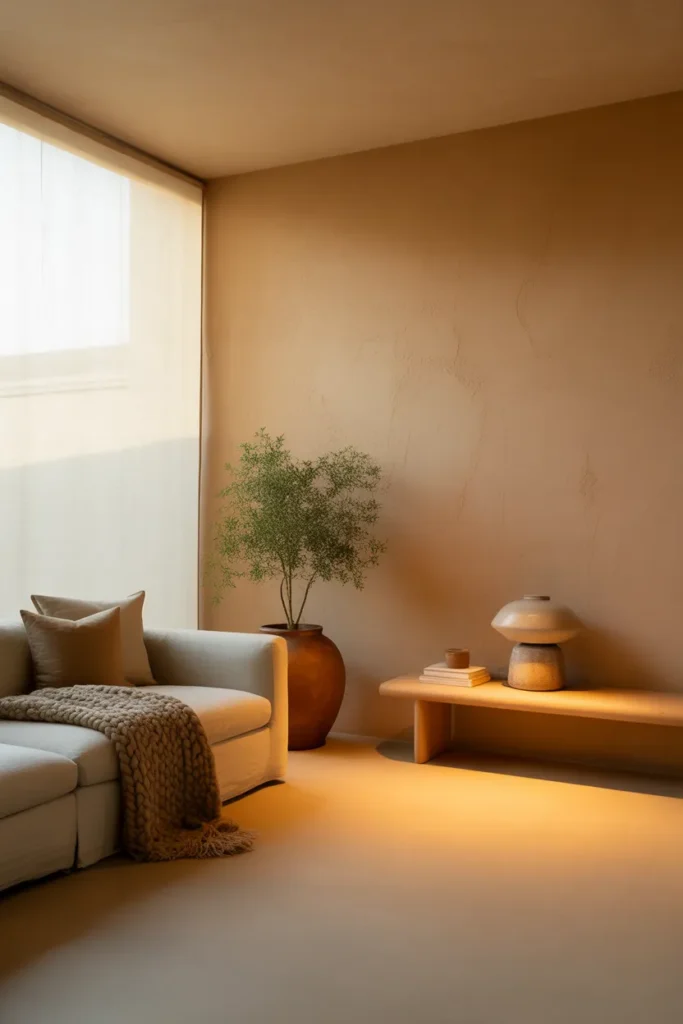
Vibe: The room is grounded — clay plaster walls have a warmth and subtle texture that painted drywall never achieves, and the room feels physically different to be inside.
Why it works: Natural clay plaster is hygroscopic — it absorbs and releases moisture from the air, acting as a passive humidity regulator that maintains indoor relative humidity between 45–65%, the range that most supports respiratory health, skin comfort, and sleep quality. Unlike synthetic paints, clay plaster contains no VOCs (volatile organic compounds) and actually absorbs airborne pollutants including formaldehyde. The hand-applied texture creates micro-shadow variation across the wall surface that changes quality with the light direction throughout the day, giving the room a living, dynamic background that flat painted walls lack entirely.
How to get it: American Clay and Meoded are two widely available natural clay plaster brands sold through specialty paint retailers. Application requires a trowel and two coats over a primed surface — a 200 square foot room takes one experienced person approximately 4–6 hours. The material cost runs $1.50–$3.00 per square foot, comparable to premium paint when applied DIY.
Quick Win: A single clay plaster accent wall (the wall behind a sofa or bed) costs approximately $80–$150 in materials for a standard room and creates 80% of the visual and tactile impact of a full-room application.
Shop The Look
- Natural clay plaster wall finish American Clay
- Trowel stainless steel plastering 12 inch
- Natural linen sofa slipcover neutral
- Terracotta large floor planter pot
- Unfinished white oak flooring sample
Also view: 15 Handcrafted Decor Ideas for a Warm, Stylish Home
2. Circadian Rhythm Lighting System for Every Room
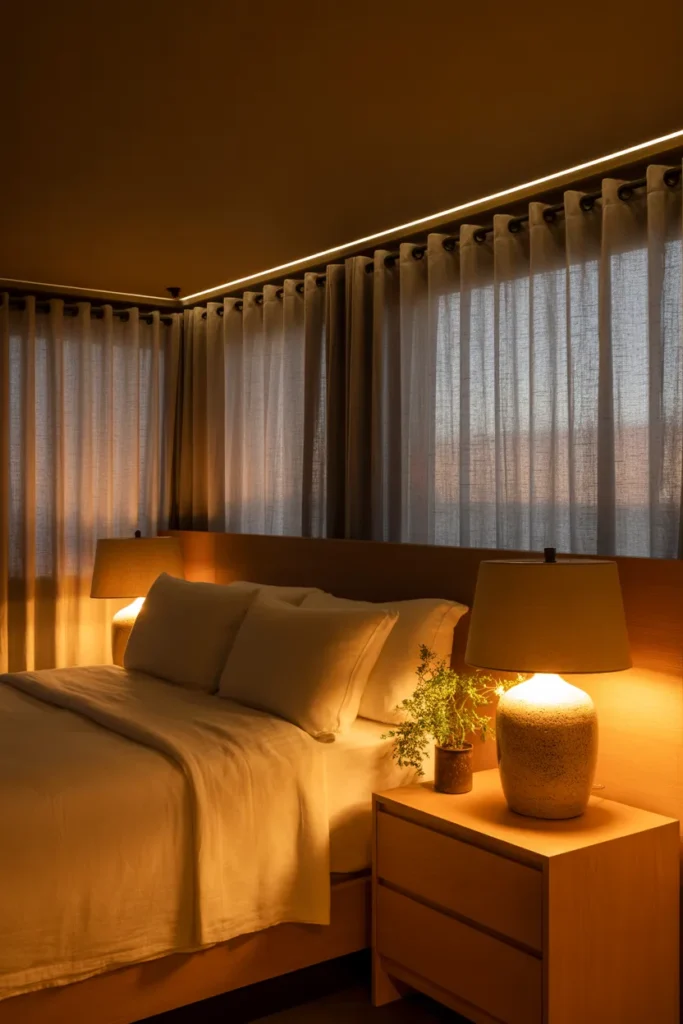
Vibe: The bedroom is sleep-ready — warm amber light from multiple low sources in the evening communicates to the body what the sun used to: that the day is ending and rest is appropriate.
Why it works: Human circadian rhythm is regulated primarily by light color temperature — cool blue-white light (5000–6500K) suppresses melatonin production and signals wakefulness, while warm amber light (2200–2700K) allows natural melatonin rise and signals sleep preparation. Most homes use the same overhead lighting throughout the day and evening, which means the nervous system receives a wakefulness signal at 9pm that directly disrupts sleep onset. A layered lighting system — bright cool-white task lighting during the day, warm amber table and floor lamps only in the evening — aligns the home’s light environment with the body’s biological needs.
How to get it: Replace bedroom and living room overhead fixtures with dimmer-controlled warm LED strips set to 2200K for evening use. Add bedside table lamps with warm-toned Edison-style LED bulbs (2200K, not “soft white” at 2700K — the 500K difference is significant). Phillips Hue and LIFX both make color-temperature-adjustable smart bulbs ($15–$25 each) that automate the transition from cool daytime to warm evening light on a schedule.
Shop The Look
- Smart LED bulb color temperature adjustable 2200K
- Warm amber bedside table lamp ceramic
- LED strip light warm white 2200K dimmable
- Smart dimmer switch single pole
- Linen blackout curtain panel warm white
3. Biophilic Plant Wall as a Living Air Filter
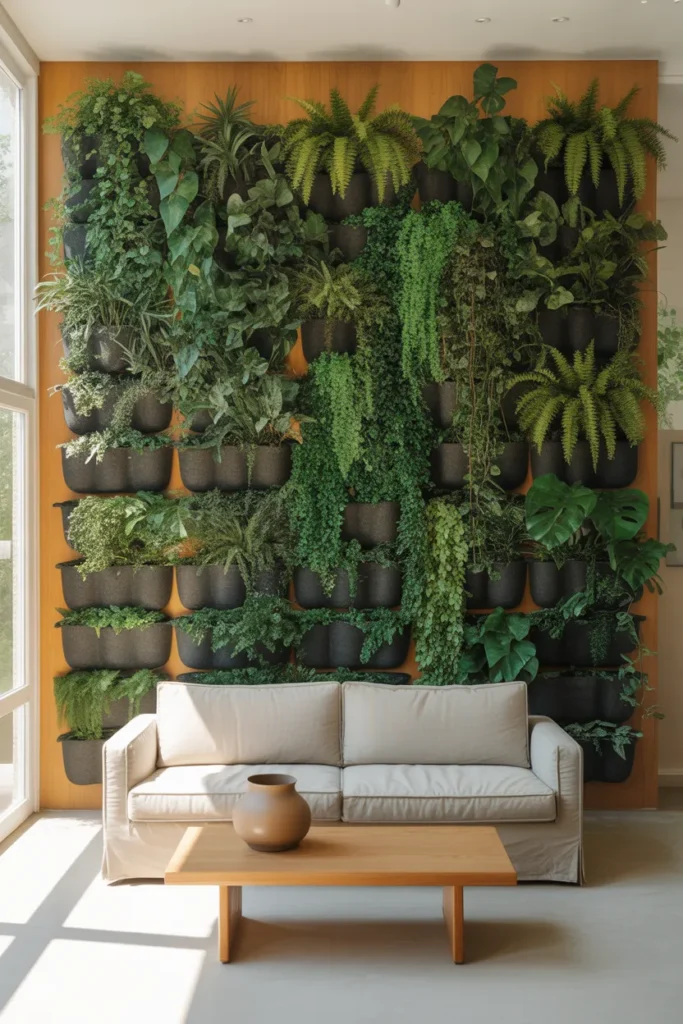
Vibe: The wall is restorative — a full living plant wall brings the psychological benefit of forest immersion into a domestic living room, reducing cortisol measurably within minutes of visual exposure.
Why it works: Visual exposure to living plants triggers the parasympathetic nervous system response — the “rest and digest” physiological state associated with reduced heart rate, lower blood pressure, and reduced cortisol — within 3–5 minutes of sustained viewing, according to multiple environmental psychology studies. A living plant wall amplifies this effect by increasing the total visual field occupied by biophilic elements. Beyond psychology, plants including pothos (Epipremnum aureum), peace lily (Spathiphyllum), and spider plant (Chlorophytum comosum) are documented by NASA clean air studies to remove benzene, formaldehyde, and trichloroethylene from indoor air.
How to get it: Wooly Pocket and Naava both make modular felt pocket planter systems that mount on a standard wall with screws and include self-watering reservoirs. A 4×6 foot section requires approximately 24 pocket planters and costs $80–$150 in planters plus $40–$80 in plants. Install near a window for adequate light, or add a full-spectrum grow light panel behind the plant wall for windowless installations.
Shop The Look
- Felt wall pocket planter modular system
- Pothos golden plant live indoor
- Philodendron heartleaf plant live indoor
- Full spectrum LED grow light panel
- Self watering planter insert reservoir
4. Acoustic Felt Panels for Sound Absorption and Calm
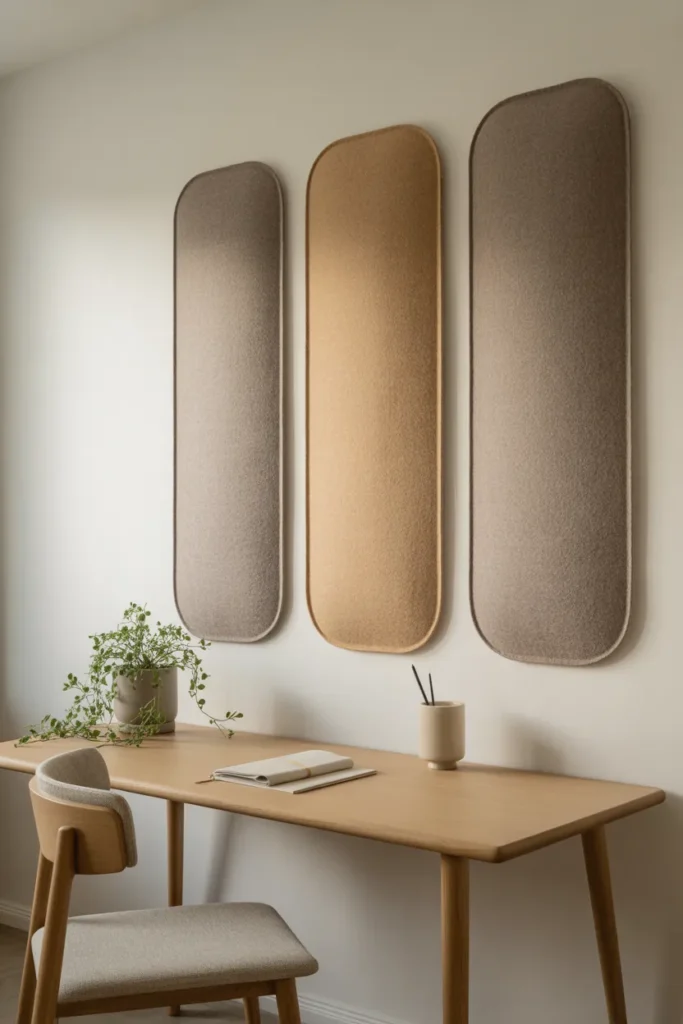
Vibe: The room is quiet — acoustic panels in warm felt tones reduce the hard-surface echo that makes modern interiors feel louder and more stressful than they need to be.
Why it works: Reverberation time — the duration sound takes to decay in a room — is directly related to stress response in occupants. Rooms with long reverberation times (bare walls, hard floors, minimal soft furnishings) create a constant low-level acoustic stress that raises cortisol even when no conscious noise source is present. A typical hard-surfaced living room has a reverberation time of 0.8–1.2 seconds; adding acoustic panels to 20–30% of the wall surface area reduces this to 0.3–0.5 seconds, which is the range associated with comfortable speech intelligibility and reduced listening fatigue. Acoustic felt panels in warm neutral tones function simultaneously as sound treatment and textile wall art.
How to get it: Kirei and BAUX both make architectural acoustic panels in natural and recycled felt materials ($30–$80 per panel) with clean mounting systems. DIY alternative: wrap standard 2-inch acoustic foam boards in natural linen fabric and mount with picture rail hooks — total cost approximately $15–$25 per panel at any standard size.
Quick Win: A single large area rug (minimum 8×10 feet) in a hard-surfaced room reduces reverberation time by approximately 15–20% — the fastest and most affordable acoustic wellness upgrade available.
Shop The Look
- Acoustic felt wall panel natural grey set
- Acoustic foam board 2 inch thickness
- Natural linen fabric upholstery by the yard
- Large jute area rug 8×10 natural
- Picture rail hook mounting set
5. Dedicated Morning Light Breakfast Nook
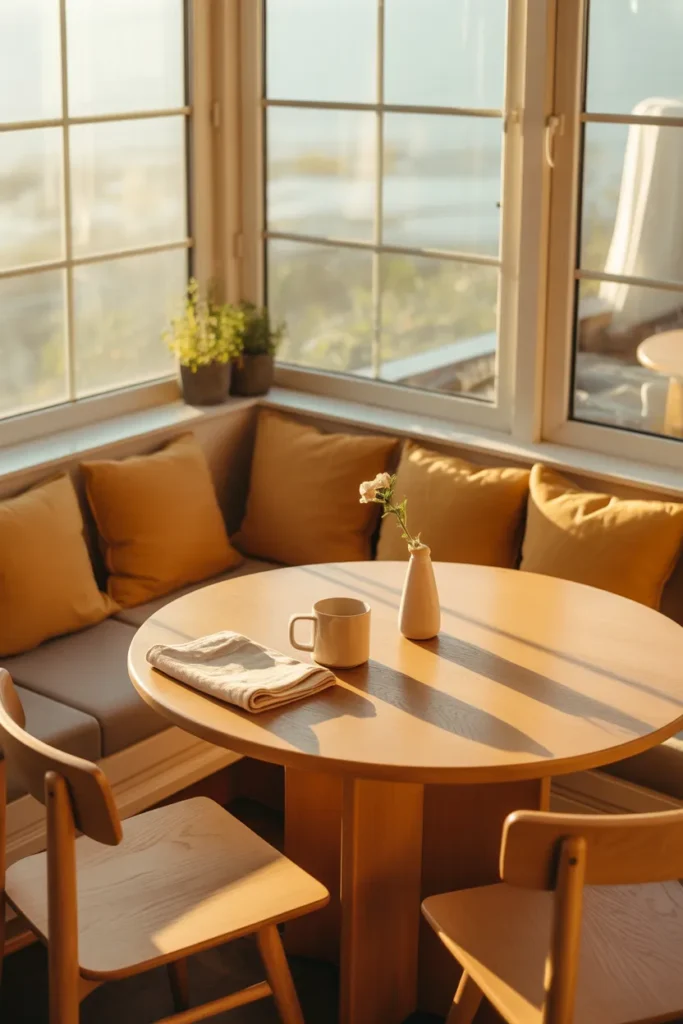
Vibe: The nook is energizing — morning sunlight at an east-facing window is the most powerful natural circadian signal available, and a dedicated space designed to receive it makes the biological benefit automatic.
Why it works: Morning light exposure (between 6–10am) is the single most evidence-supported behavioral intervention for circadian rhythm regulation, mood stabilization, and sleep quality improvement — more impactful than most pharmaceutical sleep aids according to chronobiology research. Morning light suppresses residual melatonin, raises serotonin, and sets the body’s internal clock for a 14–16 hour wake cycle that results in earlier, deeper sleep the following night. A dedicated east-facing morning nook makes light exposure a pleasurable daily ritual rather than an abstract health recommendation — the comfort of the space is the behavioral incentive that creates consistency.
How to get it: If an east-facing window is not available, position the morning seating area at the window with the most direct morning exposure regardless of orientation. Remove any window treatments that obstruct direct morning light during the 6–10am window. A simple built-in bench (plywood box with a hinged lid, upholstered in outdoor linen) takes one weekend to build and costs $80–$150 in materials.
Shop The Look
- Built in bench cushion custom linen oat
- Round dining table solid oak small
- East facing sheer curtain panel unlined
- Small herb planter windowsill ceramic
- Ceramic mug handmade warm tone
6. Natural Linen and Wool Textile Layering Throughout
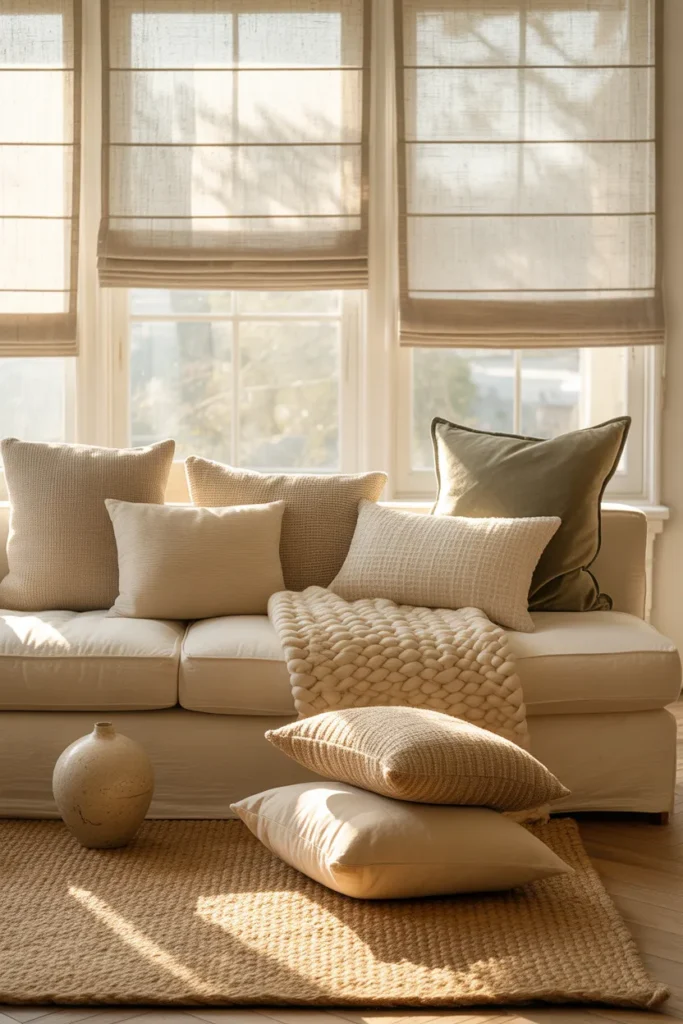
Vibe: The room is warm — layered natural textiles in linen and wool create a tactile environment that engages the senses softly and continuously, producing the sustained low-level positive sensory stimulation associated with comfort and safety.
Why it works: Tactile engagement with natural textiles — running a hand across woven linen, sinking fingers into a wool pile rug, wrapping in a chunky knit — activates the same sensory pathways involved in human touch and physical comfort. Natural fibers (linen, wool, cotton) have tactile properties that synthetic alternatives cannot replicate: linen softens with use and washing, wool has a natural elasticity that makes it spring back under pressure, and both materials breathe and regulate temperature rather than trapping heat. These properties are not merely pleasant — they contribute to the cumulative sensory environment that either supports or depletes the nervous system over hours of exposure.
How to get it: Begin with the floor (a hand-knotted or hand-loomed wool rug is the single highest-impact textile investment), then the sofa (a linen slipcover transforms any sofa for $60–$150), then cushion covers (linen or cotton covers in warm neutral tones, $15–$35 each), and finally window treatments (unlined linen Roman shades allow light diffusion while providing privacy).
Shop The Look
- Hand knotted wool area rug natural ivory 8×10
- Linen sofa slipcover natural oat
- Chunky wool throw blanket natural cream
- Linen throw pillow cover set neutral
- Linen Roman shade custom unlined
7. Dedicated Digital Detox Zone with No Screen Presence
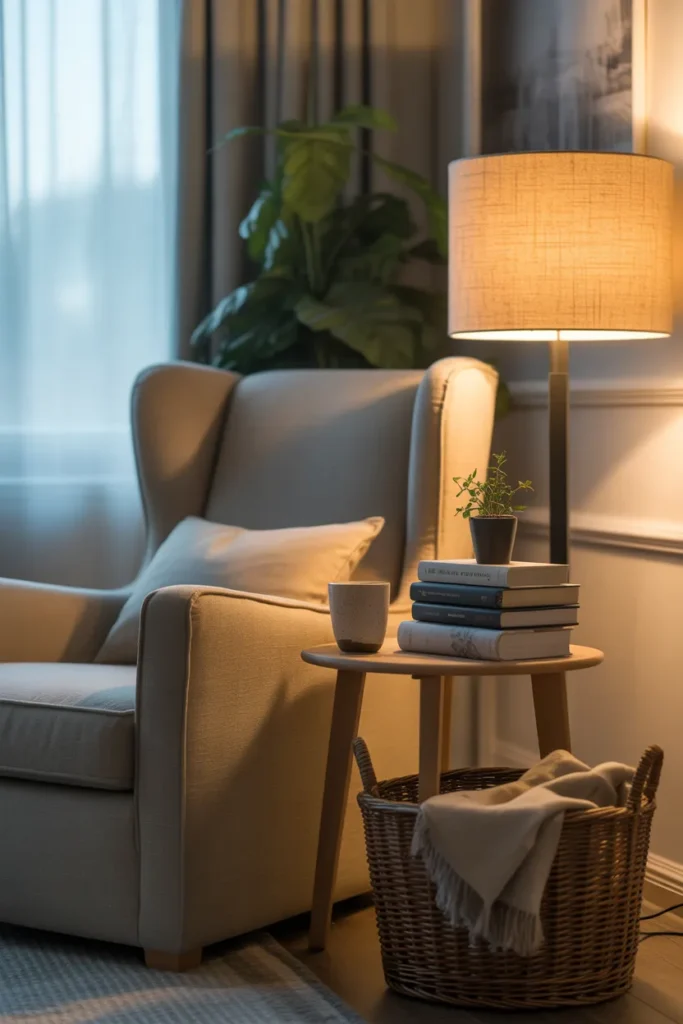
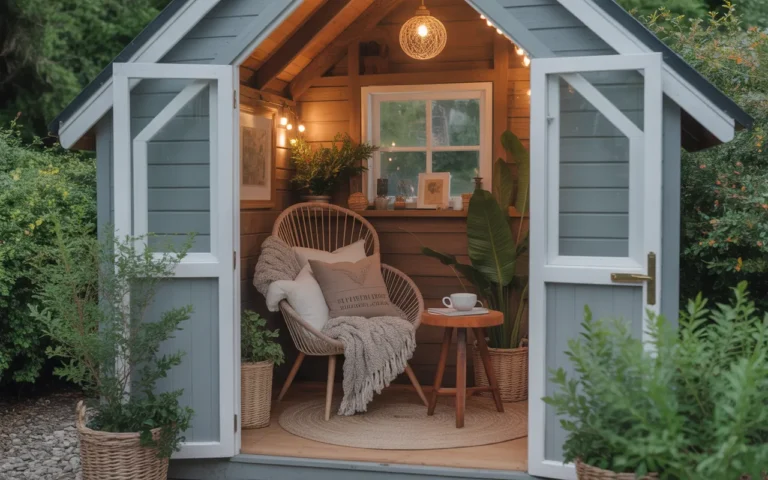
Vibe: The corner is still — a chair, a lamp, a book, and no screen is one of the most genuinely restorative environments a home can contain, and its power is exactly proportional to how rare it has become.
Why it works: The presence of screens in a room — even when off — has been shown to reduce the depth of relaxation achieved in that space, because the brain maintains a readiness-to-engage state in screen-present environments based on learned associations. Designating a physical zone as permanently screen-free creates a spatial anchor for deep rest that functions through environmental cue rather than willpower. A comfortable reading chair, warm lamp, and physical books is the minimum viable setup — the key design principle is that nothing in the zone should compete for attention or suggest productivity.
How to get it: Choose a corner that is naturally slightly removed from the main traffic flow of the room. The chair should be deep enough to sit with legs tucked (minimum 24-inch seat depth), with armrests at a comfortable height for holding a book for extended periods. The lamp should be positioned at shoulder height when seated, with a warm-toned shade that directs light onto the reading surface without glare. Remove all charging cables, remote controls, and technology objects from within visual range of the chair.
Quick Win: Moving your phone charger out of the bedroom and into a hallway outlet is the single highest-impact digital wellness intervention available — it eliminates both the temptation of pre-sleep screen use and the melatonin-suppressing light exposure that accompanies it, at zero cost.
Shop The Look
- Deep linen armchair reading chair warm neutral
- Adjustable floor lamp linen shade warm
- Solid wood side table small round
- Hardback book set neutral linen cover display
- Woven basket blanket storage living room
8. HEPA Air Purification as a Design-Integrated Feature
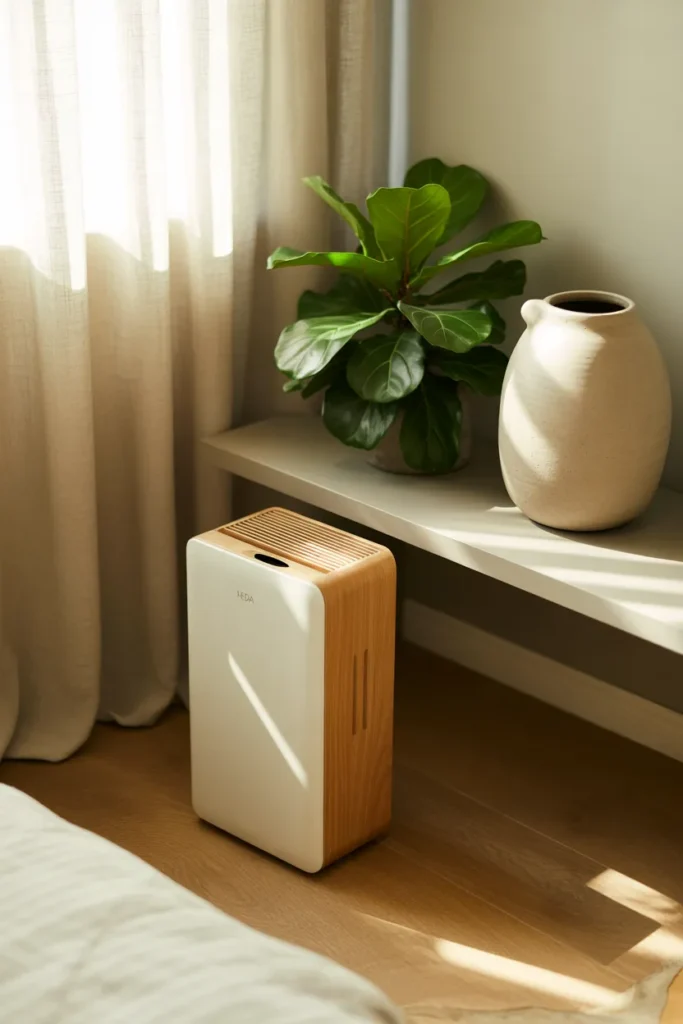
Vibe: The room is clean — not visually sparse, but genuinely clean in the air quality sense, which produces a physical feeling of ease that becomes perceptible within minutes of entering a well-filtered space.
Why it works: Indoor air quality is measurably worse than outdoor air in most homes — the EPA estimates indoor air contains 2–5 times higher concentrations of pollutants than outdoor air, including VOCs off-gassed from furniture and flooring, particulate matter from cooking and candles, mold spores, and pet allergens. HEPA filtration (High-Efficiency Particulate Air, capturing 99.97% of particles 0.3 microns and larger) removes the airborne particulate load that contributes to respiratory stress, sleep disruption, and chronic low-grade inflammation. In a wellness-centered home, air quality is treated with the same priority as light quality — both are invisible environmental factors with measurable physiological effects.
How to get it: Coway, Blueair, and Molekule make HEPA purifiers with design-conscious housings that integrate into a room rather than advertising their medical function. Size the purifier to the room’s square footage — a purifier rated for 500 square feet in a 300 square foot bedroom achieves two complete air changes per hour, the recommended minimum for meaningful air quality improvement. Run on the lowest quiet setting continuously rather than intermittently.
Shop The Look
- HEPA air purifier bedroom design conscious
- Air quality monitor indoor CO2 particulate
- Beeswax candle natural low soot alternative
- VOC free interior paint zero emission
- Activated charcoal air purifier bag natural
9. Soaking Tub Bathroom as a Home Recovery Space
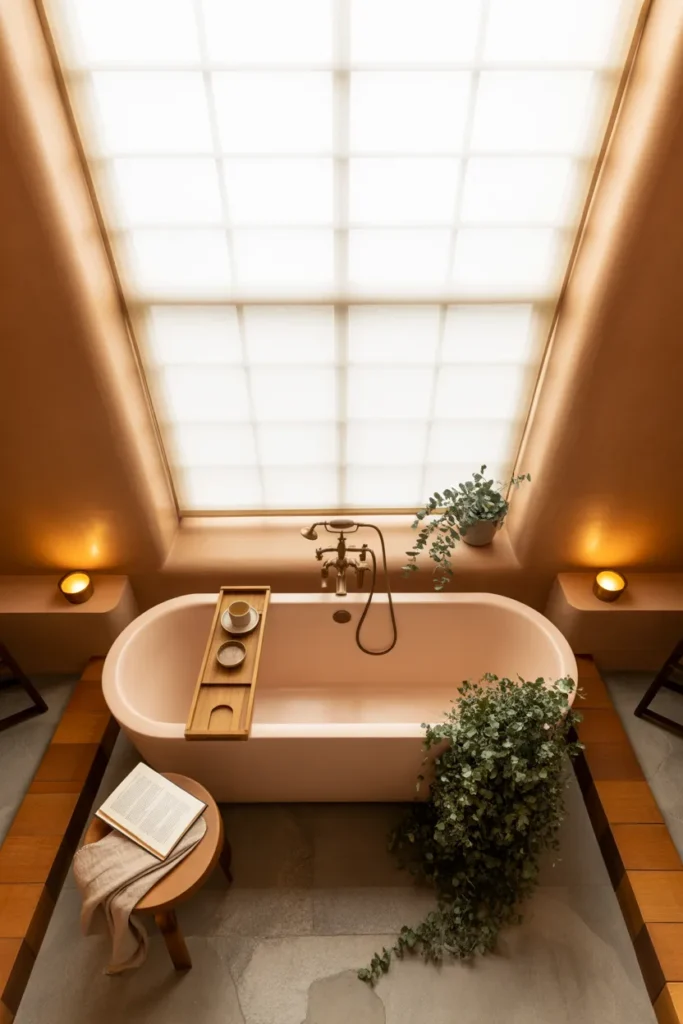
Vibe: The bathroom is restorative — a soaking tub positioned as the room’s primary feature transforms the bathroom from a hygiene space into a genuine recovery environment.
Why it works: Warm water immersion at 104°F for 20–30 minutes produces a reliable parasympathetic nervous system response — reduced cortisol, lower blood pressure, reduced muscle tension, and a core body temperature drop during the post-bath cooling phase that triggers the same physiological conditions as natural sleep onset. Hydrotherapy’s effectiveness as a stress recovery intervention is among the most consistently documented in physical medicine. The bathroom design supports this physiological function: a freestanding tub communicates that the bath is for immersion and rest rather than a rushed hygiene step, and the surrounding material environment (natural stone, clay plaster, eucalyptus) adds sensory elements that deepen the restorative quality.
How to get it: A freestanding acrylic soaking tub (ANZZI, Woodbridge, and American Standard all make quality options) runs $500–$1,200 — significantly less than custom stone tubs while maintaining the visual and functional quality of the form. Position to maximize natural light during the hours most likely to be used for soaking (evening — position near a window for privacy with frosted or textured glass).
Shop The Look
- Freestanding soaking tub acrylic oval white
- Wooden bath caddy adjustable tub tray
- Dried eucalyptus bundle shower bath
- Natural stone tile bathroom floor sample
- Linen bath towel set waffle weave
10. Meditation and Breathwork Corner with Zafu and Natural Light
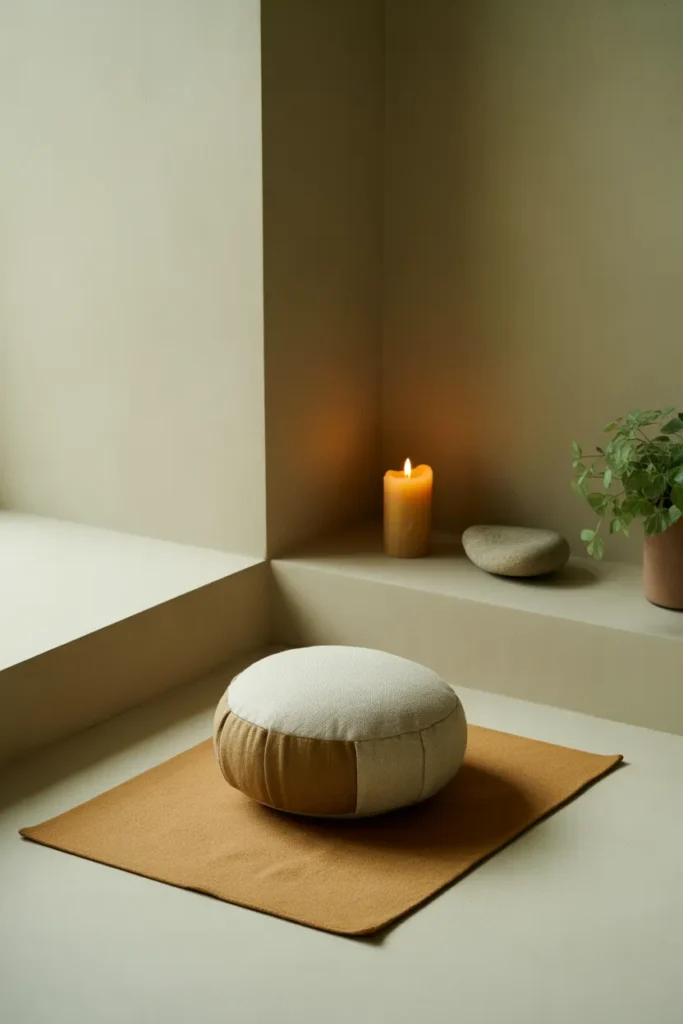
Vibe: The corner is still — a dedicated meditation space defined by a cushion, a candle, and nothing else communicates to the nervous system that this is a place for arriving, not doing.
Why it works: The physical designation of a space for meditation practice creates an environmental cue that reduces the activation energy required to begin a practice — the brain associates the specific visual field (cushion, candle, natural light) with the physiological state of calm, making that state more accessible on entry. This is the principle of stimulus-response conditioning applied constructively to wellness. The space does not need to be large — a 4×4 foot corner is sufficient — but it must be consistent and dedicated: the effectiveness of environmental cueing depends on the association being unmixed with other activities.
How to get it: A zafu cushion (buckwheat hull or kapok fill, $35–$65) and a zabuton floor mat ($40–$80) are the primary functional elements. Natural fill materials (buckwheat, kapok) are preferable to synthetic foam for extended sitting — they conform to the seated form more accurately. Position facing a wall with a simple, uncluttered visual field rather than facing into the room, which keeps the visual attention inward rather than tracking movement.
Quick Win: Placing a single cushion in an uncluttered corner and committing to sitting there for 5 minutes each morning before phone use creates a meditation practice and a wellness-centered spatial zone simultaneously — no additional objects required.
Shop The Look
- Zafu meditation cushion buckwheat natural linen
- Zabuton meditation mat wool natural
- Beeswax pillar candle natural unscented
- Smooth river stone large grey
- Low meditation altar shelf natural wood
11. Toxin-Free Bedroom with Natural Mattress and Bedding
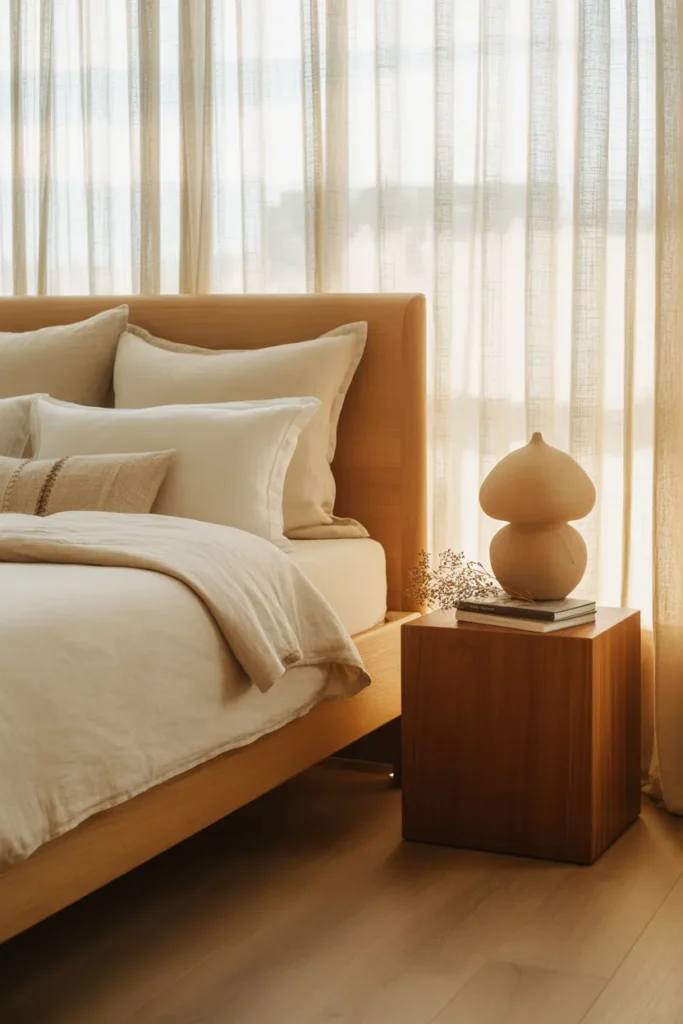
Vibe: The bedroom is clean — a natural material sleep environment is not an aesthetic choice but a physiological one, and the difference is perceptible from the first night.
Why it works: Conventional mattresses, pillows, and bedding are among the highest off-gassing sources in the home — polyurethane foam mattresses release VOCs including toluene and benzene, synthetic pillow fills release microplastics and chemical binders, and chemically treated cotton bedding introduces flame retardant residues into the sleep environment. The bedroom is where humans spend approximately one-third of their lives, making it the highest-impact room for material toxicity reduction. Natural latex, organic wool, and GOTS-certified organic cotton are the three material categories with documented low-VOC profiles and established certification standards.
How to get it: Avocado Green and Saatva Latex Hybrid both make GOTS-certified organic mattresses at $1,200–$2,500 for a queen — a significant investment with a 25-year lifespan that costs less per year than most furniture. Begin the transition with bedding: GOTS-certified organic linen or cotton duvet covers run $60–$150 and make an immediate air quality difference in the sleep environment without requiring a full mattress replacement.
Shop The Look
- Organic linen duvet cover GOTS certified warm white
- Natural latex pillow standard size
- Organic wool mattress topper queen
- Solid oak platform bed frame natural finish
- Beeswax wood furniture polish natural
12. Kitchen Herb Wall for Fresh Air and Daily Sensory Connection

Vibe: The kitchen is alive — a wall of growing herbs brings the daily sensory connection to living plants and natural fragrance that most modern kitchens entirely lack.
Why it works: Growing herbs in the kitchen creates a daily multisensory connection to living plants — visual (the varied greens and growth), tactile (the texture of leaves when harvested), and olfactory (the volatile aromatic compounds released by rosemary, thyme, and lavender that have documented anxiolytic effects in aromatherapy research). The olfactory pathway is the only sensory system with a direct neural connection to the amygdala and hippocampus — the brain’s emotional processing and memory centers — making aromatic plants the fastest-acting sensory wellness intervention available in the home environment. Beyond the sensory benefit, growing and harvesting herbs creates the kind of simple, embodied daily engagement that research in positive psychology identifies as a reliable source of low-level wellbeing.
How to get it: Mount cedar or teak shelves (1×6 boards on L-brackets) at the sunniest kitchen window, ideally south or east-facing. Begin with rosemary, thyme, and mint — the three most resilient indoor herbs for a kitchen environment. Use terracotta pots with drainage rather than sealed ceramic, as terracotta’s porosity prevents the root rot that kills most indoor herb plantings.
Shop The Look
- Cedar wall shelf bracket set kitchen
- Terracotta herb pot set small drainage holes
- Rosemary live plant indoor kitchen
- Fresh lavender plant live aromatic
- Herb seed starter kit organic kitchen
13. Outdoor-Indoor Flow with a Dedicated Transition Space
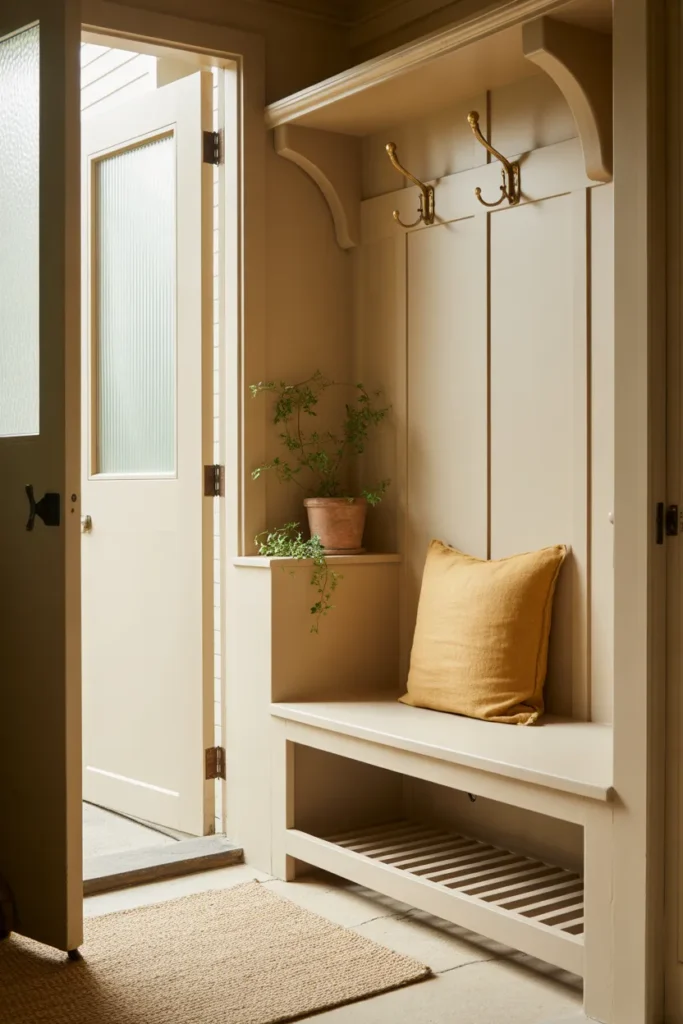
Vibe: The entry is calm — a dedicated transition space between outside and inside that is genuinely designed for the act of arriving creates a moment of decompression that most homes skip entirely.
Why it works: The transition from outdoor to indoor is a genuine neurological state change — cortisol levels, sensory alertness, and social performance mode all need to shift as we move from public to private space. A dedicated entry transition zone (with a place to sit, remove shoes, hang a coat, and leave outdoor items) creates a physical ritual that supports this neurological transition, signaling to the nervous system that a different mode is now appropriate. Japanese architecture formalizes this with the genkan (a lowered entry vestibule) for precisely this reason — the act of stepping up into the home after removing shoes is a physical enactment of the threshold between outer and inner worlds.
How to get it: Even a 4×4 foot entry zone defined by a natural fiber mat, a bench, and three wall hooks creates the functional transition space. The critical feature is that it must be fully equipped — if shoe removal requires searching for a place to sit, the transition ritual breaks down. A simple 2-step built-in bench (plywood box on legs, upholstered in outdoor linen) costs $60–$100 in materials and takes one afternoon to build.
Shop The Look
- Entryway bench built in storage linen cushion
- Antique brass coat hook wall mount set
- Natural jute door mat thick weave
- Entry hall narrow shoe storage cabinet
- Small potted plant entry hall ceramic
14. Warm Wood Ceiling Treatment for Sensory Enclosure
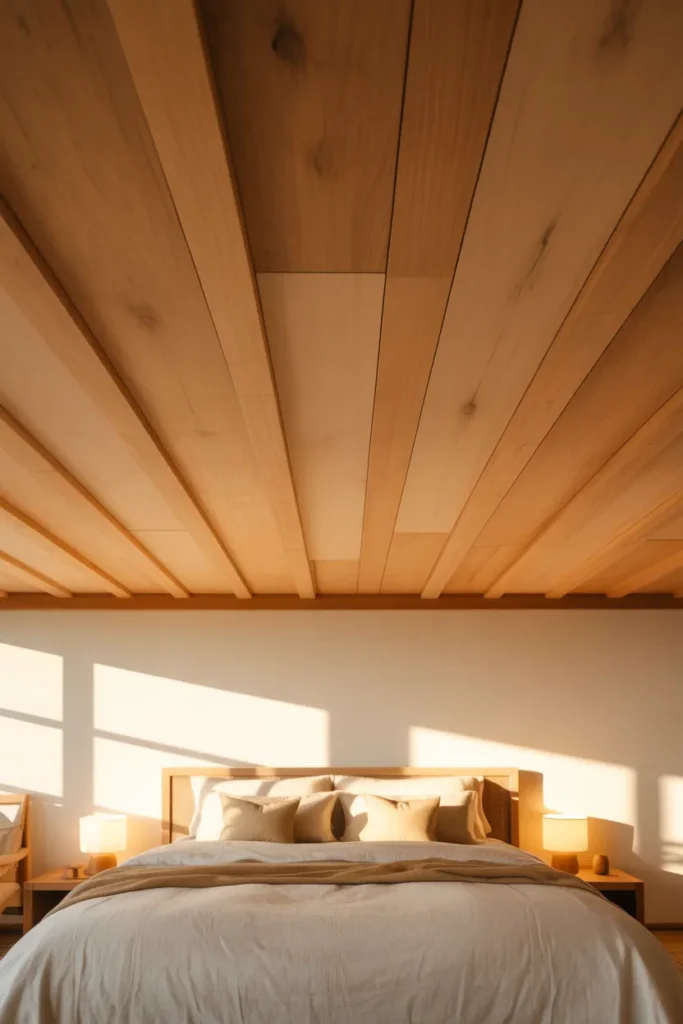
Vibe: The room is enveloping — a warm wood ceiling creates a sense of sheltered enclosure overhead that mirrors the feeling of being under a forest canopy, which is among the most psychologically restorative spatial experiences available.
Why it works: The psychological phenomenon of enclosure preference — documented in environmental psychology as the human preference for spaces with defined overhead boundaries that feel protective rather than exposed — explains why rooms with warm, visually heavy ceilings consistently rate higher for comfort and relaxation than rooms with white ceilings of the same height. Wood specifically adds the biophilic dimension: visual exposure to wood grain has been shown in multiple studies (notably at the University of British Columbia) to reduce sympathetic nervous system activation in ways that other warm ceiling materials do not replicate. The effect is measurably similar to brief exposure to a natural forest environment.
How to get it: Install 1×6 tongue-and-groove white oak or cedar planks directly onto existing drywall ceiling using construction adhesive and finish nails into joists. Finish with a natural oil (Rubio Monocoat or Osmo Polyx-Oil) rather than polyurethane — oil finishes maintain the tactile warmth of the wood and allow the material to breathe. A 12×14 foot bedroom ceiling requires approximately 280 linear feet of 1×6 plank, costing $200–$400 in cedar or $400–$700 in white oak.
Shop The Look
- Tongue and groove cedar ceiling plank 1×6
- Natural wood oil finish Rubio Monocoat
- Nail gun finish nailer 18 gauge
- Construction adhesive heavy duty panel
- White oak engineered plank ceiling grade
15. Low Furniture Profile for Visual Spaciousness and Ease
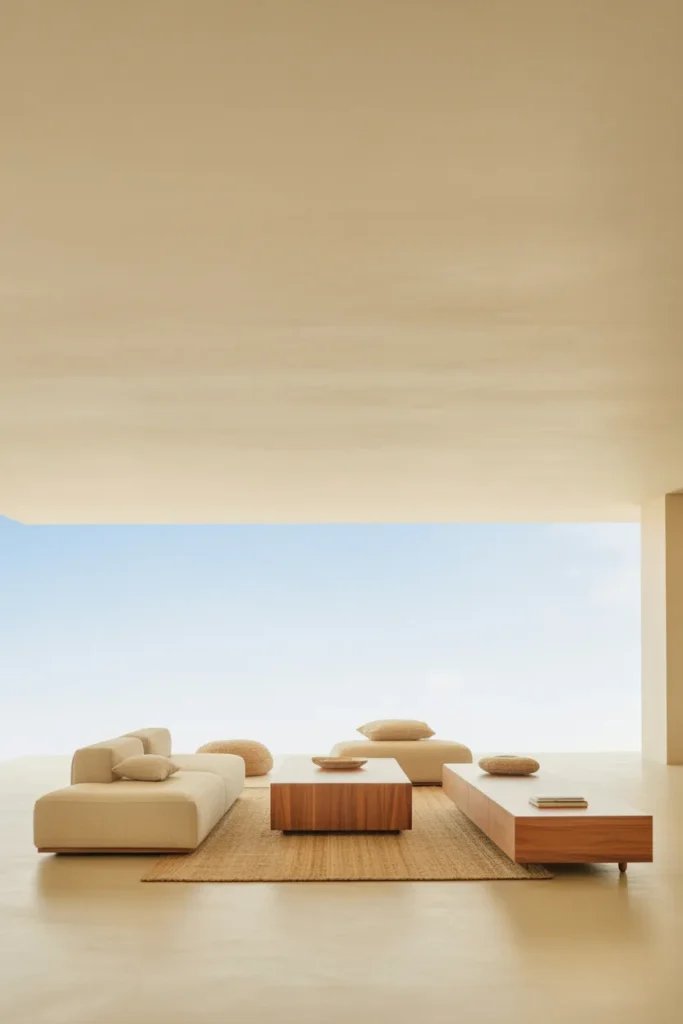
Vibe: The room is spacious — low furniture that leaves the upper zone of a room clear creates a sense of visual breathing room that registers as calm before any other feature of the room is noticed.
Why it works: Visual complexity in the upper field of vision — tall furniture, overhead clutter, crowded shelving — creates a subtle but measurable increase in cognitive load as the brain continuously scans for hazards in the peripheral visual field. Low furniture profiles that leave the upper two-thirds of a room open reduce this scanning load, creating the visual spaciousness associated with calm, open environments. This principle underpins Japanese residential design, where furniture consistently sits at or near floor level — the result is rooms that feel significantly larger than their square footage and dramatically calmer than Western equivalents with identical dimensions.
How to get it: Replace standard sofas (seat height 18–20 inches) with platform sofas or floor-level modular seating (seat height 12–15 inches). Choose coffee tables at 12–14 inches rather than the standard 16–18 inches. Clear all shelving above 54 inches — the visual field above eye level when seated should be as open as possible.
Shop The Look
- Low profile platform sofa linen natural
- Low walnut coffee table 14 inch height
- Floor cushion large linen seating
- Low media console walnut minimalist
- Large natural jute rug 9×12
16. Scent Design with Natural Essential Oil Diffusion
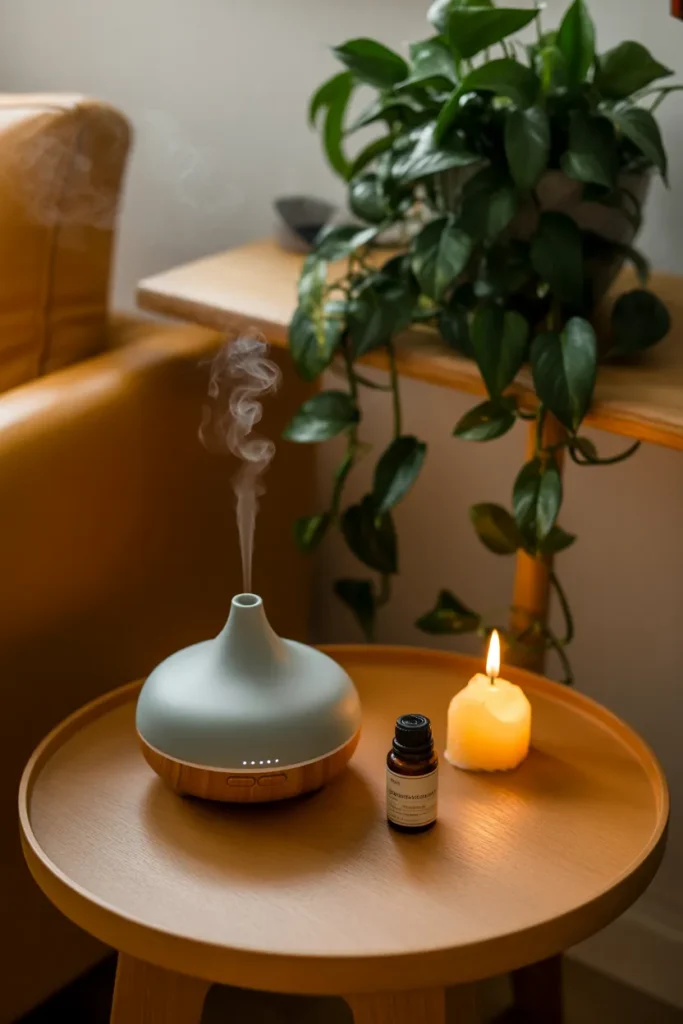
Vibe: The corner is sensory — a well-chosen scent diffused through a home creates an invisible environmental layer that registers in the limbic system before the conscious mind identifies it, shifting mood faster than any visual design change.
Why it works: The olfactory system’s direct connection to the limbic brain (amygdala and hippocampus) makes scent the fastest-acting environmental mood modifier available — aromatic compounds reach emotional processing centers in milliseconds rather than the seconds required for visual or auditory processing. Lavender (linalool) has the strongest evidence base for anxiolytic effect, with multiple randomized controlled trials showing reduced anxiety, lowered blood pressure, and improved sleep quality with diffusion at 30–45 minute intervals. Bergamot, cedarwood, and frankincense have secondary evidence for mood elevation and cognitive clarity respectively. Synthetic fragrance oils do not produce these effects — only pure essential oils contain the bioactive aromatic compounds that interact with neuroreceptors.
How to get it: Use an ultrasonic ceramic diffuser (rather than a heat diffuser, which degrades aromatic compounds) with 100% pure essential oils — not fragrance oils, which are synthetic and contain no bioactive compounds. Diffuse in 30-minute on/30-minute off cycles to prevent olfactory fatigue. Start with a blend of 3 drops lavender, 2 drops cedarwood, 1 drop bergamot for a universally calming evening environment.
Quick Win: A bundle of fresh or dried lavender ($8–$15) placed on a bedroom nightstand releases enough aromatic compound passively to produce a mild relaxation effect — the lowest-effort scent wellness intervention available.
Shop The Look
- Ceramic ultrasonic essential oil diffuser matte
- Lavender essential oil pure 100 percent
- Cedarwood essential oil therapeutic grade
- Bergamot essential oil cold pressed
- Dried lavender bundle bedroom nightstand
17. Clutter-Free Surfaces Through Intentional Storage Design
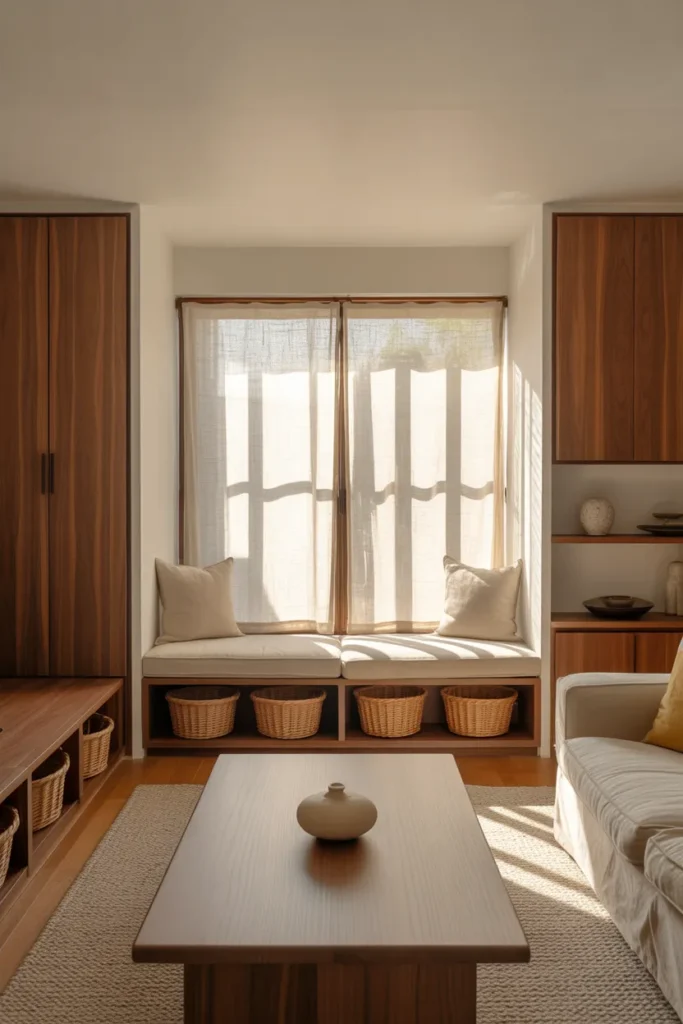
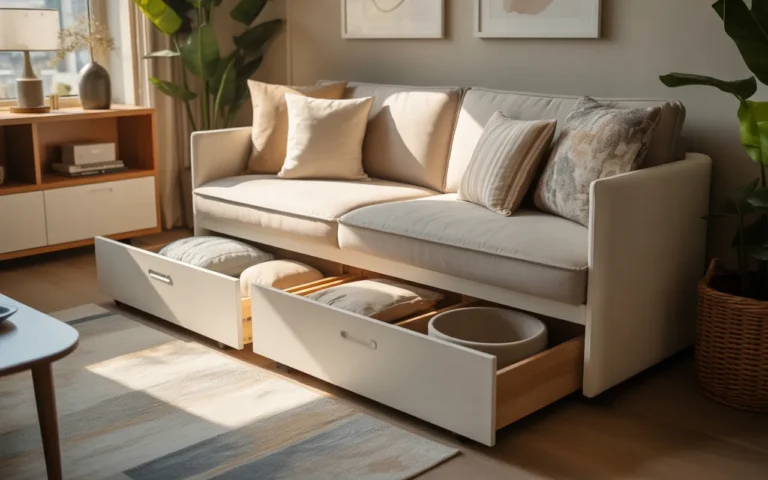
Vibe: The room is resolved — clear surfaces achieved through concealed storage rather than emptiness create a calm that feels inhabited and comfortable rather than staged and sterile.
Why it works: Visual clutter — defined as environmental stimuli competing for attention — has a direct and well-documented relationship with cortisol levels and perceived stress. Princeton University Neuroscience Institute research demonstrated that visual clutter reduces the brain’s ability to focus, increases error rates in cognitive tasks, and elevates subjective stress ratings. The critical distinction for wellness design is between emptiness (which feels uncomfortable and uninhabited) and resolved order (which feels calm and cared-for). The difference is achieved through concealed storage — everything has a designated place that is not the horizontal surface.
How to get it: The one-object rule on horizontal surfaces is the simplest implementation: every table, shelf, and counter surface is allowed one intentional object (a plant, a candle, a ceramic piece) and nothing else. Everything else goes into closed storage — lidded baskets, cabinet drawers, under-seat boxes. This requires adequate concealed storage, not fewer possessions.
Shop The Look
- Lidded wicker storage basket set natural
- Built in window seat storage box kit
- Walnut cabinet closed storage living room
- Felt lined drawer organizer set
- Ceramic decorative object single minimal
18. Forest View or Green View from Every Primary Seating Position
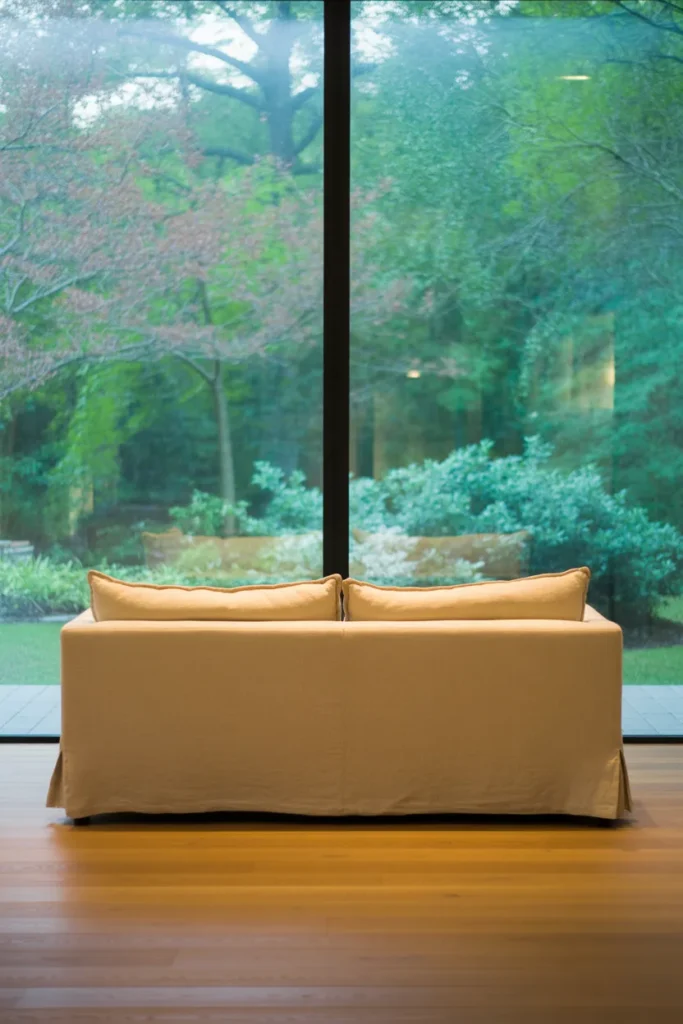
Vibe: The room is connected — orienting the primary seating toward a green outdoor view rather than a television or interior wall gives the room’s inhabitants a continuous, passive dose of the most documented restorative visual stimulus available.
Why it works: Roger Ulrich’s landmark 1984 study — in which hospital patients with window views of trees recovered faster, required less pain medication, and had shorter hospital stays than patients whose windows faced a brick wall — established the evidence base for what environmental psychologists now call restorative environment theory. Subsequent research has demonstrated that even 40 seconds of visual exposure to a green natural scene measurably improves sustained attention and reduces cognitive fatigue. In a home, orienting the primary seating toward a window with a green view rather than toward a screen makes this restorative stimulus passively available throughout every hour spent in the room.
How to get it: If the existing room layout orients seating away from windows, rearrange furniture so the primary seating faces the window with the most green view, even if this means the television is to the side or behind. If no green view exists, a large indoor plant (fiddle-leaf fig, monstera, or olive tree) placed beside or in front of a window creates a partial biophilic view substitute.
Shop The Look
- Large fiddle leaf fig tree indoor live
- Monstera deliciosa plant large indoor
- Sheer curtain panel unlined light filter
- Window seat cushion custom size linen
- Large planter pot floor standing ceramic
19. Natural Sleep Environment with Blackout and Sound Masking
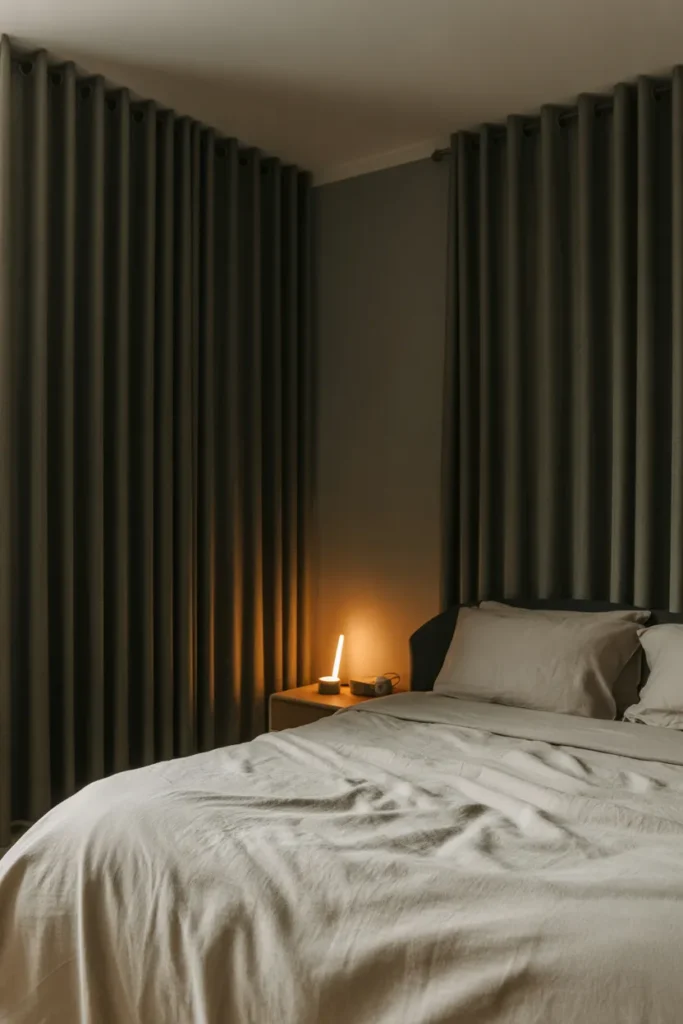
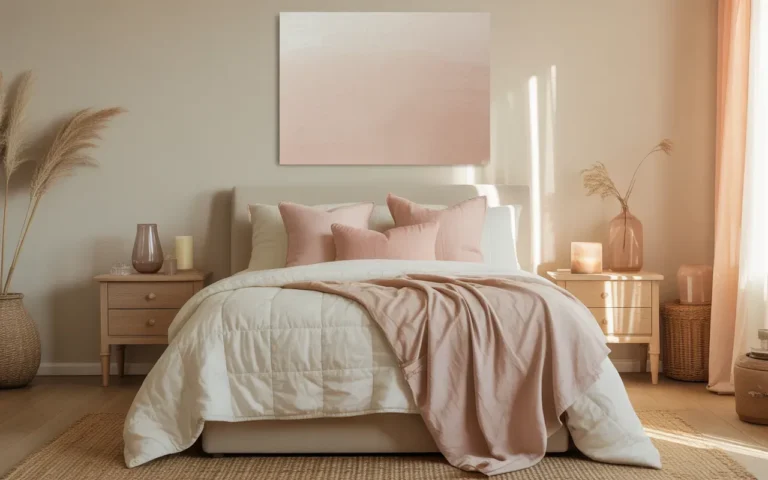
Vibe: The bedroom is deeply restful — a room engineered for sleep quality through blackout, sound masking, and low warm light is one of the highest-impact wellness investments a home can make.
Why it works: Sleep is the primary recovery mechanism for every major physiological system — immune function, hormonal regulation, cognitive consolidation, and emotional processing all depend on sleep quality more than almost any other lifestyle factor. Two environmental variables have the strongest evidence base for sleep quality impact: light (even low-level ambient light during sleep suppresses melatonin and reduces REM duration) and sound (intermittent noise, even at levels below conscious perception, increases cortisol and reduces deep sleep stages). Blackout curtains (achieving 99%+ light blocking) and continuous white noise at 65 decibels (the level that masks most residential ambient sound) address both variables at a combined cost of $80–$200.
How to get it: True blackout requires curtains that extend at least 4 inches beyond the window frame on all sides and are floor-length — gap light from the sides and bottom of standard curtains is sufficient to disrupt sleep quality. Layer blackout linen (which has the aesthetic of natural linen while achieving full light block) over a white sheer for daytime light management. Choose a white noise machine with a continuous non-looping sound rather than a looping recording, which the brain learns to anticipate and partially ignore.
Shop The Look
- Blackout linen curtain panel floor length deep tone
- White noise machine continuous non loop
- Warm amber LED bulb 2200K bedside
- Sleep mask silk blackout travel
- Curtain tension rod blackout side gap blocker
20. Barefoot-Friendly Natural Floor Materials Throughout
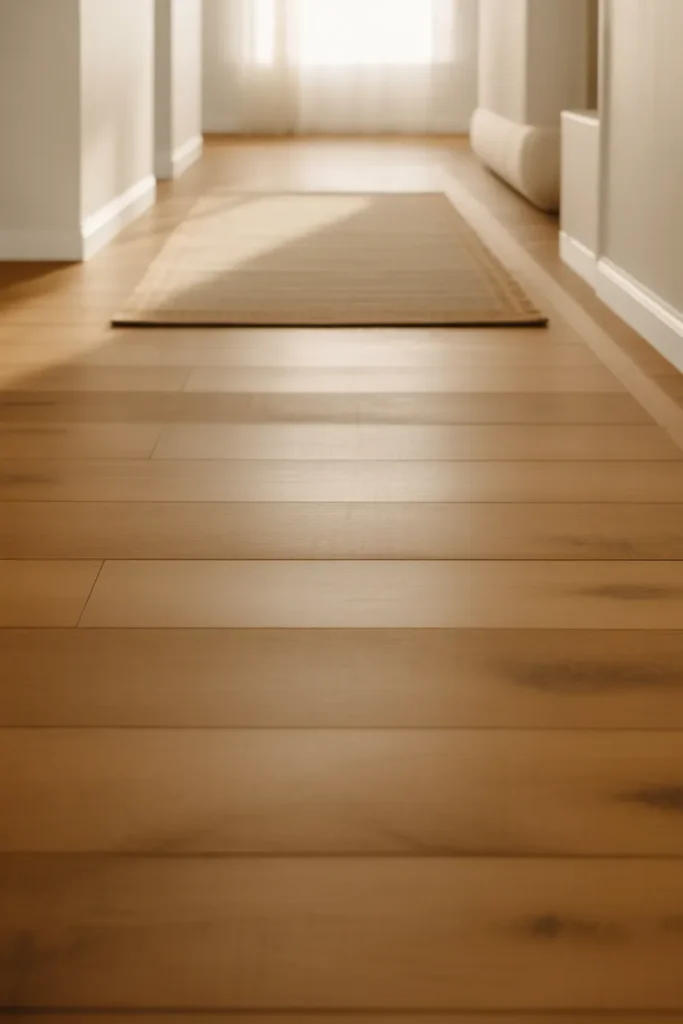
Vibe: The floor is inviting — natural materials underfoot that are warm to the touch, slightly soft, and pleasant to walk on barefoot create a grounded, embodied quality of home experience that cold tile or synthetic carpet cannot.
Why it works: Barefoot contact with warm, natural surfaces is a form of grounding that engages tactile receptors in the feet differently from shod walking — proprioceptive feedback from natural floor surfaces (cork, wood, wool) activates more sensory pathways than walking on synthetics, contributing to the overall sensory richness that wellness-centered design seeks to cultivate. Cork flooring specifically has a natural cellular structure that provides thermal insulation (it feels warm underfoot at any ambient temperature) and acoustic dampening (it reduces impact sound transmission between floors by 10–15 decibels), making it the highest-performing natural floor material for both sensory wellness and acoustic wellness simultaneously.
How to get it: Cork floor tiles (Cali Bamboo and Lumber Liquidators both carry natural cork options) run $2–$5 per square foot installed, making them cost-competitive with mid-range vinyl while dramatically outperforming vinyl on natural material properties. Unfinished white oak plank flooring ($5–$9 per square foot) finished with a natural oil rather than polyurethane maintains its warm tactile quality and can be recoated without sanding.
Shop The Look
- Natural cork floor tile 12×12 warm tone
- Unfinished white oak plank flooring
- Natural wood floor oil finish matte
- Hand knotted wool rug natural transition
- Floor buffer applicator natural oil finish
21. Whole-Home Material Consistency for Visual Rest
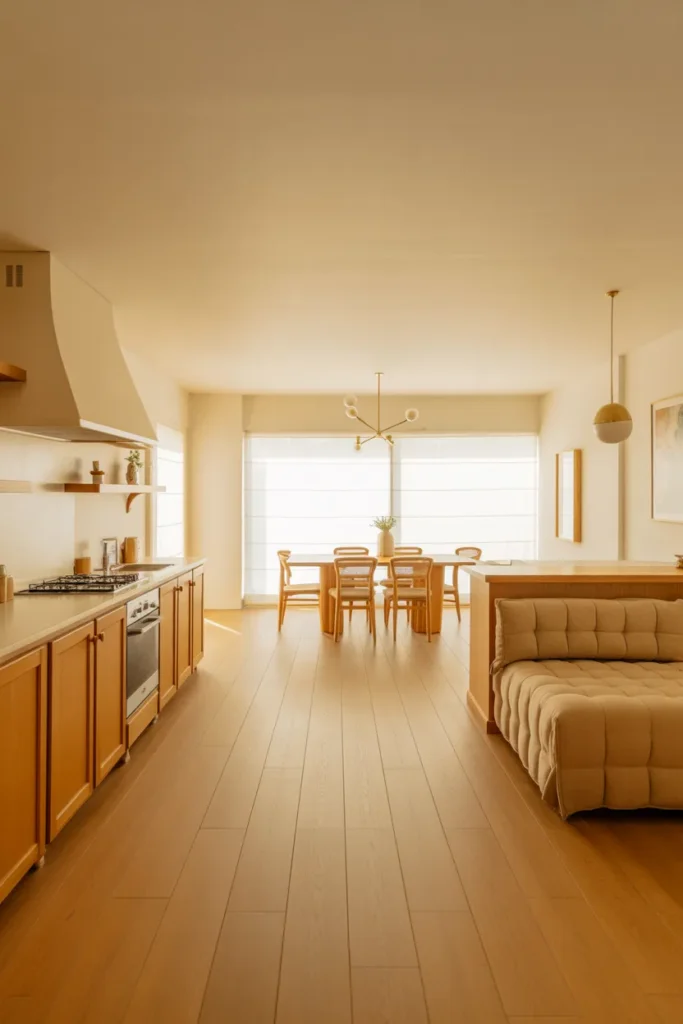
Vibe: The home is serene — material consistency across an open plan or connected rooms creates a visual calm that is immediately and physically perceptible, because the eye finds nothing to resolve, correct, or reconcile.
Why it works: Visual coherence — the experience of a unified, consistent material and color environment — reduces the low-level cognitive effort that the brain continuously expends resolving visual discontinuities between rooms. When flooring changes, wall tones shift, and hardware styles conflict between adjacent spaces, the brain performs constant micro-comparisons that accumulate into a background sense of unresolved disorder. Consistent material throughput (same floor, same wall tone, same hardware metal, same textile family) eliminates this cognitive overhead, producing the specific quality of calm associated with well-designed spaces. This is achievable through editing and replacement rather than renovation — standardizing to one metal tone for hardware throughout the home costs less than $200 in replacement pulls and handles and changes the visual experience of every room simultaneously.
How to get it: Start with the floor (the largest continuous surface) — if mixed flooring exists, use large area rugs in the same natural fiber family to create visual continuity between zones. Then standardize hardware metal: replace all visible pulls, handles, and faucets to a single tone (warm brass, matte black, or brushed nickel — choose one). Finally, align wall tones to a single warm white throughout connected spaces. These three changes — consistent floor visual, consistent metal, consistent wall tone — achieve 80% of the material cohesion effect of a full renovation.
Quick Win: Replacing all light switch plates and outlet covers throughout the home with a single consistent tone (warm white, screwless plate, $2–$4 each) is a 2-hour project that eliminates one of the most visually disruptive material inconsistencies in a typical home at a total cost of under $50.
Shop The Look
- Warm brass cabinet pull handle set consistent
- Screwless wall plate outlet cover warm white
- White oak engineered flooring throughout
- Natural linen throw pillow set cohesive
- Warm white interior paint consistent tone
How to Start Your Wellness-Centered Home Transformation
The single most impactful first move in a wellness-centered home transformation is not a purchase — it is a removal. Identify the one object, surface, or fixture in your home that creates the most visual or sensory friction when you encounter it daily and remove it this week. This might be a harsh overhead light fixture replaced temporarily by a floor lamp, a cluttered surface cleared to a single object, or a synthetic-scented candle replaced by a beeswax alternative. The act of identifying and removing a wellness obstacle is more immediately powerful than adding a wellness feature, because it directly reduces the sensory load that the home is currently imposing on the nervous system.
The most common beginner mistake in wellness-centered design is addressing aesthetics before addressing air and light. A beautifully curated room with poor air quality and harsh overhead lighting will not feel peaceful regardless of how well-chosen its objects are — because air and light are physiological, not aesthetic. They affect the nervous system before any conscious evaluation of the room takes place. Fix the light first (warm bulbs, no overhead fixtures in the evening, natural light access in the morning), then address air quality (open windows daily, add one air-purifying plant, eliminate synthetic fragrance), and only then turn attention to material and aesthetic choices.
Three specific interventions under $50 that produce immediate, measurable wellness impact in any home: replacing the bedroom overhead light with a warm 2200K LED bulb in a bedside lamp ($12–$18) for better sleep quality; adding a single HEPA air purifier bag of activated charcoal to the bedroom ($8–$15) to reduce airborne chemical off-gassing overnight; and placing a bundle of dried lavender on the bedroom nightstand ($8–$15) for evidence-based sleep-adjacent aromatherapy.
A meaningful first layer of wellness-centered home design — lighting upgrade, one natural textile addition, clutter clearing, and one air quality intervention — is achievable in a single weekend for $100–$200. A full whole-home wellness transformation encompassing natural materials, circadian lighting, acoustic treatment, and air quality systems is a 6–18 month process with a realistic investment range of $2,000–$8,000 for most homes, significantly less than the equivalent impact available through medical or therapeutic interventions addressing the same stress and sleep issues.
Frequently Asked Questions About Wellness-Centered Homes
What is the difference between a wellness-centered home and a minimalist home?
A wellness-centered home prioritizes physiological and psychological wellbeing as the primary design criteria — air quality, light quality, acoustic environment, natural materials, and sensory richness all matter as much as visual appearance. A minimalist home prioritizes the reduction of visual and material complexity as an aesthetic goal. The two approaches overlap significantly — both favor reduced clutter and material restraint — but diverge in important ways. A wellness-centered home may include rich textile layering, abundant plants, and carefully curated sensory elements that a strict minimalist aesthetic would exclude. The test is different: a wellness-centered home asks “does this support how I feel?” rather than “does this reduce visual complexity?” A home can be minimal and stressful (cold materials, poor light, acoustic harshness) or maximally furnished and deeply restorative (warm materials, circadian lighting, biophilic abundance).
Which rooms in a home have the highest wellness design impact?
The bedroom has the highest impact by a significant margin, because sleep quality is the physiological foundation of every other health metric and is directly regulated by the bedroom’s light, sound, air quality, and material environment. The cumulative nightly effect of a well-designed sleep environment compounds across years in ways that no other single wellness intervention can match. Second is the kitchen, because it is the room most directly linked to daily nutrition behavior — the design of a kitchen (its organization, its material quality, its connection to natural light) measurably influences what and how much people eat. Third is the entry space, because the quality of daily transition between outside and inside modulates the cortisol reset that determines baseline stress levels for each home session.
How much does a wellness-centered home transformation cost?
The cost range is extremely wide because the highest-impact wellness interventions are often free or very low cost. Rearranging furniture to face a green view costs nothing. Removing a harsh overhead light and using a floor lamp instead costs nothing if you own a floor lamp. Opening windows daily for air exchange costs nothing. The first meaningful investment tier — a blackout curtain, a warm LED bulb, a HEPA air purifier, and a natural fiber rug — runs $150–$400 and addresses light, air, and acoustic wellness simultaneously. A full material transformation (natural plaster walls, wood ceiling, organic bedding, living plant wall) runs $3,000–$15,000 depending on room count and existing conditions. The most effective approach is to layer interventions from no-cost behavioral (morning light exposure, daily ventilation, screen curfew) through low-cost product ($50–$500) through medium-cost material ($500–$5,000) over 12–24 months.
Can a rented home be made wellness-centered without permanent modifications?
Yes — the majority of wellness design interventions are entirely non-permanent. Lighting can be transformed with plug-in floor and table lamps and smart bulbs in existing sockets. Air quality improves through portable HEPA purifiers, daily ventilation, and the removal of synthetic fragrances. Acoustics improve through rugs, textiles, and wall-hung tapestries that remove without damage. Plants can be moved. Furniture can be rearranged. The three rental-specific limitations are wall finishes (clay plaster requires permission), flooring (cork or wood requires permission), and blackout window coverage (can be achieved with tension rod blackout curtains that require no drilling). A rented home can achieve 70–80% of the wellness impact of a fully owned and renovated wellness home through product and behavioral interventions alone.
What is the single most important wellness design principle to implement first?
Circadian light management is the highest-priority first intervention, because light is the primary regulator of every major physiological rhythm in the human body — sleep-wake cycle, cortisol production, melatonin timing, core body temperature, and digestive function all depend on the light environment for their correct timing. Implementing morning bright light exposure (minimum 10,000 lux for 20–30 minutes before 10am, achievable through a dedicated east-facing morning window seat or a full-spectrum light therapy lamp) and evening warm light only (2200K, no overhead fixtures after 7pm, all screens with blue-light filter) produces measurable improvements in sleep quality within 7–14 days — faster than any other wellness home intervention with the exception of HEPA air filtration in homes with high baseline indoor air pollutant levels.
Ready to Design a Home That Restores You?
These 21 ideas span the full spectrum of what a wellness-centered home can address — from the physiological precision of circadian lighting and HEPA air filtration to the sensory richness of clay plaster walls and natural textile layering, from the psychological clarity of clutter-free surfaces and digital-free zones to the biological depth of a natural sleep environment and a dedicated morning light ritual. You do not need to implement all 21 simultaneously — the most sustainable wellness home transformation happens in layers, each one building on the last, each one producing a perceptible shift in how the home feels to live in before the next begins. Start this week by identifying the single room in your home where you feel least at ease and asking one honest question: is it the light, the sound, the air, the material, or the clutter? The answer will tell you exactly where to begin. A home designed in service of the nervous system does not merely look different from a conventionally decorated space — it feels fundamentally different to inhabit, hour by hour, season by season, in ways that accumulate into a genuinely different quality of daily life. Pin the ideas that named something you already felt but hadn’t yet identified — those are the ones your home is asking for.