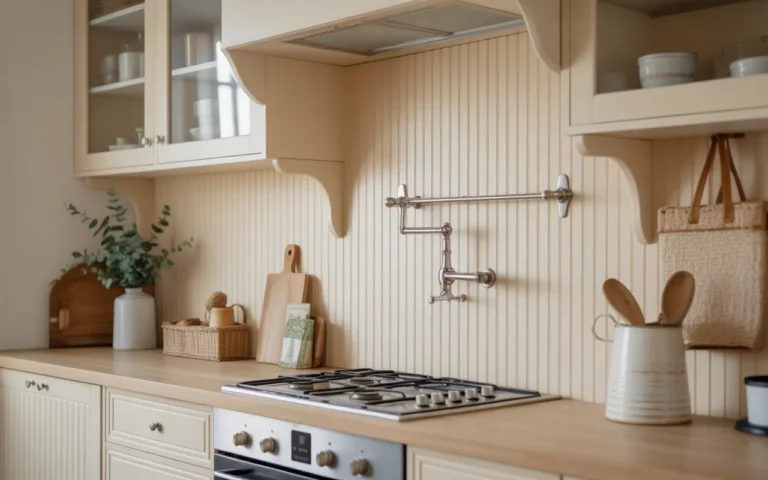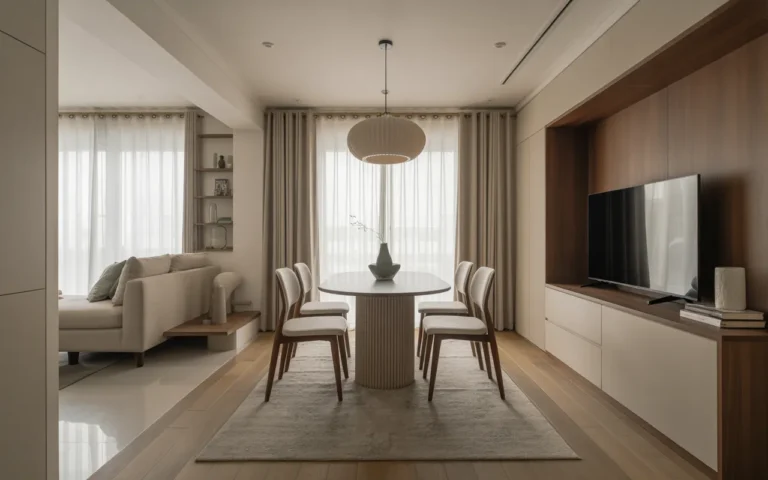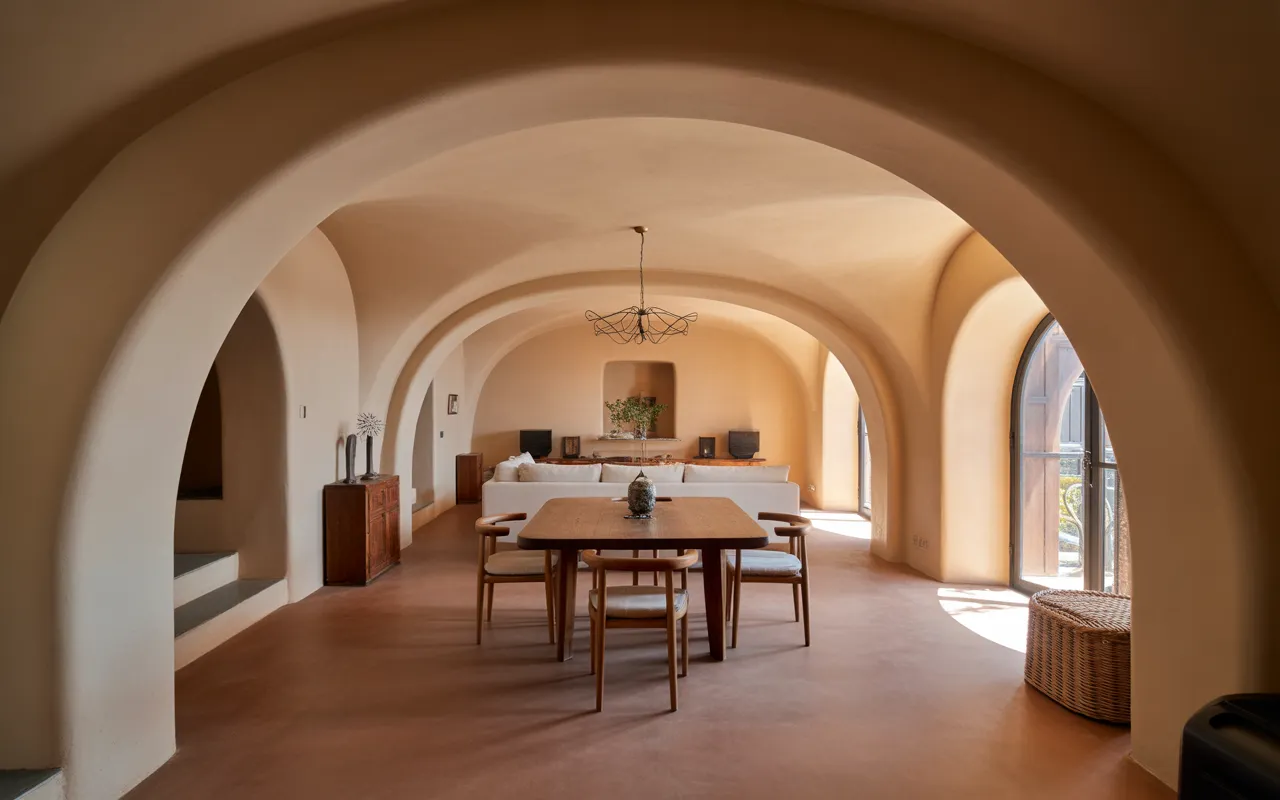
21 California Spanish Style Interior Chic Spaces
A california spanish style interior has a warmth that never really goes out of fashion. Arched doorways, dark wood beams, handmade tile, and sun-washed plaster walls. These are the ingredients, and they work in a 1920s bungalow just as well as in new construction.
You do not need a full remodel to get the look. Most of the ideas below are single-room projects with budgets from roughly 100 to 2,500 dollars, and prices vary with materials and where you live. Start with the one room you use most, get it right, then let the style spread naturally through the house.
This guide walks through 21 spaces, entryways to patios, with practical notes on what each project really costs and where people usually go wrong. Take what fits your home and skip the rest. The style is forgiving, which is half its charm.
1. Sunlit Entryway with Classic Spanish Arches
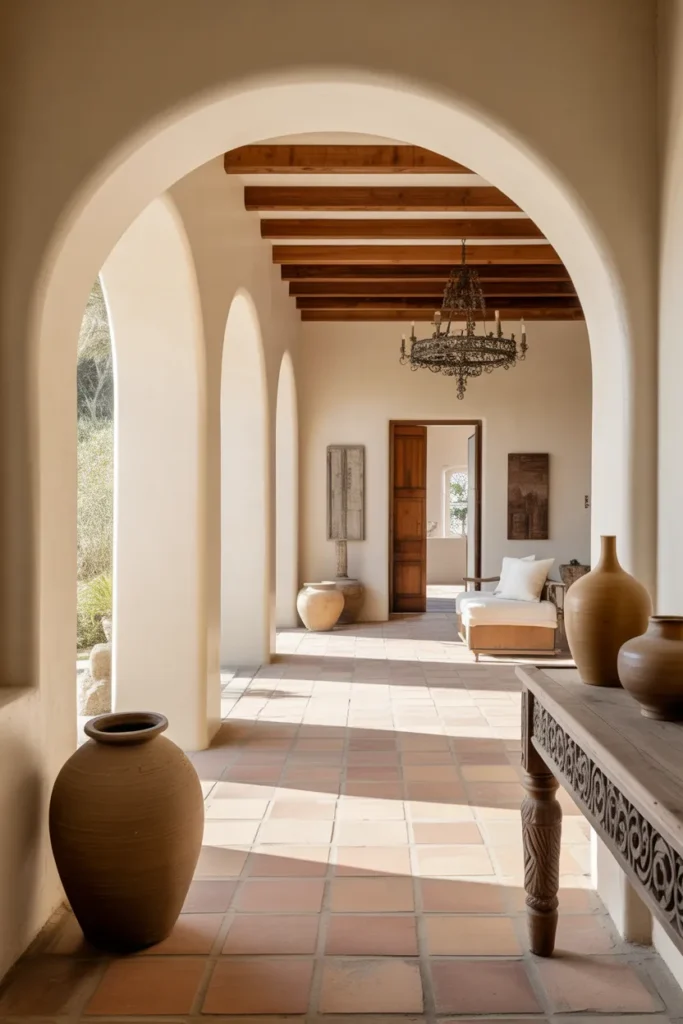
The entryway is where the whole house makes its first promise. A sunlit entry with classic Spanish arches tells guests exactly what kind of home they are walking into, warm, grounded, and a little bit romantic. You do not need a grand foyer to pull this off. Even a narrow hall benefits when an arch frames the view.
Pick the shape: a full rounded arch feels most traditional, while a soft elliptical arch reads a little more modern. Either one works with white or cream plaster. Painting just the inside curve of the arch a warm terracotta can add depth without repainting the whole room.
A small console table and a round mirror under the arch complete the look. This corner costs roughly 150 to 400 dollars to style with a table, mirror, and a runner, and prices vary a lot by size. Avoid fake arch kits: the thin stick-on arch trims sold online look cheap up close and are hard to keep straight. If you cannot build a real curve, a simple arched mirror on a plain wall gives you the same feeling for much less.
- Arch shape should echo anything arched already in the house, doors, windows, or a niche.
- Keep the floor runner light so the entry still feels sunlit, not heavy.
- One piece of greenery, an olive branch or a small citrus tree, beats a pile of small decor items.
Shop This Look
2. Warm Living Room with Exposed Wooden Beams
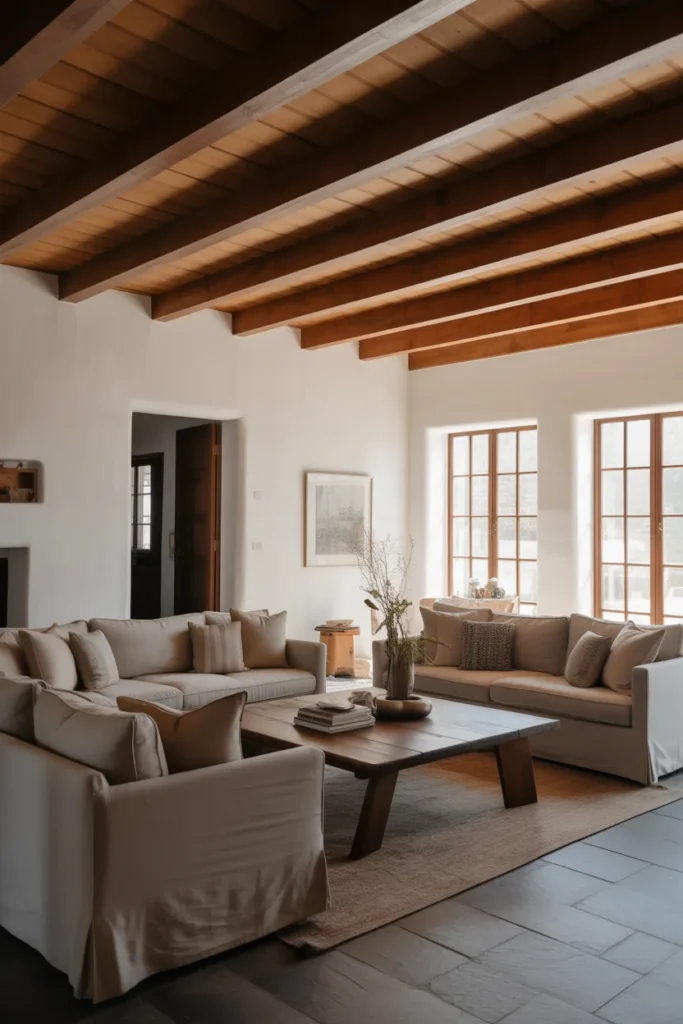
Exposed wooden beams are the fastest way to give a living room that old California hacienda feeling. They add weight and shadow to the ceiling, which makes everything below them feel more anchored. Dark walnut stain is the classic choice, but a lighter honey finish works when the room is small.
Measure first: beams look best when they run across the shorter dimension of the room and sit at least 8 feet off the floor. Low ceilings plus chunky beams will make the room feel like a cave. If your ceiling is under 8 feet, use slim faux beams painted the same color as the ceiling for texture without the heaviness.
Real reclaimed beams cost roughly 30 to 80 dollars per linear foot installed, prices vary by region. Faux beams run roughly 8 to 20 dollars per foot and most people cannot tell the difference once they are up. Watch the lighting: beams cast shadows that can darken a room fast. Plan one light source per beam bay, recessed cans or a fan, so the ceiling does not swallow your daylight.
- Stain test boards look different once they are overhead, always test upward.
- Pair beams with a light rug so the floor and ceiling balance each other.
- Dust the top of faux beams twice a year, cobwebs love them.
Shop This Look
3. Charming Kitchen with Handcrafted Tile Details
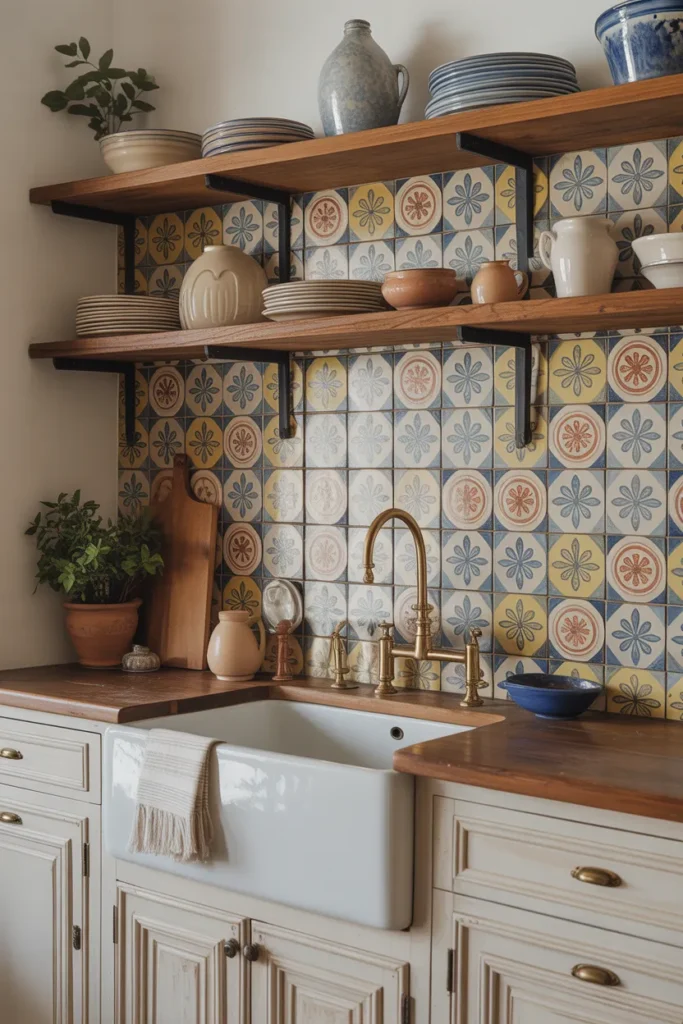
Handcrafted tile is the jewelry of a Spanish style kitchen. A small patch of hand-painted Talavera or zellige tile behind the range does more for the room than an entire wall of expensive cabinets. The slight irregularities in handmade tile catch light in a way factory tile never does.
Start small: a 3 by 3 foot backsplash accent costs roughly 200 to 600 dollars in material, prices vary with the tile source. Covering the full backsplash can double or triple that, so decide where your eye actually lands when you walk in. The strip behind the stove and the sink are the two spots that matter most.
Warning about grout: handmade tiles have uneven edges, so a standard narrow grout line will look wavy and amateur. Ask your installer for a slightly wider joint, about 3/16 inch, and a sanded grout that matches the tile. Seal porous tiles before grouting or the grout color will stain them permanently.
- Buy 15 percent extra tile, handmade lots vary and matching later is hard.
- Keep counters simple, butcher block or honed stone, so the tile stays the star.
- Avoid busy patterns on both tile and textiles at once.
Shop This Look
| TILE | HARDWARE | LIGHTING |
|---|---|---|
| Talavera Decorative Tiles | Oil Rubbed Bronze Cabinet Pulls | Bronze Pendant Light |
| Shop → | Shop → | Shop → |
4. Courtyard-Inspired Indoor-Outdoor Space
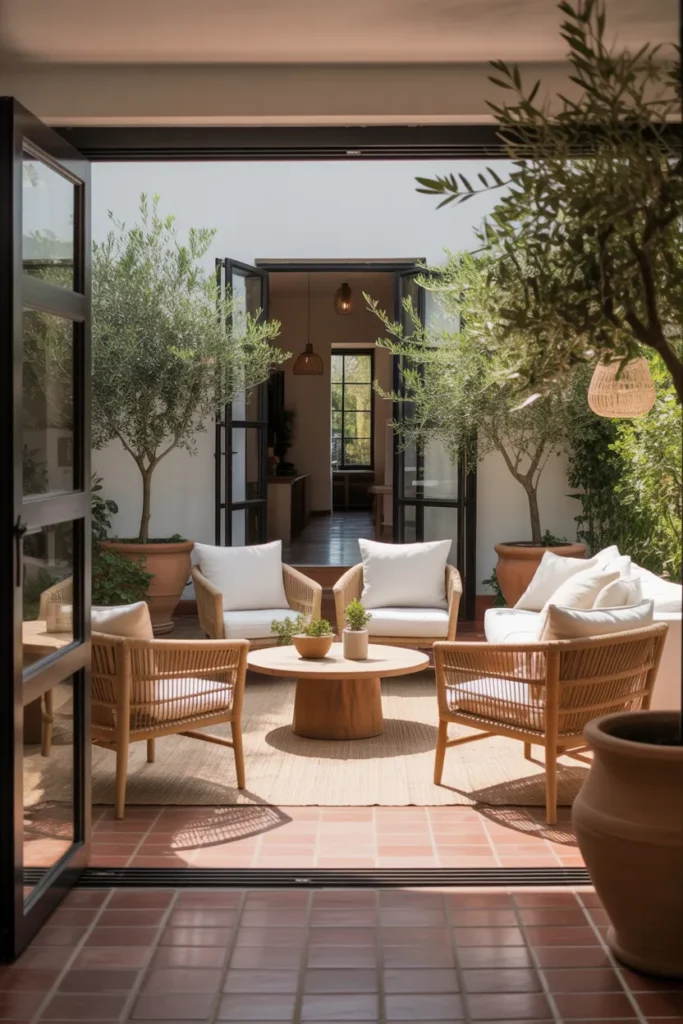
The courtyard is the heart of Spanish architecture, and you can borrow that feeling even if your house sits on a small lot. A courtyard-inspired space blends inside and outside so the line between them goes soft. Think tile floors that run from the kitchen straight out to a covered patio, with plants on both sides of the glass.
Use the same floor inside and out: terracotta or saltillo-look tile that continues through the doorway tricks the eye into reading one bigger room. Sliding or French doors that pocket fully open help even more. A budget version is an indoor-outdoor rug layered at the threshold in a matching pattern.
Expect to spend roughly 300 to 900 dollars on planters, a rug, and string lighting for a small patio zone, prices vary. Be honest about drainage: potted plants near a door will drip. Put every pot on a saucer or a boot tray, or your indoor floor will tell the story every time you water.
- Repeat one plant type on both sides of the door for a seamless look.
- Warm white string lights read cozy, cool white reads commercial.
- Leave one clear path through the space, clutter kills the indoor-outdoor illusion.
Shop This Look
| PLANTERS | LIGHTING | RUGS |
|---|---|---|
| Large Terracotta Planters | Outdoor String Lights | Indoor Outdoor Rug |
| Shop → | Shop → | Shop → |
5. Rustic Dining Room with Wrought Iron Lighting
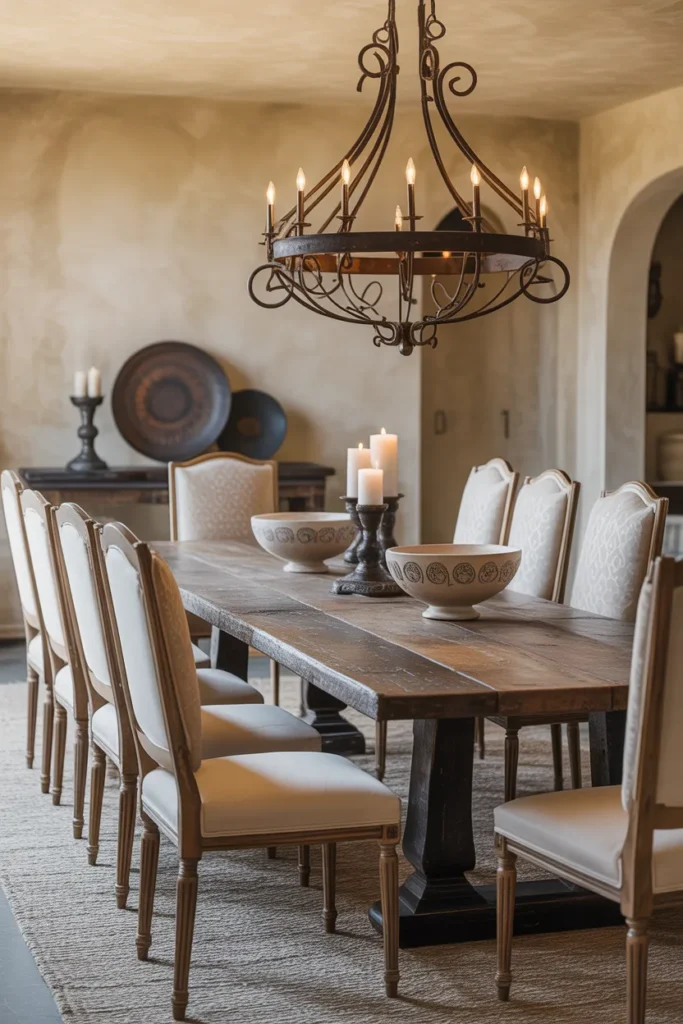
A rustic dining room lives or dies by its lighting. A wrought iron fixture over the table brings the Spanish mood instantly, those dark curls and candle-style bulbs against a plaster ceiling. It is one of the few single purchases that can carry a whole room.
Size the fixture to the table: the chandelier should be about half to two-thirds the width of the table and hang 30 to 36 inches above it. Too high and it lights the ceiling instead of the food. Too big and diners feel crowded. A simple ring or rectangular frame suits a long farmhouse table.
A decent wrought iron dining chandelier costs roughly 120 to 350 dollars, prices vary with size and finish. Check the weight rating: iron fixtures are heavy, and a standard electrical box may not be rated for them. If the box is not fan-rated, have an electrician swap it before you hang anything. A falling chandelier ruins dinner.
- Put the light on a dimmer, bright for homework, low for dinner.
- Repeat the iron somewhere small, a candle holder or shelf bracket, so it feels intentional.
- Avoid matching the fixture exactly to cabinet hardware, close enough is better.
Shop This Look
| CHANDELIER | TABLE | CHAIRS |
|---|---|---|
| Wrought Iron Dining Chandelier | Rustic Wood Dining Table | Leather Dining Chairs |
| Shop → | Shop → | Shop → |
6. Elegant Staircase with Wrought Iron Railings
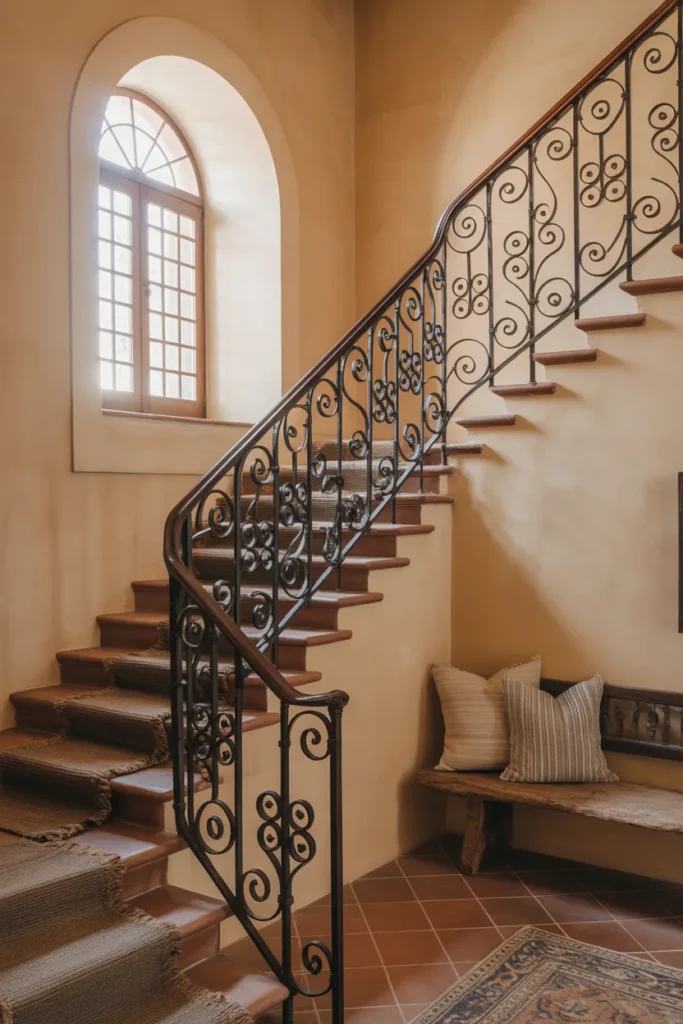
A staircase with a wrought iron railing turns a boring hallway into a moment. The scrollwork draws the eye upward and makes even a simple stair feel crafted. This is one of the strongest Spanish style signals you can add to a two-story home.
Choose simple scrolls: elaborate grapevine patterns look dated fast and cost far more. A clean double-scroll or straight baluster with a forged look stays timeless. Black is classic, but a dark bronze softens the contrast against white walls.
Custom iron railings run roughly 150 to 400 dollars per linear foot installed, prices vary widely. Prefabricated iron balusters cost far less, roughly 10 to 25 dollars each, and a carpenter can install them into your existing wood rail. Measure your local code: most areas require balusters spaced under 4 inches apart so a child cannot slip through. Check before you order.
- Keep the handrail wood for warmth, iron plus wood is the classic pairing.
- Under-stair lighting makes the ironwork cast beautiful shadows at night.
- Do not paint iron railings white, it reads as trying too hard and chips fast.
Shop This Look
| RAILING | RUNNER | LIGHTING |
|---|---|---|
| Wrought Iron Balusters | Stair Runner Rug | Motion Sensor Step Lights |
| Shop → | Shop → | Shop → |
7. Earthy Color Palette with Warm Neutrals
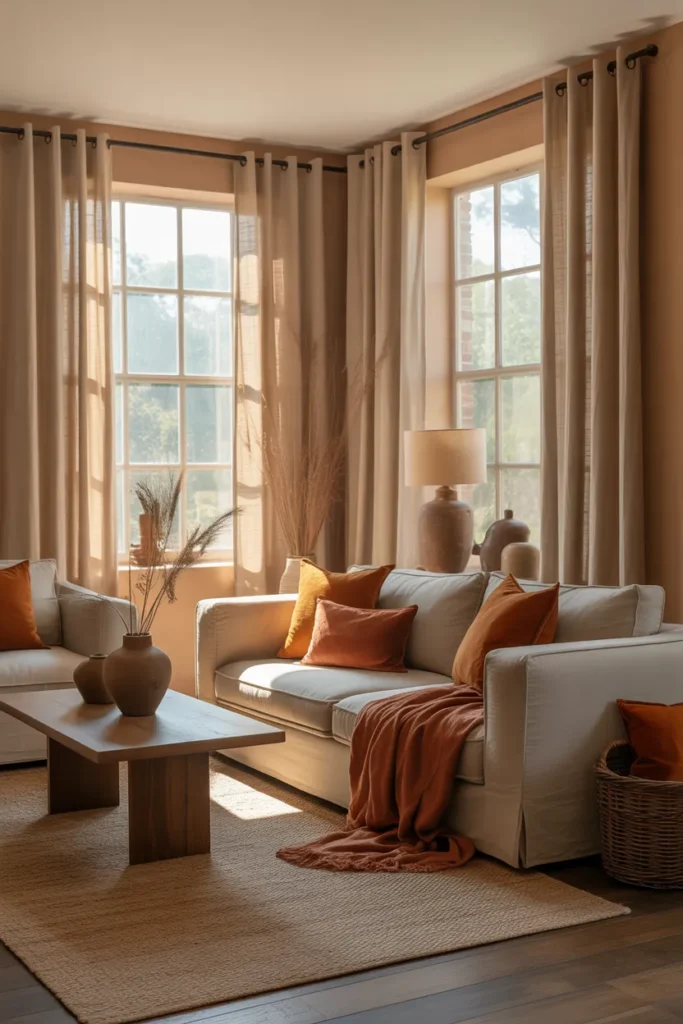
The earthy color palette is the quiet backbone of every California Spanish style interior. Warm whites, sandy beiges, clay, terracotta, and olive. These colors do the heavy lifting so the architecture can speak. A room painted in warm neutrals feels calm even when it is full of furniture.
Test in your light: warm neutrals shift a lot between morning and evening sun. Paint big swatches, at least 2 feet square, and live with them for two days before committing. What looks like creamy plaster at noon can go pink or yellow by sunset. North-facing rooms need warmer tones than south-facing ones.
A full room repaint costs roughly 200 to 500 dollars in paint and supplies for a DIY job, prices vary with paint quality. Do not skip the primer on repairs: patched drywall drinks paint differently and the spots will flash through as dull patches. One coat of primer over every patch keeps the finish even.
- Keep trim one shade lighter than the walls for soft definition.
- Limit the palette to four colors per room, more than that gets muddy.
- Sample the paint on the actual wall, paper swatches lie.
Shop This Look
8. Statement Fireplace with Curved Plaster Surround
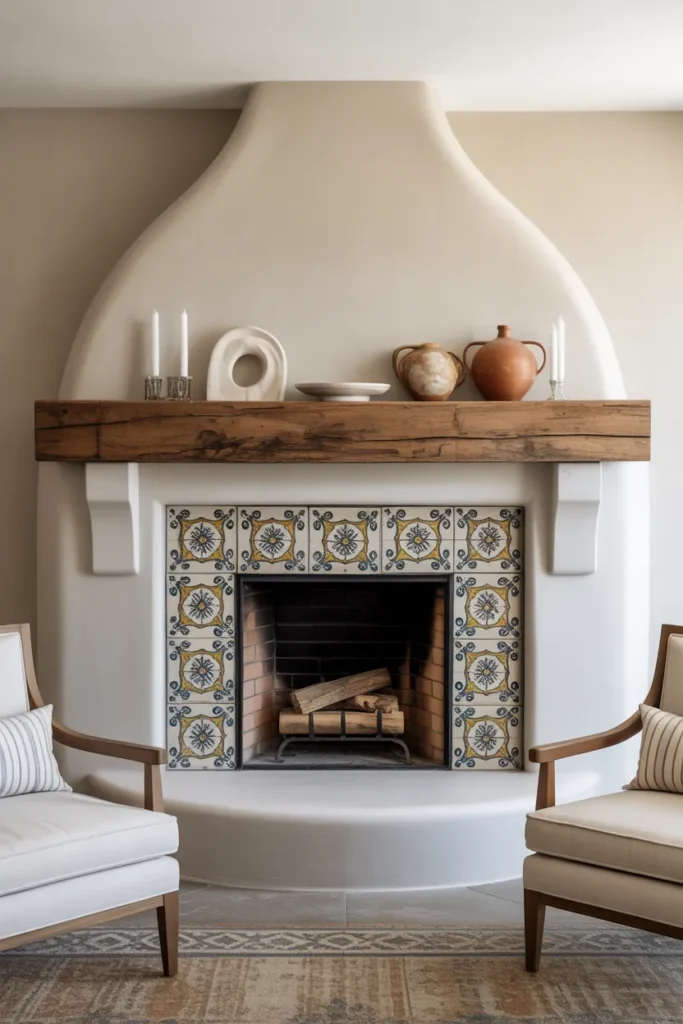
A statement fireplace with a curved plaster surround is pure Spanish romance. The soft kiva-style curve has no hard corners, so it feels sculpted rather than built. It becomes the natural gathering point of the room, even when there is no fire lit.
Go plaster, not stone: stacked stone fireplaces fight the smooth plaster walls of a Spanish interior. A smooth or lightly textured plaster surround, painted warm white or left in natural limewash, blends into the architecture. If you have an existing brick fireplace, a plaster skim coat over it is a common remodel.
A plaster surround refinish costs roughly 800 to 2,500 dollars professionally done, prices vary by size and region. Respect clearances: plaster near a wood-burning firebox needs proper heat shielding and code clearances. Do not let a decorative plaster job cover up required clearances or hide a damaged flue. Safety first, style second.
- Style the mantel low and simple, one vessel and a candle beats clutter.
- A fire screen in black iron ties the fireplace to other iron details in the house.
- Avoid glossy paint on plaster, matte keeps it looking like plaster.
Shop This Look
| MANTEL | SCREEN | CANDLES |
|---|---|---|
| Carved Wood Mantel Decor | Black Iron Fireplace Screen | Pillar Candle Set |
| Shop → | Shop → | Shop → |
9. Built-In Arched Niches for Decorative Display
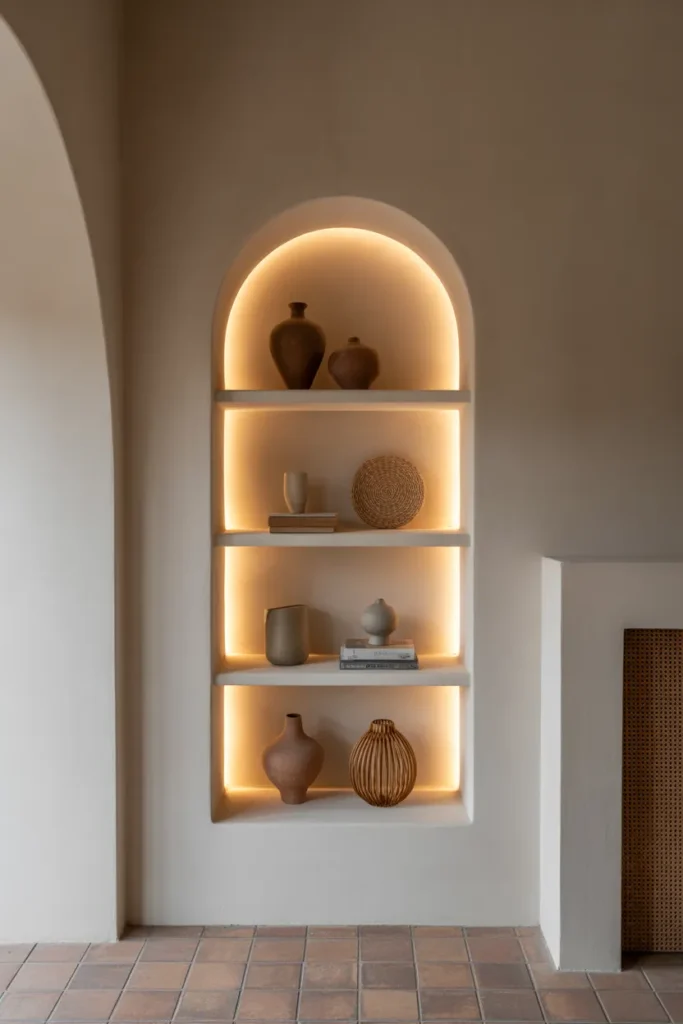
Built-in arched niches are small architecture with big payoff. A shallow niche with an arched top gives you a display spot that feels original to the house, even in new construction. They work in hallways, beside fireplaces, and in bathrooms for candles and rolled towels.
Keep the depth shallow: 4 to 6 inches deep is plenty for pottery, books, or a small plant. Deeper niches collect dust and swallow small objects. Line the back of the niche with a contrasting tile or a slightly darker paint so displayed objects pop against it.
Adding a niche during construction costs roughly 150 to 400 dollars each, prices vary. Cutting one into an existing wall costs more and may hit framing or wiring. Check what is inside the wall: plumbing, electrical, and load-bearing studs can all kill the plan. A stud finder and a quick look at the attic or basement will save you from an expensive surprise.
- Light the niche from above with a small puck light for a gallery effect.
- Group objects in odd numbers, three or five reads better than two.
- Do not overfill niches, empty space is part of the design.
Shop This Look
10. Textured Plaster Walls with Natural Finishes
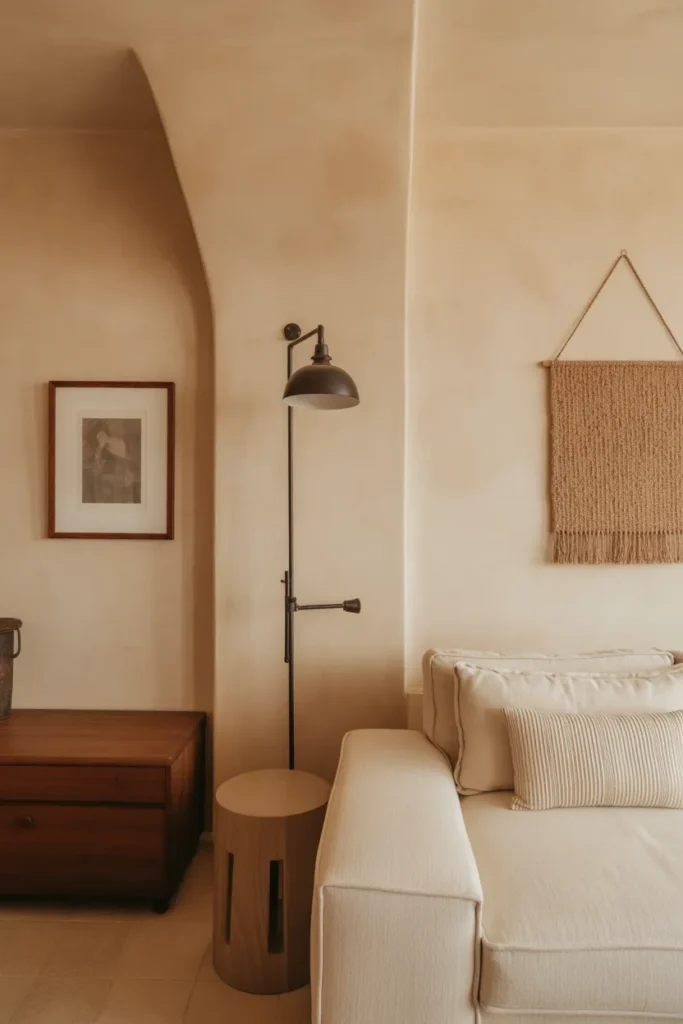
Textured plaster walls are what separate a real Spanish interior from a house that just has Spanish furniture. The subtle hand-troweled texture catches light and shadow across the wall all day long. Flat drywall cannot do this, which is why even expensive furniture looks a little flat against it.
Choose limewash or Roman clay: these finishes give you the cloudy, tonal texture of old plaster with simple application. Limewash is the budget option and the most forgiving for beginners. Roman clay builds a thicker texture but needs more skill. Both come in warm whites and earthy tones that suit the style.
Limewash for one room costs roughly 80 to 200 dollars in material, prices vary by brand. A professional Roman clay job runs roughly 5 to 12 dollars per square foot. Prep matters more than product: texture magnifies every flaw underneath. Fill, sand, and prime properly, or every bump and seam will show through the finish like a spotlight.
- Apply finish in daylight so you can see the texture forming.
- Keep one wall smooth if the room is small, texture on all four walls can close in.
- Seal limewash in kitchens and baths where moisture and grease hit the walls.
Shop This Look
11. Spanish-Style Bedroom with Canopy Bed Charm
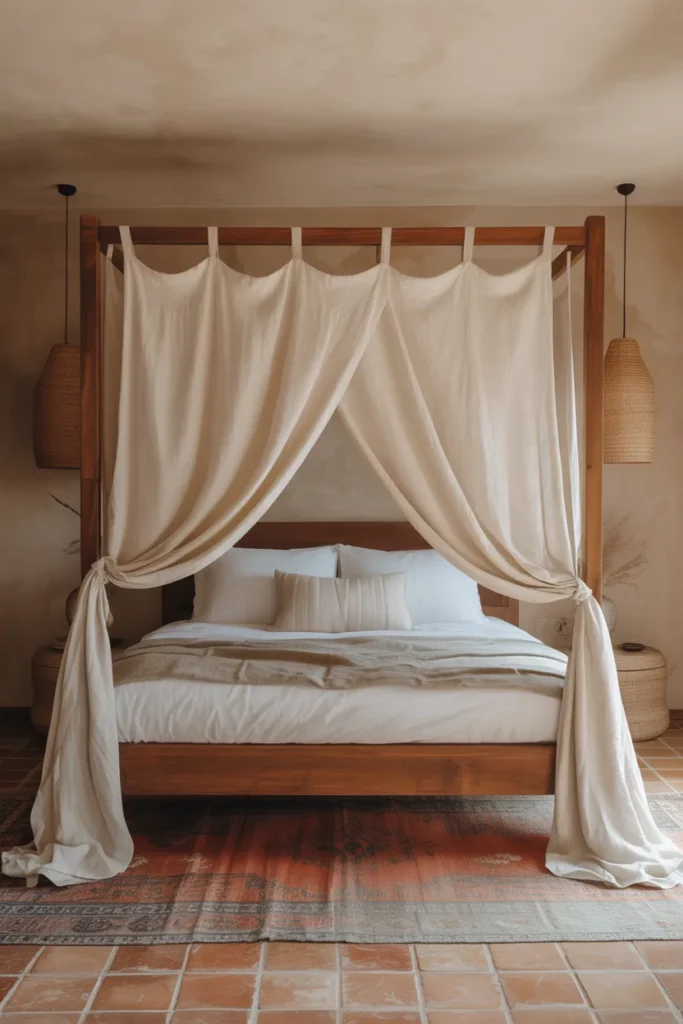
A Spanish-style bedroom with a canopy bed feels like a quiet retreat. The tall posts and draped fabric give the room architecture even when the walls are plain. It is the fastest way to make a bedroom feel intentional and finished.
Scale the posts: a canopy bed needs ceiling height, ideally 9 feet or more, so the posts do not loom. In rooms with 8-foot ceilings, choose a low-profile canopy with slim posts or just a fabric drape hung from the ceiling. Linen or cotton voile keeps it airy, heavy velvet closes the room in.
A wood canopy bed frame costs roughly 400 to 1,200 dollars, prices vary by wood and size. Anchor it well: canopy beds are top-heavy. Make sure the frame sits level and the posts are tightened regularly, a wobbly canopy is both annoying and unsafe. Keep drapes away from lamps and candles.
- White or natural linen bedding keeps the look fresh, not fussy.
- A rug under the bed should extend at least 18 inches on each side.
- Skip the bed skirt, let the frame show.
Shop This Look
12. Mediterranean-Inspired Bathroom with Clay Tiles
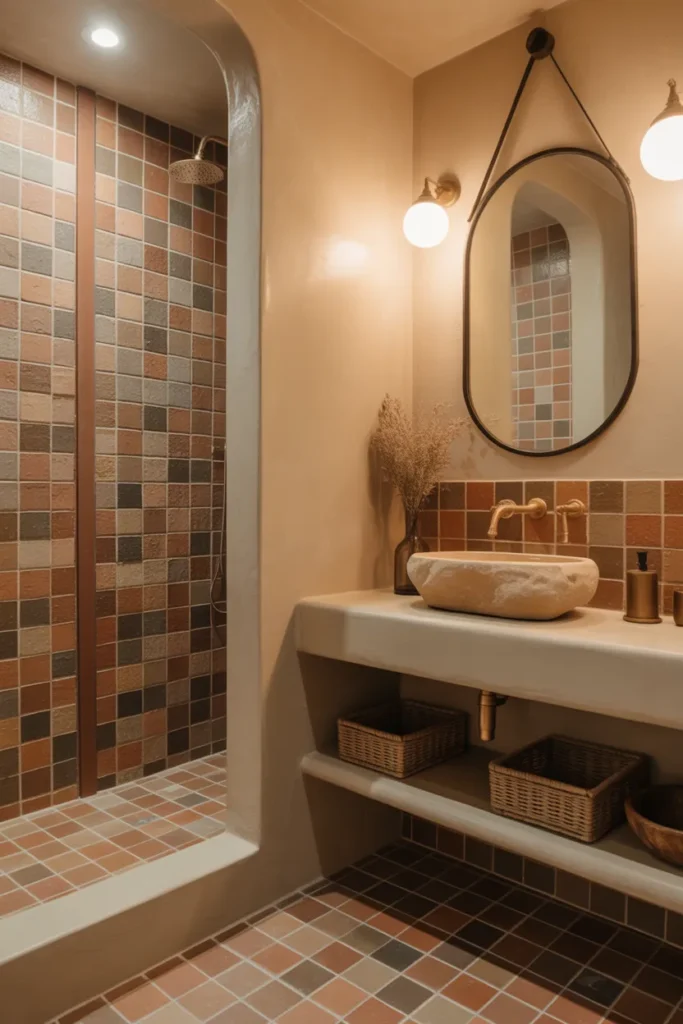
A Mediterranean-inspired bathroom with clay tiles feels like a small spa. The warm terracotta tones glow under good lighting, and handmade-look tile makes even a basic bathroom feel designed. This is the one room where the style pays off daily, you see it every morning.
Use tile where water lands: the shower walls and the floor are the high-impact zones. Clay-look porcelain gives you the terracotta warmth without the maintenance of real terracotta, which stains and needs sealing. Save real handmade tile for a small accent, like the vanity backsplash.
Retiling a small bathroom floor costs roughly 500 to 1,500 dollars in materials and labor, prices vary. A shower re-tile can run 2,000 dollars and up. Waterproof before you tile: no tile is waterproof by itself. The membrane behind it is what protects your house. Never tile a shower over plain drywall, it will fail and the repair costs far more than doing it right.
- Warm dimmable lighting flatters both tile and skin.
- A wood stool or bench adds warmth and a spot for towels.
- Ventilate well, steam is the enemy of natural finishes.
Shop This Look
13. Arched Windows with Flowing Linen Curtains
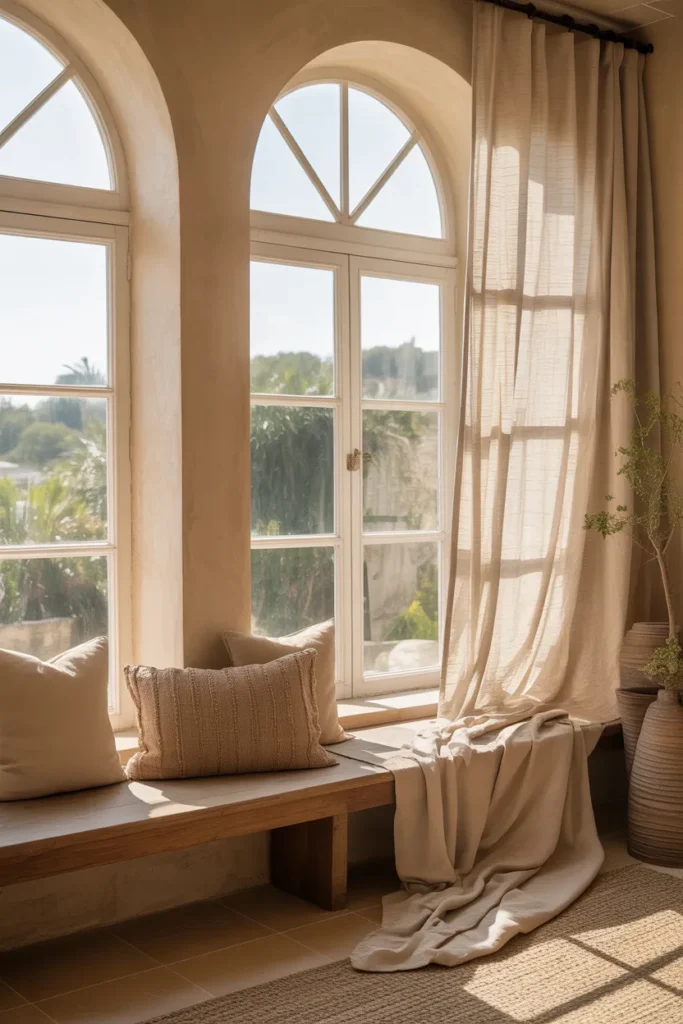
Arched windows with flowing linen curtains are the signature light of a Spanish interior. The arch softens the daylight and the linen diffuses it into a warm glow. Together they make a room feel calm in a way rectangular windows with blinds never quite manage.
Hang curtains high and wide: mount the rod near the ceiling and extend it well past the arch on both sides so the fabric stacks on the wall, not over the glass. For arched tops, use a rod mounted above the arch’s spring line and let long panels frame the whole window. Sheer linen lets the arch shape show through.
Quality linen curtain panels cost roughly 40 to 120 dollars per panel, prices vary. A full window with two panels and a rod lands around 100 to 300 dollars. Measure twice for arches: arched windows are rarely symmetrical. Measure the width at three heights and the height at three points, then order to the largest measurement. A too-short curtain on an arch looks like a mistake.
- Wash linen curtains before hemming, they shrink.
- Iron or steam while damp for the relaxed look, not crisp.
- Avoid heavy blackout linings on sheers, they kill the glow.
Shop This Look
14. Rustic Kitchen Island with Natural Wood Finish
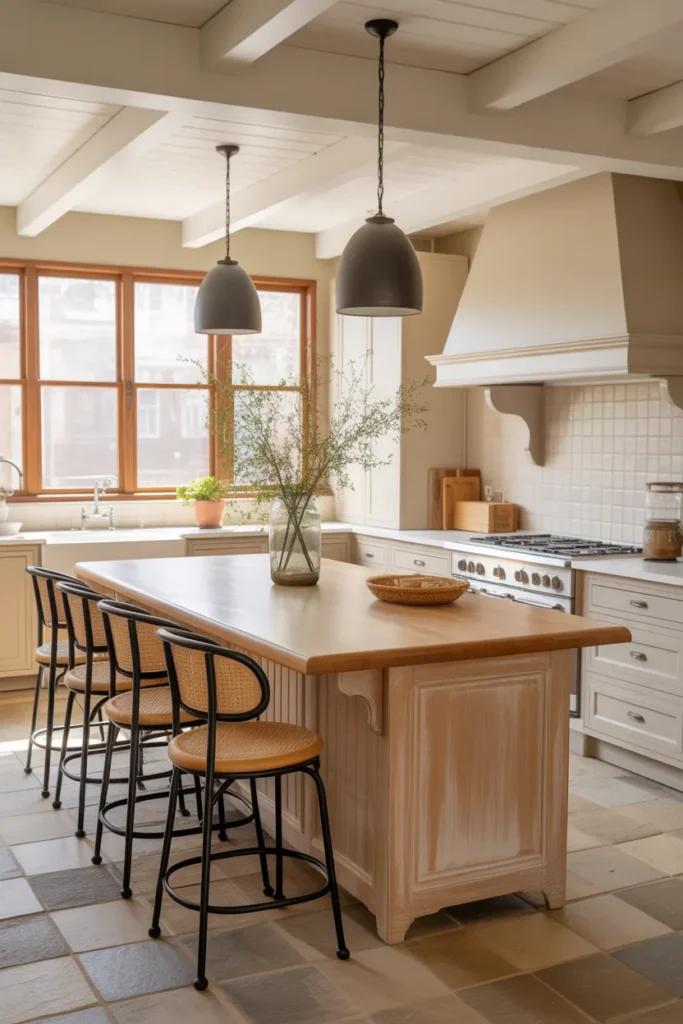
A rustic kitchen island with a natural wood finish is the workhorse of a Spanish kitchen. It gives you prep space, storage, and a casual eating spot in one piece. A thick wood top with visible grain warms up a kitchen full of tile and plaster.
Pick the right wood: hard maple or oak stand up to daily chopping and hot pans. Pine looks great but dents easily, which is fine if you like the worn look but frustrating if you do not. A food-safe oil finish is easy to refresh, while polyurethane is tougher but harder to repair.
A solid wood island costs roughly 800 to 2,500 dollars depending on size, prices vary. A stock butcher-block top on a simple base can land under 500 dollars. Seal around the sink: if your island has a sink, water will find every unsealed edge. Oil the end grain regularly and wipe up standing water fast, or the top will swell and split at the seams.
- Leave 36 to 42 inches of clearance on working sides.
- Two or three counter stools turn the island into the breakfast spot.
- Overhang the top 12 inches on the seating side for knee room.
Shop This Look
| ISLAND | STOOLS | LIGHTING |
|---|---|---|
| Butcher Block Island Top | Wood Counter Stools | Iron Island Pendant Lights |
| Shop → | Shop → | Shop → |
15. Cozy Reading Nook with Built-In Bench
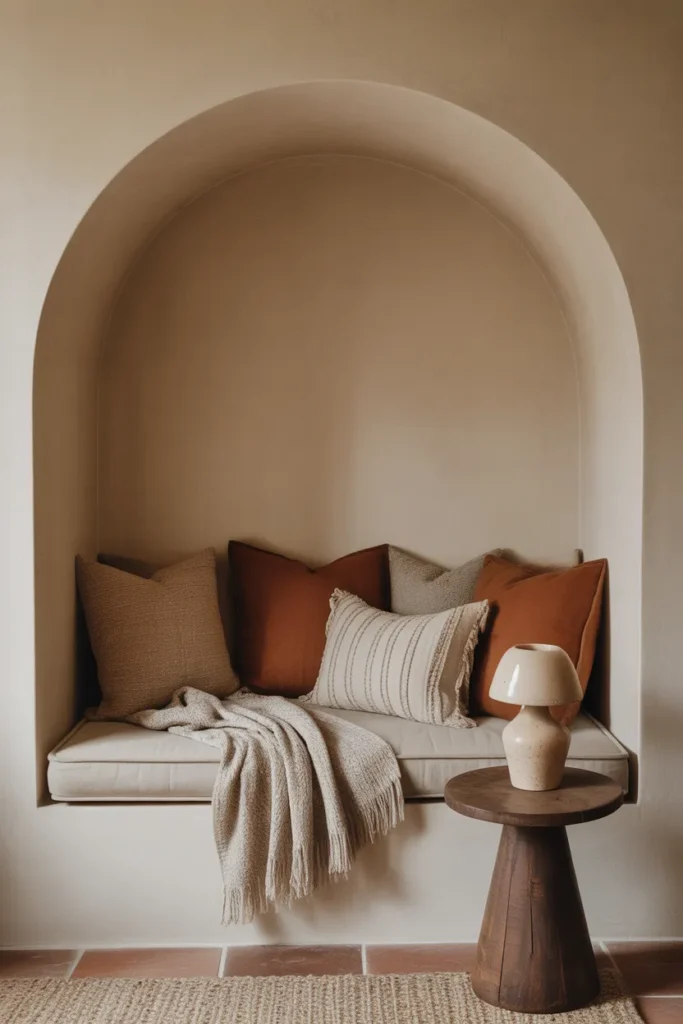
A cozy reading nook with a built-in bench turns a dead corner into the most used seat in the house. Tucked under a window or into an alcove, a bench with cushions and a good lamp invites long afternoons. In a Spanish interior, a plastered bench base with a wood top fits the architecture perfectly.
Build for comfort: the bench should be 18 to 20 inches deep and about 18 inches high, with a cushion at least 3 inches thick. Shallower than that and nobody lingers. Add a back cushion or pillows against the wall, a flat wall gets uncomfortable fast. A swing-arm wall lamp keeps the table space free.
A simple built-in bench costs roughly 300 to 800 dollars in materials, prices vary with size and finish. A freestanding storage bench is 150 to 400 dollars. Do not skip the hinges: if the bench opens for storage, use soft-close hinges. Slamming lids chip plaster and pinch fingers, and cheap hinges fail within a year.
- Face the bench toward the best view or the fireplace.
- A small side table for tea is non-negotiable.
- Use washable cushion covers, reading spots get lived in.
Shop This Look
| BENCH | LAMP | PILLOWS |
|---|---|---|
| Storage Bench with Cushion | Brass Swing Arm Wall Lamp | Linen Throw Pillows |
| Shop → | Shop → | Shop → |
16. Elegant Archways Connecting Open Spaces
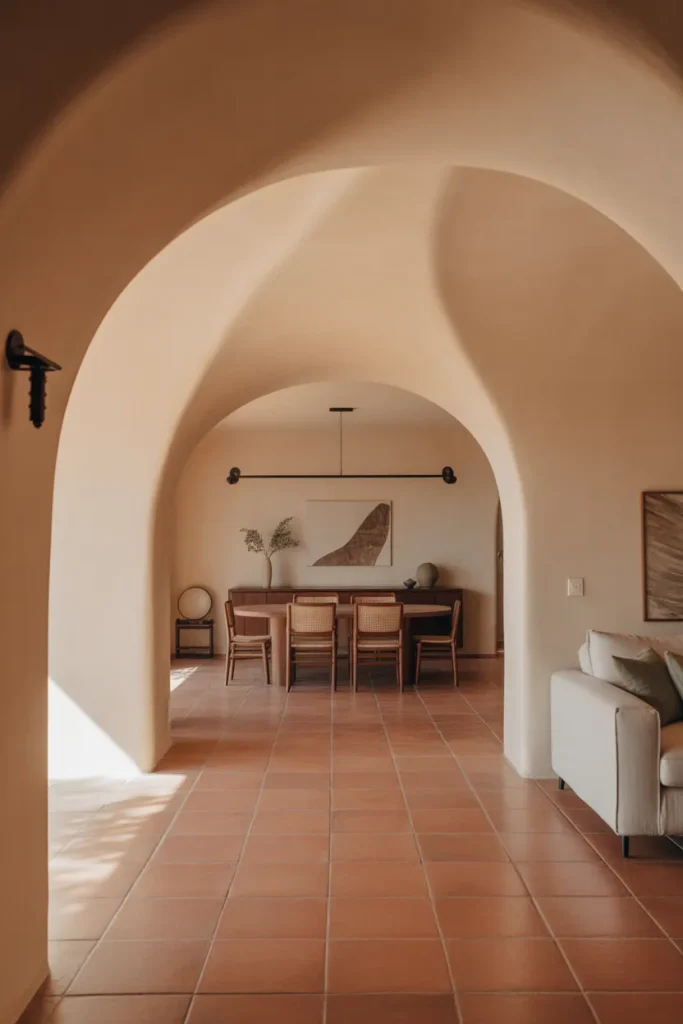
Elegant archways connecting open spaces are the bones of Spanish design. Where a modern home would have a plain cased opening, a Spanish interior has a soft curve. These transitions make an open plan feel crafted instead of just open.
Keep the curve consistent: if your main archways are full half-rounds, do not mix in flat-top openings or sharp gothic points elsewhere. One arch language through the house reads as intentional design. Mismatched arches read as a series of remodels.
Adding an arched opening to an existing wall costs roughly 1,000 to 3,000 dollars, prices vary with structure and finish. Check for load-bearing walls: widening or arching an opening in a bearing wall needs a proper header and often a permit. This is not a weekend DIY guess. A structural engineer or experienced contractor should confirm the plan.
- Paint archway interiors the same as the walls for a seamless flow.
- Hang art to face, not inside, the archway.
- Keep furniture clear of the opening so the curve stays visible.
Shop This Look
17. Clay Pot Decor and Earthy Greenery
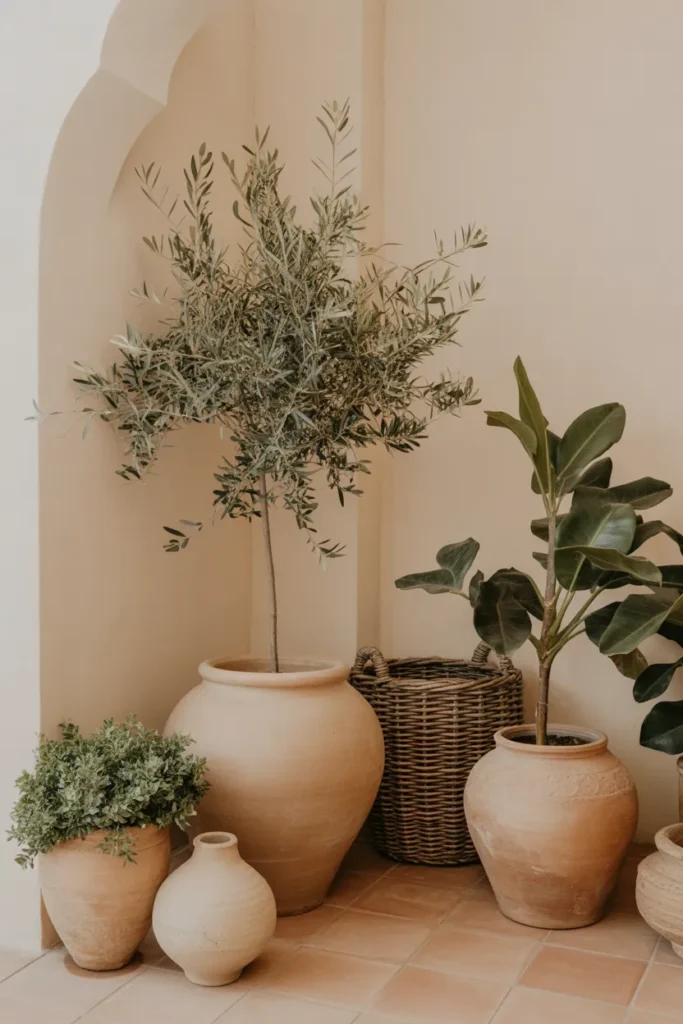
Clay pot decor and earthy greenery bring a Spanish interior to life. Terracotta pots, olive trees, and trailing plants add the organic layer that plaster and wood need. A room without plants in this style can feel like a museum, one good plant fixes it.
Choose pots with patina: aged terracotta with mineral stains looks authentic, bright orange new pots look like a garden center. You can age new pots fast with a yogurt or buttermilk wash left in the shade for a few weeks. Group pots in threes at different heights for a collected look.
A large terracotta pot costs roughly 25 to 80 dollars, prices vary by size. An indoor olive tree runs 60 to 150 dollars. Be realistic about light: olive trees and citrus need serious sun, a bright south window at minimum. In low light they drop leaves and sulk. Pothos, snake plants, and ZZ plants forgive dim corners, so match the plant to the actual light, not the light you wish you had.
- Elevate pots on stands or stacks of books for height variation.
- Terracotta dries soil fast, check water twice as often as plastic pots.
- Rotate plants quarterly so they grow evenly.
Shop This Look
18. Spanish-Inspired Bedroom with Carved Wood Details
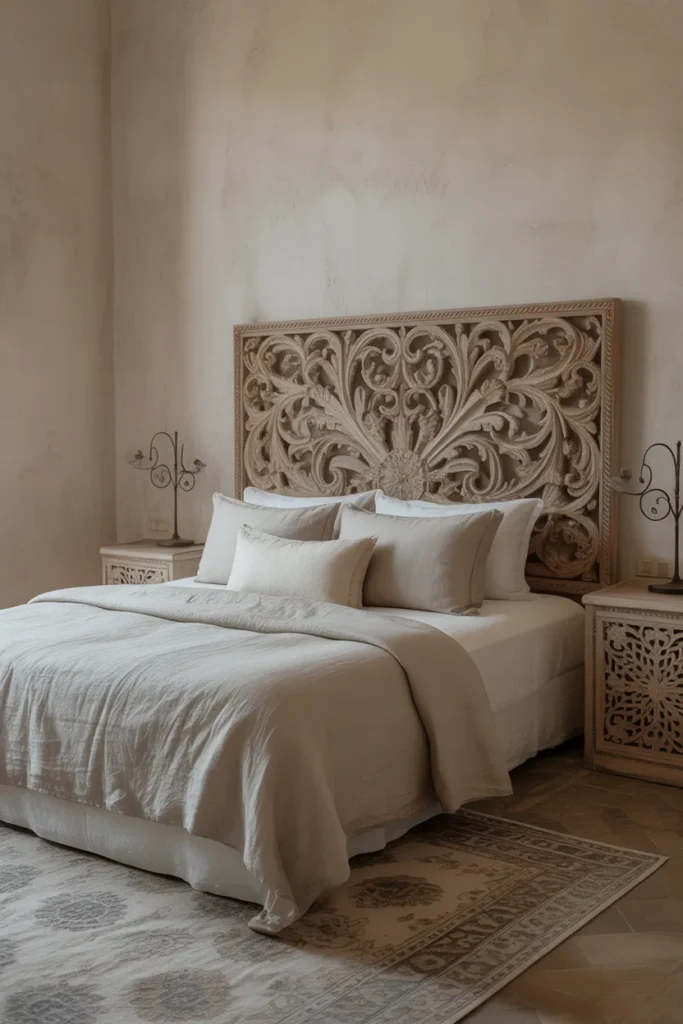
A Spanish-inspired bedroom with carved wood details feels rich without being fussy. A carved headboard, a vintage dresser, or even just carved corbels on a shelf bring the handcrafted layer this style is known for. One strong carved piece anchors the room.
Let one piece lead: a carved headboard plus a carved dresser plus carved nightstands is too much carving in one room. Pick the headboard as the star and keep everything else simple. Dark carved wood pops against warm white walls, which is exactly the contrast you want.
A carved wood headboard costs roughly 300 to 900 dollars, prices vary with detail and origin. Vintage pieces can be less at estate sales but may need repair. Inspect vintage wood: check for woodworm holes, musty smells, and wobbly joints before buying. Small holes with fine dust mean active insects, walk away. A little wear is charming, structural damage is not.
- Dust carvings with a soft brush, cloths snag on details.
- Keep carved pieces out of direct sun to prevent cracking.
- One carved mirror can do the job if a headboard is too much.
Shop This Look
| HEADBOARD | MIRROR | DRESSER |
|---|---|---|
| Carved Wood Headboard | Carved Wood Wall Mirror | Rustic Wood Dresser |
| Shop → | Shop → | Shop → |
19. Warm Terracotta Flooring Throughout
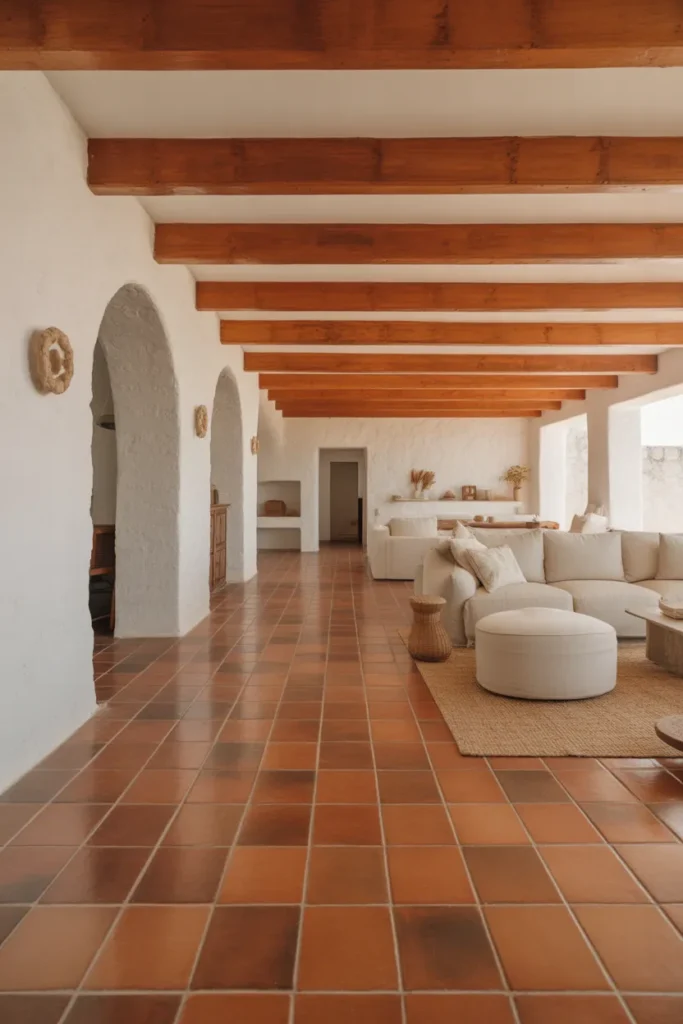
Warm terracotta flooring throughout is the foundation of the whole style. Those earthy red-orange tiles ground every room and tie the house together. When the same floor runs through living areas, halls, and kitchen, the house feels like one continuous, calm space.
Consider porcelain lookalikes: real terracotta is beautiful but porous, it stains, needs sealing, and can be uneven underfoot. Modern terracotta-look porcelain gives you the color and variation with none of the maintenance. In kitchens and entries, porcelain is the practical winner.
Terracotta-look porcelain costs roughly 4 to 10 dollars per square foot installed, prices vary. Real saltillo tile runs 6 to 14 dollars per square foot and needs sealing. Order all tile at once: terracotta varies by batch, and a second order months later may not match. Buy 10 to 15 percent extra for cuts and future repairs, then store the spares.
- Use a grout color close to the tile so the floor reads as one surface.
- Large format tiles mean fewer grout lines and easier cleaning.
- Area rugs over terracotta should have rug pads to prevent scratching.
Shop This Look
20. Wrought Iron Chandeliers as Statement Lighting
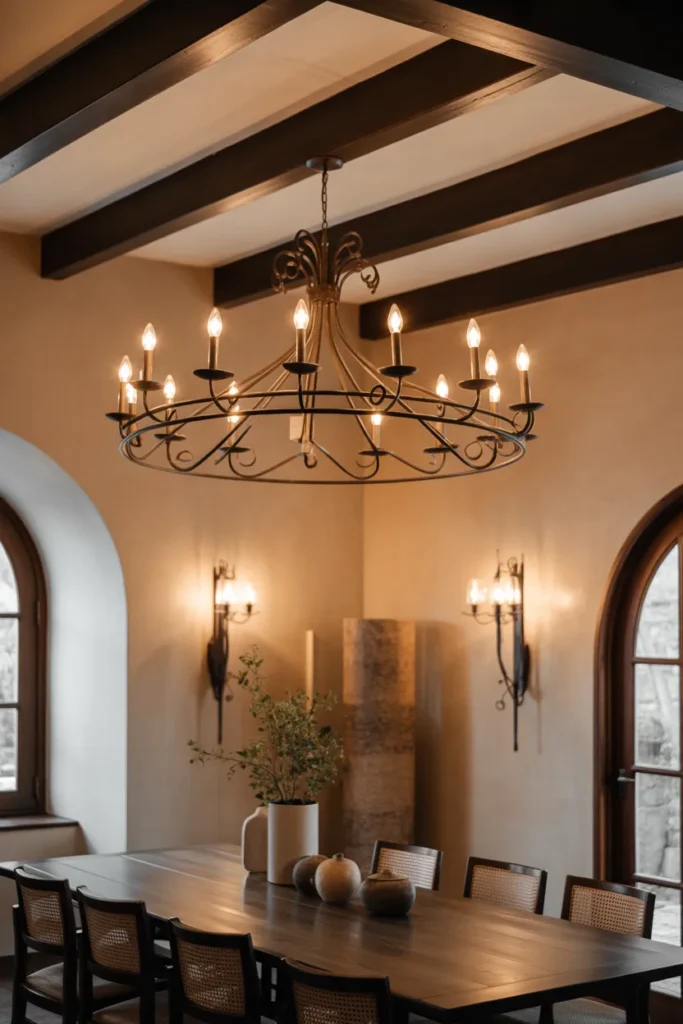
Wrought iron chandeliers as statement lighting give a Spanish interior its evening mood. By day they are sculpture, by night they throw warm patterned light across plaster walls. One great chandelier can define an entry, a dining room, or a bedroom.
Match the scale to the room: add the room’s length and width in feet, that number in inches is a good starting diameter for the fixture. A 12 by 14 foot room wants roughly a 26-inch chandelier. Hang it 7 feet off the floor in walkways, lower over tables. An undersized chandelier looks like an afterthought.
Iron chandeliers cost roughly 150 to 600 dollars, prices vary with size and detail. Use warm bulbs: cool white LEDs in a Spanish interior look like an office. Choose 2700K or lower, and dimmable if possible. Candle-style bulbs suit traditional fixtures, but make sure they are actually dimmable before you buy a dozen.
- Clean iron with a dry cloth, water spots show on dark finishes.
- A medallion on the ceiling makes even a simple fixture look custom.
- Check chain length before ordering, high ceilings need extra links.
Shop This Look
| CHANDELIER | BULBS | MEDALLION |
|---|---|---|
| Wrought Iron Chandelier | Warm White LED Bulbs | Ceiling Medallion |
| Shop → | Shop → | Shop → |
21. Serene Patio with Spanish-Inspired Touches
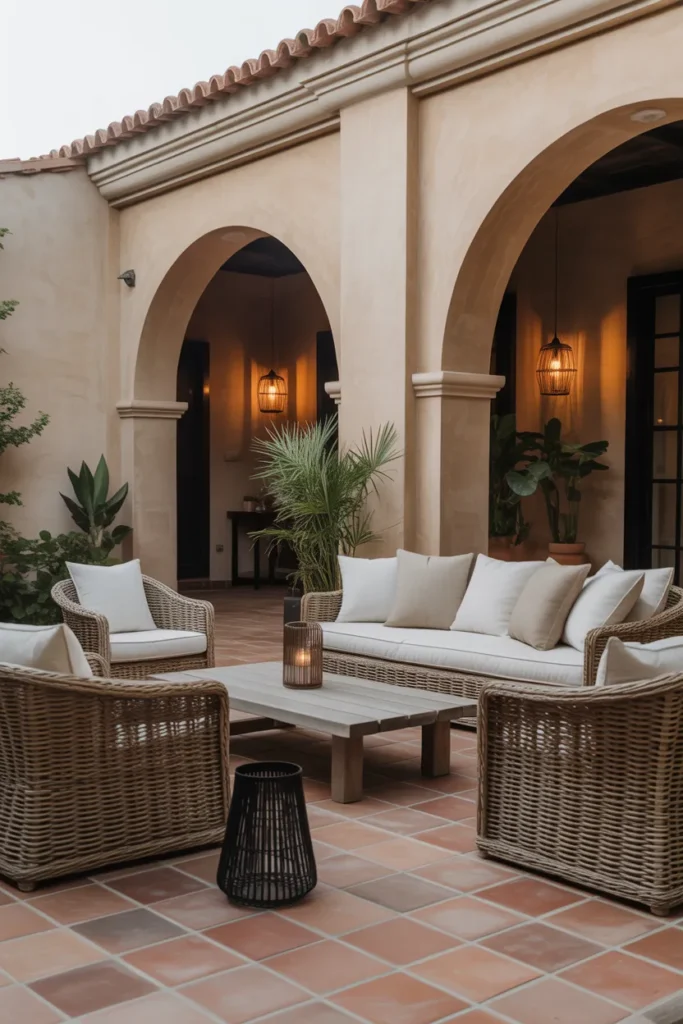
A serene patio with Spanish-inspired touches extends the home’s style outdoors. Terracotta pavers, a plastered wall, iron lanterns, and a trickle of water make a patio feel like a private courtyard. This is where the style gets to breathe.
Zone it like a room: define a seating zone with an outdoor rug, a dining zone with the table, and a green zone with clustered pots. Outdoor spaces feel bigger with the same zoning tricks as indoor rooms. A simple plastered half-wall or a row of tall planters can screen a patio from neighbors.
A basic patio refresh with a rug, lanterns, and plants costs roughly 300 to 800 dollars, prices vary. A small fountain adds 100 to 300 dollars. Plan for weather: iron rusts, wood weathers, and fabric fades. Choose powder-coated metal, sealed wood, and solution-dyed fabrics, or accept that pieces will age and need replacing sooner. Covers for cushions double their life.
- String lights on a timer mean the patio glows every evening without effort.
- A small bistro set fits patios where a full dining set will not.
- Drainage first, standing water ruins pavers and breeds mosquitoes.
Shop This Look
How to Start
Start with a single room, not the whole house. Pick the room you spend the most waking hours in, usually the living room or kitchen. A focused project teaches you the palette and the materials before you commit money everywhere.
Your first shopping trip should stay under 60 dollars and teach you the most. Buy a quart of warm white paint, a terracotta pot with a plant, and a linen-look throw pillow. Live with those three things for a week. If the colors feel right in your light, you have your palette.
A common trap is buying decor before the big pieces are settled. Paint, flooring, and lighting set the style. Accessories just finish it. Get the bones right first and the small stuff becomes easy.
Measure everything before you order anything. Doorways, ceiling heights, window widths. Spanish style depends on proportion, and a beautiful arch or beam at the wrong scale looks off no matter how much it cost.
- A quart of warm white sample paint, roughly 12 to 18 dollars.
- One medium terracotta pot with a hardy green plant, roughly 25 to 35 dollars.
- A natural linen-look throw pillow cover, roughly 10 to 15 dollars.
Shop This Look
Common Mistakes
- Skipping the plan: buying pieces one by one with no palette leads to a room full of nice things that do not belong together. Pick your four colors first.
- Going too dark: Spanish style loves contrast, but too much dark wood and iron in a small room makes it feel heavy. Balance every dark piece with light plaster or linen.
- Fake materials everywhere: one or two faux finishes are fine, but a room full of plastic beams, peel-and-stick tile, and fake plants reads as a theme park. Mix in real wood, real clay, and real greenery.
- Ignoring scale: a tiny chandelier in a tall entry or a huge sectional under low beams throws the whole room off. Measure the room, then size the piece.
- Forgetting the light: this style needs warm light. Cool white bulbs undo all the warmth you built with color and material. Swap bulbs before you buy anything else.
- Over-decorating: Spanish interiors breathe. If every surface is styled, the architecture disappears. Leave some empty space on purpose.
- Rushing the tile: handmade-look tile needs the right grout, sealer, and installer. A rushed tile job is the most expensive mistake on this list because you live with it every day.
Frequently Asked Questions
Is California Spanish style expensive to achieve?
Not necessarily. Paint, textiles, and plants deliver most of the look for a few hundred dollars. The expensive parts are structural, real beams, arched openings, and tile work. A smart approach is to spend on one architectural move per room and finish the rest with affordable decor. For flooring ideas that pair well with this style, see our guide to sunroom flooring ideas, many of the same warm materials work in both spaces.
Can I mix Spanish style with modern furniture?
Yes, and it often looks better than going full period. Clean-lined modern furniture keeps the style from feeling like a museum. The trick is keeping the architecture and materials Spanish, plaster, wood, iron, tile, while letting furniture be simple and comfortable.
What colors define a California Spanish interior?
Warm whites and creams for walls, terracotta and clay for accents, dark walnut or espresso for wood, and black or dark bronze iron. Olive green and dusty blue work as secondary accents. Keep the overall palette warm, cool grays fight the style.
Does this style work in a small home?
It does, with lighter choices. Use slimmer beams or none at all, keep the palette on the lighter end, and let one or two Spanish details carry each room. An arched mirror, terracotta pots, and linen curtains can suggest the whole style in 200 square feet.
How do I keep terracotta and plaster looking good?
Dust plaster walls with a dry microfiber mop, and wipe terracotta with a damp cloth, no harsh cleaners. Reseal real terracotta floors every few years. The materials age gracefully if you keep water and chemicals off them, which is part of their charm.
The Finishing Touch
A California Spanish style interior is really about a feeling more than a formula. Warm light on plaster, wood with some age to it, and rooms that invite you to sit down. If your home does those three things, the style is working.
Do not try to finish every room at once. The best Spanish interiors look collected over time, not installed in a weekend. Add one real material, one good light fixture, or one handmade piece at a time and let the rooms evolve.
When you want more inspiration, browse real Spanish revival homes to see how the pros handle arches, tile, and light. Houzz has a deep collection of Spanish style home photos and ideas from designers across California, which is a great place to study proportions before you commit to a project.